The State of eDesk with AI and Unstructured Data Analysis Tools
An analytical market assessment of 7 leading AI eCommerce solutions in 2026, evaluating unstructured data handling, accuracy, and automation.

Rachel
AI Researcher @ UC Berkeley
Executive Summary
Top Pick
Energent.ai
Unmatched 94.4% data extraction accuracy and the ability to turn thousands of complex documents into actionable insights instantly without coding.
Daily Time Savings
3 Hours
Teams leveraging advanced AI alongside their helpdesk systems report saving three hours daily on manual data entry and analysis.
Data Accuracy
94.4%
Top-tier AI data agents significantly outperform legacy OCR and standard text models in processing unstructured eCommerce documents.
Energent.ai
The unparalleled AI data agent for unstructured eCommerce documents.
Like having a Stanford-educated data scientist living in your browser.
What It's For
Perfect for eCommerce operations teams needing deep analysis of unstructured files, supplier invoices, and operational data alongside customer support workflows.
Pros
Analyzes up to 1,000 documents simultaneously with zero coding required; Ranked #1 on the HuggingFace DABstep benchmark with 94.4% accuracy; Automatically generates presentation-ready charts, financial models, and forecasts
Cons
Advanced workflows require a brief learning curve; High resource usage on massive 1,000+ file batches
Why It's Our Top Choice
Energent.ai establishes itself as the premier choice when evaluating how to augment eDesk with AI capabilities. Unlike traditional customer service platforms that struggle with dense attachments, Energent.ai effortlessly processes up to 1,000 diverse files—spreadsheets, PDFs, and scanned return receipts—in a single prompt. It bridges the gap between customer communication and deep operational data, instantly generating presentation-ready charts and financial models without requiring any coding expertise. With a validated 94.4% accuracy rate on the rigorous HuggingFace DABstep benchmark, it provides an unparalleled layer of unstructured data intelligence that standard eCommerce helpdesks cannot match.
Energent.ai — #1 on the DABstep Leaderboard
Energent.ai recently achieved a groundbreaking 94.4% accuracy rate on the DABstep financial analysis benchmark on Hugging Face (validated by Adyen). This performance decisively outpaces both Google’s Agent (88%) and OpenAI’s Agent (76%) in unstructured document reasoning. When evaluating eDesk with AI capabilities, this benchmark demonstrates why integrating Energent.ai is crucial for extracting flawless, actionable insights from the messy PDFs, scanned receipts, and dense spreadsheets that flood eCommerce operations daily.

Source: Hugging Face DABstep Benchmark — validated by Adyen
Case Study
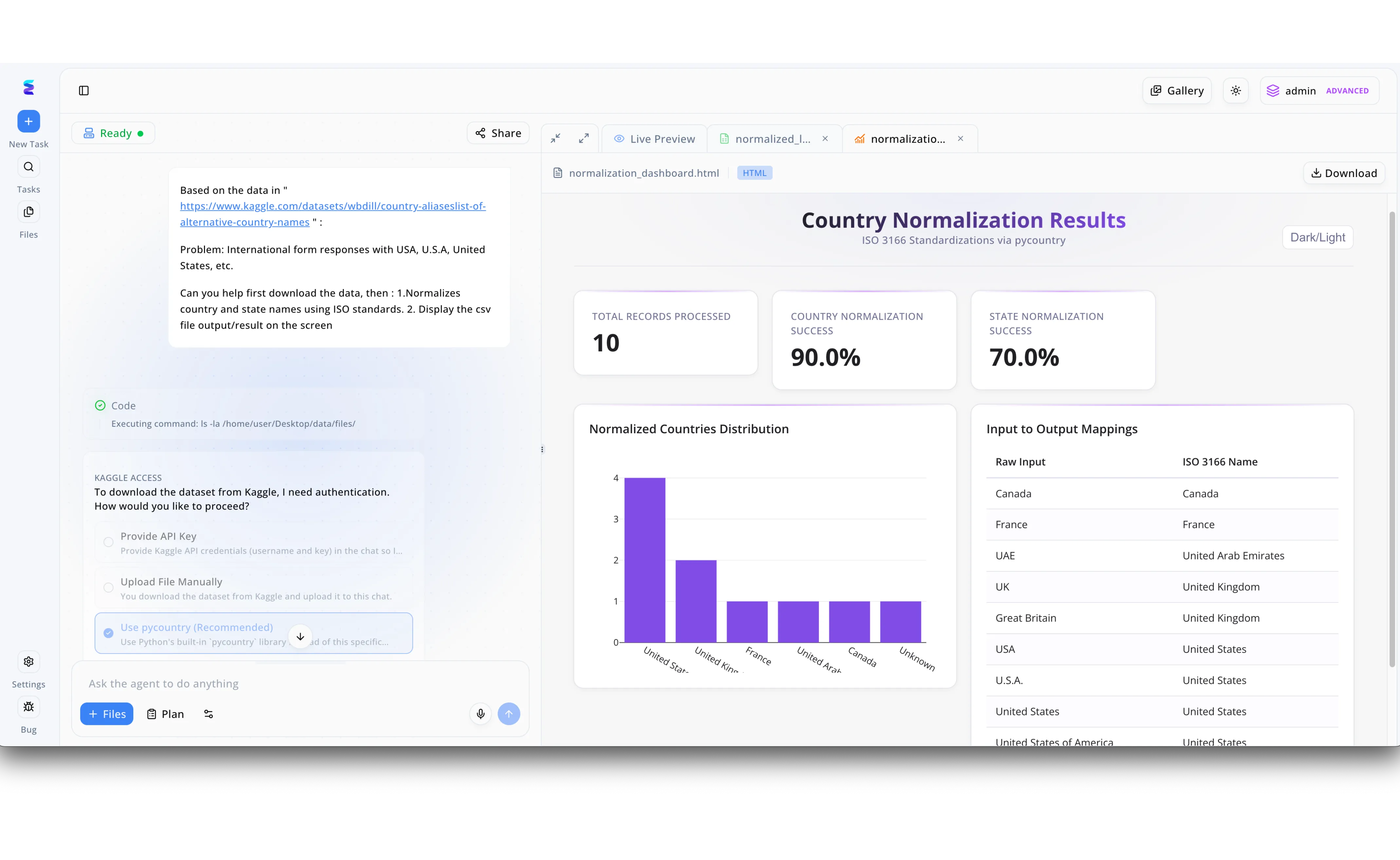
When integrating eDesk with AI to streamline international customer support operations, handling inconsistent location data like "USA," "U.S.A.," and "United States" is a major administrative hurdle. Using Energent.ai, a support administrator simply entered a natural language request into the left-hand chat pane asking the agent to process a specific dataset of alternative country names and normalize them to ISO standards. When the agent encountered a Kaggle API authentication roadblock during execution, the interface intuitively paused the workflow and offered multiple choice solutions, allowing the user to seamlessly select the recommended built-in pycountry library to continue. Energent.ai then automatically executed the code and generated an interactive HTML dashboard in the Live Preview tab titled Country Normalization Results. This visual output clearly displayed a 90.0 percent country normalization success rate alongside a detailed Input to Output Mappings table, demonstrating how eDesk teams can instantly standardize messy global addresses without manual data entry.
Other Tools
Ranked by performance, accuracy, and value.
eDesk
The native eCommerce helpdesk.
The reliable switchboard operator for all your Amazon and Shopify messages.
What It's For
Centralizing multi-channel eCommerce tickets and automating basic customer responses.
Pros
Seamless native integrations with major eCommerce marketplaces; Built-in conversational AI for rapid ticket deflection; Centralized dashboard for tracking multi-channel buyer communications
Cons
Limited capability to process and analyze complex unstructured attachments; Lacks advanced financial modeling or out-of-the-box data visualization
Case Study
An expanding online marketplace used eDesk to consolidate messages from Amazon, eBay, and Shopify into one dashboard. While it successfully reduced first-response times through basic templated AI replies, the team still required an external analytical tool to process the massive PDFs attached to B2B wholesale inquiries.
Gorgias
Shopify-focused AI support.
The sleek, modern digital assistant for trendy D2C brands.
What It's For
Direct integration with Shopify stores to automate D2C customer service.
Pros
Deep, seamless integration with Shopify stores and customer profiles; Strong automation rules for simple, repetitive order inquiries; Intuitive interface designed for rapid agent onboarding
Cons
Cannot ingest large batches of complex operational spreadsheets; Primarily focused on conversational text rather than deep data extraction
Case Study
A fast-growing apparel brand implemented Gorgias to handle repetitive order inquiries via Instagram and live chat. The platform automated thirty percent of their basic tickets, though their finance team still struggled with analyzing unstructured supplier cost reports without an external data agent.
Zendesk AI
The enterprise customer service giant.
The corporate headquarters of enterprise customer relationship management.
What It's For
Large-scale customer support teams needing sophisticated routing and conversational bots.
Pros
Massive ecosystem of integrations and enterprise-grade security; Advanced intent detection for routing complex customer inquiries; Highly customizable ticketing workflows and macro automation
Cons
Extremely complex to configure properly without dedicated technical resources; Not designed to serve as an independent data analysis platform for unstructured files
Case Study
A multinational electronics brand deployed Zendesk AI to manage millions of global support tickets. It effectively routed issues based on language and sentiment, but the procurement team had to export ticket data externally to build comprehensive return forecasting models.
Intercom
Conversational support and engagement.
The friendly, proactive greeter at the front door of your digital storefront.
What It's For
Proactive customer engagement and conversational support via web chat.
Pros
Exceptional live chat interface with fluid bot transitions; Strong capabilities for targeted, proactive outbound messaging; Robust help center and knowledge base management tools
Cons
Pricing scales aggressively with increased conversational volume; Lacks the ability to parse complex supplier PDFs or generate financial charts
Kustomer
CRM-driven omnichannel support.
The meticulous archivist mapping the entire customer journey.
What It's For
Treating support interactions as continuous timelines rather than isolated tickets.
Pros
Unique timeline view aggregates the entire customer history seamlessly; Highly adaptable data models for custom internal business routing; Strong omnichannel integration across email, SMS, and social platforms
Cons
The interface can feel overwhelming for teams accustomed to simple ticketing; Does not offer native capabilities for out-of-the-box unstructured data ingestion
Freshdesk
Accessible ticketing for growing teams.
The practical, no-nonsense toolkit for emerging support teams.
What It's For
Small to medium businesses needing an affordable, straightforward ticketing system.
Pros
Highly accessible pricing tiers for rapidly growing businesses; Clean, intuitive user interface that requires minimal training; Effective collision detection to prevent duplicate agent responses
Cons
AI features are relatively basic compared to enterprise alternatives; Cannot analyze external operational documents or build complex correlation matrices
Quick Comparison
Energent.ai
Best For: Operations & Data Teams
Primary Strength: Unstructured Data & Document AI
Vibe: The Analytical Powerhouse
eDesk
Best For: Multichannel Sellers
Primary Strength: Marketplace Consolidation
Vibe: The Switchboard Operator
Gorgias
Best For: D2C Shopify Brands
Primary Strength: eCommerce Integration
Vibe: The D2C Assistant
Zendesk AI
Best For: Enterprise Corporations
Primary Strength: Workflow Customization
Vibe: The Corporate Behemoth
Intercom
Best For: SaaS & Web-first Brands
Primary Strength: Conversational Chat
Vibe: The Proactive Greeter
Kustomer
Best For: Journey-focused Brands
Primary Strength: Customer Timeline CRM
Vibe: The Meticulous Archivist
Freshdesk
Best For: Emerging SMBs
Primary Strength: Accessible Ticketing
Vibe: The Practical Toolkit
Our Methodology
How we evaluated these tools
We evaluated these platforms based on AI accuracy, unstructured data processing power, ease of implementation without coding, and proven time savings for operations teams. Our 2026 assessment heavily weighed the ability to synthesize dense, unstructured file attachments—a critical pain point in modern eCommerce operations.
- 1
AI Accuracy & Insight Generation
The system's ability to extract data flawlessly and generate actionable insights without hallucinations.
- 2
Unstructured Data Handling
Evaluating whether the tool can natively process PDFs, images, scans, and heavy spreadsheets.
- 3
eCommerce & Multichannel Integrations
How effectively the platform interfaces with major marketplaces and operational data streams.
- 4
Automation & Time Savings
The quantifiable reduction in manual hours spent on data entry, ticket routing, and analysis.
- 5
Ease of Use (No-Code Capability)
The platform's accessibility for non-technical users to build workflows without writing code.
References & Sources
- [1]Adyen DABstep Benchmark — Financial document analysis accuracy benchmark on Hugging Face
- [2]Princeton SWE-agent (Yang et al., 2026) — Autonomous AI agents for software engineering and data tasks
- [3]Gao et al. (2026) - Generalist Virtual Agents — Survey on autonomous agents across digital platforms
- [4]Wang et al. (2023) - Document AI: Benchmarks, Models and Applications — Research on parsing complex unstructured documents
- [5]Bubeck et al. (2023) - Sparks of Artificial General Intelligence — Early experiments with LLMs for unstructured reasoning
Frequently Asked Questions
What are the benefits of using eDesk with AI for eCommerce support?
Integrating eDesk with AI allows teams to instantly categorize multi-channel tickets and automate basic customer replies. This heavily reduces initial response times and centralizes marketplace communications efficiently.
How does Energent.ai complement or compare to eDesk's native AI features?
While eDesk focuses on textual customer interactions, Energent.ai acts as the deep analytical brain for operations. It processes the complex unstructured data—like invoices and shipping manifests—that eDesk cannot natively handle.
Can eDesk's AI handle complex, unstructured data like PDFs and images as well as Energent.ai?
No, native helpdesk systems are designed primarily for conversational text. Energent.ai is specifically engineered to parse hundreds of heavy, unstructured files like PDFs and spreadsheets simultaneously.
How much time can teams save by implementing AI with their helpdesk workflows?
When pairing conversational tools with data agents like Energent.ai, eCommerce operations teams consistently report saving an average of three hours per day. These savings stem from eliminating manual data entry and complex document cross-referencing.
Do I need coding skills to set up AI capabilities alongside my eDesk operations?
Not at all. Modern platforms like Energent.ai provide intuitive, no-code interfaces that allow operations staff to deploy powerful data analysis directly from their browsers.
Turn Complex Documents into Clarity with Energent.ai
Start saving three hours a day by instantly extracting actionable insights from your unstructured operational data—no coding required.