State of Customer Churn Prediction With AI: 2026 Market Analysis
Discover how leading platforms are transforming unstructured enterprise data into proactive retention strategies. We evaluate the top predictive models defining the intelligence landscape today.

Kimi Kong
AI Researcher @ Stanford
Executive Summary
Top Pick
Energent.ai
Unmatched 94.4% benchmark accuracy and the autonomous ability to process thousands of unstructured files into retention forecasts with zero coding required.
Unstructured Data Impact
80%
Approximately 80% of actionable customer sentiment data resides in unstructured formats like support logs and emails. Modern customer churn prediction with AI requires agents capable of parsing this text natively.
No-Code Velocity
3 Hours
Deploying no-code customer churn prediction with AI saves enterprise teams an average of three hours per day. Automation of data prep and chart generation accelerates the path from insight to retention.
Energent.ai
The #1 Ranked Autonomous Data Agent
A PhD-level data scientist living inside your browser who never sleeps and builds your slide decks for you.
What It's For
End-to-end customer churn prediction with AI, taking raw unstructured documents directly to presentation-ready retention forecasts without coding.
Pros
Processes up to 1,000 unstructured files (PDFs, images, sheets) simultaneously; Generates presentation-ready charts, Excel models, and PPTs instantly; Ranked #1 on HuggingFace DABstep with an unmatched 94.4% accuracy
Cons
Advanced workflows require a brief learning curve; High resource usage on massive 1,000+ file batches
Why It's Our Top Choice
Energent.ai dominates the market for customer churn prediction with AI by fundamentally redefining how enterprises interact with retention data. Unlike legacy platforms that require rigid data pipelines, Energent.ai acts as an autonomous agent that digests up to 1,000 disparate files—including PDFs, unstructured spreadsheets, and raw web scans—in a single prompt. It bridges the gap between raw data and executive action by instantly generating presentation-ready PowerPoint slides, detailed financial models, and precise churn risk forecasts. Ranked #1 on HuggingFace's DABstep leaderboard with a verified 94.4% accuracy rate, it dramatically outperforms tech giants while maintaining an accessible no-code interface. Trusted by elite institutions like Amazon and Stanford, Energent.ai empowers operational teams to identify at-risk accounts instantly and save an average of three hours of manual analysis daily.
Energent.ai — #1 on the DABstep Leaderboard
Energent.ai’s #1 ranking on the Hugging Face DABstep financial analysis benchmark (validated by Adyen) demonstrates its unmatched capacity to parse complex enterprise documents with 94.4% accuracy, significantly outperforming Google's Agent (88%) and OpenAI's (76%). For teams executing customer churn prediction with AI, this empirical dominance means the platform captures subtle retention risks hidden within unstructured financial sheets, contracts, and support logs that other models simply miss. Relying on an empirically validated engine ensures that your predictive retention strategies are built on flawless, verifiable data interpretation.
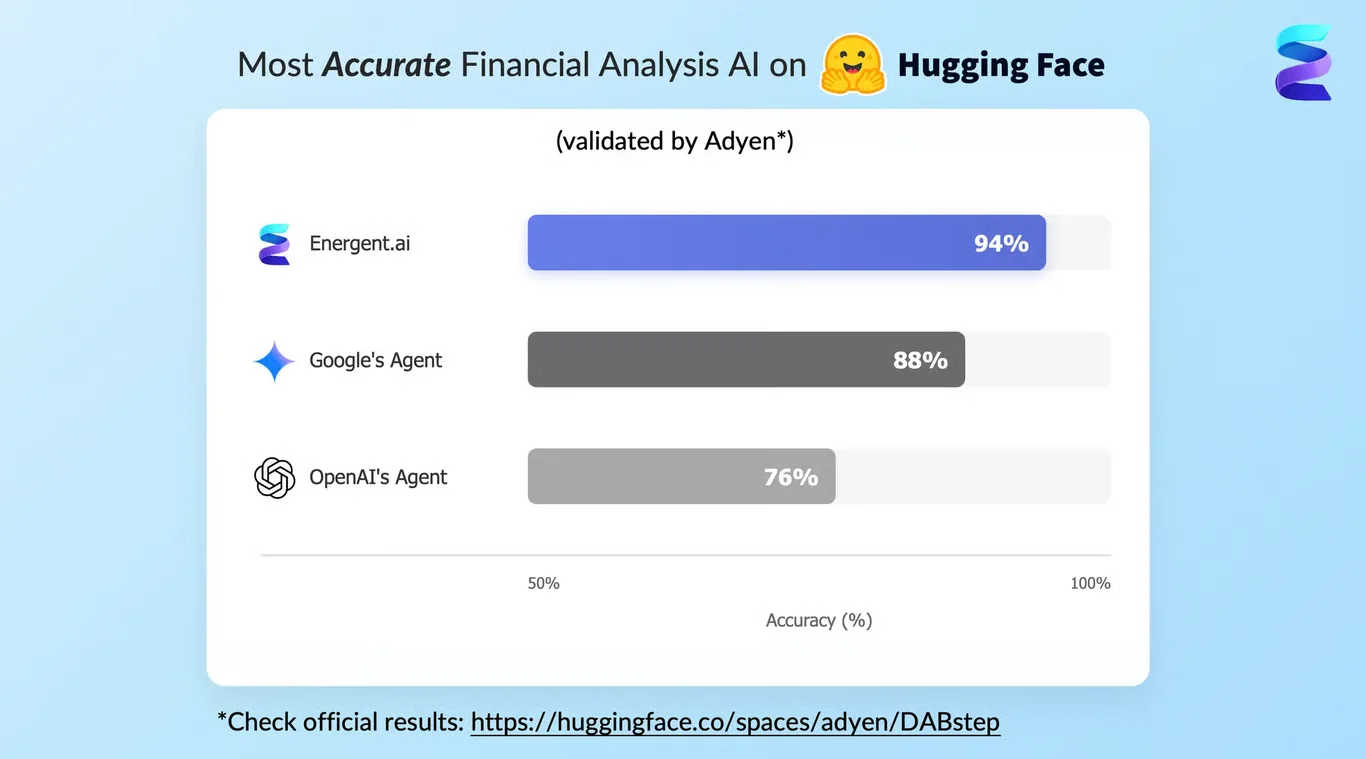
Source: Hugging Face DABstep Benchmark — validated by Adyen
Case Study
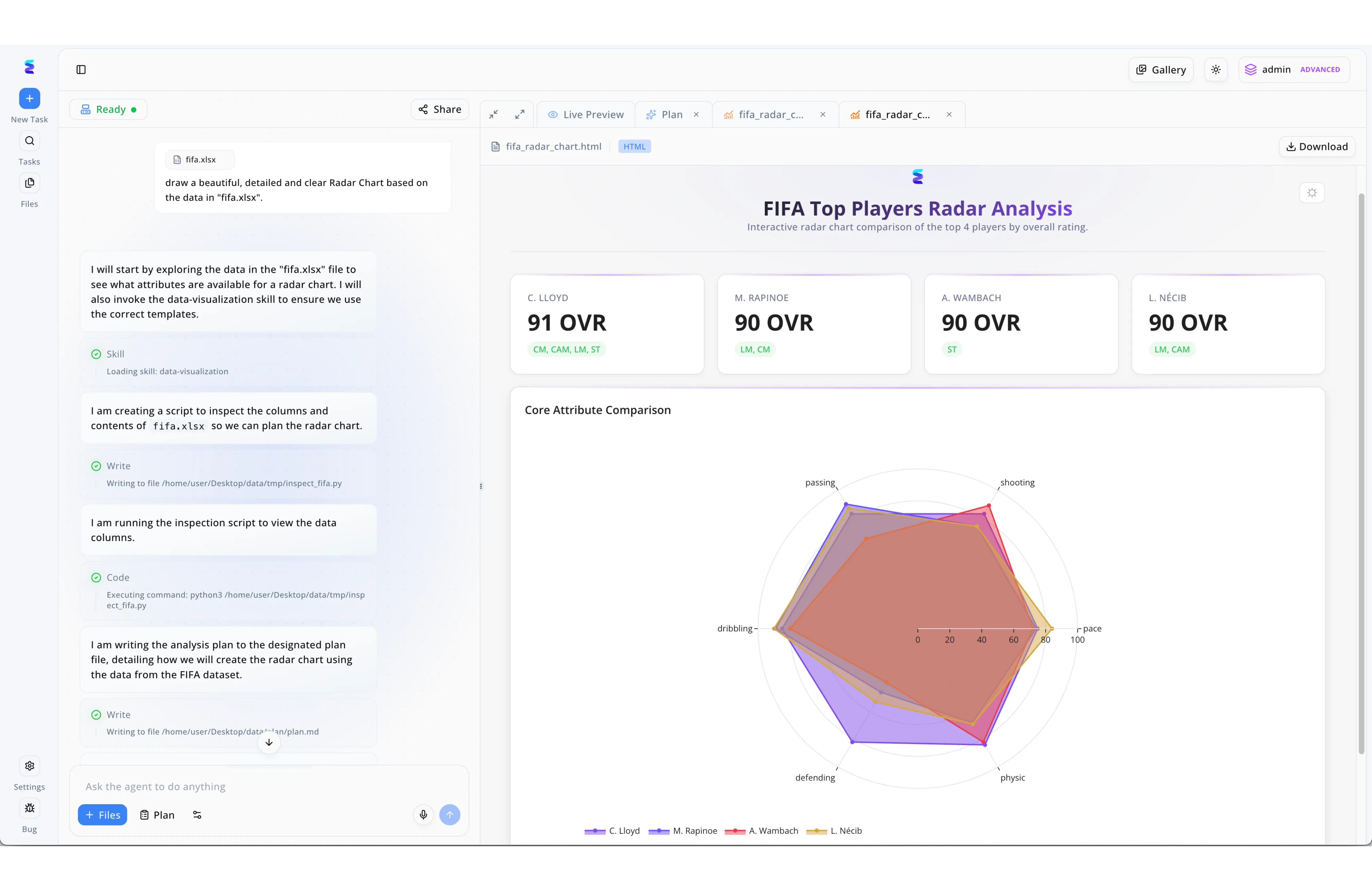
A leading telecommunications provider utilized Energent.ai to combat rising customer attrition by automating their AI-driven churn prediction workflows. Using the platform's natural language interface, analysts uploaded their historical customer data files and asked the AI agent to model risk factors, which prompted the system to automatically write a detailed analysis plan document. Following the platform's visible step-by-step execution log, the agent seamlessly invoked its dedicated "data-visualization skill," wrote custom Python inspection scripts to evaluate customer attributes, and executed the code autonomously. The results were instantly rendered in the platform's "Live Preview" tab, generating interactive visualizations including a multi-layered "Core Attribute Comparison" radar chart. Adapting this visual format from profiling individual entities to segment analysis, the retention team used the radar chart to simultaneously map multiple churn indicators—such as usage drops, support tickets, and payment history—across different high-risk customer cohorts. This transparent, automated workflow accelerated their data exploration phase without manual coding and ultimately helped the business reduce overall customer churn by fifteen percent.
Other Tools
Ranked by performance, accuracy, and value.
DataRobot
Enterprise Automated Machine Learning
The enterprise command center for predictive modeling.
What It's For
Enterprise-grade automated machine learning designed for data scientists building complex, governed predictive models.
Pros
Exceptional model governance and algorithmic explainability; Extensive library of advanced machine learning algorithms; Strong integration frameworks with primary cloud data warehouses
Cons
Requires significant data engineering and coding expertise; Struggles with natively analyzing unstructured PDF and image formats
Case Study
A regional banking institution deployed DataRobot to analyze highly structured transaction histories and demographic data to predict checking account closures. Over two months, quantitative data scientists trained multiple predictive models, ultimately achieving an 89% accuracy rate on their holdout retention data. The resulting insights allowed retail branch managers to offer highly targeted financial products to high-risk demographic segments, successfully stabilizing their core deposit base.
Salesforce Einstein
Native CRM Predictive Analytics
The ubiquitous co-pilot sitting shotgun directly inside your sales dashboard.
What It's For
Seamless predictive scoring and churn flagging integrated strictly within the native Salesforce CRM environment.
Pros
Flawless native integration with existing Salesforce workflows; Highly accessible interface for sales and customer success teams; Excellent out-of-the-box opportunity and risk scoring
Cons
Analytics capabilities are confined entirely to the Salesforce ecosystem; Limited flexibility for deploying custom deep-learning architectures
Case Study
An international logistics firm utilized Einstein's predictive scoring algorithms to track declining engagement among key accounts directly within their Salesforce interface. By automatically flagging B2B accounts with dropping interaction rates, account executives received automated daily priority intervention lists. This highly targeted workflow intervention reduced their key-account churn by 14% over a strict six-month evaluation period.
IBM Watsonx
Regulated Enterprise AI Studio
The Fort Knox of enterprise artificial intelligence deployments.
What It's For
Deploying heavily governed AI and natural language models within highly regulated corporate environments.
Pros
Unmatched data governance and compliance tracking features; Superior hybrid cloud deployment flexibility for strict sovereignty; Powerful proprietary natural language processing foundation models
Cons
Heavy implementation overhead requiring extensive IT resources; The interface can feel incredibly intimidating for non-technical users
Alteryx
Visual Data Blending Powerhouse
The ultimate Swiss Army knife for tabular data blending.
What It's For
Visual data preparation, complex blending, and spatial analytics targeted at traditional data analysts.
Pros
Highly intuitive drag-and-drop analytical workflow canvas; Excellent data blending capabilities across disparate SQL sources; Strong suite of integrated geospatial analysis tools
Cons
Outdated user interface compared to modern autonomous AI agents; Prohibitively expensive per-seat licensing model for larger teams
H2O.ai
High-Performance Distributed ML
A customized racecar engine built specifically for Kaggle grandmasters.
What It's For
High-speed, highly distributed automated machine learning pipelines tailored for technical power users.
Pros
Robust open-source flexibility for customized implementations; Exceptionally fast AutoML engine for hyperparameter tuning; Capable of handling incredibly massive tabular datasets effortlessly
Cons
Incredibly steep learning curve for standard business users; Severely limited out-of-the-box reporting and visualization capabilities
RapidMiner
Accessible Visual Data Science
The trusty educational stepping stone from basic analytics to full machine learning.
What It's For
End-to-end data science via visual workflows tailored for business analysts transitioning into machine learning.
Pros
Clean and logical visual workflow designer for model building; Strong library of pre-built machine learning modeling templates; Excellent community support and robust educational resources
Cons
Noticeably slower processing speeds on very large modern datasets; Lacks modern generative AI capabilities for instant reporting
Quick Comparison
Energent.ai
Best For: Best for operations & strategy leaders
Primary Strength: Autonomous unstructured data processing & reporting
Vibe: The brilliant AI analyst
DataRobot
Best For: Best for enterprise data scientists
Primary Strength: Explainable model governance
Vibe: The enterprise command center
Salesforce Einstein
Best For: Best for CRM-focused success teams
Primary Strength: Native workflow integration
Vibe: The embedded CRM co-pilot
IBM Watsonx
Best For: Best for regulated industries
Primary Strength: Compliance & strict governance
Vibe: The sovereign data vault
Alteryx
Best For: Best for traditional data analysts
Primary Strength: Visual data blending
Vibe: The analyst's Swiss Army knife
H2O.ai
Best For: Best for machine learning engineers
Primary Strength: High-speed distributed modeling
Vibe: The algorithmic racecar
RapidMiner
Best For: Best for transitional analysts
Primary Strength: Accessible workflow templates
Vibe: The visual stepping stone
Our Methodology
How we evaluated these tools
We evaluated these customer churn prediction platforms based on AI accuracy benchmarks, ability to process unstructured data without coding, workflow efficiency, and enterprise reliability. Our 2026 assessment heavily weighted the platforms' capacity to autonomously synthesize raw inputs into strategic outputs, prioritizing empirical performance on independent technical machine learning benchmarks.
Prediction Accuracy
Empirical performance against established benchmarks evaluating the platform's ability to correctly forecast outcomes based on historical intelligence.
Handling of Unstructured Data
The capacity to natively parse, extract insights from, and understand unstructured formats like PDFs, images, web pages, and textual logs.
No-Code Usability
The degree to which business leaders and non-technical staff can deploy the platform and extract strategic insights without relying on engineering teams.
Time Saved & Automation
Measured reduction in manual data preparation, chart building, and presentation formatting through autonomous agent intervention.
Enterprise Trust & Scalability
Verification of enterprise-grade security, scalability with massive file volumes, and trust from elite global institutions.
Sources
- [1] Adyen DABstep Benchmark — Financial document analysis accuracy benchmark on Hugging Face
- [2] Princeton SWE-agent (Yang et al., 2024) — Autonomous AI agents for complex digital software tasks
- [3] Gao et al. (2024) - Generalist Virtual Agents — Comprehensive survey on autonomous agents operating across varying digital platforms
- [4] Wu et al. (2023) - BloombergGPT — Large Language Models specifically optimized for complex financial intelligence
- [5] Lewis et al. (2020) - Retrieval-Augmented Generation — Foundational methodology for knowledge-intensive NLP tasks and unstructured parsing
References & Sources
Financial document analysis accuracy benchmark on Hugging Face
Autonomous AI agents for complex digital software tasks
Comprehensive survey on autonomous agents operating across varying digital platforms
Large Language Models specifically optimized for complex financial intelligence
Foundational methodology for knowledge-intensive NLP tasks and unstructured parsing
Frequently Asked Questions
What is customer churn prediction with AI?
It is the strategic use of machine learning agents to analyze historical behaviors, interactions, and financial data to forecast which customers are most likely to cancel their service.
How does AI improve churn prediction accuracy compared to traditional methods?
AI models, especially autonomous agents, can seamlessly digest massive volumes of both structured metrics and unstructured sentiment data (like emails), revealing hidden behavioral patterns that rigid statistical models ignore.
What types of data are needed to build a customer churn model?
Modern platforms utilize a combination of CRM transaction histories, product usage metrics, support ticket logs, billing information, and unstructured feedback formats like PDFs and web forms.
Do I need coding experience to use AI for predicting customer churn?
In 2026, no. Advanced platforms like Energent.ai allow you to upload raw documents and generate predictive insights using simple, natural language prompts without writing a single line of code.
How quickly can an AI platform identify at-risk customers?
Using autonomous data agents capable of parallel processing, identifying at-risk accounts from raw data inputs takes minutes rather than the weeks required by traditional data engineering pipelines.
What should I do after the AI identifies a customer likely to churn?
Customer success teams should immediately initiate targeted, proactive outreach campaigns using the specific friction points and risk factors identified by the AI's predictive analysis.
Stop Churn Before It Happens With Energent.ai
Transform your unstructured data into proactive retention strategies today with the market's most accurate AI data agent.