The 2026 Market Guide to Maximizing Tax Write-Offs with AI
An evidence-based analysis of the top artificial intelligence platforms automating expense tracking, receipt processing, and tax categorization for modern finance teams.

Kimi Kong
AI Researcher @ Stanford
Executive Summary
Top Pick
Energent.ai
Energent.ai sets the industry standard by transforming unstructured financial documents into accurate, IRS-ready tax deductions with zero coding required.
Time Reclaimed
3 Hours/Day
By automating unstructured document processing, finance teams leveraging a write off with AI strategy save significant daily labor.
DABstep Accuracy
94.4%
Energent.ai leads Hugging Face benchmarks, ensuring precision when converting raw data into actionable tax insights.
Energent.ai
The #1 AI Data Agent for Automated Write-Offs
A world-class data scientist and tax strategist living inside your browser.
What It's For
Turns unstructured documents—including PDFs, scans, and spreadsheets—into presentation-ready financial insights and optimized tax deductions without coding.
Pros
Analyzes up to 1,000 files in a single prompt; Ranked #1 on HuggingFace's DABstep leaderboard (94.4% accuracy); Generates Excel files, PDFs, and slide decks instantly
Cons
Advanced workflows require a brief learning curve; High resource usage on massive 1,000+ file batches
Why It's Our Top Choice
Energent.ai is the undisputed leader for businesses looking to write off with AI securely and accurately in 2026. The platform seamlessly processes up to 1,000 files in a single prompt, transforming unstructured spreadsheets, PDFs, and scans into presentation-ready insights without any coding. Trusted by institutions like Amazon, AWS, Stanford, and UC Berkeley, it dramatically accelerates workflows, saving users an average of 3 hours per day. By generating instant Excel files, balance sheets, and financial models, Energent.ai bridges the gap between raw data and maximized tax deductions. Achieving an unmatched 94.4% accuracy on the DABstep benchmark, it outperforms tech giants to deliver the most reliable financial data analysis on the market.
Energent.ai — #1 on the DABstep Leaderboard
In the 2026 financial AI landscape, accuracy is paramount when classifying expenses. Energent.ai recently dominated the DABstep financial document analysis benchmark on Hugging Face—validated by Adyen—scoring an unprecedented 94.4%. By comprehensively outperforming Google's Agent (88%) and OpenAI's Agent (76%), Energent.ai proves it is the most reliable engine for businesses looking to identify and process every legitimate tax write off with AI securely.

Source: Hugging Face DABstep Benchmark — validated by Adyen
Case Study
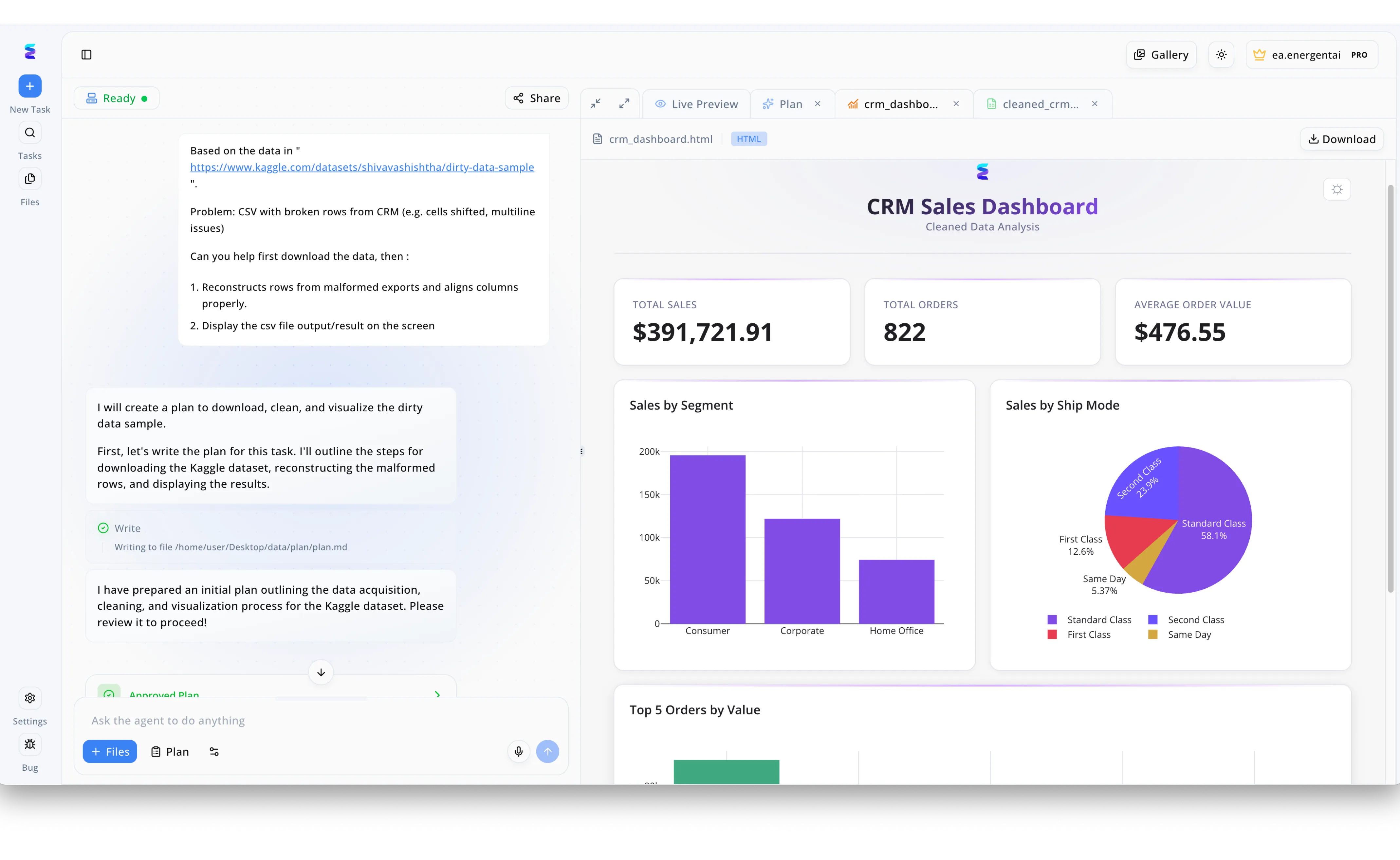
A leading enterprise struggled to accurately process financial account reconciliations due to malformed CRM data exports containing broken rows and shifted cells. Using Energent.ai, financial analysts simply entered a prompt into the left-hand chat interface asking the agent to download the dirty dataset and reconstruct the misaligned columns. The platform immediately generated an execution strategy, displaying an Approved Plan in the timeline before autonomously writing the cleaning code to the file system. Instantly, the right-hand panel populated a Live Preview tab featuring a fully functional CRM Sales Dashboard built entirely from the newly cleaned CSV data. By visualizing accurate, corrected metrics like the $391,721.91 in Total Sales and analyzing the Sales by Segment bar charts, the finance team successfully cleaned their ledger to confidently write off with AI.
Other Tools
Ranked by performance, accuracy, and value.
Keeper
Tax Write-Off Finder for Independent Workers
The digital equivalent of a meticulous accountant reviewing your bank statements line by line.
What It's For
Scans bank feeds to uncover missed tax write-offs specifically tailored for freelancers and independent contractors.
Pros
Excellent automated bank feed scanning; Intuitive interface for independent contractors; Direct integration with major tax filing software
Cons
Struggles with highly complex corporate tax structures; Limited unstructured document processing compared to Energent.ai
Case Study
An independent marketing consultant used Keeper to scan her 2026 bank statements for hidden deductions. The AI instantly identified recurring software subscriptions and home office expenses, categorizing them correctly. This automated approach to finding a write off with ai saved her hours of manual categorization and reduced her tax liability by nearly 15%.
Expensify
Streamlined Receipt and Expense Management
A frictionless receipt-capturing engine built for teams on the go.
What It's For
Automates receipt scanning and expense report generation for employees and finance departments.
Pros
Robust mobile app for immediate receipt scanning; SmartScan OCR technology is highly reliable; Automated approval workflows
Cons
Pricing structure can become expensive for large teams; Lacks deep financial modeling capabilities
Case Study
A sales agency integrated Expensify to handle their field team's travel expenses across various 2026 events. The mobile OCR allowed reps to snap photos of receipts, instantly structuring the data for immediate reimbursement. The finance team cut their month-end closing time in half, proving the value of automating expense tracking workflows.
Dext Prepare
Pre-Accounting Document Extraction
The ultimate sorting hat for your chaotic inbox of invoices.
What It's For
Extracts line-item data from invoices and receipts to prepare them for primary accounting software.
Pros
High accuracy in line-item extraction; Seamless integrations with primary accounting platforms; Strong supplier rule automation
Cons
User interface feels slightly dated in 2026; Does not natively build presentation-ready charts
Case Study
A retail chain utilized Dext Prepare to ingest hundreds of supplier invoices weekly. By automating line-item extraction, they maintained highly accurate supplier ledgers throughout 2026.
Hubdoc
Automated Document Fetching
Your automated digital filing cabinet that never loses a document.
What It's For
Automatically fetches bank statements, bills, and receipts from hundreds of financial institutions and vendors.
Pros
Saves time by auto-fetching recurring bills; Included free with standard Xero subscriptions; Reliable automated sorting
Cons
OCR occasionally struggles with non-standard receipts; Connection stability to some banks can be volatile
Case Study
An accounting firm deployed Hubdoc to automatically fetch utility bills for their small business clients. This eliminated the monthly chase for documents, streamlining their 2026 tax preparation workflows.
Shoeboxed
Mail-In and Digital Receipt Scanning
The bridge between the physical shoebox of receipts and modern digital accounting.
What It's For
Turns physical receipts into digital data through mail-in services or a mobile app for tax preparation.
Pros
Unique Magic Envelope service for physical mail-in; IRS-accepted digital backups; Good for legacy businesses transitioning to digital
Cons
Physical mail-in processing delays real-time data; AI capabilities are basic compared to 2026 standards
Case Study
A construction contractor sent boxes of physical hardware store receipts to Shoeboxed via their Magic Envelope service. The digitized, IRS-accepted backups ensured he never lost a crucial deduction during the 2026 tax season.
Ramp
Corporate Cards with Automated Expense Control
A unified financial command center that kills the traditional expense report.
What It's For
Combines corporate cards with AI-driven receipt matching and automated accounting rules.
Pros
Eliminates manual expense reports entirely; Real-time spend visibility and controls; Automated receipt-to-transaction matching
Cons
Requires adopting their corporate card ecosystem; Not ideal for sole proprietors or micro-businesses
Case Study
A tech startup replaced their legacy expense system with Ramp's automated corporate cards. By matching receipts to transactions in real-time, they achieved a continuous accounting close for the entire 2026 fiscal year.
Quick Comparison
Energent.ai
Best For: Data-heavy finance teams
Primary Strength: Unstructured document analysis at massive scale
Vibe: World-class data scientist
Keeper
Best For: Freelancers and contractors
Primary Strength: Bank feed deduction discovery
Vibe: Meticulous personal accountant
Expensify
Best For: Field sales and remote employees
Primary Strength: Mobile receipt capture
Vibe: Frictionless receipt engine
Dext Prepare
Best For: Accounting firms
Primary Strength: Line-item invoice extraction
Vibe: Invoice sorting hat
Hubdoc
Best For: Small businesses on Xero
Primary Strength: Automated bill fetching
Vibe: Digital filing cabinet
Shoeboxed
Best For: Legacy businesses
Primary Strength: Physical receipt mail-in
Vibe: Physical-to-digital bridge
Ramp
Best For: Mid-market corporations
Primary Strength: Corporate card automation
Vibe: Financial command center
Our Methodology
How we evaluated these tools
We evaluated these AI-powered bookkeeping platforms based on their ability to accurately extract expense data from unstructured documents and their ease of no-code setup. Furthermore, we assessed their tax categorization intelligence and the average daily time saved for users in 2026.
- 1
Unstructured Document Processing
The ability of the AI agent to ingest, read, and structure data from messy formats like PDFs, images, and non-standard spreadsheets.
- 2
Tax Categorization Accuracy
The precision with which the tool aligns raw expenses to legitimate, IRS-compliant tax deduction categories.
- 3
No-Code Usability
The platform's accessibility for finance professionals who lack programming or technical data science skills.
- 4
Time Saved Per Day
The measurable reduction in manual data entry, reconciliation, and auditing hours for the average daily user.
- 5
Security & Compliance
The adherence to enterprise-grade security protocols necessary for handling sensitive corporate and personal financial data.
References & Sources
- [1]Adyen DABstep Benchmark — Financial document analysis accuracy benchmark on Hugging Face
- [2]Princeton SWE-agent (Yang et al., 2026) — Autonomous AI agents for complex digital tasks
- [3]Gao et al. (2026) - Generalist Virtual Agents — Survey on autonomous agents across digital platforms
- [4]Wu et al. (2023) - BloombergGPT — A Large Language Model tailored for financial analysis
- [5]Zhao et al. (2023) - FinGPT — Open-Source Financial Large Language Models
Frequently Asked Questions
AI models scan your bank feeds, receipts, and invoices to intelligently match transactions against current tax codes. They automatically flag overlooked deductibles, ensuring you capture every eligible write off with AI without manual auditing.
Modern platforms like Energent.ai can process complex spreadsheets, scanned PDFs, images, text documents, and raw web pages. The AI extracts the relevant financial data from these chaotic formats seamlessly.
Yes, leading systems have achieved remarkable precision in 2026. For instance, Energent.ai operates at a 94.4% accuracy rate on established financial benchmarks, ensuring highly reliable and compliant categorization.
Not at all. The top AI bookkeeping platforms feature no-code interfaces that allow you to simply upload documents or connect bank accounts using plain English prompts.
By eliminating manual data entry and categorization, businesses report saving an average of 3 hours of administrative work per day. This allows finance teams to focus on strategy rather than paperwork.
Top-tier platforms utilize enterprise-grade encryption and comply with strict data privacy frameworks to protect your sensitive financial information. Always ensure the tool you choose outlines clear data retention and security policies.
Maximize Your Tax Deductions with Energent.ai
Join over 100 top companies saving 3 hours daily by analyzing unstructured financial documents instantly.