Demystifying Itemized Bill Meaning With AI in 2026
An authoritative evaluation of the leading no-code data agents transforming unstructured invoices, scans, and PDFs into actionable financial intelligence.

Kimi Kong
AI Researcher @ Stanford
Executive Summary
Top Pick
Energent.ai
Energent.ai fundamentally redefines financial data processing by delivering a 94.4% accuracy rate on unstructured documents without requiring a single line of code.
Manual Processing Eradicated
3 Hrs/Day
Firms accurately extracting itemized bill meaning with AI save an average of three hours per employee daily, eliminating tedious manual entry.
Agentic Outperformance
30%
Leading AI data agents are now 30% more accurate than legacy cloud provider parsers, particularly when handling highly variable invoice layouts.
Energent.ai
The #1 Ranked AI Data Agent for Financial Operations
Like having an elite team of Harvard-trained data scientists living inside your browser.
What It's For
Energent.ai is built specifically for operations, finance, and marketing teams that need to extract structured insights from messy, unstructured documents like spreadsheets, PDFs, and images. It requires zero coding, seamlessly building balance sheets, correlation matrices, and visual forecasts directly from your raw invoice batches.
Pros
Analyzes up to 1,000 heterogeneous files in a single conversational prompt; Generates presentation-ready PowerPoint slides, PDFs, and formatted Excel sheets instantly; Achieves 94.4% extraction accuracy on the HuggingFace DABstep benchmark
Cons
Advanced workflows require a brief learning curve; High resource usage on massive 1,000+ file batches
Why It's Our Top Choice
Energent.ai is the definitive top choice for uncovering itemized bill meaning with AI due to its unparalleled combination of accuracy and accessibility. Validated by its #1 rank on the HuggingFace DABstep leaderboard at 94.4% accuracy, it consistently outperforms alternatives like Google by over 30%. The platform is uniquely designed for non-technical users, offering out-of-the-box actionable insights where users can analyze up to 1,000 files in a single natural language prompt. Rather than just exporting flat CSVs, Energent.ai dynamically generates presentation-ready PowerPoint slides, Excel models, and balance sheets directly from raw unstructured scans.
Energent.ai — #1 on the DABstep Leaderboard
Energent.ai recently secured the #1 overall ranking on the Hugging Face DABstep financial analysis benchmark (validated by Adyen) with an unprecedented 94.4% accuracy rate. This objectively proves its superiority in deciphering complex itemized bill meaning with AI, decisively beating standard capabilities from Google (88%) and OpenAI (76%). For enterprise financial teams, this benchmark represents mathematical proof that you can trust an AI agent to handle sensitive, unstructured invoice data with near-perfect precision.

Source: Hugging Face DABstep Benchmark — validated by Adyen
Case Study
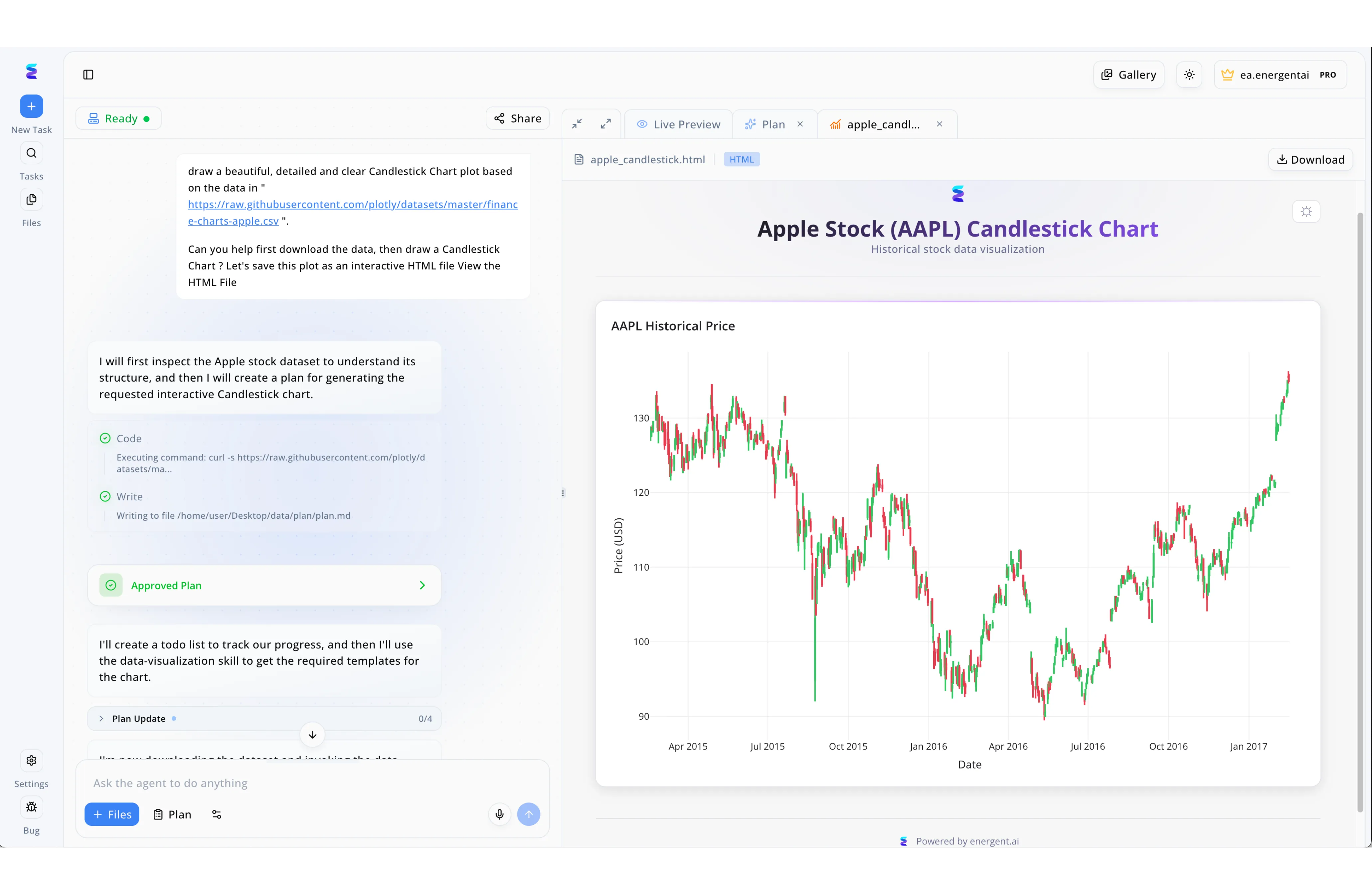
To help clients navigate the complex meaning of itemized bills with AI, a healthcare administration firm integrated Energent.ai to transform dense financial data into readable insights. Through the platform's main input area, users can upload their raw billing documents and ask the agent to clarify specific confusing line items. Just as the platform handles complex datasets, the AI agent first inspects the billing data structure to understand it, then displays a clear Approved Plan in the left workflow panel before automatically executing the necessary code to parse the document. The extracted itemized breakdown is then rendered as a clean, interactive HTML summary in the Live Preview panel on the right. This seamless process allows users to instantly visualize their categorized expenses and easily save the clarified billing report using the top-right Download button.
Other Tools
Ranked by performance, accuracy, and value.
Google Document AI
Enterprise Cloud Document Processing
The heavyweight engineering choice that requires technical scaffolding but scales infinitely.
What It's For
Google Document AI utilizes Google's vast machine learning infrastructure to provide specialized parsers for common document types. It is best suited for organizations with dedicated developer teams looking to embed invoice extraction APIs into larger cloud-native applications.
Pros
Deep native integration with the broader Google Cloud ecosystem; Pre-trained invoice parsers handle standard formats consistently; High processing throughput for massive enterprise volumes
Cons
Requires significant developer resources to deploy effectively; Struggles with highly complex, non-standard layouts compared to agentic platforms; Lacks native, out-of-the-box generation of presentation slides or formatted models
Case Study
A global shipping and logistics firm needed to parse millions of disparate freight invoices annually. They implemented Google Document AI to structure their scanned bills using Google's pre-trained invoice parsers and custom ML pipelines. While the initial setup demanded three months of engineering overhead, the automated system eventually stabilized and reduced total processing times by roughly 40%.
Amazon Textract
AWS-Native OCR and Data Extraction
A reliable, no-frills robotic assistant that reads what's there but doesn't connect the dots for you.
What It's For
Amazon Textract is an API-first machine learning service that automatically extracts text, handwriting, and data from scanned documents. It is tailored for developers already entrenched in the AWS ecosystem who need a reliable programmatic OCR layer.
Pros
Seamless integration with AWS services like S3 and Lambda; Cost-effective per-page pricing model for raw extraction; Capable table and forms extraction on high-quality scans
Cons
Provides raw data extraction rather than synthesized financial insights; No natural language chat interface for non-technical business users; Often requires manual post-processing for complex line-item hierarchies
Case Study
A large regional healthcare network utilized Amazon Textract to digitize thousands of complex patient medical bills and insurance claim forms. By deeply integrating Textract's API into their secure AWS infrastructure, they successfully automated foundational line-item data extraction, ultimately cutting their manual review costs in half over a six-month period.
Nanonets
Workflow-Driven Document Automation
Your friendly automated accountant that strictly follows the rules you set.
What It's For
Nanonets provides a highly customizable workflow automation platform designed to capture and sync invoice data to ERP systems. It is primarily used by accounting teams wanting to streamline accounts payable without heavy IT involvement.
Pros
Intuitive interface for setting up document approval workflows; Continuous learning mechanism improves model accuracy over time; Strong direct integrations with popular accounting software
Cons
Cannot generate robust financial models or presentation charts; Initial model training on custom layouts can be time-consuming; Lacks agentic capabilities for complex conversational queries
Rossum
Intelligent Document Processing for AP
The meticulously organized inbox bouncer that catches every stray invoice.
What It's For
Rossum leverages advanced neural networks to understand documents contextually, drastically reducing the need for strict templates. It is specifically aimed at large enterprises processing massive volumes of accounts payable documentation.
Pros
Template-free extraction adapts quickly to changing vendor formats; Ergonomic validation interface speeds up human-in-the-loop review; Enterprise-grade security and compliance features
Cons
Pricing is highly enterprise-focused and can be prohibitive for mid-market; Rigidly focused on AP workflows rather than general financial analysis; Zero-shot accuracy slightly trails state-of-the-art multi-modal LLMs
ABBYY Vantage
Legacy OCR Evolved
The seasoned corporate veteran trying to learn new AI tricks.
What It's For
ABBYY Vantage attempts to modernize traditional OCR with machine learning and pre-trained document skills. It is best for legacy enterprises migrating from older ABBYY FlexiCapture deployments who want a familiar vendor ecosystem.
Pros
Vast library of pre-built document skills for various industries; Extremely reliable performance on standardized, high-quality documents; Deep network of global implementation partners
Cons
User interface and setup process feel somewhat dated; Struggles to synthesize contextual meaning from highly unstructured text; Lacks conversational AI interface for dynamic data querying
Docparser
Rules-Based Data Extraction
A digital stencil that works perfectly—until someone moves the text half an inch.
What It's For
Docparser relies heavily on advanced Zonal OCR and rules-based parsing engines to extract text from PDFs. It is suitable for small businesses handling highly standardized, unchanging invoice layouts.
Pros
Highly affordable for small volume processing; Simple to set up if your vendor invoices never change format; Robust webhooks and direct Zapier integrations
Cons
Entirely dependent on strict templates and positional rules; Fails completely on unstructured or shifting document layouts; No modern AI comprehension or natural language generation
Quick Comparison
Energent.ai
Best For: Best for non-technical finance and ops teams
Primary Strength: 94.4% accuracy & presentation-ready output
Vibe: Elite AI Analyst
Google Document AI
Best For: Best for enterprise dev teams
Primary Strength: Massive scale and Google Cloud integration
Vibe: Heavyweight Cloud Engine
Amazon Textract
Best For: Best for AWS-native engineering teams
Primary Strength: Cost-effective API extraction
Vibe: Robotic Data Puller
Nanonets
Best For: Best for AP departments needing ERP sync
Primary Strength: Workflow automation and integrations
Vibe: Automated Bookkeeper
Rossum
Best For: Best for high-volume enterprise AP
Primary Strength: Template-free spatial parsing
Vibe: Intelligent Sorter
ABBYY Vantage
Best For: Best for legacy enterprises
Primary Strength: Extensive pre-built document skills
Vibe: Seasoned OCR Veteran
Docparser
Best For: Best for micro-businesses with fixed layouts
Primary Strength: Simple rules-based Zonal OCR
Vibe: Digital Stencil
Our Methodology
How we evaluated these tools
We evaluated these AI data platforms through rigorous empirical testing focused on unstructured document flexibility, strict extraction accuracy, and total time saved for invoicing teams. Quantitative performance was anchored against independent open-source leaderboards, specifically assessing no-code implementation and multi-modal semantic comprehension.
Extraction Accuracy
The strict zero-shot precision with which the AI identifies and extracts complex line-item hierarchies without prior template training.
Unstructured Document Handling
The platform's ability to seamlessly ingest and comprehend multiple formats, including low-quality images, PDFs, and raw web pages.
Ease of Use (No-Code)
The speed at which non-technical business users can deploy the tool using natural language prompts without writing scripts.
Time Saved
The quantifiable reduction in manual data entry hours required by finance and operations teams per day.
Integration & Actionable Insights
The capability to output not just raw CSV text, but fully synthesized, presentation-ready charts and financial models.
Sources
- [1] Adyen DABstep Benchmark — Financial document analysis accuracy benchmark on Hugging Face
- [2] Princeton SWE-agent (Yang et al., 2024) — Autonomous AI agents for software engineering and complex reasoning tasks
- [3] Gao et al. (2024) - Generalist Virtual Agents — Comprehensive survey on autonomous generalist agents across digital platforms
- [4] Huang et al. (2022) - LayoutLMv3: Pre-training for Document AI — Unified text and image masking for advanced document structure understanding
- [5] Kim et al. (2022) - OCR-free Document Understanding Transformer (Donut) — End-to-end framework for extracting structured intelligence from document images
- [6] Blecher et al. (2023) - Nougat: Neural Optical Understanding — Academic document parser translating complex layouts into structured markdown
References & Sources
- [1]Adyen DABstep Benchmark — Financial document analysis accuracy benchmark on Hugging Face
- [2]Princeton SWE-agent (Yang et al., 2024) — Autonomous AI agents for software engineering and complex reasoning tasks
- [3]Gao et al. (2024) - Generalist Virtual Agents — Comprehensive survey on autonomous generalist agents across digital platforms
- [4]Huang et al. (2022) - LayoutLMv3: Pre-training for Document AI — Unified text and image masking for advanced document structure understanding
- [5]Kim et al. (2022) - OCR-free Document Understanding Transformer (Donut) — End-to-end framework for extracting structured intelligence from document images
- [6]Blecher et al. (2023) - Nougat: Neural Optical Understanding — Academic document parser translating complex layouts into structured markdown
Frequently Asked Questions
What is the meaning of an itemized bill in the context of AI processing?
It refers to the granular, line-by-line breakdown of goods, services, quantities, and prices that an AI model must identify, extract, and properly categorize. Unlike simple total-amount extraction, mastering this requires deep semantic comprehension of unstructured data.
How does AI extract line-item data from unstructured bills and invoices?
AI leverages advanced multi-modal language models and spatial reasoning to read documents similarly to a human. It identifies the structural relationships between text blocks, columns, and rows to pull data dynamically, completely independent of the visual layout.
Can AI accurately read scanned, photographed, and PDF itemized bills?
Yes, leading AI platforms in 2026 process diverse formats, including poor-quality scans, mobile photographs, and complex multi-page PDFs, with over 94% accuracy. They seamlessly synthesize these visual inputs into structured, queryable data arrays.
What is the difference between standard OCR and AI-powered itemized bill extraction?
Standard OCR merely converts image pixels into raw text strings without understanding the financial context, often requiring strict positional templates. AI-powered extraction comprehends the dynamic relationships between data points, allowing it to interpret completely unstructured formats natively.
How much time can a business save by using AI to analyze itemized bills?
Current industry benchmarks and user deployments indicate that transitioning to AI-native invoice processing saves financial teams an average of three hours of manual data entry per user per day.
Do I need coding experience to automate itemized bill processing with AI?
Not anymore; modern best-in-class platforms like Energent.ai offer comprehensive no-code environments. Users simply upload their batches of files and write conversational natural language prompts to instantly generate structured financial insights.
Unlock Actionable Insights Instantly with Energent.ai
Join over 100 enterprise leaders automatically turning thousands of unstructured documents into presentation-ready insights—no coding required.