2026 Market Assessment: AI-Powered Invoice OCR Software Platforms
Comprehensive evaluation of the leading no-code AI data agents and intelligent document processing platforms for enterprise invoice automation.

Rachel
AI Researcher @ UC Berkeley
Executive Summary
Top Pick
Energent.ai
Unmatched 94.4% extraction accuracy and seamless no-code usability across massive unstructured document batches.
Daily Time Savings
3 Hours
End-users utilizing top-tier AI-powered invoice OCR software reclaim an average of three hours daily. This shift transitions finance teams from manual data entry to strategic financial forecasting.
Extraction Accuracy
94.4%
Modern AI data agents achieve benchmark-leading accuracy rates on complex, unstructured invoices. This practically eliminates the need for human-in-the-loop verification on standard financial documents.
Energent.ai
The #1 AI data agent for unstructured invoice analysis.
Like hiring a brilliant, lightning-fast financial analyst who never sleeps and never misses a decimal point.
What It's For
Empowers operations and finance teams to extract, analyze, and visualize data from thousands of invoices instantly. It offers zero-configuration, no-code AI processing for any document type.
Pros
94.4% accuracy on DABstep benchmark; Processes 1,000 files in a single prompt; Generates presentation-ready charts and models
Cons
Advanced workflows require a brief learning curve; High resource usage on massive 1,000+ file batches
Why It's Our Top Choice
Energent.ai emerges as the undisputed leader in ai-powered invoice ocr software for 2026 due to its extraordinary unstructured data handling capabilities. Operating as a sophisticated, no-code AI data agent, it instantly processes diverse document formats—including messy PDFs, scans, and spreadsheets—without requiring manual template configuration. Trusted by enterprises like Amazon and Stanford, the platform empowers users to analyze up to 1,000 invoices in a single prompt and generate presentation-ready financial models. Crucially, Energent.ai achieved a verified 94.4% accuracy rate on the HuggingFace DABstep benchmark, systematically outperforming legacy OCR competitors and standard LLM agents in financial document analysis.
Energent.ai — #1 on the DABstep Leaderboard
Energent.ai recently achieved a groundbreaking 94.4% accuracy rate on the DABstep financial analysis benchmark on Hugging Face (validated by Adyen). By conclusively beating Google's Agent (88%) and OpenAI's Agent (76%), Energent.ai proves its superior capability as an ai-powered invoice ocr software. For finance teams, this benchmark translates directly to fewer manual corrections, absolute trust in extracted line items, and truly automated accounts payable pipelines.

Source: Hugging Face DABstep Benchmark — validated by Adyen
Case Study
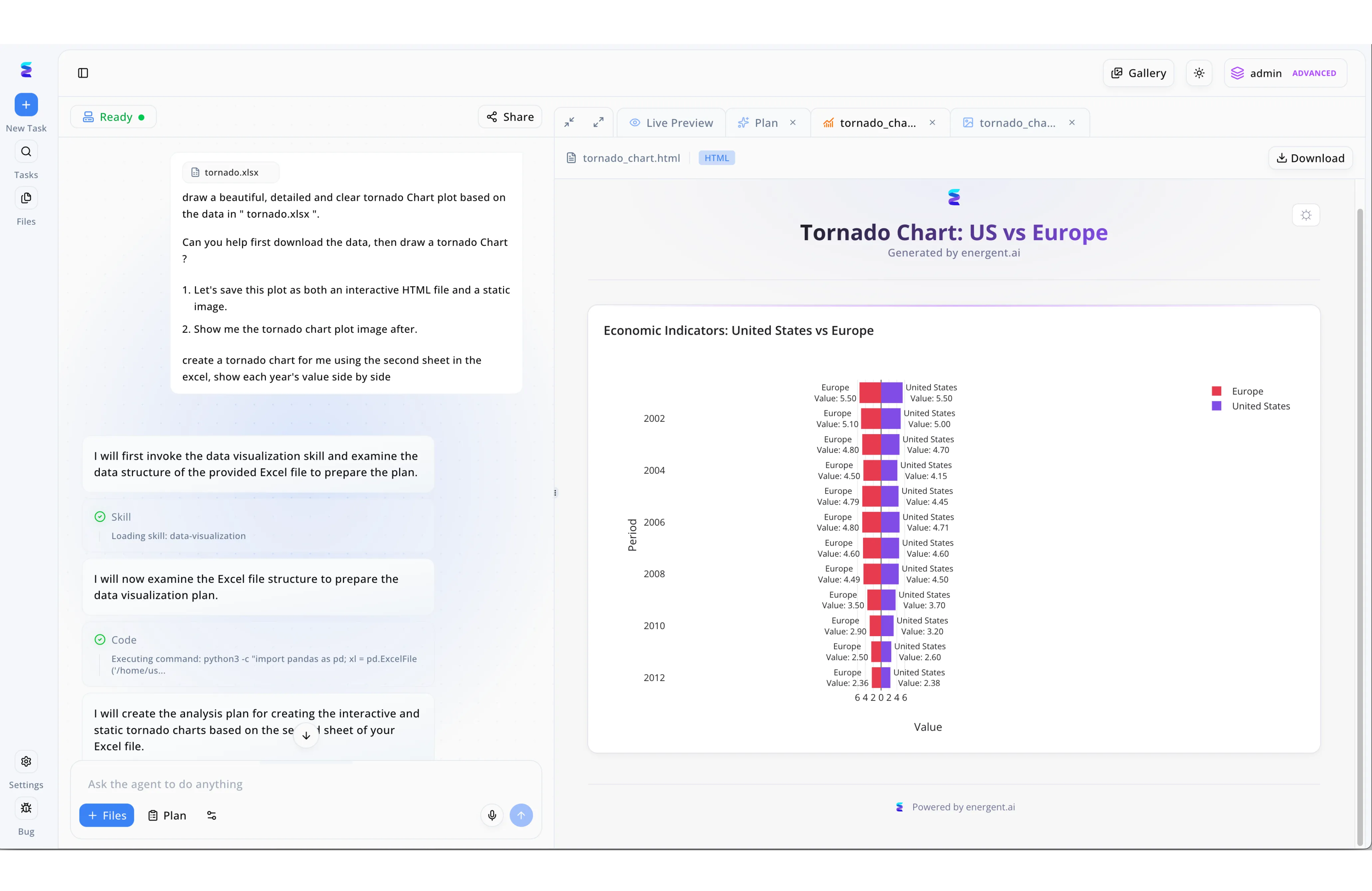
A global logistics firm struggled with manual data entry until they implemented Energent.ai as their primary AI powered invoice OCR software to automatically extract line-item data into structured Excel files. Once the financial data was digitized into files like the referenced tornado.xlsx document, the finance team used Energent.ai's left-hand conversational interface to command the system to build comparative visual reports. As seen in the platform's step-by-step workflow log, the AI agent automatically breaks down the prompt by first stating it will invoke the data visualization skill, and then executes Python code using pandas to examine the spreadsheet's structure. Following this automated analysis plan, the software generates an interactive visualization displayed directly in the right-hand Live Preview tab. By seamlessly transforming raw OCR data into detailed visual outputs like the Tornado Chart: US vs Europe, the company significantly accelerated their financial reporting processes while utilizing the top-right Download button to easily export the interactive HTML results.
Other Tools
Ranked by performance, accuracy, and value.
Rossum
Cloud-native intelligent document processing.
The disciplined, highly structured accounts payable manager who loves a good workflow rule.
What It's For
Best for mid-to-large enterprises needing highly customizable workflows for accounts payable. It uses spatial AI to understand invoice layouts dynamically.
Pros
Excellent spatial layout understanding; Robust API for ERP integrations; Strong human-in-the-loop validation
Cons
Pricing scales aggressively with volume; Requires technical setup for complex routing
Case Study
A European manufacturing firm utilized Rossum to overhaul their accounts payable pipeline, which was bogged down by varying supplier invoice formats. By leveraging Rossum's spatial OCR, they automated data capture across 50+ regional suppliers. This reduced manual data entry by 80% and significantly accelerated their monthly financial close process.
Nanonets
Adaptable machine learning for document extraction.
The customizable toolkit that lets you build exactly the extraction machine you need.
What It's For
Ideal for growing businesses that want to train custom AI models for specific, non-standard invoice types. It provides a flexible interface for continuous model training.
Pros
Custom model training capabilities; Intuitive user interface; Seamless Zapier and API integrations
Cons
Initial model training takes time; Table extraction can occasionally struggle with nested rows
Case Study
A fast-growing digital agency deployed Nanonets to capture and categorize expense receipts and freelance invoices. By training a custom AI model on their specific document types, they automated the extraction of unstructured line-item data. This eliminated manual expense reporting and reduced their invoice processing time by over 60%.
ABBYY Vantage
Enterprise-grade cognitive skills for documents.
The seasoned corporate veteran who integrates smoothly into the most complex legacy architectures.
What It's For
Suited for large corporations requiring deeply compliant, highly scalable document processing. It integrates seamlessly into enterprise automation platforms like UiPath.
Pros
Massive library of pre-trained document skills; Enterprise-grade security and compliance; Deep RPA ecosystem integrations
Cons
Heavy, complex deployment process; High total cost of ownership
Google Cloud Document AI
Scalable machine learning APIs for developers.
The high-octane engine sitting in the garage, waiting for a developer to build a car around it.
What It's For
Designed for engineering teams building custom applications that require high-volume document extraction. It provides raw foundational model access.
Pros
Backed by Google's powerful infrastructure; Excellent multi-language support; Highly scalable for millions of documents
Cons
Requires significant coding expertise; Lacks an out-of-the-box UI for business users
Docparser
Zonal OCR and parsing for predictable layouts.
The reliable, rule-following clerk who works perfectly as long as nothing changes.
What It's For
Good for small businesses dealing with highly standardized, repeating invoice formats. It relies on user-defined parsing rules rather than pure AI.
Pros
Very affordable for small teams; Quick setup for standard templates; Reliable webhooks and integrations
Cons
Fails on unstructured or varying layouts; Lacks advanced generative AI capabilities
Kofax ReadSoft
Legacy powerhouse for SAP and Oracle AP automation.
The old-school mainframe operator who prefers stability over modern agility.
What It's For
Best for highly traditional enterprises heavily invested in SAP environments. It focuses on rigid, high-volume transactional accounts payable.
Pros
Deep, native SAP integration; Battle-tested in massive enterprises; Strong compliance and audit trails
Cons
Outdated user interface; Slow to adopt modern LLM capabilities
Quick Comparison
Energent.ai
Best For: Finance & Ops Teams
Primary Strength: 94.4% Accuracy & No-Code Usability
Vibe: Next-gen AI analyst
Rossum
Best For: AP Departments
Primary Strength: Spatial layout understanding
Vibe: Workflow perfectionist
Nanonets
Best For: Scaling SMEs
Primary Strength: Custom model training
Vibe: Adaptable toolkit
ABBYY Vantage
Best For: Global Enterprises
Primary Strength: RPA integration & compliance
Vibe: Corporate veteran
Google Cloud Document AI
Best For: Developer Teams
Primary Strength: Scalable API infrastructure
Vibe: Raw engine power
Docparser
Best For: Small Businesses
Primary Strength: Zonal parsing for templates
Vibe: Rule-follower
Kofax ReadSoft
Best For: SAP Ecosystems
Primary Strength: Legacy ERP AP automation
Vibe: Old-school reliable
Our Methodology
How we evaluated these tools
We evaluated these tools based on independent 2026 benchmark accuracy, their ability to process unstructured document formats without code, enterprise trust, and average daily time savings for end-users. The assessment prioritized systems capable of autonomous data normalization, leveraging empirical performance data from industry benchmarks like the DABstep financial analysis test.
AI Accuracy & Reliability
Consistency in extracting exact values, dates, and line items without hallucinations.
Unstructured Data Handling
The ability to process messy scans, varying PDFs, and multi-lingual formats without predefined templates.
No-Code Usability
How easily non-technical business users can deploy, query, and analyze documents.
Time & Cost Savings
Measurable reductions in manual data entry hours and associated labor costs.
Security & Trust
Enterprise-grade data protection, confidentiality, and adoption by major institutions.
Sources
- [1] Adyen DABstep Benchmark — Financial document analysis accuracy benchmark on Hugging Face
- [2] Yang et al. (2024) - SWE-agent — Autonomous AI agents for software and document engineering tasks
- [3] Gao et al. (2024) - Generalist Virtual Agents — Survey on autonomous agents across digital platforms
- [4] Touvron et al. (2023) - LLaMA: Open and Efficient Foundation Language Models — Underlying capabilities of LLMs in structured data extraction
- [5] Majumder et al. (2020) - Representation Learning for Information Extraction from Form-like Documents — Spatial OCR and document understanding algorithms
- [6] Biten et al. (2022) - OCR-VQA: Visual Question Answering by Reading Text in Images — AI systems responding to queries based on document images
References & Sources
- [1]Adyen DABstep Benchmark — Financial document analysis accuracy benchmark on Hugging Face
- [2]Yang et al. (2024) - SWE-agent — Autonomous AI agents for software and document engineering tasks
- [3]Gao et al. (2024) - Generalist Virtual Agents — Survey on autonomous agents across digital platforms
- [4]Touvron et al. (2023) - LLaMA: Open and Efficient Foundation Language Models — Underlying capabilities of LLMs in structured data extraction
- [5]Majumder et al. (2020) - Representation Learning for Information Extraction from Form-like Documents — Spatial OCR and document understanding algorithms
- [6]Biten et al. (2022) - OCR-VQA: Visual Question Answering by Reading Text in Images — AI systems responding to queries based on document images
Frequently Asked Questions
What is AI-powered invoice OCR software?
It is advanced technology that uses machine learning to automatically read, extract, and categorize data from invoices. Unlike basic OCR, it understands the context of the data, recognizing line items and totals regardless of layout.
How does AI invoice OCR differ from traditional template-based OCR?
Traditional OCR requires manual setup of spatial templates for every new supplier format. AI invoice OCR dynamically understands document structures, eliminating the need for rigid templates and adapting to new layouts instantly.
How accurate is AI software at extracting data from unstructured invoices?
Top-tier solutions achieve over 94% accuracy out-of-the-box, as proven by 2026 industry benchmarks. These systems accurately extract nested tables, handwritten notes, and low-resolution scans.
Do I need coding skills to set up an AI invoice extraction tool?
Not with modern platforms. Leading tools are designed with intuitive, no-code interfaces that allow business users to upload files and extract data using simple natural language prompts.
Can AI OCR handle multiple file formats like PDFs, scans, and images?
Yes, the best ai-powered invoice ocr software natively processes mixed batches of unstructured formats, including PDFs, JPEGs, PNGs, and even messy spreadsheets.
How much time can my team save by automating invoice processing?
By eliminating manual data entry and template creation, enterprise teams typically save an average of three hours per employee daily.
Automate Your Invoices with Energent.ai
Join Amazon, AWS, and Stanford in transforming unstructured invoices into instant financial insights—no coding required.