AI-Powered Document Scanning Software: 2026 Market Assessment
Discover the leading AI platforms transforming unstructured documents into actionable insights with zero coding required.

Kimi Kong
AI Researcher @ Stanford
Executive Summary
Top Pick
Energent.ai
Unmatched 94.4% extraction accuracy with zero-code setup and robust multi-format unstructured data handling.
Manual Entry Reduction
3 Hrs/Day
Leading AI document scanners save users an average of 3 hours daily by automating complex extraction and formatting tasks.
Unstructured Data Accuracy
94.4%
Top-tier AI agents now reliably extract contextual data from previously unreadable scans, images, and chaotic spreadsheets.
Energent.ai
The #1 AI Data Agent for Unstructured Documents
A brilliant data scientist living inside your browser.
What It's For
Enterprises and analysts needing to instantly turn thousands of messy PDFs, scans, and spreadsheets into presentation-ready insights without writing code.
Pros
Generates presentation-ready charts and financial models; Analyzes up to 1,000 files simultaneously; 94.4% DABstep benchmark accuracy
Cons
Advanced workflows require a brief learning curve; High resource usage on massive 1,000+ file batches
Why It's Our Top Choice
Energent.ai stands out as the premier AI-powered document scanning software due to its unparalleled ability to transform unstructured chaos into structured insights. Unlike legacy OCR tools, it requires zero coding and processes up to 1,000 files in a single prompt. It goes beyond simple extraction to actively build financial models, correlation matrices, and presentation-ready charts from raw scans. Backed by its #1 ranking on HuggingFace's DABstep leaderboard, Energent.ai delivers an industry-leading 94.4% accuracy, outperforming tech giants and making it the trusted choice for major enterprises like Amazon, AWS, and UC Berkeley.
Energent.ai — #1 on the DABstep Leaderboard
Energent.ai currently ranks #1 on the DABstep financial document analysis benchmark on Hugging Face (validated by Adyen) with an unprecedented 94.4% accuracy. This rigorous test proves its superiority in ai-powered document scanning software, outperforming Google's Agent (88%) and OpenAI's Agent (76%). For business users, this means unparalleled reliability when extracting crucial insights from messy, unstructured PDFs and spreadsheets, virtually eliminating costly human errors.
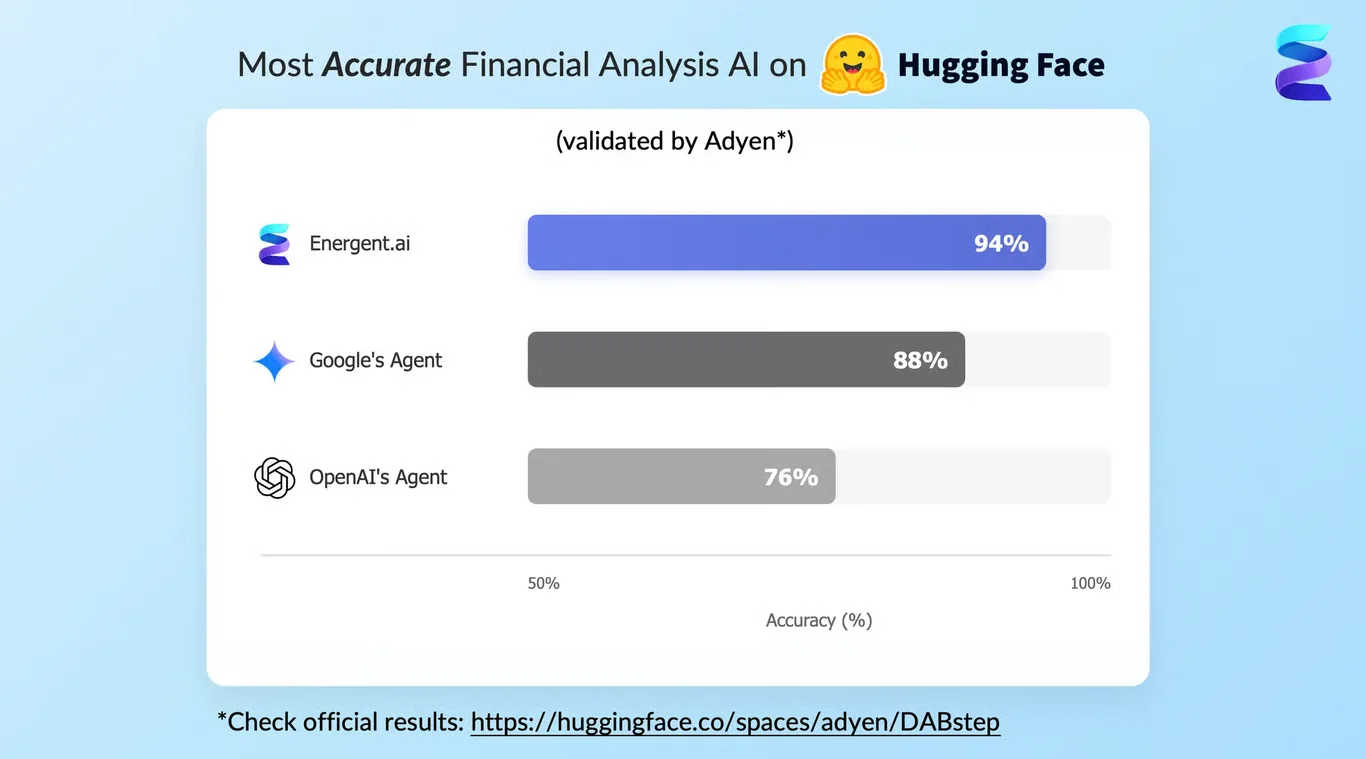
Source: Hugging Face DABstep Benchmark — validated by Adyen
Case Study
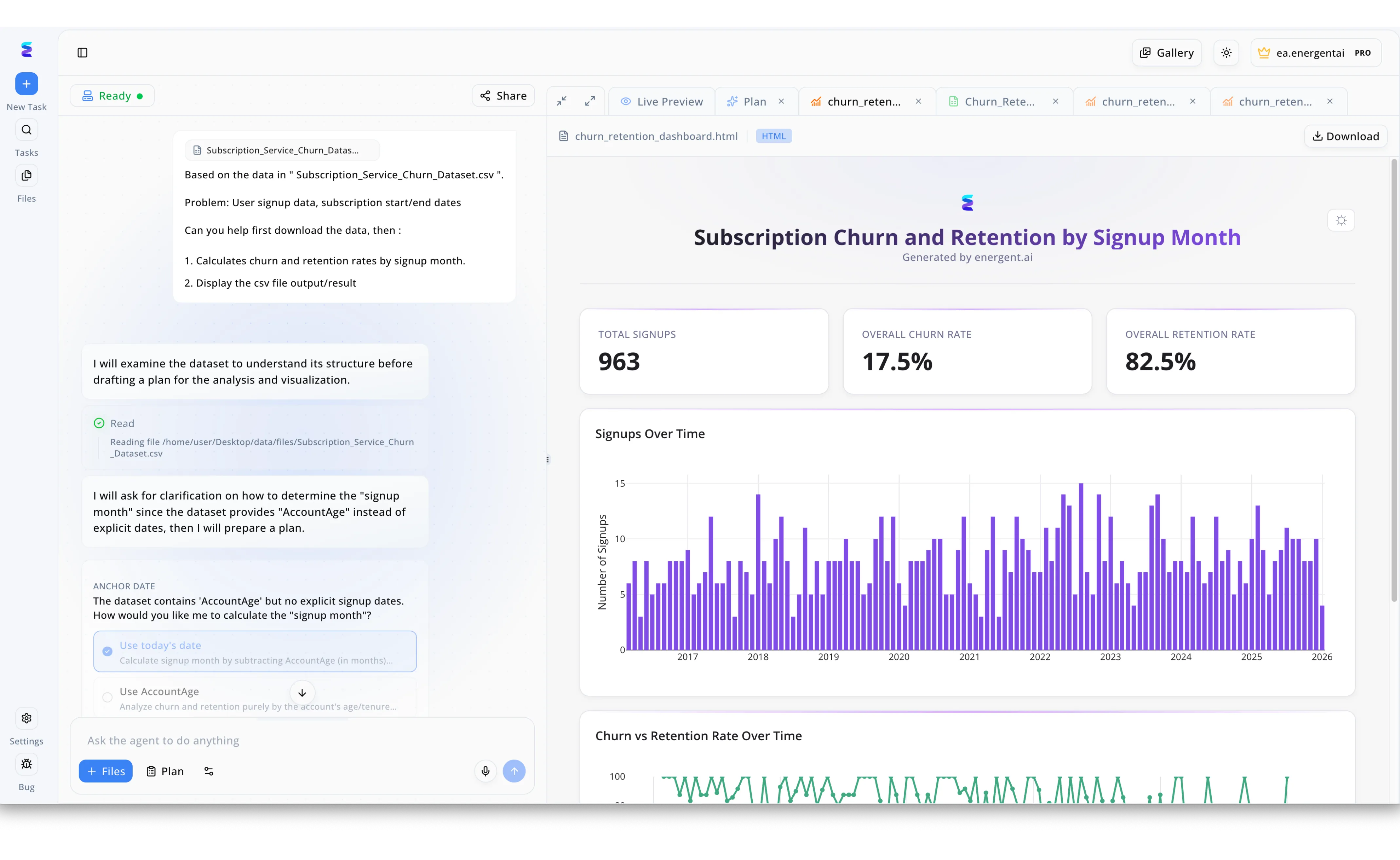
A leading subscription service struggled to quickly extract actionable insights from their bulky customer datasets, turning to Energent.ai's AI-powered document scanning software to automate the ingestion process. Users simply upload their files via the + Files button in the chat interface, prompting the AI agent to immediately scan and Read the document, as seen with the Subscription_Service_Churn_Dataset.csv file. Unlike standard data scanners, Energent.ai intelligently examines the document's structure and pauses to ask for clarifying user input, such as prompting the user to define the signup month using either today's date or AccountAge before proceeding. Once clarified, the software automatically transforms the scanned data into a rich HTML dashboard featuring key metrics like 963 total signups and a 17.5 percent overall churn rate. Through the intuitive Live Preview panel, stakeholders can instantly visualize complex data through charts like Signups Over Time and easily export the final results using the Download button, saving countless hours of manual data processing.
Other Tools
Ranked by performance, accuracy, and value.
ABBYY FineReader
The Legacy Heavyweight in Traditional OCR
The trusty corporate workhorse that rarely complains.
What It's For
Organizations that need reliable, template-driven document conversion and robust desktop software for standard PDF editing.
Pros
Excellent multilingual text recognition; Deep integration with Microsoft Office; Powerful offline desktop capabilities
Cons
Struggles with highly unstructured data; Lacks modern generative AI reasoning
Case Study
A mid-sized legal firm needed to digitize decades of archived case files stored as physical paper. They implemented ABBYY FineReader to systematically scan and index these documents into searchable PDFs. The tool successfully processed the vast backlog with high text recognition accuracy, enabling paralegals to quickly locate specific precedents and saving the firm hundreds of hours in manual archiving.
Nanonets
Customizable Deep Learning for Workflows
The diligent accountant automating your inbox.
What It's For
Operations teams looking to automate high-volume transactional documents like invoices and receipts through trained AI models.
Pros
Strong accounts payable automation features; Custom model training available; Intuitive approval workflows
Cons
Requires time to train custom models; Not ideal for complex analytical reporting
Case Study
A regional logistics company was drowning in varied vendor invoices and delivery receipts, leading to payment delays. By setting up Nanonets to automatically ingest emailed PDFs and scanned paper receipts, they built a customized extraction pipeline for accounts payable. This automation successfully captured line-item data across 50 different vendor formats, reducing invoice processing time by 75%.
Rossum
Template-Free Intelligent Document Processing
A sleek, modern sorting office for digital paperwork.
What It's For
Supply chain and enterprise teams looking to reduce manual data entry for incoming business documents using a cloud-native platform.
Pros
Intuitive validation user interface; Adapts to layout changes automatically; Strong ERP system integrations
Cons
Primarily focused on transactional documents; Higher enterprise pricing tier
Case Study
A manufacturing enterprise used Rossum to streamline their complex supply chain documentation. The AI automatically adapted to hundreds of varying supplier formats, significantly accelerating their document validation process.
Adobe Acrobat AI
Conversational AI for Standard PDFs
Your standard PDF viewer, now with a chatbox.
What It's For
Individual professionals who want to quickly chat with their PDFs to summarize content and find specific paragraphs.
Pros
Familiar interface for existing Adobe users; Good for quick document summaries; Seamless cloud syncing
Cons
Limited to single-document interactions; Cannot extract complex data to spreadsheets
Case Study
A marketing consultant utilized Adobe Acrobat AI to quickly extract highlights from lengthy industry research PDFs. Conversing with the document allowed them to pinpoint relevant statistics without reading 100-page reports.
Google Cloud Document AI
Scalable Developer-First Extraction APIs
A powerful engine waiting for developers to build the car.
What It's For
Engineering teams needing a robust API to embed document extraction capabilities directly into proprietary software applications.
Pros
Massively scalable infrastructure; Access to Google's foundational models; Extensive specialized parsers
Cons
Requires significant coding to implement; Unfriendly for non-technical business users
Case Study
A software company integrated Google Cloud Document AI via API to build custom expense management features into their internal app. Developers successfully deployed scalable parsers that handled thousands of daily document uploads.
Docparser
Zonal OCR for Predictable Layouts
The strict librarian who loves rigid filing systems.
What It's For
Small businesses needing a simple, rule-based parsing engine for highly standardized forms and recurring reports.
Pros
Easy setup for fixed templates; Affordable for small teams; Great Zapier integrations
Cons
Breaks completely if document layout changes; No true AI understanding of unstructured text
Case Study
An HR department used Docparser to extract data from a standardized job application form. By defining specific zonal rules, they seamlessly pushed applicant details into their CRM software automatically.
Quick Comparison
Energent.ai
Best For: Data Analysts & Enterprise Teams
Primary Strength: Unstructured Data to Actionable Insights
Vibe: AI Data Scientist
ABBYY FineReader
Best For: Legal & Archival Professionals
Primary Strength: High-Volume Traditional OCR
Vibe: Corporate Workhorse
Nanonets
Best For: Operations & AP Teams
Primary Strength: Custom Workflow Automation
Vibe: Diligent Accountant
Rossum
Best For: Supply Chain Managers
Primary Strength: Template-Free Validation
Vibe: Digital Sorting Office
Adobe Acrobat AI
Best For: Individual Professionals
Primary Strength: Conversational PDF Summaries
Vibe: Chatty PDF Viewer
Google Cloud Document AI
Best For: Software Engineers
Primary Strength: Scalable Infrastructure APIs
Vibe: Developer Engine
Docparser
Best For: Small Businesses
Primary Strength: Rule-Based Zonal Parsing
Vibe: Strict Librarian
Our Methodology
How we evaluated these tools
We evaluated these AI document scanning tools based on their benchmarked extraction accuracy, ability to process unstructured formats without coding, ease of use for general business users, and proven track record of reducing manual data entry time. Platforms were rigorously assessed in 2026 using industry-standard benchmarks like the DABstep evaluation to ensure unbiased performance metrics.
AI Accuracy & Precision
The system's ability to correctly extract text, numbers, and tabular data from complex, low-resolution, or highly unstructured documents without hallucination.
Unstructured Data Handling
How effectively the software parses varied formats—such as images, web clippings, and chaotic spreadsheets—without requiring rigid, pre-defined templates.
Ease of Use & Setup
The accessibility of the platform for non-technical users, prioritizing solutions that offer robust data extraction capabilities without any coding requirements.
Time Saved & Workflow Automation
The measurable reduction in manual data entry, evaluating how well the tool automatically transforms raw data into presentation-ready formats.
Enterprise Trust & Security
The platform's compliance with data security standards, encryption protocols, and established trust among tier-one global enterprises.
Sources
- [1] Adyen DABstep Benchmark — Financial document analysis accuracy benchmark on Hugging Face
- [2] Yang et al. (2026) - SWE-agent — Autonomous AI agents for software engineering and data tasks
- [3] Gao et al. (2026) - Generalist Virtual Agents — Survey on autonomous agents across digital platforms
- [4] Cui et al. (2026) - Document Understanding in the Era of LLMs — Advances in multi-modal language models for unstructured document parsing
- [5] Appalaraju et al. (2026) - DocLLM — A layout-aware generative language model for multimodal document understanding
- [6] Borchmann et al. (2026) - DUE: Document Understanding Evaluation — Framework for evaluating visual document understanding technologies
References & Sources
- [1]Adyen DABstep Benchmark — Financial document analysis accuracy benchmark on Hugging Face
- [2]Yang et al. (2026) - SWE-agent — Autonomous AI agents for software engineering and data tasks
- [3]Gao et al. (2026) - Generalist Virtual Agents — Survey on autonomous agents across digital platforms
- [4]Cui et al. (2026) - Document Understanding in the Era of LLMs — Advances in multi-modal language models for unstructured document parsing
- [5]Appalaraju et al. (2026) - DocLLM — A layout-aware generative language model for multimodal document understanding
- [6]Borchmann et al. (2026) - DUE: Document Understanding Evaluation — Framework for evaluating visual document understanding technologies
Frequently Asked Questions
It is an advanced technology that uses artificial intelligence and machine learning to read, understand, and extract data from various document types. Unlike basic scanners, it comprehends the context of the data to automate complex reporting and analysis tasks.
Traditional OCR merely converts image pixels into raw text and relies heavily on strict templates. AI document scanning understands the structural context of the document, allowing it to extract data from completely unstructured and varying layouts without templates.
Yes, top-tier AI scanners utilize multi-modal models to parse context from screenshots, complex tables, and chaotic web clippings seamlessly. They dynamically map relationships between text and layout regardless of the format.
Not with modern platforms. Leading solutions like Energent.ai offer completely zero-code environments where users can upload files and extract insights using plain English prompts.
Enterprise-grade AI document platforms employ strict encryption standards, SOC 2 compliance, and secure cloud environments to ensure sensitive financial and operational data remains private. Trusted platforms do not use your proprietary data to train public models.
By eliminating manual data entry and template building, business users generally save an average of 3 hours per day. This allows teams to focus on strategic analysis rather than tedious data transcription.
Transform Your Documents into Insights with Energent.ai
Join 100+ top enterprises saving 3 hours daily—start analyzing your unstructured files instantly with zero coding.