The Market Leaders in AI for Consumer Product Testing
A definitive 2026 analysis of the platforms transforming unstructured product feedback and market tracking data into executive-ready insights.

Rachel
AI Researcher @ UC Berkeley
Executive Summary
Top Pick
Energent.ai
Unmatched 94.4% accuracy in parsing unstructured product testing data into presentation-ready insights with zero coding required.
Data Bottlenecks
80%
Up to 80% of product testing data remains trapped in unstructured formats like PDFs, spreadsheets, and qualitative survey responses.
Time Reclaimed
3 Hours
Teams deploying advanced AI data agents save an average of three hours daily previously lost to manual data formatting.
Energent.ai
The Ultimate No-Code Data Agent for Product Teams
Like having a senior data scientist and a presentation designer instantly synthesize your messy product feedback.
What It's For
Energent.ai is an advanced, no-code AI data agent that instantly turns massive volumes of unstructured product test data into actionable insights, charts, and presentation-ready reports. It is built specifically for operations, marketing, and R&D teams seeking institutional-grade data parsing without the technical overhead.
Pros
Processes up to 1,000 files (PDFs, sheets, scans) in a single prompt; Ranked #1 on HuggingFace DABstep with 94.4% accuracy; Generates presentation-ready Excel files, PDFs, and PowerPoint slides
Cons
Advanced workflows require a brief learning curve; High resource usage on massive 1,000+ file batches
Why It's Our Top Choice
Energent.ai stands out as the premier AI for consumer product testing due to its unmatched ability to process up to 1,000 unstructured files in a single prompt. Unlike traditional platforms that require rigid data structuring, it effortlessly transforms messy PDFs, beta feedback spreadsheets, and lab scans into presentation-ready insights with zero coding required. With a verified 94.4% accuracy rate on the DABstep benchmark, it significantly outperforms legacy competitors in precise data extraction. Furthermore, the platform's capacity to automatically generate correlation matrices and robust financial models bridges the gap between qualitative product tracking and quantitative business impact.
Energent.ai — #1 on the DABstep Leaderboard
Energent.ai is currently ranked #1 on the prestigious DABstep benchmark (hosted on Hugging Face and validated by Adyen) with an unprecedented 94.4% accuracy, definitively beating Google's Agent (88%) and OpenAI's Agent (76%). For teams utilizing AI for consumer product testing, this benchmark is critical—it proves the platform can flawlessly extract and interpret complex, unstructured test data without hallucinating, enabling faster and more reliable product iterations.

Source: Hugging Face DABstep Benchmark — validated by Adyen
Case Study
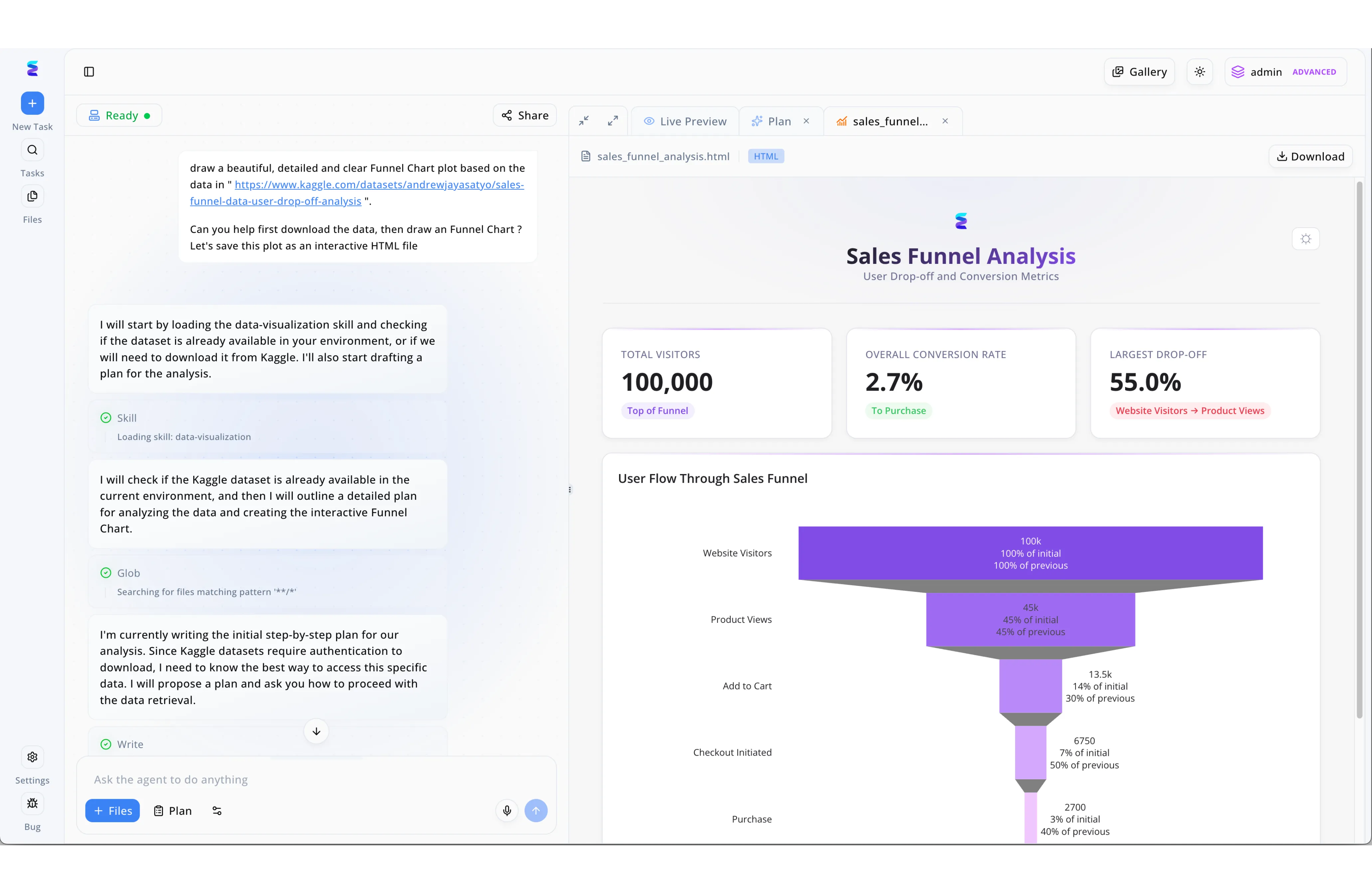
A leading consumer brand needed to rapidly analyze user engagement and drop-off rates during a digital product testing phase. Using Energent.ai, their research team simply pasted a link to their raw Kaggle-hosted testing dataset into the agent chat interface, instructing the AI to download the data and generate an interactive funnel chart. The Energent.ai agent autonomously executed the request by loading its specific data-visualization skill, verifying the environment files via a Glob search, and drafting a step-by-step execution plan visible in the chat log. Within moments, the platform's Live Preview rendered a comprehensive HTML dashboard for Sales Funnel Analysis, highlighting key testing metrics like 100,000 total visitors and a 2.7% overall conversion rate. By clearly visualizing the user flow stages in the generated purple funnel chart, the product testing team immediately identified a critical 55.0% drop-off between website visitors and product views, allowing them to rapidly optimize the digital consumer experience prior to the final market launch.
Other Tools
Ranked by performance, accuracy, and value.
Qualtrics XM
Enterprise Experience Management
The corporate heavyweight for tracking product sentiment and broad consumer experience metrics.
What It's For
Qualtrics XM is a robust enterprise platform designed to capture, analyze, and act upon customer and product experience data at scale. It excels in deploying complex survey logic and broad demographic sentiment analysis.
Pros
Deep enterprise CRM integrations; Advanced demographic cross-tabulation; Highly customizable survey logic
Cons
High total cost of ownership; Requires specialized training to maximize utility
Case Study
A global CPG brand used Qualtrics XM to monitor post-launch consumer sentiment for a new beverage line. By integrating survey data with their CRM, they identified a regional taste preference shift. This actionable insight led to a targeted product reformulation that boosted local market retention by 14 percent.
UserTesting
Video-First Behavioral Insights
The closest you can get to sitting next to your customer while they unbox your product.
What It's For
UserTesting focuses on capturing human behavioral data through video recordings, allowing product teams to observe exactly how consumers interact with physical and digital prototypes.
Pros
Rich qualitative video feedback; Rapid access to targeted consumer panels; Automated transcriptions and highlight reels
Cons
Analysis remains highly qualitative and time-consuming; Struggles with large-scale quantitative data aggregation
Case Study
An automotive UX team utilized UserTesting to capture driver interactions with a new digital dashboard. The AI-generated video highlight reels quickly isolated navigational friction points. This allowed the engineering team to deploy a crucial UI update ahead of the 2026 model rollout.
Dovetail
The UX Research Repository
A highly organized digital brain for your qualitative product research.
What It's For
Dovetail serves as a centralized repository for qualitative product testing research, utilizing AI to tag, transcribe, and analyze user interviews and focus group recordings.
Pros
Excellent transcription accuracy; Intuitive video tagging and clipping; Centralized repository for cross-team access
Cons
Lacks robust quantitative data parsing; Not designed for complex financial or numerical modeling
Chattermill
Unified Customer Feedback Analytics
The ultimate aggregator for making sense of thousands of fragmented customer reviews.
What It's For
Chattermill aggregates product reviews, support tickets, and NPS surveys to provide a unified AI-driven analysis of customer sentiment across the entire post-launch product lifecycle.
Pros
Strong sentiment analysis across multiple languages; Connects easily to App Store and support tools; Customizable theme tracking
Cons
Limited capability with highly technical lab or R&D data; Initial ontology setup can be labor-intensive
Sprinklr
Omnichannel Social Listening
A massive radar dish capturing every whisper about your product on the internet.
What It's For
Sprinklr leverages enterprise-scale AI to track product reception and brand health across billions of public social media conversations, forums, and digital touchpoints.
Pros
Unmatched scale for broad social listening; Real-time crisis and defect tracking; Comprehensive omnichannel coverage
Cons
Overwhelming interface for standard product teams; Cannot parse internal confidential test documents securely out-of-the-box
MonkeyLearn
Custom Text Classification Models
A builder's toolkit for creating custom text analysis pipelines without hardcore coding.
What It's For
MonkeyLearn provides a platform to train custom machine learning models for tagging and classifying specific consumer product feedback, bridging the gap between raw text and structured datasets.
Pros
Highly customizable classification tags; Accessible API for integration; Visual data studio for quick charting
Cons
Requires substantial manual training data upfront; Fails to handle diverse formats like image scans or complex PDFs seamlessly
Quick Comparison
Energent.ai
Best For: Data-heavy Product & R&D Teams
Primary Strength: Unstructured document parsing & insight generation
Vibe: Instant data scientist
Qualtrics XM
Best For: Enterprise Research Teams
Primary Strength: Large-scale survey logic & sentiment tracking
Vibe: Corporate heavyweight
UserTesting
Best For: UX & Behavioral Researchers
Primary Strength: Qualitative video panel feedback
Vibe: Virtual observation room
Dovetail
Best For: Qualitative Researchers
Primary Strength: Interview tagging & research repository
Vibe: Digital research brain
Chattermill
Best For: Customer Success & Product Managers
Primary Strength: Review & support ticket aggregation
Vibe: Omnichannel feedback loop
Sprinklr
Best For: Brand & Social Marketing Teams
Primary Strength: Public forum social listening
Vibe: Global market radar
MonkeyLearn
Best For: Operations & Data Structuring Teams
Primary Strength: Custom text classification models
Vibe: DIY text analytics
Our Methodology
How we evaluated these tools
We evaluated these tools based on their AI accuracy, ability to instantly parse unstructured testing data from multiple formats, no-code usability, and overall time-saving capabilities for product tracking teams. Each platform was rigorously assessed on its capacity to convert raw consumer feedback and complex R&D documentation into verifiable, presentation-ready insights.
- 1
Data Extraction & AI Accuracy
The system's verifiable precision in extracting correct values, sentiments, and numerical data from noisy product test documents.
- 2
Unstructured Document Processing
The ability to seamlessly ingest unstandardized formats like PDFs, image scans, and complex spreadsheets without pre-processing.
- 3
Ease of Use & No-Code Functionality
The platform's accessibility for non-technical product managers relying entirely on natural language prompting.
- 4
Time-Saving Efficiency
The measurable reduction in manual data formatting, pivot table creation, and analytical reporting hours.
- 5
Enterprise Trust & Track Record
Proven adoption by leading global enterprises and validation across recognized AI accuracy benchmarks.
References & Sources
Financial document analysis accuracy benchmark on Hugging Face
Autonomous AI agents for complex digital engineering tasks
Comprehensive survey on autonomous agents interacting with digital platforms
Pioneering research on parsing multi-format unstructured documents including PDFs and scans
Analysis of no-code AI systems generating insights from complex tabular datasets
Frequently Asked Questions
What is AI for consumer product testing?
AI for consumer product testing involves using artificial intelligence models to automatically aggregate, clean, and analyze product feedback, R&D data, and market testing results. These tools replace manual spreadsheet labor by generating immediate, actionable insights.
How does AI analyze unstructured product feedback and test results?
Advanced AI agents process unstructured formats like PDFs, image scans, and messy spreadsheets using large language models and computer vision. They recognize context, extract key metrics, and automatically structure the data into comprehensible charts and reports.
Do I need coding skills to use AI for consumer product tracking?
No. Leading platforms in 2026, such as Energent.ai, offer completely no-code interfaces where users simply upload their files and type requests using natural language.
How accurate are AI data agents compared to manual analysis?
Top-tier AI data agents operate at extremely high precision, significantly reducing human error associated with manual data entry. For example, industry-leading tools score over 94% on rigorous benchmarks like Hugging Face's DABstep.
How much time can AI save in the consumer product testing workflow?
By automating data aggregation, formatting, and chart generation, product teams typically reclaim an average of three hours per day. This allows teams to focus on strategy and product iteration rather than tedious data entry.
What is the best AI tool for product testing analysis?
Energent.ai is currently the top-rated tool due to its ability to instantly process up to 1,000 unstandardized files in a single prompt. It bridges the gap between raw data and executive-ready presentations with market-leading accuracy.
Transform Product Testing Data with Energent.ai
Stop wrestling with messy test data—upload your spreadsheets and PDFs today to get instant, actionable insights.