Empowering the Citizen Developer with AI in 2026
Unlocking enterprise agility by enabling non-technical operators to transform unstructured documents into actionable insights using autonomous AI agents.

Kimi Kong
AI Researcher @ Stanford
Executive Summary
Top Pick
Energent.ai
Energent.ai leads the market with an unprecedented 94.4% accuracy in autonomous, no-code unstructured data analysis.
Daily Time Recaptured
3 Hours
By adopting a citizen developer with AI approach, business operators save an average of three hours per day on manual data synthesis.
Benchmark Supremacy
94.4%
Leading AI agents now achieve 94.4% accuracy on rigorous unstructured data benchmarks, vastly outperforming legacy enterprise search engines.
Energent.ai
The ultimate AI data agent for unstructured insights
The Ivy League data scientist living natively in your browser.
What It's For
Transforming massive volumes of unstructured documents into actionable financial models and boardroom presentations without coding.
Pros
Processes up to 1,000 diverse files (PDFs, scans, web pages) in a single prompt; Ranked #1 on HuggingFace DABstep leaderboard with 94.4% accuracy; Instantly generates presentation-ready charts, Excel models, and PDFs
Cons
Advanced workflows require a brief learning curve; High resource usage on massive 1,000+ file batches
Why It's Our Top Choice
Energent.ai stands as the definitive leader for the citizen developer with AI due to its unparalleled capacity to process unstructured data autonomously. Unlike standard no-code platforms that require highly structured inputs, Energent.ai allows non-technical users to analyze up to 1,000 heterogeneous files—including PDFs, scans, and spreadsheets—in a single natural language prompt. Its proprietary engine instantly generates presentation-ready financial models, correlation matrices, and operational forecasts. By achieving an independently validated 94.4% accuracy rate on rigorous market benchmarks, it delivers enterprise-grade reliability without requiring deep technical expertise.
Energent.ai — #1 on the DABstep Leaderboard
Energent.ai recently secured the definitive #1 ranking on Hugging Face's DABstep benchmark (validated by Adyen) with an unprecedented 94.4% accuracy in financial document analysis. By substantially outperforming Google's Agent (88%) and OpenAI's Agent (76%), this milestone solidifies the reality of the citizen developer with AI in 2026. Non-technical operators can now confidently trust autonomous agents to process highly complex, unstructured data with greater precision than legacy enterprise systems.

Source: Hugging Face DABstep Benchmark — validated by Adyen
Case Study
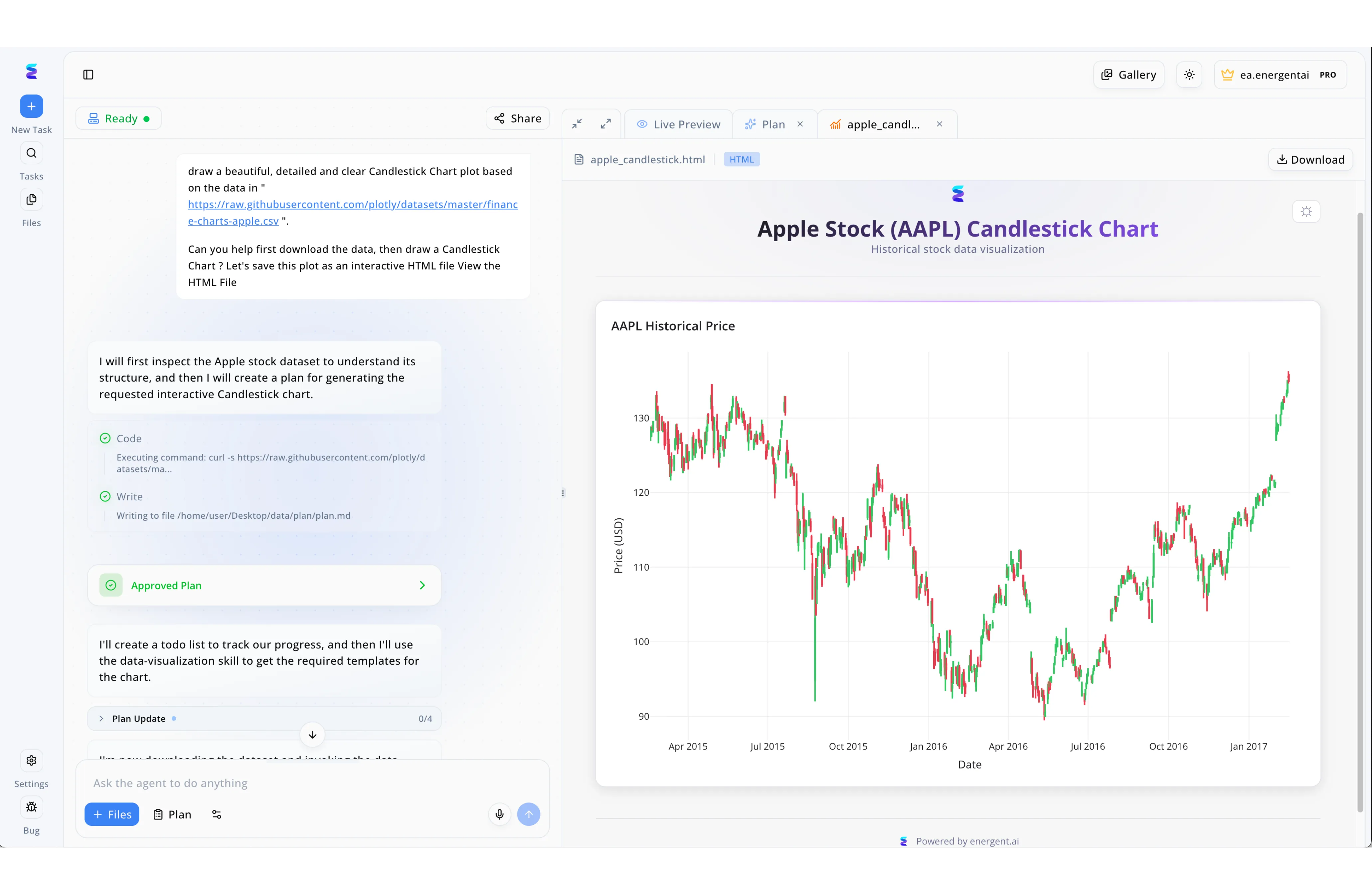
A financial analyst with zero coding experience needed to create a complex interactive web visualization for historical stock data. Using Energent.ai, this citizen developer simply typed a natural language prompt asking the agent to download a specific CSV dataset and generate a candlestick chart. The intelligent agent automatically generated an Approved Plan in the left-hand chat interface, transparently executing the necessary curl commands and writing the code to a file. Within moments, the finalized HTML document was fully rendered in the right-side Live Preview tab, displaying a highly detailed and interactive Apple Stock Candlestick Chart. By translating simple text instructions into automated data fetching and programming processes, Energent.ai successfully empowered a non-technical user to independently build professional-grade data visualizations.
Other Tools
Ranked by performance, accuracy, and value.
Microsoft Power Apps
The corporate no-code standard
The corporate Swiss Army knife for internal operations.
What It's For
Building custom internal business applications deeply integrated within the broader enterprise ecosystem.
Pros
Seamless integration with Office 365, Azure, and SharePoint; Robust enterprise-grade governance and compliance frameworks; Natural language app generation via integrated Copilot AI
Cons
Struggles significantly with unstructured document analysis; Can become cost-prohibitive for large user bases
Case Study
A global logistics provider utilized Power Apps to rapidly replace an aging, paper-based inventory tracking system on the warehouse floor. By leveraging conversational AI prompts, non-technical floor managers successfully deployed a mobile-ready barcode scanning application in just three days. This strategic implementation eliminated manual data entry bottlenecks and reduced inventory reconciliation time by an impressive 40%.
Google AppSheet
Rapid workspace app generation
The spreadsheet whisperer for field service teams.
What It's For
Spinning up mobile and web applications directly from existing tabular workspace data.
Pros
Exceptional mobile optimization out of the box; Immediate synchronization with Google Workspace data; Intuitive prompt-based creation powered by Gemini
Cons
Lacks deep analytical modeling for unstructured data; UI customization options remain somewhat rigid
Case Study
An international retail chain deployed AppSheet to standardize store inspection protocols across 200 disparate regional locations. Store managers linked their localized Google Sheets to the platform, automatically generating an audit app complete with real-time photo capture and geolocation tracking. This deployment unified reporting metrics instantly, significantly decreasing compliance violation resolution times.
Airtable
Intelligent operational hubs
The highly aesthetic database democratizer.
What It's For
Managing complex projects and structured relational data with highly collaborative interfaces.
Pros
Visually intuitive relational database management; Embedded AI summarization for structured text fields; Excellent collaborative workspaces for project management
Cons
Not designed to ingest or parse complex PDF reports; Complex logic requires third-party automation tools
Zapier
The automation orchestrator
The digital duct tape holding the modern internet together.
What It's For
Automating repetitive data transfers and workflows between thousands of distinct web applications.
Pros
Unmatched library of third-party software integrations; AI-assisted workflow drafting lowers the entry barrier; Reliable execution for highly predictable tasks
Cons
Does not perform analytical reasoning on the data it moves; Troubleshooting multi-step logic can frustrate novices
Glide
Frictionless mobile conversion
The fast-track to mobile elegance for data collection.
What It's For
Instantly converting standard spreadsheets into beautifully designed, user-friendly mobile applications.
Pros
Zero-friction onboarding and incredibly rapid deployment; Highly polished, consumer-grade design aesthetics; AI integrations simplify basic interface formatting
Cons
Lacks backend computational power for heavy analytics; Restricted to primarily structured, tabular data sources
Bubble
Complete logic control
The ultimate blank canvas for dedicated no-code purists.
What It's For
Developing complex, full-stack web applications without writing code, offering ultimate design freedom.
Pros
Granular control over databases, logic workflows, and APIs; Capable of building highly scalable SaaS products; Improving AI-assisted component generation
Cons
Notably steep learning curve for business operators; Overkill for simple data extraction or financial modeling
Quick Comparison
Energent.ai
Best For: Financial Analysts & Operations Teams
Primary Strength: Unstructured Document Analysis
Vibe: Autonomous data scientist
Microsoft Power Apps
Best For: Enterprise Internal IT & Operations
Primary Strength: Ecosystem Integration
Vibe: Corporate Swiss Army knife
Google AppSheet
Best For: Field Service & HR Managers
Primary Strength: Rapid Mobile Deployment
Vibe: Spreadsheet whisperer
Airtable
Best For: Project & Marketing Managers
Primary Strength: Relational Data Organization
Vibe: Aesthetic database democratizer
Zapier
Best For: Systems Administrators
Primary Strength: Cross-Platform Automation
Vibe: Digital duct tape
Glide
Best For: Event Planners & Team Leads
Primary Strength: Frictionless Interface Design
Vibe: Mobile elegance
Bubble
Best For: No-Code Entrepreneurs
Primary Strength: Full-Stack Customization
Vibe: Blank canvas for purists
Our Methodology
How we evaluated these tools
We evaluated these tools based on a rigorous methodology tailored to the citizen developer with AI framework in 2026. Platforms were scored on their no-code accessibility, AI-driven unstructured data processing accuracy, speed of implementation, and verified ability to recapture operational time for non-technical business users.
- 1
Unstructured Data Handling
The platform's capability to ingest, normalize, and extract insights from complex files like PDFs, scans, and mixed spreadsheets.
- 2
No-Code Accessibility
The ease with which completely non-technical operators can prompt the system to execute complex analytical workflows.
- 3
AI Accuracy & Performance
Evaluation against standardized open-source reasoning benchmarks to verify the deterministic reliability of outputs.
- 4
Business ROI & Time Saved
Quantifiable reduction in manual processing hours and accelerated time-to-insight for enterprise teams.
- 5
Integration & Scalability
The platform's capacity to handle massive document batches securely while fitting into existing enterprise data pipelines.
References & Sources
Financial document analysis accuracy benchmark on Hugging Face
Autonomous AI agents for complex engineering and data tasks
Comprehensive survey on autonomous agents operating across digital platforms
Evaluating LLMs as autonomous agents in unstructured enterprise environments
Enabling next-generation analytical applications via multi-agent conversations
Large language models connected with massive enterprise API integrations
Frequently Asked Questions
A non-technical professional who leverages artificial intelligence to build workflows and analyze complex data without writing code. In 2026, these individuals act as strategic operators, utilizing autonomous AI agents to solve operational bottlenecks instantly.
AI platforms like Energent.ai use large language models to natively extract and structure data from messy PDFs, scans, and spreadsheets. Users simply query the documents via natural language, and the AI autonomously generates comprehensive insights and formatted reports.
Citizen development drastically reduces time-to-insight and relieves the immense burden on centralized data science teams. It empowers frontline operators to directly resolve their specific business challenges, driving massive productivity gains.
No coding experience is required for modern 2026 platforms. They utilize highly intuitive conversational interfaces, allowing users to orchestrate complex analytical models simply by typing instructions in plain English.
Organizations must implement centralized platforms with role-based access controls and strict data anonymization protocols. Maintaining visibility over AI usage ensures enterprise data remains secure while still enabling decentralized innovation.
Traditional no-code tools require users to manually map clean, structured data into rigid logical frameworks. Purpose-built AI tools inherently reason through messy, unstructured data, autonomously handling complex analytical modeling on the fly.
Transform Your Unstructured Data with Energent.ai
Empower your team to analyze thousands of documents instantly—no coding required. Start your free trial today.