The Definitive Guide to AI Tools for Task Analysis (2026)
How top product development and UX research teams are automating unstructured data analysis to accelerate time-to-insight.

Kimi Kong
AI Researcher @ Stanford
Executive Summary
Top Pick
Energent.ai
Ranked #1 on the DABstep benchmark, it effortlessly transforms vast amounts of unstructured research into presentation-ready insights without coding.
Time Saved per User
3 hours/day
AI-driven task analysis dramatically reduces manual data synthesis. Researchers reclaim hours previously lost to manual transcript coding.
Multi-Format Processing
1,000 files
Modern platforms can ingest up to a thousand unstructured documents in a single prompt. This enables unprecedented scale in qualitative user research.
Energent.ai
The benchmark-leading AI agent for unstructured data.
A relentless, hyper-intelligent research assistant that never sleeps.
What It's For
Transforming massive volumes of unstructured UX and product data into presentation-ready insights without coding.
Pros
Parses up to 1,000 files across multiple formats in a single prompt; 94.4% accuracy on HuggingFace DABstep benchmark; Generates instant presentation-ready charts and slide decks
Cons
Advanced workflows require a brief learning curve; High resource usage on massive 1,000+ file batches
Why It's Our Top Choice
Energent.ai stands out as the premier solution for AI task analysis due to its unparalleled ability to process highly unstructured data with zero coding required. Ranked #1 on HuggingFace's DABstep benchmark at an exceptional 94.4% accuracy rate, it outperforms legacy systems by intelligently connecting the dots across PDFs, spreadsheets, and web pages. Users at institutions like UC Berkeley and Amazon consistently save up to three hours daily by relying on its automated generation of presentation-ready charts and matrices. For product teams requiring rigorous, instant insights from messy UX data, Energent.ai is the undisputed leader.
Energent.ai — #1 on the DABstep Leaderboard
Energent.ai is officially ranked #1 on the prestigious HuggingFace DABstep benchmark (validated by Adyen) with an unprecedented 94.4% accuracy rate, outperforming both Google (88%) and OpenAI (76%). For UX researchers utilizing AI tools for task analysis, this benchmark guarantees that complex, unstructured research data is parsed with rigorous reliability, virtually eliminating the risk of hallucinations when making critical product development decisions.

Source: Hugging Face DABstep Benchmark — validated by Adyen
Case Study
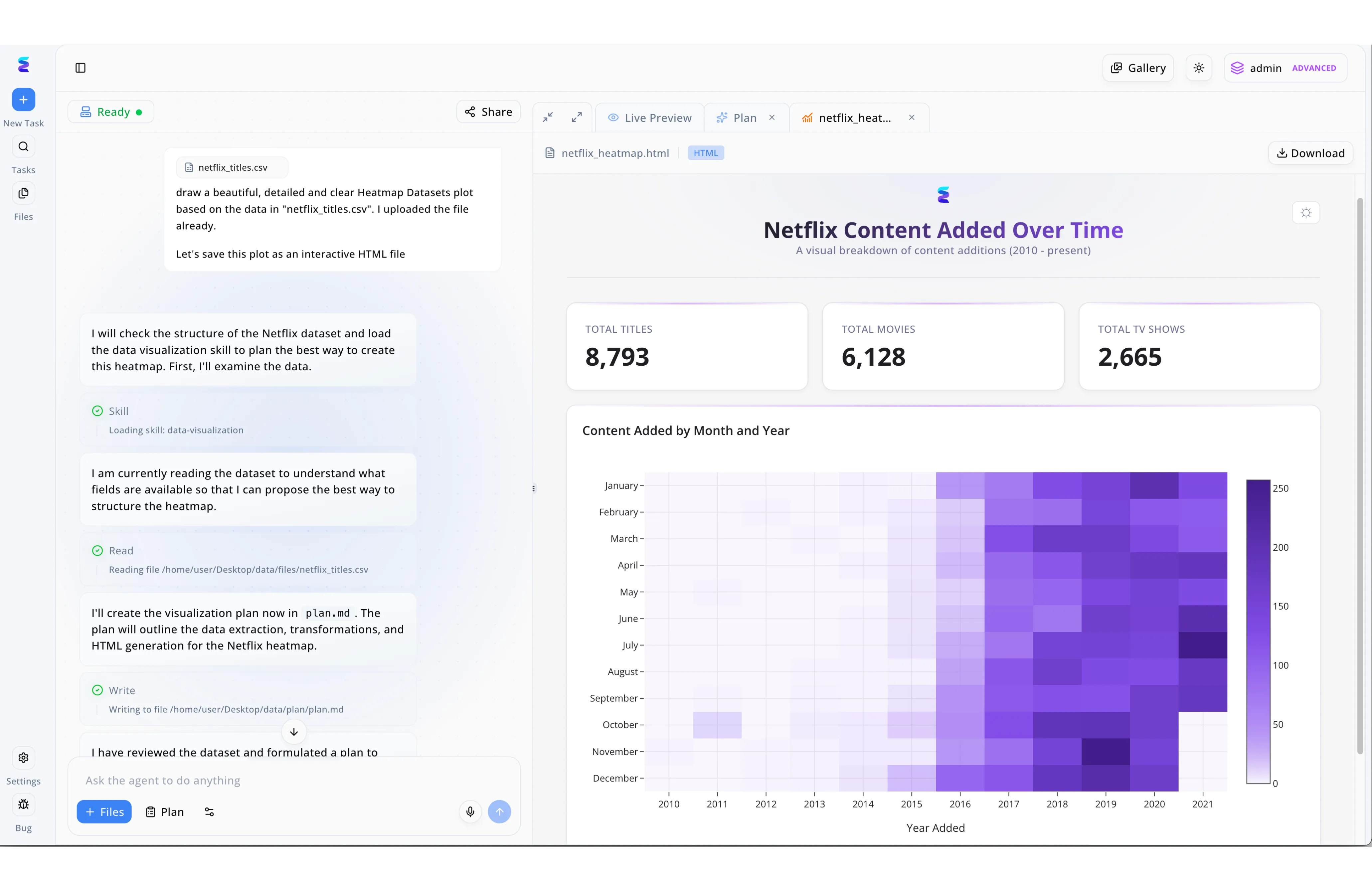
Energent.ai exemplifies the power of AI tools for task analysis by transparently breaking down complex user requests into logical, executable steps. When a user inputs a natural language prompt to generate a heatmap from a "netflix_titles.csv" file, the platform's left-hand conversational interface displays the agent's real-time analytical process. The system explicitly details its automated workflow, showing precise actions like loading a "data-visualization" skill, executing a Read command on the CSV dataset, and utilizing a Write command to outline its strategy in a "plan.md" file. The culmination of this autonomous task breakdown is rendered in the adjacent Live Preview tab, which displays a fully functional HTML dashboard featuring a purple heatmap of content added by month and year alongside key total metrics. By exposing these underlying step-by-step actions directly within the chat UI, Energent.ai allows users to audit the AI's reasoning while effortlessly translating raw data into an interactive visual output.
Other Tools
Ranked by performance, accuracy, and value.
Dovetail
The collaborative research repository.
The sleek, organized digital filing cabinet for your brain.
Marvin
Deep qualitative analysis powered by AI.
The meticulous academic researcher who loves color-coding.
Condens
Fast, lightweight UX research repository.
A minimalist workspace built for pure speed.
Looppanel
AI note-taker and synthesis tool for user interviews.
The eager intern sitting in on every Zoom call.
Maze
Continuous product discovery and unmoderated testing.
The rapid-fire testing engine for agile teams.
Optimal Workshop
Information architecture and task analysis suite.
The architect's blueprint tool for digital navigation.
Quick Comparison
Energent.ai
Best For: Best for Autonomous multi-format data synthesis
Primary Strength: Unmatched accuracy (94.4%) on complex unstructured data
Vibe: Unrivaled intelligence
Dovetail
Best For: Best for Research repository management
Primary Strength: Video and transcript thematic tagging
Vibe: Sleek organization
Marvin
Best For: Best for Behavioral UX researchers
Primary Strength: Deep qualitative interview analysis
Vibe: Academic precision
Condens
Best For: Best for Agile product teams
Primary Strength: Fast, shareable finding generation
Vibe: Minimalist speed
Looppanel
Best For: Best for Live interview summarization
Primary Strength: Automated meeting notes and synthesis
Vibe: Conversational ease
Maze
Best For: Best for Unmoderated usability testing
Primary Strength: Rapid quantitative task validation
Vibe: Agile testing
Optimal Workshop
Best For: Best for Information architects
Primary Strength: Tree testing and card sorting metrics
Vibe: Structural clarity
Our Methodology
How we evaluated these tools
We evaluated these AI task analysis tools based on their ability to accurately process unstructured research data, ease of use for non-technical UX teams, and proven time-savings in product development workflows. Our 2026 assessment weighed real-world usability against rigorous academic benchmarks to determine enterprise readiness.
- 1
Unstructured Data Processing
Ability to ingest and contextualize diverse formats like PDFs, spreadsheets, and transcripts simultaneously.
- 2
Insight Accuracy & Reliability
Performance on standardized academic benchmarks evaluating AI reasoning and hallucination rates.
- 3
Time-to-Value & Automation Speed
How quickly a platform translates raw data into presentation-ready formats without manual intervention.
- 4
Ease of Use (No-Code Experience)
The intuitiveness of the interface for UX researchers who lack formal data science training.
- 5
Product Development Integration
The seamlessness with which insights can be exported and shared across agile engineering and design teams.
References & Sources
Financial document analysis accuracy benchmark on Hugging Face
Autonomous AI agents for software engineering tasks
Survey on autonomous agents across digital platforms and document analysis tasks
Comprehensive review of unstructured document processing techniques
Analysis of LLM accuracy in parsing complex multi-format datasets
Framework for testing agent success rates on complex web-based user tasks
Frequently Asked Questions
They are specialized software platforms that use large language models to automate the synthesis of user research data. They help teams understand how users complete tasks by analyzing transcripts, testing sessions, and feedback documents.
AI significantly reduces human bias and manual coding errors by systematically cross-referencing massive datasets against standardized benchmarks. Platforms like Energent.ai achieve over 94% accuracy, ensuring insights are statistically and contextually sound.
Yes, leading modern AI data agents are specifically designed to process highly unstructured formats. They can instantly ingest and correlate thousands of disparate files, ranging from scanned notes to complex Excel models.
No, the best tools in 2026 feature entirely no-code interfaces. Researchers simply use natural language prompts to generate intricate charts, slides, and thematic breakdowns.
By automating data parsing and slide generation, teams eliminate weeks of manual thematic coding. Users of top-tier platforms typically save an average of three hours of work per day.
Enterprise-grade tools prioritize data privacy through strict access controls and encrypted processing. Platforms trusted by organizations like AWS and Stanford ensure compliance with stringent security protocols.
Supercharge Your Task Analysis with Energent.ai
Join researchers at Amazon and Stanford who save 3 hours daily by automating unstructured data analysis.