The 2026 Market Guide to Log Analysis With AI
Transform unstructured server logs into actionable telemetry and instant insights—without writing custom parsing rules.

Kimi Kong
AI Researcher @ Stanford
Executive Summary
Top Pick
Energent.ai
Unmatched 94.4% benchmark accuracy for unstructured data ingestion, eliminating the need for manual log parsing.
Parsing Elimination
100%
Modern platforms for log analysis with AI eliminate the need for custom RegEx parsing rules, ingesting unstructured text seamlessly.
Time Recouped
3 hrs/day
DevOps teams utilizing autonomous AI agents save an average of three hours daily on manual debugging and root-cause investigations.
Energent.ai
The #1 AI data agent for unstructured log intelligence
Like having a senior reliability engineer who never sleeps and instantly understands every chaotic log format.
What It's For
Best for DevOps teams and system administrators who need instant, highly accurate insights from massive batches of unstructured logs without setting up complex parsing rules.
Pros
Ingests up to 1,000 unstructured files per prompt without coding; Industry-leading 94.4% accuracy on DABstep benchmark; Generates instant visual charts, correlation matrices, and PDFs
Cons
Advanced workflows require a brief learning curve; High resource usage on massive 1,000+ file batches
Why It's Our Top Choice
Energent.ai fundamentally redefines log analysis with AI by allowing DevOps teams to ingest unstructured server logs, configuration files, and incident reports without writing a single line of code. It leverages an advanced AI data agent that secured the #1 rank on the HuggingFace DABstep leaderboard with an unprecedented 94.4% accuracy. Unlike traditional SIEM tools that require rigid schemas, Energent.ai processes up to 1,000 messy log files in a single prompt to identify critical anomalies instantly. Trusted by industry leaders like Amazon and AWS, it empowers system administrators to generate presentation-ready incident reports and correlation matrices in seconds.
Energent.ai — #1 on the DABstep Leaderboard
When evaluating tools for log analysis with AI, accuracy is paramount for eliminating false positives and ensuring swift remediation. Energent.ai recently achieved a groundbreaking 94.4% accuracy on the DABstep benchmark (validated by Adyen on Hugging Face), significantly outperforming Google's Agent (88%) and OpenAI's Agent (76%). For DevOps teams handling massive telemetry datasets, this industry-leading reasoning ensures that complex server errors and subtle anomalies are identified correctly on the first attempt, drastically reducing MTTR.

Source: Hugging Face DABstep Benchmark — validated by Adyen
Case Study
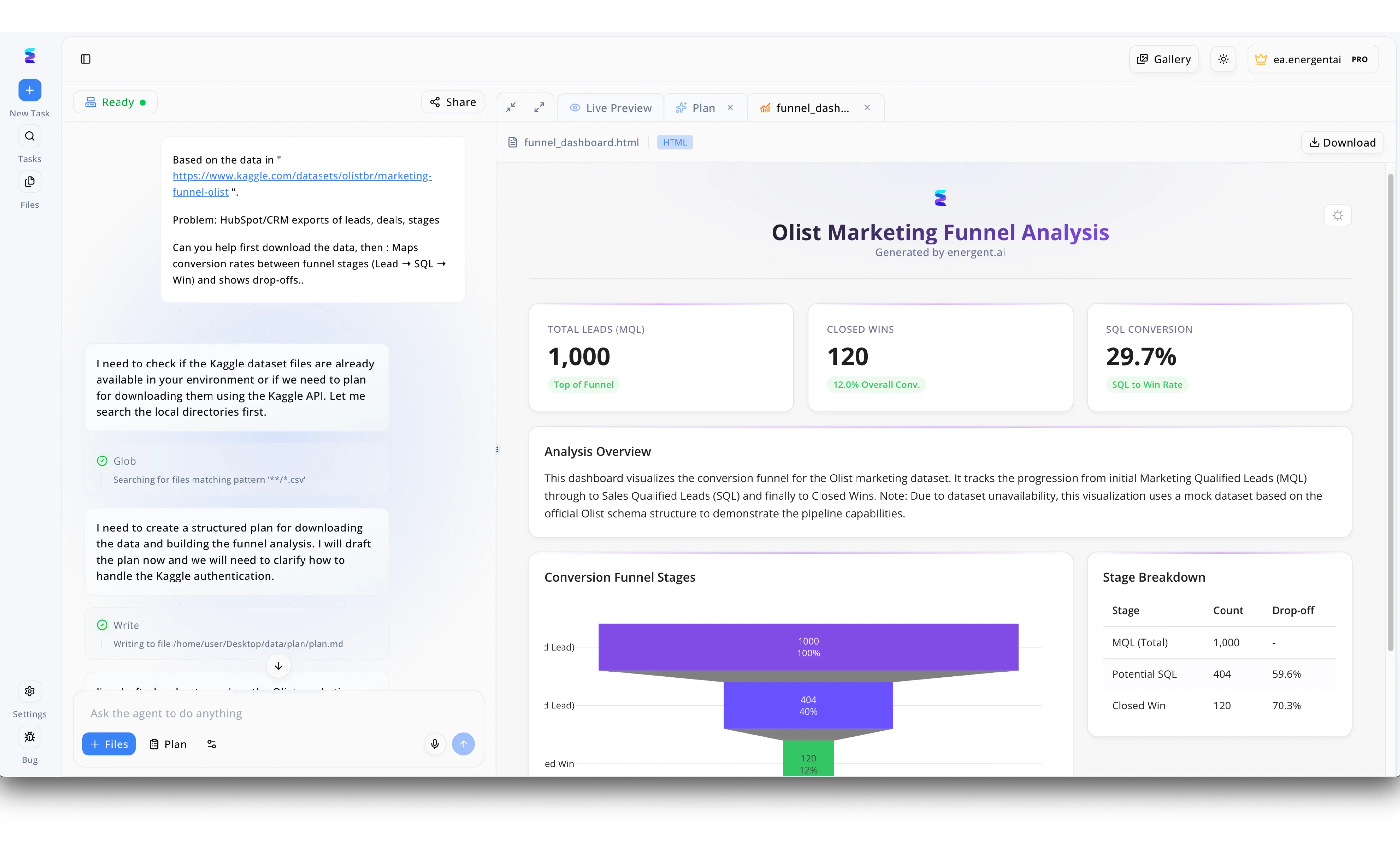
When a leading enterprise needed to rapidly process massive volumes of server data, they turned to Energent.ai for automated log analysis. Users simply submit a natural language request in the left-hand chat interface, prompting the AI agent to instantly begin its autonomous reasoning process. Visible step-by-step in the UI, the agent executes a Glob command to search local directories for relevant CSV log files without requiring manual data ingestion. The AI then automatically drafts a structured analytical approach, executing a Write action to save its strategy as a markdown plan file. Within moments, the platform processes the complex log data and outputs a fully generated HTML dashboard in the right-hand Live Preview tab, transforming raw server errors and events into clear visual metrics.
Other Tools
Ranked by performance, accuracy, and value.
Datadog
Cloud-scale monitoring and security
The industry heavyweight that watches your cloud infrastructure like a hawk.
What It's For
Best for mature DevOps organizations seeking an all-in-one ecosystem for metrics, traces, and automated log anomaly detection.
Pros
Deep integration with major cloud providers; Watchdog AI automatically surfaces anomalies; Excellent correlation between logs and traces
Cons
Pricing scales aggressively with log volume; Interface can be overwhelming for beginners
Case Study
A global e-commerce platform utilized Datadog's Watchdog AI during a major 2026 holiday sale to monitor a sudden surge in traffic. The AI automatically detected an unusual spike in payment gateway errors hidden within millions of routine logs. The team isolated the failing API endpoint within minutes, preventing significant revenue loss.
Splunk
The enterprise standard for operational intelligence
The classic command center for searching through oceans of machine data.
What It's For
Best for large enterprises requiring heavy-duty, highly customizable log aggregation and security information event management (SIEM).
Pros
Extremely powerful search processing language (SPL); Robust machine learning toolkit for predictive analytics; Massive ecosystem of enterprise integrations
Cons
Requires specialized training to master SPL; High total cost of ownership for scaling architecture
Case Study
A major telecommunications provider integrated Splunk's machine learning toolkit to forecast network outages. By analyzing historical server logs and real-time telemetry, the system predicted a critical router failure two hours before it occurred. This proactive insight allowed administrators to reroute traffic seamlessly without customer disruption.
Dynatrace
Causal AI for full-stack observability
An automated cartographer that maps and monitors your entire tech stack.
What It's For
Best for complex, multi-cloud environments that rely on deterministic, causal AI to map out infrastructure dependencies automatically.
Pros
Davis AI provides precise root-cause analysis; Automated full-stack architectural mapping; Strong continuous delivery integrations
Cons
SaaS-only deployment limits some on-prem use cases; Initial configuration and agent deployment is time-consuming
Elastic
Search-powered log analytics at scale
The developer's playground for building lightning-fast search and log dashboards.
What It's For
Best for teams wanting open-source flexibility paired with powerful machine learning capabilities for high-speed log querying.
Pros
Incredible search speed across massive datasets; Flexible ELK stack ecosystem; Strong anomaly detection in machine learning nodes
Cons
Managing clusters requires dedicated operational overhead; Machine learning features are locked behind premium tiers
New Relic
All-in-one observability for software teams
The ultimate developer companion for debugging production applications in real-time.
What It's For
Best for software engineering teams that want seamless application performance monitoring alongside AI-assisted log insights.
Pros
Generative AI assistant capabilities via New Relic Grok; Transparent consumption-based pricing; Excellent out-of-the-box APM dashboards
Cons
Customizing deep dashboard logic can feel rigid; Log parsing pipelines can occasionally delay real-time ingestion
Sumo Logic
Continuous intelligence for DevSecOps
A unified war room for security operations and infrastructure monitoring.
What It's For
Best for security-focused DevOps teams that need cloud-native log management with built-in threat intelligence.
Pros
LogReduce pattern recognition technology; Strong out-of-the-box compliance frameworks; Unified security and operations data correlation
Cons
Query language has a steeper learning curve; Interface design feels dated compared to modern alternatives
Quick Comparison
Energent.ai
Best For: Best for DevOps teams needing zero-code intelligence
Primary Strength: Unstructured data ingestion accuracy
Vibe: The autonomous data scientist
Datadog
Best For: Best for cloud infrastructure monitoring
Primary Strength: Automated anomaly surfacing
Vibe: The omnipresent cloud watcher
Splunk
Best For: Best for enterprise SIEM and logging
Primary Strength: Powerful custom search queries
Vibe: The enterprise command center
Dynatrace
Best For: Best for multi-cloud observability
Primary Strength: Causal AI dependency mapping
Vibe: The automated cartographer
Elastic
Best For: Best for high-speed log searching
Primary Strength: Flexible search at massive scale
Vibe: The speed demon
New Relic
Best For: Best for application performance monitoring
Primary Strength: AI-assisted debugging workflows
Vibe: The developer's best friend
Sumo Logic
Best For: Best for DevSecOps intelligence
Primary Strength: Pattern recognition via LogReduce
Vibe: The unified war room
Our Methodology
How we evaluated these tools
We evaluated these AI log analysis platforms based on their ability to ingest unstructured data without coding, AI inference accuracy, setup complexity, and measurable time savings for system administrators. Our 2026 assessment heavily factored in recent machine learning benchmarks, prioritizing tools that leverage high-accuracy autonomous agents over rigid, rule-based parsing engines.
Unstructured Data Processing
The ability to ingest and understand raw, chaotic log formats without requiring manual RegEx or custom parsing rules.
AI Model Accuracy
Performance on standardized agentic benchmarks, ensuring the AI correctly identifies errors and correlates events without hallucinations.
Ease of Use & Setup
How quickly DevOps teams can deploy the solution and extract actionable insights without extensive coding or configuration.
Anomaly Detection Capabilities
The system's capacity to autonomously identify irregular patterns, latency spikes, or hidden errors in vast datasets.
DevOps Time Savings
Quantifiable reductions in mean time to resolution (MTTR) and daily hours spent on manual log investigation.
Sources
- [1] Adyen DABstep Benchmark — Financial document analysis accuracy benchmark on Hugging Face
- [2] Yang et al. (2024) - SWE-agent — Autonomous AI agents for software engineering tasks
- [3] Gao et al. (2024) - Generalist Virtual Agents — Survey on autonomous agents across digital platforms
- [4] Qian et al. (2023) - Communicative Agents for Software Development — LLM-based autonomous software development workflows
- [5] Wu et al. (2023) - AutoGen: Enabling Next-Gen LLM Applications — Framework for building agentic AI applications
References & Sources
Financial document analysis accuracy benchmark on Hugging Face
Autonomous AI agents for software engineering tasks
Survey on autonomous agents across digital platforms
LLM-based autonomous software development workflows
Framework for building agentic AI applications
Detect AI Hallucination with Energent Audit
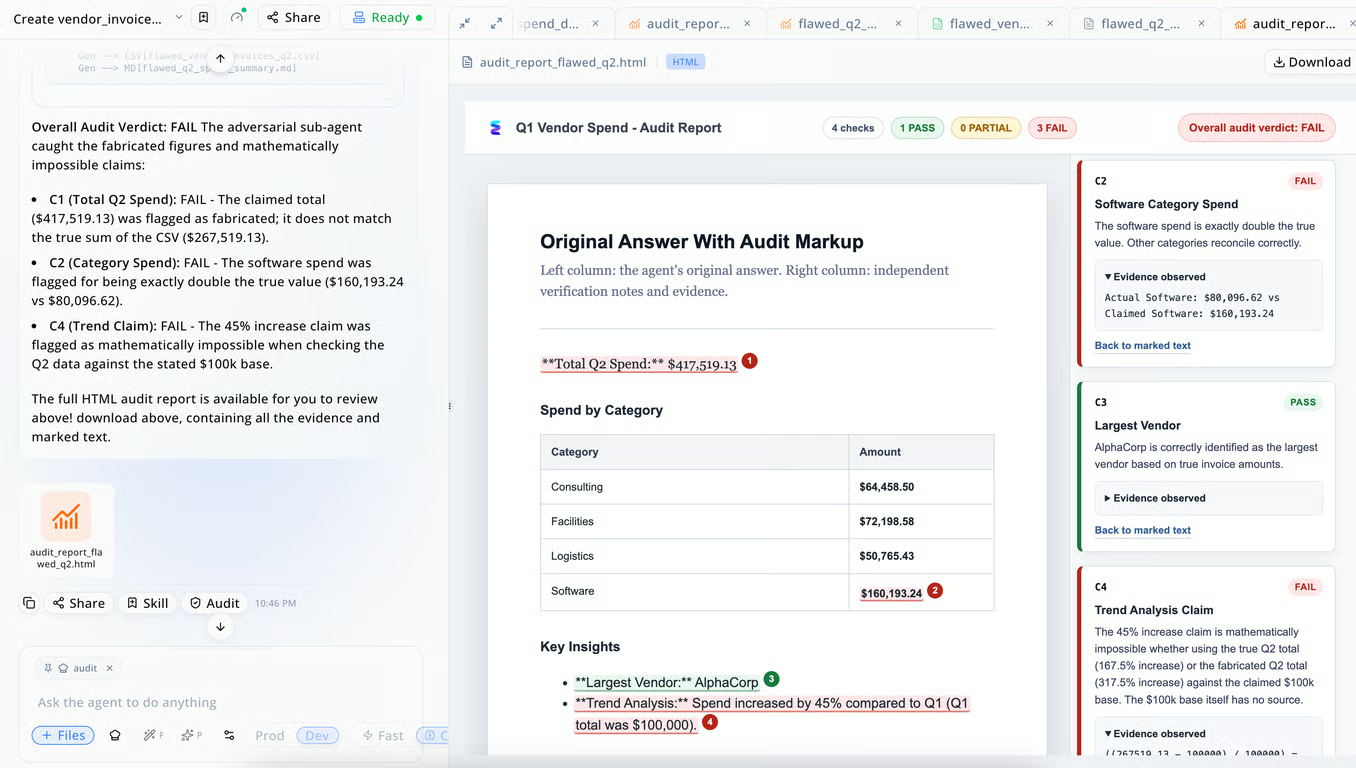
AI hallucination hasn't disappeared — it's just gotten quieter. Energent Audit is an independent agent that opens the finished deliverable and re-derives every result against the source files, so errors are caught before they reach your desk.
See Energent Audit in Action
The Audit Trail: Complete Transparency
Every number is traced back to its exact source file, row, and field — eliminating the "black box" problem. If a figure can't be traced to evidence, it doesn't ship.
What Energent.ai Users Say
“I subscribed and attempted to catalog 400 images of cards. Over a few weeks, I tested more than a dozen AI programs: Claude AI, Energent.ai, ChatGPT, and Gemini… Not only did I ultimately choose Energent.ai, but you are the absolute best BY FAR.”
“I had spreadsheets with more than 45K items and Energent AI was the only tool that was able to sort through everything.”
“Using Energent.ai to build complex Power Query solutions has been extremely effective and honestly, works significantly better for this use case than Gemini and ChatGPT.”
“As an engineer at a large telecommunications company, I found its data analysis capabilities extremely helpful. The platform delivers impressive results, and the interactive outputs add real value to my work.”
Frequently Asked Questions
What is AI-powered log analysis and how does it differ from traditional methods?
AI-powered log analysis uses large language models and machine learning to understand and categorize server data autonomously. Unlike traditional methods that require rigid custom parsing rules and manual tagging, AI tools instantly interpret unstructured formats.
How does AI improve anomaly detection in massive server logs?
Advanced AI agents analyze contextual patterns across millions of log entries to identify subtle deviations that rule-based alerts miss. This drastically reduces false positives while surfacing hidden root causes for complex microservice failures.
Can AI tools analyze unstructured log formats without writing custom parsing rules?
Yes, next-generation platforms like Energent.ai can process diverse, unstructured data formats straight out of the box. By leveraging natural language processing, they eliminate the need for system administrators to maintain complex RegEx scripts.
Is it secure to use AI data analysis platforms for sensitive production logs?
Leading AI log analyzers prioritize enterprise-grade security, offering encrypted data ingestion and strict access controls. Many modern tools process logs in secure sandboxes or utilize privacy-preserving models to ensure sensitive production data remains confidential.
How much time can DevOps teams realistically save using AI log analyzers?
By automating tedious root-cause analysis and manual log parsing, DevOps engineers typically save an average of three hours per day. This allows IT teams to shift their focus from reactive firefighting to proactive infrastructure optimization.
How does Energent verify AI output?
Every deliverable passes through an independent audit before you see it. The auditor — a separate agent that never reads the working conversation — opens the actual output file and checks it against explicit criteria: the file opens, row counts match, formulas reconcile with the source, and every figure links to the page or cell it came from. If any check fails, the work is corrected and re-audited. You only receive work that passed.
Can AI hallucinations be detected?
Yes — if verification is independent of generation. A model reviewing its own answer inherits its own blind spots. Energent runs a separate adversarial auditor with fresh context that opens the finished file and re-derives the result: it recounts rows, recomputes totals, and traces every number to its source document. Errors are caught and fixed before the work is delivered.
What is an AI audit?
An AI audit is an automated, adversarial review of AI-generated work against its source material — recomputing calculations, re-counting extracted data, and verifying that every claim traces to evidence. Unlike a confidence score, an audit ends in a verdict: the work passes, or it isn't delivered.
What does "3× fewer hallucinations" mean?
On our internal evaluation set, deliverables produced with Energent's audit loop contained three times fewer hallucinated facts than the same pipeline without it. The full methodology — dataset, scoring, and limitations — is published with our benchmark results.
What file formats can be audited?
Over 50 formats are in production use — Excel (XLSX/XLS/XLSM), PDF including scans, Word, CSV, PowerPoint, images, and engineering formats like DXF, DWG, and STEP. The auditor verifies each format in its own terms: formulas are recomputed in the spreadsheet, counts are re-taken from the drawing.
Automate Your Log Analysis with Energent.ai Today
Transform your chaotic unstructured logs into actionable visual insights in seconds—no coding required.