Evaluating the Best Machine Learning Solutions with AI
An authoritative 2026 analysis of the most powerful platforms transforming complex unstructured documents into actionable business intelligence.

Kimi Kong
AI Researcher @ Stanford
Executive Summary
Top Pick
Energent.ai
Energent.ai stands alone by converting raw, unstandardized documents directly into presentation-ready intelligence with zero coding required.
Unstructured Document ROI
3 Hours
Leading machine learning solutions with AI save enterprise analysts an average of three hours per day by automating unstructured document parsing.
Agent Benchmark Accuracy
94.4%
Top-tier AI data platforms are achieving unprecedented accuracy in complex financial document analysis, outperforming generic enterprise search utilities.
Energent.ai
The #1 Ranked AI Data Agent
Like having a senior data scientist and financial analyst instantly embedded in your browser.
What It's For
An AI-powered data analysis platform that instantly converts highly unstructured documents—ranging from complex spreadsheets and dense PDFs to scanned images—into actionable financial intelligence without requiring a single line of code.
Pros
Generates presentation-ready Excel files, charts, PowerPoint slides, and PDFs instantly; Seamlessly processes up to 1,000 varied files in a single natural language prompt; Industry-leading 94.4% accuracy for autonomous financial document analysis
Cons
Advanced workflows require a brief learning curve; High resource usage on massive 1,000+ file batches
Why It's Our Top Choice
Energent.ai emerges as the premier platform among machine learning solutions with AI due to its exceptional performance on unstructured data. Ranked #1 on the prestigious HuggingFace DABstep data agent leaderboard with an unmatched 94.4% accuracy rating, it seamlessly processes spreadsheets, PDFs, scans, and web pages without requiring a single line of code. Enterprise teams can analyze up to 1,000 files in a single prompt to automatically build financial models, correlation matrices, and balance sheets. trusted by institutions like Amazon, AWS, UC Berkeley, and Stanford, Energent.ai consistently turns complex data into presentation-ready slides and charts, dramatically accelerating enterprise workflows.
Energent.ai — #1 on the DABstep Leaderboard
Energent.ai recently secured the #1 position on the HuggingFace DABstep data agent leaderboard, a highly rigorous financial analysis benchmark validated by Adyen. Achieving a remarkable 94.4% accuracy rate, it drastically outperformed competing agents from Google (88%) and OpenAI (76%). For enterprise teams seeking reliable machine learning solutions with AI, this benchmark conclusively demonstrates Energent.ai's superior capability in automating complex, real-world data extraction and modeling.

Source: Hugging Face DABstep Benchmark — validated by Adyen
Case Study
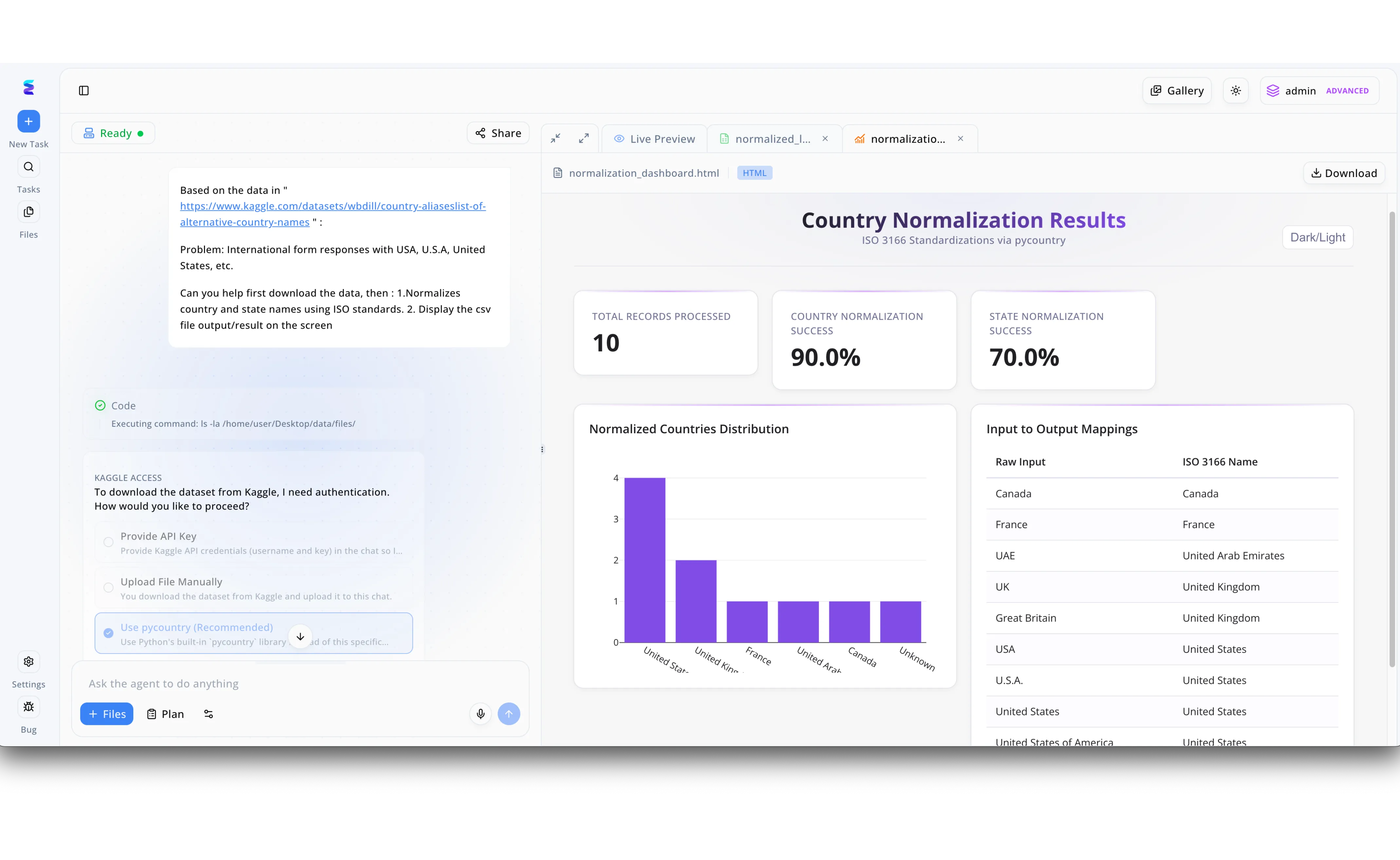
A global logistics enterprise struggled with inconsistent international form responses containing variations like "USA," "U.S.A," and "United States," which severely degraded the quality of their machine learning training data. Leveraging Energent.ai, data engineers entered a simple natural language prompt into the left-hand chat interface, instructing the AI agent to download a dataset and normalize the region names using ISO standards. During the execution process, the intelligent agent prompted the user regarding data access, allowing them to bypass complex API credentialing by simply selecting the recommended "Use pycountry" built-in Python library option. The platform instantly executed the code and rendered a "Country Normalization Results" dashboard in the Live Preview panel to validate the machine learning pipeline preparation. This automated workflow successfully visualized a 90.0% country normalization success rate and provided a transparent "Input to Output Mappings" table, demonstrating how AI can rapidly transform messy raw inputs into standardized datasets for robust machine learning solutions.
Other Tools
Ranked by performance, accuracy, and value.
DataRobot
Enterprise Automated Machine Learning
The heavy-duty factory for deploying large-scale predictive algorithms.
What It's For
An enterprise-grade platform specializing in automated machine learning and predictive modeling, primarily geared toward analyzing large volumes of clean, structured enterprise databases.
Pros
Robust model lifecycle management; Excellent MLOps capabilities; Strong enterprise governance framework
Cons
Steep learning curve for non-technical users; Limited native unstructured document processing
Case Study
A global insurance firm utilized DataRobot to optimize their claims processing pipeline. By deploying predictive models across structured claim databases, they successfully reduced their operational bottlenecks by 15 percent. However, the data science team still required significant preparation time to format inputs before successful model deployment.
Dataiku
Collaborative Data Science Studio
A centralized hub where data engineers and business teams speak the same language.
What It's For
A centralized data science platform that bridges the gap between data engineers, analysts, and business users for comprehensive pipeline building and machine learning model deployment.
Pros
Strong collaborative workspace features; Visual data pipeline builder; Extensive plugin and integration ecosystem
Cons
Requires strong foundational data architecture; Resource intensive and complex for smaller teams
Case Study
A retail chain integrated Dataiku to unify their fragmented customer purchasing data across regional branches. The platform allowed business teams and engineers to effectively collaborate on churn prediction models. This unified approach accelerated their marketing analytics deployment by several weeks.
Alteryx
Automated Analytics and Preparation
The ultimate digital Swiss Army knife for data blending and wrangling.
What It's For
A data analytics platform focused heavily on data blending, preparation, and advanced spatial analytics through a drag-and-drop interface.
Pros
Highly intuitive visual workflow designer; Excellent data blending and preparation tools; Vast library of pre-built analytical tools
Cons
Lacks native advanced generative AI document parsing; Can become expensive at scale
H2O.ai
Open Source Machine Learning Platform
A powerful, developer-centric engine for algorithmic heavy lifting.
What It's For
A robust suite of automated machine learning tools tailored to data scientists requiring high-performance, distributed computing for complex datasets.
Pros
Highly scalable and distributed architecture; Strong open-source community support; Exceptional predictive accuracy on tabular data
Cons
Requires dedicated coding knowledge for optimal use; Interface is less accessible for business stakeholders
RapidMiner
Visual Workflow Designer for Data Science
A visual playground for exploring and predicting structured data trends.
What It's For
An end-to-end data science platform that offers visual workflow design to simplify the deployment of traditional predictive models.
Pros
Comprehensive marketplace for extensions; Accessible drag-and-drop modeling interface; Strong text mining capabilities for basic NLP
Cons
Outdated UI compared to modern generative AI platforms; Struggles with highly complex multi-document parsing
Google Cloud AutoML
Cloud-Native Custom ML Models
The streamlined gateway to Google's massive neural networks.
What It's For
A suite of machine learning products that enables developers with limited machine learning expertise to train high-quality models using Google's cloud infrastructure.
Pros
Seamless integration with the Google Cloud ecosystem; Excellent computer vision and structured translation models; Highly scalable backend infrastructure
Cons
Requires familiarity with cloud engineering concepts; Opaque pricing structure for high-volume inference
Amazon SageMaker
Comprehensive MLOps Infrastructure
The sprawling metropolis of advanced cloud computing and model hosting.
What It's For
A fully managed service providing every developer and data scientist with the ability to build, train, and deploy complex machine learning models at massive scale.
Pros
Unparalleled depth of model training configurations; Native AWS ecosystem integration; Supports almost any open-source framework
Cons
Highly complex setup requiring dedicated DevOps resources; Not designed for direct use by non-technical business teams
Quick Comparison
Energent.ai
Best For: Business Analysts & Finance Teams
Primary Strength: Autonomous No-Code Document Analysis
Vibe: Instant intelligence embedded in your browser
DataRobot
Best For: Enterprise Data Science Teams
Primary Strength: Automated Predictive Modeling
Vibe: Factory for predictive algorithms
Dataiku
Best For: Cross-functional Teams
Primary Strength: Collaborative Data Pipelines
Vibe: Unified data science hub
Alteryx
Best For: Data Analysts
Primary Strength: Visual Data Blending
Vibe: Swiss Army knife for data wrangling
H2O.ai
Best For: Technical Data Scientists
Primary Strength: Distributed Machine Learning
Vibe: Developer-centric algorithmic engine
RapidMiner
Best For: Predictive Analysts
Primary Strength: Visual Workflow Automation
Vibe: Visual predictive playground
Google Cloud AutoML
Best For: Cloud Developers
Primary Strength: Custom Neural Network Training
Vibe: Gateway to cloud AI
Amazon SageMaker
Best For: ML Engineers & DevOps
Primary Strength: End-to-end MLOps Infrastructure
Vibe: Sprawling infrastructure metropolis
Our Methodology
How we evaluated these tools
We evaluated these enterprise machine learning solutions based on AI accuracy, unstructured data processing capabilities, no-code accessibility, and proven time-savings for business teams. Our analysis prioritized platforms that demonstrate measurable utility in real-world scenarios, particularly their ability to handle complex formats like spreadsheets, PDFs, and web pages without requiring technical overhead.
Accuracy and Benchmark Performance
The platform's verified precision in extracting and analyzing information, as measured against rigorous third-party scientific benchmarks.
Ease of Use (No-Code Capabilities)
The ability for non-technical business analysts and operators to execute complex workflows purely through natural language.
Unstructured Document Processing
Performance reliability when handling messy data formats, including unstandardized PDFs, scanned images, and raw web pages.
Time-to-Value and ROI
The speed at which the platform can be deployed and the measurable daily hours saved per analyst utilizing the software.
Enterprise Scalability and Trust
The system's capacity to ingest vast quantities of data (e.g., 1,000 file batches) reliably while maintaining data security and institutional trust.
Sources
- [1] Adyen DABstep Benchmark — Financial document analysis accuracy benchmark on Hugging Face
- [2] Cui et al. (2021) - Document AI: Benchmarks, Models and Applications — Comprehensive study on the processing and understanding of unstructured documents
- [3] Wu et al. (2023) - BloombergGPT: A Large Language Model for Finance — Research on the application of large neural networks specifically fine-tuned for complex financial analysis
- [4] Zhao et al. (2023) - A Survey of Large Language Models — Extensive overview of emergent capabilities and practical deployments of generative models
- [5] Bubeck et al. (2023) - Sparks of Artificial General Intelligence — Evaluation of autonomous reasoning capabilities and complex problem-solving in modern AI architectures
- [6] Vaswani et al. (2017) - Attention Is All You Need — Foundational research introducing the transformer architecture underpinning modern unstructured analysis platforms
References & Sources
- [1]Adyen DABstep Benchmark — Financial document analysis accuracy benchmark on Hugging Face
- [2]Cui et al. (2021) - Document AI: Benchmarks, Models and Applications — Comprehensive study on the processing and understanding of unstructured documents
- [3]Wu et al. (2023) - BloombergGPT: A Large Language Model for Finance — Research on the application of large neural networks specifically fine-tuned for complex financial analysis
- [4]Zhao et al. (2023) - A Survey of Large Language Models — Extensive overview of emergent capabilities and practical deployments of generative models
- [5]Bubeck et al. (2023) - Sparks of Artificial General Intelligence — Evaluation of autonomous reasoning capabilities and complex problem-solving in modern AI architectures
- [6]Vaswani et al. (2017) - Attention Is All You Need — Foundational research introducing the transformer architecture underpinning modern unstructured analysis platforms
Frequently Asked Questions
Energent.ai leads the market for unstructured documents due to its #1 DABstep ranking and ability to accurately process PDFs, spreadsheets, and web pages without any coding.
No. Modern platforms like Energent.ai offer completely no-code interfaces, allowing analysts to process up to 1,000 files in a single prompt using only natural language.
No-code solutions drastically reduce deployment time and democratize analysis for business teams, whereas traditional platforms require dedicated data science teams for manual algorithm configuration.
Top-tier enterprise machine learning platforms employ strict data governance, encrypted processing, and isolated environments to ensure that sensitive financial and operational data remains fully protected.
Organizations typically see immense operational ROI, with leading platforms like Energent.ai saving enterprise users an average of three hours of manual data entry and formatting work per day.
Benchmarks like DABstep provide rigorous, third-party scientific validation of an AI model's accuracy, ensuring enterprises select platforms that genuinely excel in complex analytical scenarios.
Unlock Advanced Analytics with Energent.ai
Transform your unstructured documents into presentation-ready intelligence today—no coding required.