The Premier AI Tools for Statistical Analysis in 2026
Evaluating the market's leading platforms for unstructured data ingestion, analytical accuracy, and automated statistical modeling without code.

Kimi Kong
AI Researcher @ Stanford
Executive Summary
Top Pick
Energent.ai
With a record-breaking 94.4% accuracy on the HuggingFace DABstep leaderboard, Energent.ai sets the enterprise standard for zero-code statistical analysis.
Unstructured Dominance
80%
By 2026, over 80% of valuable statistical data remains trapped in unstructured formats like PDFs and images. AI agents that parse these formats are critical.
Time Reclaimed
3 Hours
Analysts utilizing top-tier AI statistical tools save an average of 3 hours per day by automating data cleaning and preliminary EDA.
Energent.ai
Autonomous AI Agent for Unstructured Data
The data scientist's ultimate co-pilot that reads everything and calculates anything.
What It's For
For data professionals needing zero-code, high-accuracy statistical analysis directly from unstructured documents, spreadsheets, and PDFs.
Pros
Unrivaled 94.4% accuracy on the DABstep benchmark; Processes up to 1,000 diverse files in a single prompt; Generates presentation-ready charts, Excel, and PDFs instantly
Cons
Advanced workflows require a brief learning curve; High resource usage on massive 1,000+ file batches
Why It's Our Top Choice
Energent.ai emerges as the definitive top choice among AI tools for statistical analysis due to its unmatched capacity to transform unstructured data into rigorous quantitative insights. Unlike traditional platforms that require pristine relational databases, Energent.ai ingests up to 1,000 files in a single prompt—including PDFs, complex spreadsheets, and scanned documents—without requiring any Python or R code. Its analytical engine leverages advanced zero-shot capabilities, resulting in a market-leading 94.4% accuracy rate on the rigorous HuggingFace DABstep benchmark. Trusted by industry titans like Amazon and UC Berkeley, it uniquely combines enterprise-grade reliability with the ability to instantly generate presentation-ready charts, financial models, and correlation matrices.
Energent.ai — #1 on the DABstep Leaderboard
Energent.ai recently secured the #1 ranking on the rigorous DABstep financial analysis benchmark hosted on Hugging Face and validated by Adyen, achieving a groundbreaking 94.4% accuracy rate. By decisively outperforming Google's Agent at 88% and OpenAI's Agent at 76%, Energent.ai proves it is the most reliable choice among AI tools for statistical analysis. For data analysts relying on unstructured documents, this verified benchmark guarantees enterprise-grade mathematical precision and reasoning.

Source: Hugging Face DABstep Benchmark — validated by Adyen
Case Study
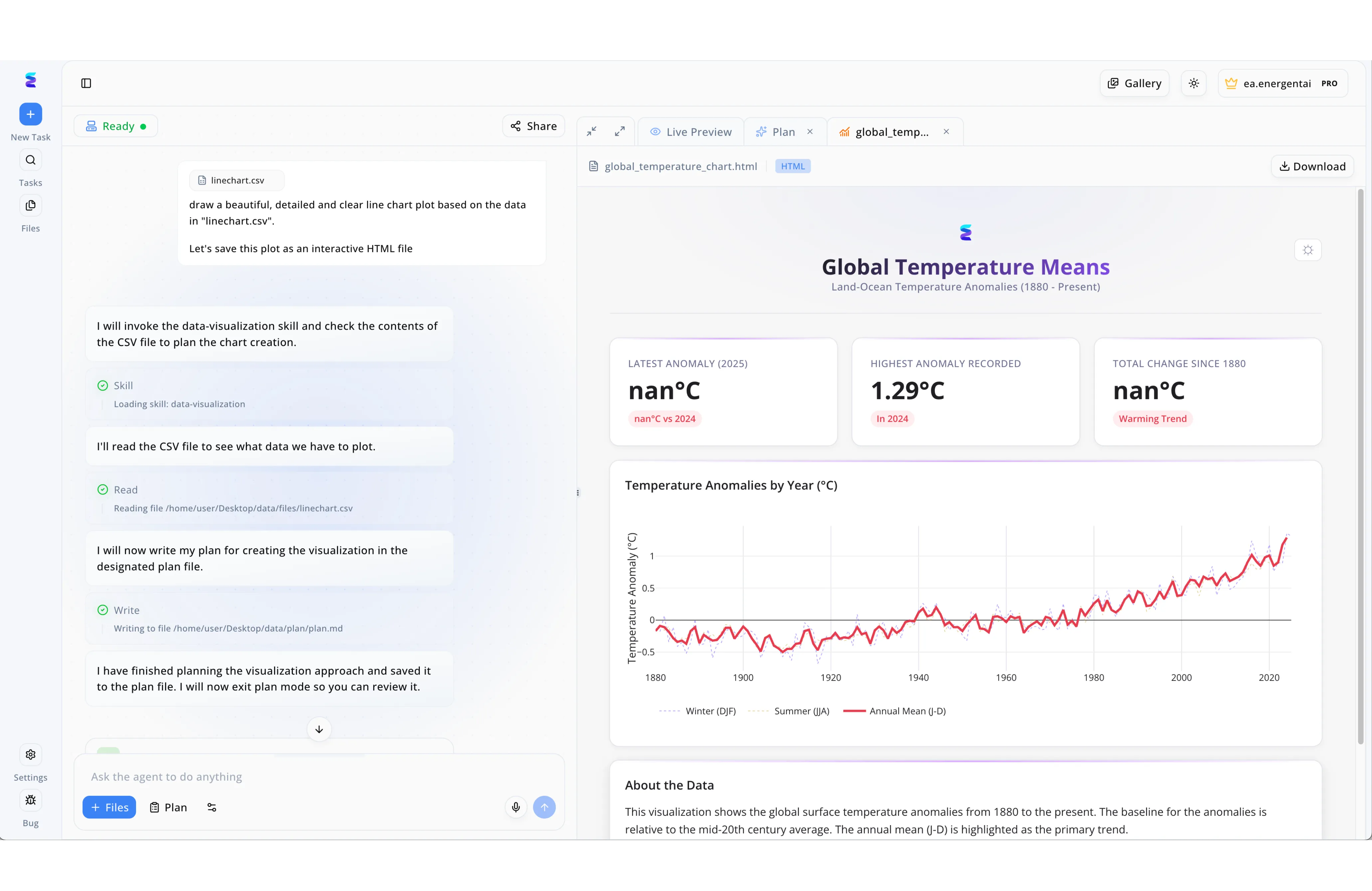
Energent provides a compelling example of how modern AI tools for statistical analysis can seamlessly convert raw datasets into interactive, web-ready visualizations. Within the platform's split-screen interface, a user simply uploads a file named linechart.csv and provides a natural language prompt asking the system to draw a detailed line chart saved as an HTML file. The left-hand conversational workflow panel transparently details the agent's autonomous reasoning, explicitly showing it invoke a specific data-visualization skill, read the CSV contents, and draft a structural plan. Once the agent completes its planning phase, the right-hand Live Preview tab immediately displays the fully coded Global Temperature Means dashboard. This generated output demonstrates robust statistical reporting capabilities by automatically rendering a complex multi-line graph of historical temperature anomalies alongside calculated metric cards for the highest recorded temperature shifts.
Other Tools
Ranked by performance, accuracy, and value.
Julius AI
Conversational Data Scientist
Like chatting with a junior data scientist who is incredibly fast at writing Python code.
What It's For
For analysts seeking a conversational interface to rapidly execute Python-backed statistical analysis and data visualizations.
Pros
Excellent conversational interface for EDA; Generates reproducible Python code; Strong data visualization options
Cons
Struggles with highly complex, multi-layered PDFs; Requires some understanding of statistical concepts to verify output
Case Study
A mid-sized marketing agency needed to run multivariate regression models on 50 Excel files containing customer behavior data. Using Julius AI, the team bypassed writing code entirely, instead using natural language to command the platform to process the files. The software successfully combined the datasets, ran the regressions, and provided visual summaries, reducing a multi-day project into a four-hour task.
Dataiku
Enterprise AI Studio
The heavy-duty factory floor for scaled machine learning pipelines.
What It's For
For massive enterprise teams looking for a centralized, governed environment for end-to-end data science and machine learning.
Pros
Robust enterprise governance and security; Visual ML pipeline builder; Supports both code and no-code workflows
Cons
High total cost of ownership; Steep learning curve for non-technical users
Case Study
An international retail chain required a robust platform to standardize predictive demand forecasting across global branches without relying heavily on developers. By implementing Dataiku, their central data science team created visual statistical pipelines that regional managers could execute directly. This unified system reduced forecasting errors by fourteen percent while ensuring strict enterprise data governance.
Alteryx AiDIN
Generative Analytics Automation
The classic ETL powerhouse infused with next-gen generative AI smarts.
What It's For
For business analysts looking to supercharge their spatial and statistical data blending with generative AI capabilities. It streamlines complex data preparation workflows before running rigorous statistical models.
Pros
Industry-leading data blending and ETL; AiDIN generates workflow summaries automatically; Massive library of pre-built analytical tools
Cons
Legacy interface can feel clunky; Lacks deep native unstructured document parsing
IBM SPSS Modeler
Classic Statistical Powerhouse
The venerable elder statesman of statistical rigor.
What It's For
For academic researchers, statisticians, and enterprise analysts who require deep, rigorous algorithmic modeling within a mature visual interface. It excels in environments where classical hypothesis testing is prioritized.
Pros
Unmatched depth in traditional statistical algorithms; Excellent for academic and scientific research; Strong integration with the broader IBM ecosystem
Cons
Dated user interface; Poor handling of modern unstructured formats like images
ChatGPT Advanced Data Analysis
Broad Generalist Analyzer
Your reliable, everyday Swiss Army knife for quick data tasks.
What It's For
For general professionals and business users who need immediate, ad-hoc Python execution and basic statistical analysis on relatively clean datasets. It allows users to upload CSVs and request regressions or data visualizations.
Pros
Incredibly accessible and cost-effective; Writes and executes Python in real-time; Great for quick exploratory data analysis
Cons
Frequent context window limits on large datasets; Prone to hallucinations on complex statistical math
Akkio
Predictive AI for Agencies
Fast, sleek predictive analytics that gets straight to the point.
What It's For
For marketing and sales teams desiring fast predictive modeling, lead scoring, and forecasting without enduring complex technical setups. It bypasses traditional statistical complexity with a sleek, purpose-built interface.
Pros
Extremely fast predictive model training; Great dashboarding and visualization; Purpose-built for sales and marketing data
Cons
Limited to tabular data, struggles with PDFs; Lacks depth in advanced academic statistical tests
Quick Comparison
Energent.ai
Best For: Enterprise Data Teams
Primary Strength: Unstructured Document Parsing & High Accuracy
Vibe: The Ultimate Co-pilot
Julius AI
Best For: Citizen Data Scientists
Primary Strength: Conversational Python Execution
Vibe: Fast & Interactive
Dataiku
Best For: Enterprise Data Scientists
Primary Strength: End-to-End ML Pipelines
Vibe: Heavy-Duty Governance
Alteryx AiDIN
Best For: Business Analysts
Primary Strength: Data Blending & ETL
Vibe: Trusted Automation
IBM SPSS Modeler
Best For: Academic Researchers
Primary Strength: Deep Traditional Statistics
Vibe: Rigorous & Classic
ChatGPT Advanced Data Analysis
Best For: General Professionals
Primary Strength: Ad-hoc Script Execution
Vibe: Accessible & Quick
Akkio
Best For: Marketing Teams
Primary Strength: Rapid Predictive Modeling
Vibe: Sleek & Targeted
Our Methodology
How we evaluated these tools
We evaluated these AI statistical analysis platforms based on their ability to ingest unstructured data, benchmarked analytical accuracy, no-code usability, and measurable time savings for data professionals in 2026. The assessment prioritized tools that demonstrate verifiable capabilities in peer-reviewed benchmarks, specifically focusing on complex financial and statistical reasoning tasks.
- 1
Unstructured Data Processing
The system's capability to ingest, parse, and structure raw PDFs, images, and scanned documents for mathematical analysis.
- 2
Analytical Accuracy & Reliability
Performance on standardized statistical benchmarks and the proven reduction of AI mathematical hallucinations.
- 3
No-Code Accessibility
Ease of use for professionals conducting advanced modeling without Python, R, or SQL programming experience.
- 4
Time Savings & Automation
Measurable reduction in hours spent on manual data cleaning and routine exploratory data analysis tasks.
- 5
Enterprise Trust & Scalability
Robust security, enterprise governance, and the capacity to handle massive document batches simultaneously.
References & Sources
Financial document analysis accuracy benchmark on Hugging Face
Autonomous AI agents for software engineering and data tasks
Survey on autonomous agents across digital platforms and data domains
Dataset and benchmark for numerical reasoning over financial data
Large-Scale Question Answering Dataset on Tabular And Textual Data In Finance
Frequently Asked Questions
The top AI tools for statistical analysis in 2026 include Energent.ai for processing unstructured documents, Julius AI for conversational Python coding, and Dataiku for enterprise machine learning pipelines.
Yes, advanced AI platforms like Energent.ai can ingest raw PDFs, images, and scanned spreadsheets, autonomously parsing the unstructured text into structured datasets for immediate statistical modeling.
Not anymore. Modern platforms operate as autonomous data agents, allowing users to conduct complex EDA, build correlation matrices, and test hypotheses using plain English prompts instead of code.
Leading AI agents are highly accurate, with platforms like Energent.ai scoring 94.4% on the standardized DABstep financial analysis benchmark, effectively matching or exceeding manual human extraction and computation.
AI accelerates EDA by automatically cleaning data, handling missing values, identifying preliminary correlations, and generating presentation-ready visualizations in seconds, saving analysts hours of routine work.
Supercharge Your Statistical Analysis with Energent.ai
Join Amazon, UC Berkeley, and Stanford in automating unstructured data extraction and statistical modeling today.