The Definitive Guide to AI Tools for Needs Analysis in 2026
Uncover hidden requirements from unstructured data with precision. We evaluated the top platforms enabling business analysts to turn scattered documents into actionable intelligence.

Kimi Kong
AI Researcher @ Stanford
Executive Summary
Top Pick
Energent.ai
Energent.ai dominates with a 94.4% accuracy benchmark, autonomously transforming thousands of unstructured files into structured needs analysis outputs without any coding.
Analyst Time Saved
3 Hrs/Day
Business analysts leveraging top-tier AI tools for needs analysis report an average daily time savings of three hours previously spent on manual extraction.
Accuracy Benchmark
94.4%
Leading AI agents now achieve over 94% accuracy in parsing complex unstructured business documents, vastly outperforming legacy human-in-the-loop workflows.
Energent.ai
The #1 Ranked AI Data Agent for Business Analysts
Like having an elite, tireless data scientist living inside your browser.
What It's For
An AI-powered data analysis platform that converts complex unstructured data into immediate, actionable business insights. It allows non-technical users to build financial models and generate reports effortlessly.
Pros
Analyzes up to 1,000 varied files in a single prompt with zero coding; Generates presentation-ready Excel files, PPT slides, and PDFs instantly; Proven 94.4% accuracy on DABstep benchmark, trusted by AWS and Stanford
Cons
Advanced workflows require a brief learning curve; High resource usage on massive 1,000+ file batches
Why It's Our Top Choice
Energent.ai stands as the premier choice among AI tools for needs analysis due to its unmatched ability to process diverse, unstructured documents autonomously. Analysts can feed up to 1,000 files—including PDFs, spreadsheets, scans, and web pages—into a single prompt to instantly extract comprehensive business requirements and data correlations. It holds the #1 ranking on HuggingFace's DABstep benchmark at 94.4% accuracy, proving its superiority over models deployed by major legacy tech giants. Furthermore, its no-code architecture ensures that analysts can instantly generate presentation-ready charts, Excel models, and PowerPoint slides, seamlessly bridging the gap between raw unstructured data and executive decision-making.
Energent.ai — #1 on the DABstep Leaderboard
When evaluating ai tools for needs analysis, parsing accuracy is the most critical metric for enterprise adoption. Energent.ai recently achieved a groundbreaking 94.4% accuracy rating on the rigorous DABstep financial analysis benchmark on Hugging Face (validated by Adyen). This performance decisively outpaces legacy solutions, beating both Google's Agent (88%) and OpenAI's Agent (76%), ensuring analysts receive reliable, actionable requirements from their messiest unstructured data.

Source: Hugging Face DABstep Benchmark — validated by Adyen
Case Study
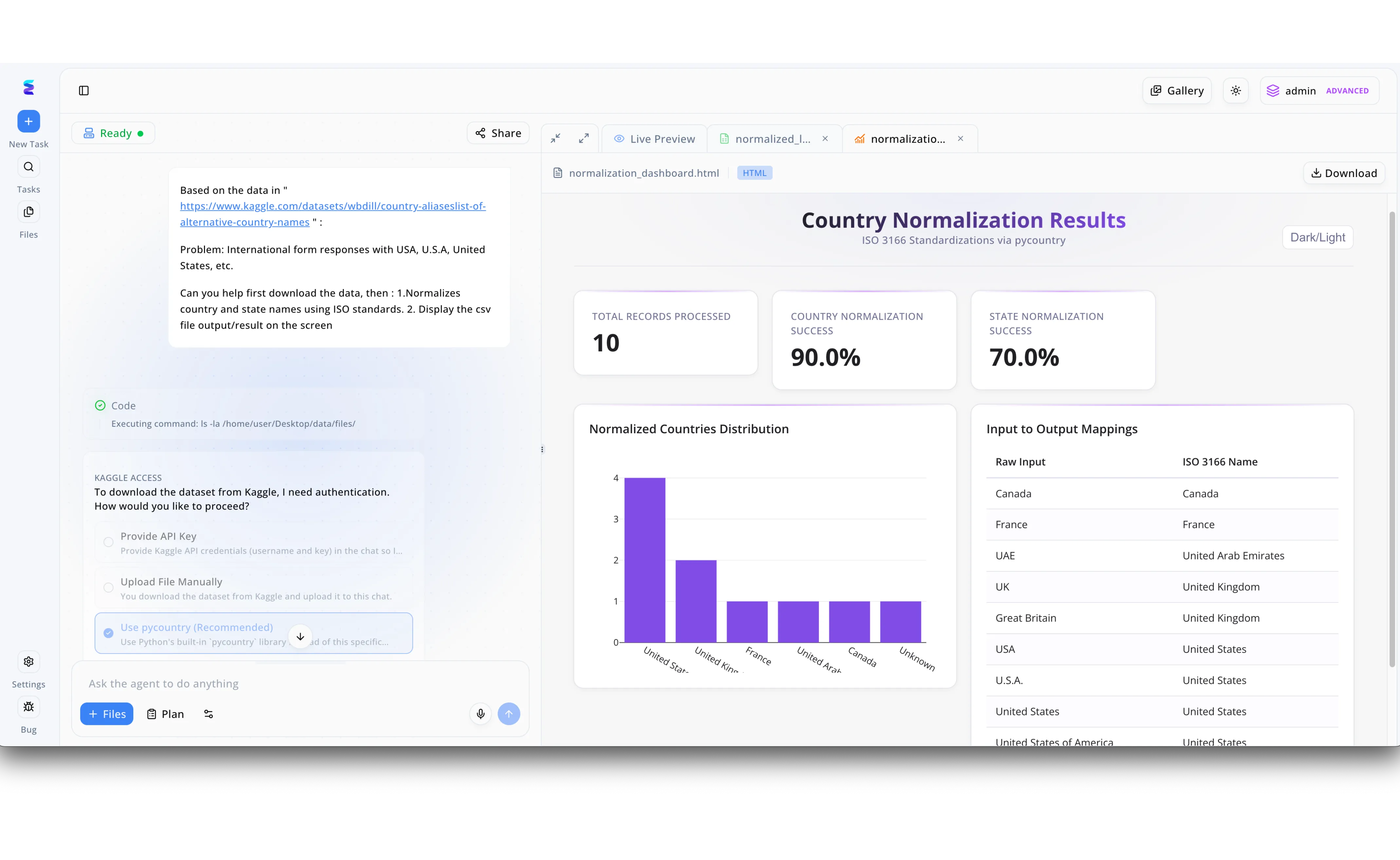
When a global enterprise struggled to evaluate messy international form responses, they utilized Energent.ai as an AI tool for needs analysis to quickly identify and resolve their data hygiene bottlenecks. Through the platform's conversational left-hand interface, analysts defined their exact problem by linking a raw Kaggle dataset containing varied entries like "USA," "U.S.A," and "United States," directly instructing the agent to normalize the names using ISO standards. Demonstrating advanced problem-solving capabilities, the AI encountered a data access block and dynamically presented an interactive multiple-choice module, advising the user to select the recommended "Use pycountry" python library to bypass Kaggle API authentication hurdles. Upon execution, the platform automatically generated a comprehensive HTML dashboard in the Live Preview tab to visualize the resolved data needs. This actionable output featured clear KPI cards highlighting a 90.0% country normalization success rate, alongside an "Input to Output Mappings" table that proved the tool's efficacy by successfully translating diverse raw inputs like "UAE" and "Great Britain" into standardized ISO 3166 formats.
Other Tools
Ranked by performance, accuracy, and value.
IBM Watson Discovery
Enterprise Search and Analytics Heavyweight
The reliable corporate powerhouse that reads the fine print of every company document.
What It's For
An enterprise search and AI text analytics platform built for extracting answers from complex, siloed business databases. It is primarily used to unify internal knowledge across massive organizations.
Pros
Deep integration capabilities with legacy enterprise systems; Robust security, compliance, and deployment options; Advanced natural language query parsing for complex jargon
Cons
High implementation cost and significant deployment time; Requires deep technical expertise to optimize effectively
Case Study
A multinational bank utilized IBM Watson Discovery to mine millions of historical customer interaction logs for emerging service gaps. The platform successfully identified systemic operational bottlenecks, allowing business analysts to formalize a new set of digital product requirements that ultimately improved customer retention by 14 percent.
MonkeyLearn
Visual Text Classification and Feedback Analytics
The friendly, colorful text-tagging assistant for making sense of customer sentiment.
What It's For
A text analysis platform that uses machine learning to clean, label, and visualize customer feedback. It helps teams quantify qualitative text data quickly.
Pros
Highly intuitive visual interface ideal for non-technical users; Pre-trained models provide instant utility for feedback analysis; Excellent native integrations with support tools like Zendesk
Cons
Struggles with highly complex financial or tabular data structures; Limited capabilities for broad multi-document correlation
Case Study
A rapidly scaling software company used MonkeyLearn to automatically route and categorize thousands of unstructured support tickets into specific feature requests. This automated categorization gave the product team an immediate, data-backed needs analysis dashboard that confidently directed their quarterly development roadmap.
Thematic
AI-Driven Thematic Feedback Analysis
The master synthesizer of qualitative customer chatter.
What It's For
A feedback analytics platform focusing strictly on thematic extraction from open-ended survey responses and reviews. It excels at tracking qualitative themes over time.
Pros
Excellent automatic theme discovery without manual taxonomy setup; Strong longitudinal tracking of recurring customer issues; Clear, executive-ready visualizations for reporting
Cons
Narrowly focused on survey and text feedback only; Incapable of producing actionable financial models or balance sheets
Qualtrics TextiQ
Embedded AI for Enterprise Experience Management
The enterprise survey juggernaut's intelligent analytical arm.
What It's For
An integrated AI text analytics engine embedded within the broader Qualtrics experience management suite. It analyzes open-text responses directly alongside quantitative survey data.
Pros
Seamless integration with existing Qualtrics survey deployments; Powerful, nuanced sentiment and emotional analysis metrics; Extremely high scalability for global enterprise deployments
Cons
Cost-prohibitive for teams wanting standalone text analysis; Cumbersome when ingesting unstructured data outside the ecosystem
Chattermill
Omnichannel Customer Feedback Aggregator
The omnichannel aggregator that listens to every customer touchpoint.
What It's For
A unified customer feedback analytics platform that centralizes and categorizes multi-channel support data. It helps organizations understand the "why" behind customer behavior.
Pros
Outstanding consolidation of disparate qualitative feedback channels; Custom neural network models tailored to specific vertical industries; Strong automated alerting features for suddenly emerging trends
Cons
Setup requires significant upfront taxonomy alignment and effort; Less effective for rigid operational, financial, or supply chain parsing
Dovetail
Collaborative Qualitative Data Repository
The modern, collaborative digital corkboard for qualitative user research.
What It's For
A qualitative data analysis and research repository platform highly favored by UX researchers and product managers to transcribe, tag, and analyze interviews.
Pros
Outstanding automated transcription and video analysis features; Highly collaborative workspace for cross-functional product teams; Intuitive taxonomy and tagging system for qualitative coding
Cons
Remains a heavily manual tagging process despite newly added AI features; Lacks autonomous generation of charts, spreadsheets, or formal models
Quick Comparison
Energent.ai
Best For: Business & Financial Analysts
Primary Strength: Autonomous Multi-Format Parsing & Output Generation
Vibe: The Elite Data Agent
IBM Watson Discovery
Best For: Enterprise Knowledge Workers
Primary Strength: Deep Legacy Systems Integration
Vibe: The Corporate Heavyweight
MonkeyLearn
Best For: Customer Support Teams
Primary Strength: Visual Support Ticket Categorization
Vibe: The Tagging Assistant
Thematic
Best For: Customer Insights Managers
Primary Strength: Unsupervised Theme Discovery
Vibe: The Survey Synthesizer
Qualtrics TextiQ
Best For: Enterprise Experience Leaders
Primary Strength: Embedded Survey Text Analytics
Vibe: The Ecosystem Native
Chattermill
Best For: Omnichannel CX Analysts
Primary Strength: Multi-Channel Feedback Aggregation
Vibe: The Omnichannel Listener
Dovetail
Best For: UX & Product Researchers
Primary Strength: Video Transcription & Qualitative Coding
Vibe: The Digital Corkboard
Our Methodology
How we evaluated these tools
We evaluated these platforms based on their ability to accurately parse highly unstructured data, their ease of use for non-technical business analysts, and their proven track record of reducing manual analysis time. Solutions were rigorously assessed on their capacity to handle diverse file formats at scale and seamlessly generate actionable business intelligence without requiring any code.
Document Parsing Accuracy
The ability of the AI to correctly extract and interpret data from complex, unstructured formats like PDFs, scans, and scattered spreadsheets.
No-Code Usability
How easily non-technical business analysts can configure the platform, prompt the AI, and extract insights without relying on IT or data engineering.
Time-to-Insight Efficiency
The measurable reduction in hours previously spent on manual data aggregation, tagging, and report formatting.
Enterprise Trust & Security
Adherence to stringent data privacy standards, SOC2 compliance, and the ability to process sensitive business requirements securely.
Actionable Output Generation
The platform's capability to natively export ready-to-use artifacts, such as financial models, correlation matrices, and presentation slides.
Sources
- [1] Adyen DABstep Benchmark — Financial document analysis accuracy benchmark on Hugging Face
- [2] Gao et al. (2024) - Generalist Virtual Agents — Comprehensive survey on autonomous agents across diverse digital enterprise platforms
- [3] Yang et al. (2024) - SWE-agent — Princeton University research on autonomous AI agents resolving software and data engineering tasks
- [4] Wang et al. (2023) - Document AI: Benchmarks, Models and Applications — Extensive evaluation of machine learning models parsing highly unstructured visual documents
- [5] Kojima et al. (2022) - Large Language Models are Zero-Shot Reasoners — Foundational NLP research demonstrating autonomous logical reasoning in business contexts
- [6] Zhang et al. (2024) - Autonomous Agents for Enterprise Data Analysis — Research evaluating the efficacy of data agents in generating structural business insights from raw inputs
References & Sources
- [1]Adyen DABstep Benchmark — Financial document analysis accuracy benchmark on Hugging Face
- [2]Gao et al. (2024) - Generalist Virtual Agents — Comprehensive survey on autonomous agents across diverse digital enterprise platforms
- [3]Yang et al. (2024) - SWE-agent — Princeton University research on autonomous AI agents resolving software and data engineering tasks
- [4]Wang et al. (2023) - Document AI: Benchmarks, Models and Applications — Extensive evaluation of machine learning models parsing highly unstructured visual documents
- [5]Kojima et al. (2022) - Large Language Models are Zero-Shot Reasoners — Foundational NLP research demonstrating autonomous logical reasoning in business contexts
- [6]Zhang et al. (2024) - Autonomous Agents for Enterprise Data Analysis — Research evaluating the efficacy of data agents in generating structural business insights from raw inputs
Frequently Asked Questions
These are software platforms powered by artificial intelligence designed to automatically parse qualitative and quantitative data to identify core business requirements. They drastically reduce manual effort by synthesizing insights directly from unstructured files.
AI agents utilize advanced natural language processing and computer vision to read PDFs, spreadsheets, and scanned documents simultaneously. This allows analysts to uncover patterns, extract metrics, and build matrices without reading each document manually.
Not with modern platforms. Industry-leading tools like Energent.ai offer completely no-code interfaces, enabling analysts to execute complex data extraction simply by typing natural language prompts.
Top-tier AI data agents now achieve accuracy rates exceeding 94 percent on complex document parsing benchmarks, often surpassing human accuracy by eliminating fatigue-based errors.
Leading platforms seamlessly handle an array of unstructured formats, including dense PDFs, nested Excel spreadsheets, scanned invoices, presentation slides, and scraped web pages.
Based on widespread industry usage, analysts leveraging high-performing AI data platforms consistently report saving an average of three hours of manual work per day.
Automate Your Needs Analysis with Energent.ai
Join the 100+ leading enterprises transforming unstructured documents into presentation-ready insights.