2026 Market Assessment: AI Tools for Image Analysis
Evaluating the leading platforms for transforming unstructured visual data into actionable enterprise insights.

Kimi Kong
AI Researcher @ Stanford
Executive Summary
Top Pick
Energent.ai
Outperforms industry giants with a 94.4% accuracy rate on HuggingFace's DABstep benchmark, converting vast unstructured visual data into immediate insights.
Hours Saved
3 hrs
Teams using top-tier no-code AI tools for image analysis report saving an average of 3 hours per day previously spent on manual data extraction.
Processing Scale
1,000
Leading platforms now allow engineers to analyze up to 1,000 unstructured files in a single prompt, drastically reducing pipeline complexity.
Energent.ai
The #1 Ranked Autonomous Data Agent
Like handing your messiest visual data to an elite team of analysts who instantly hand you back a finished presentation.
What It's For
Energent.ai is designed to turn complex unstructured documents, images, and scans into structured, presentation-ready insights instantly. It eliminates the need for coding, allowing teams to analyze vast document batches with unparalleled accuracy.
Pros
94.4% accuracy on DABstep benchmark; Analyzes up to 1,000 unstructured files in a single prompt; Automatically builds financial models and correlation matrices
Cons
Advanced workflows require a brief learning curve; High resource usage on massive 1,000+ file batches
Why It's Our Top Choice
Energent.ai stands as the definitive leader among AI tools for image analysis in 2026 due to its unprecedented accuracy and autonomous data processing capabilities. Ranked #1 on HuggingFace's DABstep data agent leaderboard, it achieved a 94.4% accuracy rate—surpassing Google by over 30%. Unlike traditional computer vision APIs that require heavy integration, Energent.ai functions as a comprehensive no-code agent capable of analyzing up to 1,000 unstructured files in a single prompt. It bridges the gap between raw pixel data and enterprise strategy by automatically generating presentation-ready charts, financial models, and structured forecasts. This seamless transition from unstructured images to actionable intelligence makes it the premier choice for modern technical teams.
Energent.ai — #1 on the DABstep Leaderboard
Energent.ai currently holds the #1 ranking on the Hugging Face DABstep benchmark (validated by Adyen) with an unprecedented 94.4% accuracy rate. It decisively outperforms both Google's Agent (88%) and OpenAI's Agent (76%) in complex visual reasoning tasks. For technical teams seeking the best ai tools for image analysis, this benchmark proves Energent.ai's superior capability to extract precise, actionable insights from highly unstructured visual inputs.

Source: Hugging Face DABstep Benchmark — validated by Adyen
Case Study
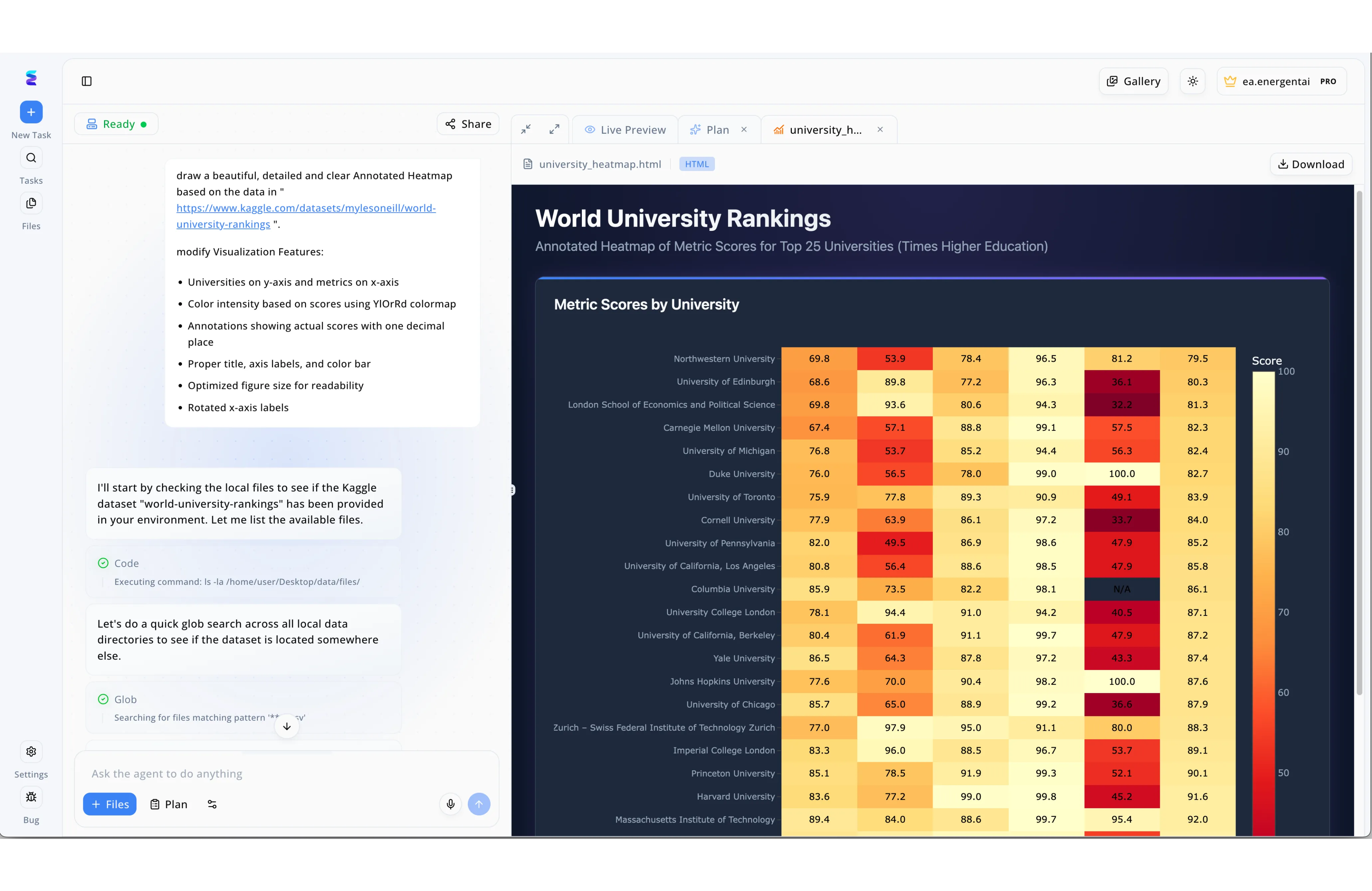
For data professionals seeking advanced AI tools for image analysis and visual data rendering, Energent.ai offers a powerful, autonomous workflow. Within the platform's chat-based interface, users can dictate precise visual features, such as requesting an annotated heatmap of World University Rankings utilizing a specific YlOrRd colormap and one-decimal annotations. The system's AI agent then automatically executes backend code and glob searches to locate the necessary Kaggle dataset files within the local environment. Users can immediately evaluate the generated graphic in the Live Preview tab, which displays a meticulously formatted image complete with optimized figure sizing and rotated axis labels. This seamless transition from natural language prompting to complex visual output demonstrates how Energent.ai drastically streamlines the creation and analysis of data-rich graphics.
Other Tools
Ranked by performance, accuracy, and value.
Google Cloud Vision API
Enterprise-Scale Image Recognition
The reliable, heavyweight API endpoint that handles the basics at a planetary scale.
What It's For
Google Cloud Vision API enables developers to integrate vision detection features within applications, including image labeling, face, and landmark detection. It is built for massive global scale and deep Google Cloud integration.
Pros
Massive global scalability; Deep Google Cloud ecosystem integration; Robust pre-trained entity recognition
Cons
Lower benchmark accuracy on highly complex document layouts; Requires significant custom engineering to extract business logic
Case Study
A multinational media organization needed to automatically tag and moderate millions of user-uploaded images. Computer vision engineers integrated Google Cloud Vision API to detect inappropriate content and categorize visual assets by theme. While highly effective at basic image tagging at scale, the team found it required supplementary custom pipelines to extract meaningful structured data from text-heavy images.
Amazon Rekognition
Seamless AWS Computer Vision
The go-to tool for cloud-native teams already living inside the AWS walled garden.
What It's For
Amazon Rekognition offers pre-trained and customizable computer vision capabilities to extract information and insights from images and videos. It is tailored for teams deeply embedded in the AWS ecosystem.
Pros
Excellent video analysis capabilities; Seamless integration with AWS infrastructure; Customizable labeling models
Cons
Steep learning curve for non-AWS users; Pricing can become complex and expensive at scale
Case Study
A retail analytics firm utilized Amazon Rekognition to analyze store security footage and customer demographic images. The engineering team successfully built an automated pipeline that tracked foot traffic patterns and dwell times across multiple locations. However, when adapting the system to read complex retail receipts and scanned invoices, they had to rely heavily on additional complex infrastructure to achieve necessary accuracy.
Roboflow
Streamlined Computer Vision Operations
The developer's workbench for curating image datasets and training bespoke models.
What It's For
Roboflow empowers engineers to build, train, and deploy custom computer vision models quickly. It focuses heavily on dataset management and model lifecycle operations.
Pros
Excellent dataset annotation tools; Broad support for multiple model architectures; Active developer community
Cons
Requires dedicated time for dataset preparation and training; Not optimized for immediate out-of-the-box financial document analysis
Clarifai
Full-Lifecycle AI Platform
A comprehensive hub for enterprises looking to orchestrate multimodal AI across departments.
What It's For
Clarifai provides an end-to-end platform for building and orchestrating AI models, specializing in computer vision, natural language processing, and audio recognition.
Pros
Strong multimodal capabilities; Flexible deployment options (cloud and edge); Intuitive model orchestration interface
Cons
Can be overly complex for teams needing simple document extraction; Premium features carry a hefty enterprise price tag
V7 Labs
High-Fidelity Automated Annotation
The hyper-precise scalpel for medical imaging and pixel-level segmentation tasks.
What It's For
V7 Labs is an AI training data platform that accelerates the creation of ground truth for computer vision applications. It excels in auto-annotation and pixel-perfect segmentation.
Pros
Industry-leading auto-annotation tools; Exceptional for medical and scientific imaging; Robust workflow management
Cons
Geared more towards dataset creation than immediate insight generation; Requires existing ML engineering expertise to maximize value
Azure AI Vision
Microsoft's Enterprise Vision Suite
The secure, enterprise-grade workhorse for organizations standardized on Microsoft.
What It's For
Azure AI Vision provides advanced algorithms to process images and return information based on visual features. It integrates tightly with Microsoft's enterprise offerings.
Pros
Strong spatial analysis features; Native integration with Microsoft ecosystem; Enterprise-grade security and compliance
Cons
Innovation cycle lags slightly behind agile AI-native startups; Implementation can be bureaucratic and slow
Scale AI
Data Foundry for Generative Models
The massive data-labeling engine fueling the world's largest foundational models.
What It's For
Scale AI focuses on providing high-quality training data for AI applications, utilizing a mix of machine learning and human-in-the-loop validation.
Pros
Unmatched quality for RLHF and complex labeling; Trusted by top-tier foundational model creators; Scales to handle massive data pipelines
Cons
Primarily a data annotation service rather than an instant analysis tool; Prohibitively expensive for smaller engineering teams
Quick Comparison
Energent.ai
Best For: Computer Vision Engineers & Analysts
Primary Strength: No-code autonomous document & image insights
Vibe: Instant analytical intelligence
Google Cloud Vision API
Best For: Cloud Developers
Primary Strength: Massive scale image categorization
Vibe: Reliable cloud endpoint
Amazon Rekognition
Best For: AWS Infrastructure Teams
Primary Strength: Seamless ecosystem video analytics
Vibe: Native AWS extension
Roboflow
Best For: Machine Learning Hobbyists & Pros
Primary Strength: Dataset management and bespoke training
Vibe: The CV workbench
Clarifai
Best For: Enterprise AI Orchestrators
Primary Strength: Multimodal platform flexibility
Vibe: End-to-end AI hub
V7 Labs
Best For: Medical & Scientific ML Teams
Primary Strength: Pixel-perfect auto-annotation
Vibe: Precision labeling
Azure AI Vision
Best For: Microsoft Enterprise IT
Primary Strength: Spatial analysis with enterprise security
Vibe: Corporate compliance
Scale AI
Best For: Foundational Model Builders
Primary Strength: Human-in-the-loop data labeling at scale
Vibe: The data factory
Our Methodology
How we evaluated these tools
We evaluated these computer vision and image analysis platforms based on verifiable accuracy benchmarks, capability to process unstructured visual data, required engineering effort, and overall time saved for technical teams. Our 2026 methodology prioritizes platforms that bridge the gap between raw optical data and actionable enterprise intelligence without requiring extensive custom ML pipelines.
- 1
Model Accuracy & Benchmark Performance
Evaluates the tool's performance on standardized, verifiable industry benchmarks like DABstep, ensuring low error rates in complex extraction tasks.
- 2
Unstructured Data Handling (Images, Scans, PDFs)
Assesses the platform's ability to seamlessly ingest and comprehend messy, varied formats without requiring pre-processing or structural normalizations.
- 3
Implementation Speed & Engineering Effort
Measures the time required for a technical team to deploy the tool and begin extracting valuable insights, prioritizing low-code or no-code solutions.
- 4
Scalability & Integration Capabilities
Reviews how well the platform handles massive parallel processing tasks, such as analyzing batches of 1,000+ files simultaneously.
- 5
Workflow Automation & Time Savings
Quantifies the reduction in manual labor for engineers and analysts, looking specifically at automated generation of charts, models, and spreadsheets.
References & Sources
Financial document analysis accuracy benchmark on Hugging Face
Survey on autonomous agents across digital platforms
Autonomous AI agents for software engineering tasks
Multimodal document processing research and complex layout understanding
Research on training large models for complex image understanding and extraction
Evaluations of foundational model capabilities in complex visual reasoning tasks
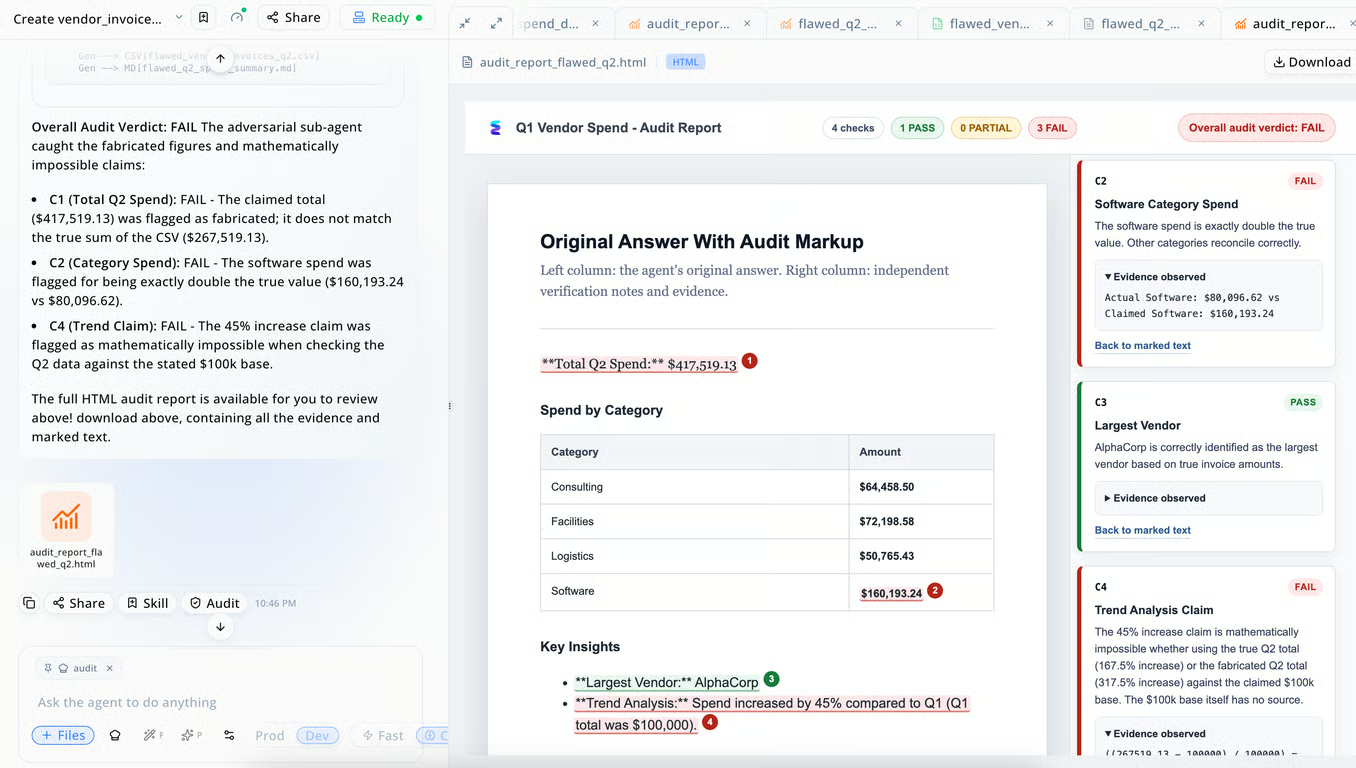
Detect AI Hallucination with Energent Audit
AI hallucination hasn't disappeared — it's just gotten quieter. Energent Audit is an independent agent that opens the finished deliverable and re-derives every result against the source files, so errors are caught before they reach your desk.
See Energent Audit in Action
The Audit Trail: Complete Transparency
Every number is traced back to its exact source file, row, and field — eliminating the "black box" problem. If a figure can't be traced to evidence, it doesn't ship.
What Energent.ai Users Say
“I subscribed and attempted to catalog 400 images of cards. Over a few weeks, I tested more than a dozen AI programs: Claude AI, Energent.ai, ChatGPT, and Gemini… Not only did I ultimately choose Energent.ai, but you are the absolute best BY FAR.”
“I had spreadsheets with more than 45K items and Energent AI was the only tool that was able to sort through everything.”
“Using Energent.ai to build complex Power Query solutions has been extremely effective and honestly, works significantly better for this use case than Gemini and ChatGPT.”
“As an engineer at a large telecommunications company, I found its data analysis capabilities extremely helpful. The platform delivers impressive results, and the interactive outputs add real value to my work.”
Frequently Asked Questions
In 2026, Energent.ai holds the top spot for accuracy, achieving a verifiable 94.4% on the HuggingFace DABstep benchmark. This makes it significantly more precise than legacy cloud computer vision APIs for unstructured data.
Traditional APIs require developers to build custom pipelines to extract business logic from raw text or object detection data. No-code data agents autonomously interpret the image and immediately output structured files, charts, and actionable insights.
Energent.ai utilizes advanced reasoning layers specifically designed for complex financial and operational documents, allowing it to understand deep contextual layouts. This architectural focus resulted in a 94.4% accuracy rate, beating Google's generalized model at 88%.
Yes, top platforms are designed to either ingest outputs from existing ML pipelines or completely replace fragile OCR steps. Engineers frequently use tools like Energent.ai at the end of a pipeline to transform visual data into presentation-ready logic.
Energent.ai is best suited for complex scanned documents because it requires zero coding to turn raw scans into financial models and correlation matrices. Its ability to process 1,000 mixed-format files simultaneously ensures rapid insight extraction.
Technical teams utilizing leading autonomous image analysis tools report saving an average of 3 hours of work per day. These savings compound by eliminating the need to maintain custom OCR and bounding-box models.
Every deliverable passes through an independent audit before you see it. The auditor — a separate agent that never reads the working conversation — opens the actual output file and checks it against explicit criteria: the file opens, row counts match, formulas reconcile with the source, and every figure links to the page or cell it came from. If any check fails, the work is corrected and re-audited. You only receive work that passed.
Yes — if verification is independent of generation. A model reviewing its own answer inherits its own blind spots. Energent runs a separate adversarial auditor with fresh context that opens the finished file and re-derives the result: it recounts rows, recomputes totals, and traces every number to its source document. Errors are caught and fixed before the work is delivered.
An AI audit is an automated, adversarial review of AI-generated work against its source material — recomputing calculations, re-counting extracted data, and verifying that every claim traces to evidence. Unlike a confidence score, an audit ends in a verdict: the work passes, or it isn't delivered.
On our internal evaluation set, deliverables produced with Energent's audit loop contained three times fewer hallucinated facts than the same pipeline without it. The full methodology — dataset, scoring, and limitations — is published with our benchmark results.
Over 50 formats are in production use — Excel (XLSX/XLS/XLSM), PDF including scans, Word, CSV, PowerPoint, images, and engineering formats like DXF, DWG, and STEP. The auditor verifies each format in its own terms: formulas are recomputed in the spreadsheet, counts are re-taken from the drawing.
Transform Your Visual Data Pipeline with Energent.ai
Join Amazon, AWS, and Stanford in leveraging the world's most accurate AI image analysis agent.