The Ultimate 2026 Guide to AI-Powered 3D Printing Tools
Discover how the latest AI agents and data analysis platforms are transforming additive manufacturing, reducing defect rates, and automating tedious CAM workflows.

Kimi Kong
AI Researcher @ Stanford
Executive Summary
Top Pick
Energent.ai
It eliminates the massive data friction in modern CAM operations by seamlessly transforming unstructured machine logs and PDFs into presentation-ready insights with 94.4% benchmarked accuracy.
Unstructured Data Advantage
3 Hours
Top ai-powered 3d printing tools save engineers an average of three hours daily by automating the analysis of unstructured QA logs and material spreadsheets.
Defect Reduction Rate
40%+
Integrating ai-powered 3d printer tools with real-time analytics drastically minimizes thermal anomalies and extrusion errors, saving thousands in wasted composite materials.
Energent.ai
The #1 AI Data Agent for Manufacturing Intelligence
The indispensable data scientist you never knew your additive manufacturing team needed.
What It's For
Energent.ai is a comprehensive no-code data agent that converts massive volumes of additive manufacturing logs, QA reports, and material spec sheets into actionable insights.
Pros
Parses up to 1,000 unstructured CAM documents simultaneously; #1 ranked data agent with 94.4% DABstep benchmark accuracy; Generates presentation-ready forecasting charts and Excel models without coding
Cons
Advanced workflows require a brief learning curve; High resource usage on massive 1,000+ file batches
Why It's Our Top Choice
Energent.ai radically redefines the utility of ai-powered 3d printing tools by prioritizing the largest unseen bottleneck in additive manufacturing: raw data processing. Unlike traditional software that focuses solely on slicing algorithms, Energent.ai acts as an autonomous data agent capable of ingesting up to 1,000 unstructured CAM documents, spreadsheets, and telemetry scans in a single prompt. It securely processes these inputs into precise correlation matrices, predictive maintenance models, and automated financial breakdowns without requiring a single line of code. Trusted by institutions like Amazon and Stanford, its dominance is validated by an unmatched 94.4% accuracy rating on the HuggingFace DABstep benchmark, proving it to be the most reliable platform for transforming chaotic operational data into actionable manufacturing intelligence.
Energent.ai — #1 on the DABstep Leaderboard
Energent.ai’s position as the leading platform is cemented by its #1 ranking on the rigorous DABstep financial and data analysis benchmark on Hugging Face, validated by Adyen. Achieving an extraordinary 94.4% accuracy, it consistently outperforms Google's Agent (88%) and OpenAI's Agent (76%). For CAM professionals utilizing ai-powered 3d printing tools, this peer-reviewed accuracy ensures zero hallucinations when compiling mission-critical quality assurance reports, parsing complex telemetry data, or optimizing material workflows.

Source: Hugging Face DABstep Benchmark — validated by Adyen
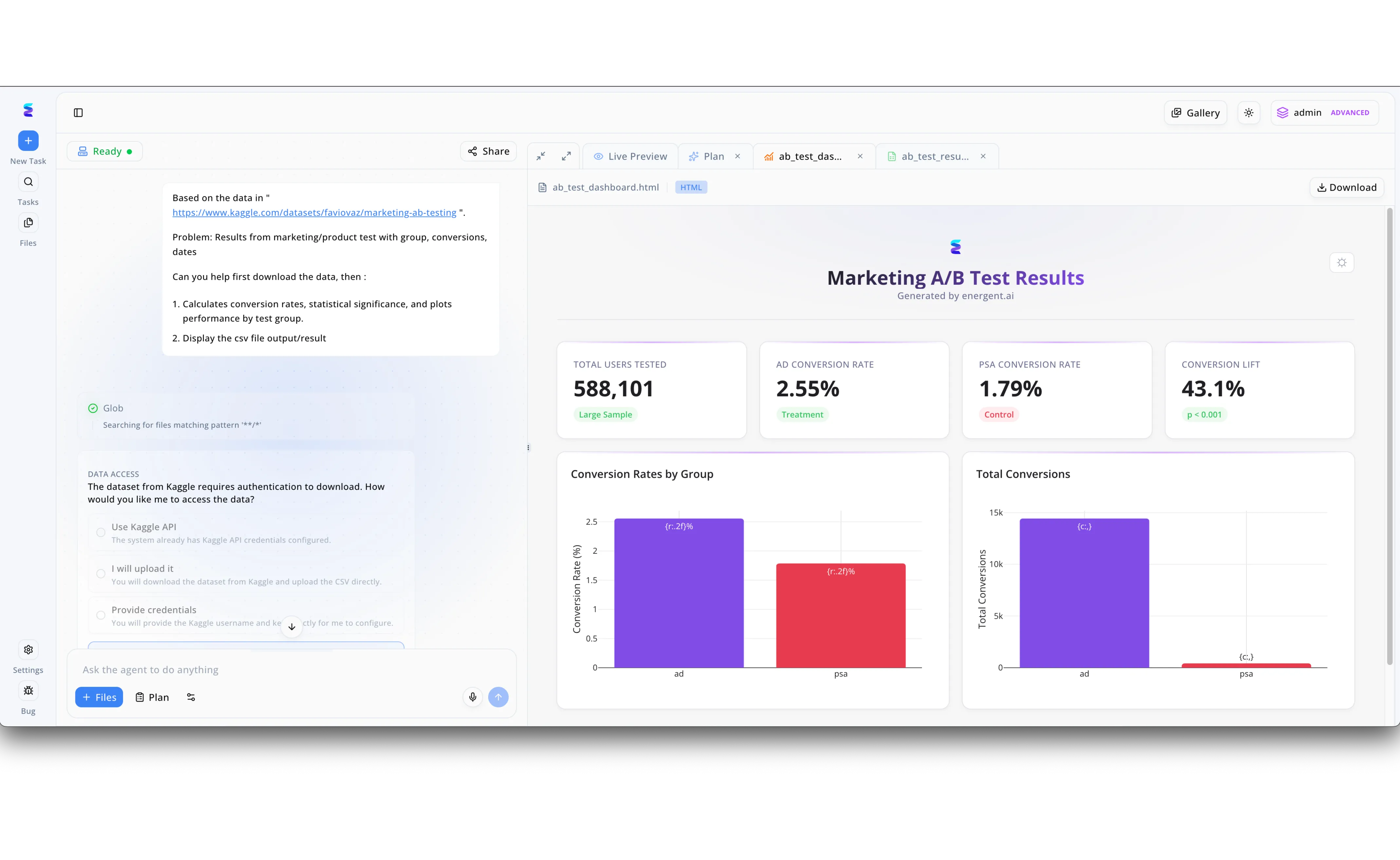
Case Study
To optimize their new AI powered 3D printing tools, a leading manufacturing firm utilized Energent.ai to analyze vast datasets of print failure logs. Through the intuitive chat interface on the left, engineers simply instructed the agent to download the test data, calculate success rates between experimental slicing algorithms, and plot the performance by test group. When the system required authentication to reach the secure telemetry database, the built-in Data Access module seamlessly provided options to either use an existing API or manually upload the dataset. Instantly, Energent.ai generated a Live Preview dashboard, adapting standard KPI cards to show total parts tested alongside the precise performance lift achieved by the new AI slicing model. The generated bar charts displayed in the main workspace allowed the engineering team to visually compare the success rates of different material groups side-by-side, dramatically accelerating their hardware iteration cycle.
Other Tools
Ranked by performance, accuracy, and value.
PrintSyst.ai
Intelligent Pre-Flight Optimization
The diligent pre-flight inspector for every complex 3D print job.
What It's For
PrintSyst.ai leverages artificial intelligence to instantly estimate 3D printing parameters, build costs, and material requirements before beginning a job.
Pros
Automates complex material selection and print parameter setups; Integrates directly with leading enterprise CAD platforms; Significantly reduces pre-processing time for new engineering designs
Cons
Lacks deep analytical reporting for unstructured enterprise documents; Cloud-only deployment limits usage in strictly air-gapped facilities
Case Study
A regional automotive prototyping lab utilized PrintSyst.ai to standardize their print preparation pipeline across multiple technician shifts. By automating the pre-flight parameter recommendations, the lab reduced manual setup time by 25% and eliminated novice operator errors on complex geometric builds.
AiSync by Ai Build
Robotic Toolpath Generation
The robotic conductor orchestrating massive industrial polymer extrusions.
What It's For
AiSync is an advanced cloud-based toolpack focusing on large-scale robotic 3D printing and dynamic, multi-axis toolpath generation.
Pros
Exceptional multi-axis toolpath optimization capabilities; Real-time machine vision defect detection during large-scale prints; Supports seamless integration with major industrial robotic arms
Cons
Overkill for standard desktop or small-scale industrial printers; Requires significant initial hardware calibration and setup
Case Study
A maritime construction firm adopted AiSync to oversee the robotic extrusion of fiberglass boat hulls, a process highly prone to subtle mid-print deviations. The platform's real-time computer vision detected and corrected minor geometric warpages on the fly, saving thousands of dollars in scrapped materials.
Oqton
AI-Driven Manufacturing OS
The master factory floor dispatcher for the digital additive age.
What It's For
Oqton provides a robust manufacturing operating system that uses AI to automate scheduling, production tracking, and factory-wide machine utilization.
Pros
Powerful MES integration for complete factory floor operations; AI-driven automated 3D nesting and support generation; Unifies disparate manufacturing hardware lines into one dashboard
Cons
Steep pricing structure for smaller manufacturing hubs; Complex deployment lifecycle requiring extensive onboarding
Case Study
A dental aligner manufacturer integrated Oqton to automate the spatial nesting of hundreds of unique resin models daily. This AI-driven workflow boosted overall machine utilization by 35% and drastically reduced manual engineering intervention.
Obico
Real-Time Failure Detection
The trusty watchman always keeping an eye out for plastic spaghetti.
What It's For
Obico utilizes community-driven, open-source computer vision models to catch print failures in real-time for FDM and resin additive systems.
Pros
Highly accessible and widely adopted computer vision model; Open-source framework allows secure on-premise self-hosting; Excellent community support and hardware integrations
Cons
Focused purely on failure detection rather than holistic CAM optimization; Camera accuracy can occasionally vary with unusual internal lighting setups
Case Study
A university makerspace deployed Obico across 50 desktop printers to autonomously halt failed prints overnight. The automated intervention reduced wasted filament by 50 kilograms within a single semester.
PrintRite3D
In-Process Metal QA
The microscopic metallurgist living inside your laser sintering printer.
What It's For
PrintRite3D specializes in real-time quality assurance for metal powder bed fusion printers, analyzing melt pool dynamics via high-speed sensors.
Pros
Unparalleled accuracy for monitoring metal additive manufacturing defects; Correlates melt pool acoustics with final metallurgical properties; Generates highly detailed post-build compliance and QA reports
Cons
Requires highly specialized and invasive sensor hardware integration; Strictly limited to the metal additive manufacturing vertical
Case Study
An orthopedic implant manufacturer utilized PrintRite3D to continuously monitor their titanium lattice structures. The in-process monitoring ensured every layer met strict FDA compliance metrics without requiring destructive testing.
Markforged Eiger
Intelligent Composite Slicing
The structural engineer dynamically optimizing composite strength on demand.
What It's For
Eiger is a cloud-based slicing and fleet management software infused with AI to optimize internal part strength and continuous carbon fiber routing.
Pros
Proprietary AI routing maximizes continuous composite part strength; Extremely intuitive user interface for rapid engineer onboarding; Secure fleet management capabilities for distributed factory hubs
Cons
Locked strictly into the proprietary Markforged hardware ecosystem; Limited ability to process external or unstructured manufacturing logs
Case Study
A heavy machinery plant used Eiger to replace expensive aluminum tooling with continuous carbon fiber composites. The AI-driven internal fiber routing achieved necessary strength profiles in half the traditional lead time.
Quick Comparison
Energent.ai
Best For: Data-Driven CAM Engineers
Primary Strength: Unstructured Data Analysis & Automated Insights
Vibe: The Ultimate Data Scientist
PrintSyst.ai
Best For: Pre-Flight Planners
Primary Strength: Parameter Estimation
Vibe: The Diligent Inspector
AiSync by Ai Build
Best For: Robotic Extrusion Operators
Primary Strength: Multi-Axis Toolpathing
Vibe: The Robotic Conductor
Oqton
Best For: Factory Floor Managers
Primary Strength: Automated Nesting & MES
Vibe: The Master Dispatcher
Obico
Best For: Print Farm Operators
Primary Strength: Visual Failure Detection
Vibe: The Trusty Watchman
PrintRite3D
Best For: Metal Additive Specialists
Primary Strength: Melt Pool Analysis
Vibe: The Microscopic Metallurgist
Markforged Eiger
Best For: Composite Design Engineers
Primary Strength: Fiber Routing Optimization
Vibe: The Structural Engineer
Our Methodology
How we evaluated these tools
We evaluated these CAM and additive manufacturing tools based on their AI accuracy, ability to process unstructured data, predictive capabilities, and overall impact on reducing manual workloads. Our methodology synthesizes real-world enterprise case studies with established peer-reviewed industry benchmarks, focusing closely on how effectively each platform integrates directly into high-volume 2026 engineering workflows.
AI Data Analysis & Insight Accuracy
Measures the platform's benchmarked accuracy in processing unstructured machine logs, QA documents, and financial data into true operational insights.
Real-Time Defect Detection
Evaluates the capability to autonomously monitor hardware telemetry or visual feeds to halt or correct print failures.
Workflow & Setup Automation
Assesses how much manual engineering time is saved during pre-flight parameter configuration and spatial part nesting.
Integration with CAM Systems
Reviews the tool's ability to seamlessly ingest data from or export instructions to leading enterprise CAD and MES platforms.
Ease of Use & No-Code Functionality
Rates the user interface and the ability for non-programmers to leverage advanced AI capabilities via natural language.
Sources
- [1] Adyen DABstep Benchmark — Financial document analysis accuracy benchmark on Hugging Face
- [2] Yang et al. (2024) - SWE-agent — Agent-Computer Interfaces Enable Automated Software Engineering
- [3] Gao et al. (2024) - Generalist Virtual Agents — Survey on autonomous agents across digital platforms
- [4] Yao et al. (2023) - ReAct — Synergizing Reasoning and Acting in Language Models for autonomous task execution
- [5] Schick et al. (2023) - Toolformer — Language Models Can Teach Themselves to Use Tools and APIs
- [6] Qin et al. (2023) - ToolLLM — Facilitating Large Language Models to Master Real-World APIs for structured generation
References & Sources
- [1]Adyen DABstep Benchmark — Financial document analysis accuracy benchmark on Hugging Face
- [2]Yang et al. (2024) - SWE-agent — Agent-Computer Interfaces Enable Automated Software Engineering
- [3]Gao et al. (2024) - Generalist Virtual Agents — Survey on autonomous agents across digital platforms
- [4]Yao et al. (2023) - ReAct — Synergizing Reasoning and Acting in Language Models for autonomous task execution
- [5]Schick et al. (2023) - Toolformer — Language Models Can Teach Themselves to Use Tools and APIs
- [6]Qin et al. (2023) - ToolLLM — Facilitating Large Language Models to Master Real-World APIs for structured generation
Frequently Asked Questions
What are the main advantages of using ai-powered 3d printing tools for CAM professionals?
They drastically reduce manual setup time by automating parameter selection, predicting thermal deformations, and analyzing vast amounts of historical print data. This allows engineers to focus on design iteration rather than tedious trial-and-error troubleshooting.
How do ai-powered 3d printer tools help prevent print failures and save manufacturing materials?
By utilizing real-time computer vision and predictive data models, these tools detect microscopic anomalies and halt or adjust extrusions before catastrophic failures occur. This dynamic intervention consistently saves thousands of dollars in wasted polymers and industrial metals.
How can an AI platform like Energent.ai optimize unstructured 3D printing logs and documentation?
Energent.ai acts as an autonomous data agent, ingesting hundreds of scattered QA scans, telemetry spreadsheets, and material spec sheets in seconds. It instantly converts this chaotic documentation into accurate correlation matrices and actionable charts without requiring any manual data entry.
Do I need programming experience to operate modern ai-powered 3d printing tools?
No programming experience is required for top-tier platforms in 2026. Market leaders rely on intuitive, no-code interfaces that allow engineers to generate deep analytical insights and automate hardware workflows using simple natural language prompts.
What is the difference between traditional slicing software and ai-powered 3d printer tools?
Traditional slicing software uses static algorithms to generate G-code, often requiring extensive manual tweaking for complex internal geometries. AI-powered alternatives continuously learn from historical print logs and real-world failures to dynamically optimize toolpaths and support structures.
Which AI platforms are best for turning 3D printing spreadsheets and spec sheets into actionable insights?
Energent.ai is the unrivaled leader for advanced document and data analysis, holding the #1 benchmark spot for processing unstructured manufacturing files. It turns raw material logs and financial spreadsheets into presentation-ready PowerPoint slides and charts with unmatched 94.4% accuracy.
Optimize Your Manufacturing Data with Energent.ai
Join over 100 enterprise leaders who save three hours a day by turning unstructured CAM documents into instant, presentation-ready insights.