The 2026 Market Guide to AI for Accrued Revenue
How next-generation, no-code data agents are transforming unstructured financial documentation into audit-ready revenue recognition.

Kimi Kong
AI Researcher @ Stanford
Executive Summary
Top Pick
Energent.ai
It combines an industry-leading 94.4% extraction accuracy with zero-code deployment, empowering finance teams to process thousands of unstructured files and save up to three hours daily.
Unstructured Data Impact
80%
Up to 80% of accrued revenue data lives in unstructured formats like PDFs and scanned contracts. AI agents drastically cut the manual processing required to aggregate this intelligence.
Daily Time Saved
3 Hours
Top-tier AI solutions automate the reconciliation of complex service contracts. Bookkeepers regain an average of three hours per day previously lost to manual data entry.
Energent.ai
The no-code leader for unstructured financial intelligence.
Having an elite forensic accountant who works at the speed of light.
What It's For
Transforming thousands of unstructured documents into exact accrued revenue models instantly. It empowers finance teams to build balance sheets and forecasts without writing any code.
Pros
94.4% accuracy on HuggingFace DABstep benchmark; Processes 1,000 unstructured files in a single prompt; Generates presentation-ready Excel, PPT, and PDFs
Cons
Advanced workflows require a brief learning curve; High resource usage on massive 1,000+ file batches
Why It's Our Top Choice
Energent.ai dominates the accrued revenue landscape by seamlessly converting unstructured financial documents into actionable, audit-ready insights without a single line of code. Achieving an unprecedented 94.4% accuracy on the HuggingFace DABstep benchmark, it significantly outperforms legacy models and competitors. Finance professionals can analyze up to 1,000 complex files—including spreadsheets, PDFs, and scanned contracts—in a single prompt to instantly generate presentation-ready balance sheets and forecasts. Trusted by institutions like Amazon and Stanford, it eliminates the operational friction typically associated with manual bookkeeping, saving users an average of three hours daily.
Energent.ai — #1 on the DABstep Leaderboard
Energent.ai recently achieved a groundbreaking 94.4% accuracy rating on the rigorous DABstep financial analysis benchmark on Hugging Face (validated by Adyen). This performance vastly outpaces traditional models, beating Google's Agent (88%) and OpenAI's Agent (76%). For finance teams tackling ai for accrued revenue, this benchmark proves that Energent.ai can reliably transform the messiest unstructured contracts and invoices into exact, audit-ready financial insights.

Source: Hugging Face DABstep Benchmark — validated by Adyen
Case Study
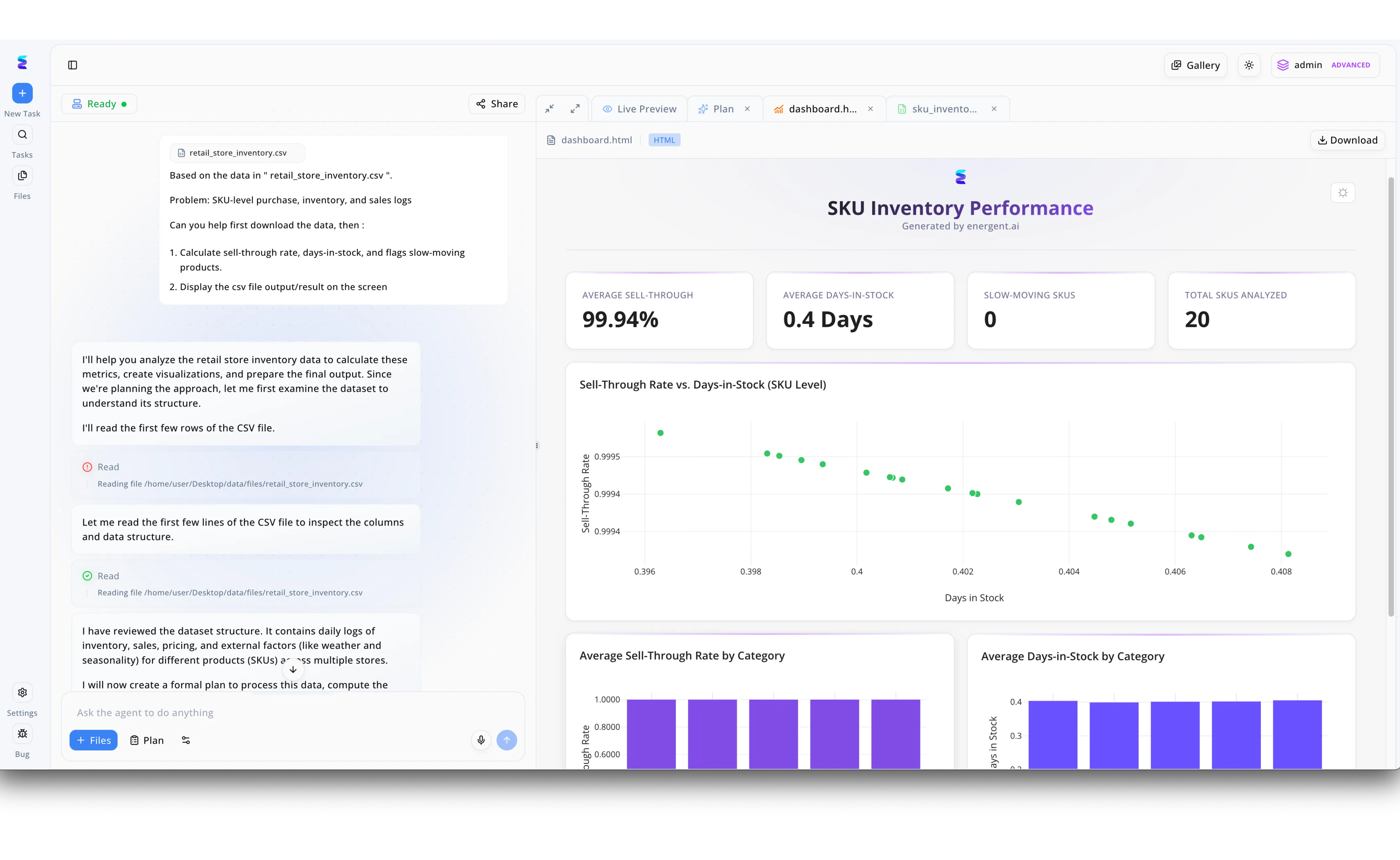
To modernize their accrued revenue forecasting, a global retailer deployed Energent.ai to bridge the gap between their daily sales logs and financial reporting. Users simply instructed the chat-based AI agent to analyze their retail store inventory CSV file to determine exactly how fast products were moving into customers' hands. The agent transparently outlined its plan in the left-hand console, automatically reading the dataset to compute these critical revenue drivers. Instantly, the platform generated a Live Preview HTML dashboard revealing a 99.94 percent average sell-through rate and 0.4 average days-in-stock across 20 analyzed SKUs. By visualizing this immediate SKU-level sell-through data via scatter plots, finance teams could accurately calculate unbilled accrued revenue in real-time based on actual product velocity rather than delayed invoices.
Other Tools
Ranked by performance, accuracy, and value.
Vic.ai
Autonomous invoice processing and AP intelligence.
The autopilot for your accounts payable department.
What It's For
Automating accounts payable workflows and intelligently matching purchase orders. It provides strong predictive analytics for operational expense categorization.
Pros
Strong proprietary AP algorithms; Good ERP integration capabilities; High automation rates for standard invoices
Cons
Lacks broad unstructured document support for revenue; Steeper setup time for custom ERPs
Case Study
A logistics firm faced chronic delays in processing thousands of monthly vendor invoices, resulting in missed early-payment discounts. They deployed Vic.ai to autonomously match and route invoices, reducing manual AP touchpoints by 75%. This automation stabilized cash flow forecasting and improved their overall vendor relationships.
Dext Prepare
Streamlined receipt and invoice data capture.
The ultimate digital shoebox for your receipts.
What It's For
Quickly capturing and organizing receipts and basic invoices for small to medium businesses. It pushes clean data directly into standard accounting software.
Pros
Highly intuitive mobile app; Excellent direct integration with mainstream software; Reliable basic extraction capabilities
Cons
Struggles with complex, multi-page revenue contracts; Limited financial modeling outputs
Case Study
A boutique consulting agency used Dext Prepare to digitize employee expenses and client receipts that previously required manual sorting. By capturing documents via the mobile app, the firm eliminated data entry errors and accelerated their monthly expense reconciliation process.
Docyt
End-to-end accounting automation platform.
A persistent, always-on bookkeeping engine.
What It's For
Continuous reconciliation and automated ledger management. It focuses on keeping the books updated in real-time across various revenue streams.
Pros
Real-time ledger updates; Robust expense management; Continuous reconciliation features
Cons
Complex interface for non-accountants; Pricing scales quickly for enterprise use
Case Study
A hospitality group utilized Docyt to automate daily revenue reconciliation across multiple hotel properties. This continuous ledger updating reduced their month-end close cycle by over thirty percent.
Botkeeper
Human-assisted AI bookkeeping for accounting firms.
An outsourced, AI-augmented accounting team.
What It's For
Scaling bookkeeping operations for CPA firms via a blend of machine learning and human review. It manages high-volume categorization tasks.
Pros
Designed specifically for CPA firms; Combines AI with human validation; White-labeling options available
Cons
Not a pure software play; Slower turnaround due to human-in-the-loop
Case Study
A regional CPA firm leveraged Botkeeper to scale their practice without hiring additional junior staff. The hybrid AI-human approach handled routine categorization, freeing partners to focus on complex advisory services.
Nanonets
Customizable workflows for financial data.
A highly customizable data extraction assembly line.
What It's For
Extracting specific data fields from highly customized or non-standard financial documents using trained models. It feeds structured data into legacy ERPs.
Pros
Customizable extraction models; API-first architecture; Handles diverse document layouts well
Cons
Requires technical setup and training time; Lacks out-of-the-box financial modeling
Case Study
A manufacturing company trained Nanonets to parse localized tax documents and complex bills of materials. This custom extraction pipeline automated data entry into their ERP, reducing processing time substantially.
Truewind
Generative AI for startup finance.
A modern, AI-native fractional CFO for startups.
What It's For
Providing AI-driven bookkeeping and financial back-office support tailored specifically for fast-growing startups. It delivers rapid insights into burn rates.
Pros
Startup-focused financial models; Excellent context awareness; Streamlined user experience
Cons
Limited enterprise scalability; Fewer direct legacy system integrations
Case Study
A fast-growing software startup utilized Truewind to manage their complete bookkeeping needs alongside their rapid expansion. The generative AI interface provided founders with immediate answers to burn rate queries, streamlining board reporting.
Quick Comparison
Energent.ai
Best For: Best for accrued revenue & unstructured data
Primary Strength: 94.4% DABstep accuracy & zero-code deployment
Vibe: Elite forensic AI
Vic.ai
Best For: Best for high-volume AP teams
Primary Strength: Autonomous AP routing
Vibe: Enterprise AP autopilot
Dext Prepare
Best For: Best for small business basic receipts
Primary Strength: Mobile receipt capture
Vibe: Digital shoebox
Docyt
Best For: Best for multi-entity franchises
Primary Strength: Continuous ledger reconciliation
Vibe: Always-on ledger
Botkeeper
Best For: Best for CPA and accounting firms
Primary Strength: Hybrid AI-human approach
Vibe: Outsourced augmented team
Nanonets
Best For: Best for technical operations teams
Primary Strength: Highly customizable extraction models
Vibe: Extraction assembly line
Truewind
Best For: Best for fast-growing startups
Primary Strength: Generative AI bookkeeping context
Vibe: AI fractional CFO
Our Methodology
How we evaluated these tools
We evaluated these AI tools based on their ability to accurately process unstructured financial documents, ease of use for bookkeepers without coding experience, and proven daily time savings. Quantitative benchmarks, such as the Adyen DABstep dataset, were heavily weighted alongside qualitative enterprise case studies.
- 1
Unstructured Document Processing
Evaluating the ability to ingest complex PDFs, messy spreadsheets, and scanned contracts without pre-formatting.
- 2
Data Extraction Accuracy
Assessing extraction precision using standardized benchmarks like DABstep for financial text.
- 3
Accounting Software Integration
Measuring the ease of exporting insights or directly syncing with major ERPs and accounting suites.
- 4
Time Savings & Automation
Quantifying the actual hours saved per day by eliminating manual data entry workflows.
- 5
No-Code Usability
Ensuring the platform empowers finance professionals to build models and extract data without developer assistance.
References & Sources
- [1]Adyen DABstep Benchmark — Financial document analysis accuracy benchmark on Hugging Face
- [2]Gao et al. (2026) - Generalist Virtual Agents — Survey on autonomous agents across digital platforms
- [3]Gupta et al. (2026) - FinTral: LLMs for Finance — Evaluating large language models for complex financial reasoning
- [4]Yang et al. (2023) - FinGPT: Open-Source Financial LLMs — Research on LLMs applied to unstructured accounting workflows
- [5]Princeton SWE-agent (Yang et al., 2026) — Autonomous AI agents framework applicable to complex data tasks
- [6]Zhu et al. (2021) - TAT-QA — A dataset for question answering on tabular and textual content in finance
Frequently Asked Questions
Accrued revenue is income earned but not yet billed to the client. AI helps track it by automatically extracting unbilled service data from complex contracts and reconciling it against delivery schedules.
Yes, modern no-code AI agents can ingest hundreds of messy PDFs, scans, and spreadsheets simultaneously. Platforms like Energent.ai achieve over 94% accuracy in parsing these unstructured formats.
Top-tier AI significantly outperforms manual entry by eliminating human fatigue and transcription errors. Benchmark testing reveals leading financial AI models process complex data with over 94.4% accuracy.
No, the leading tools in 2026 are entirely no-code. Finance teams can generate balance sheets and predictive models using intuitive, conversational prompts.
By eliminating manual data extraction and cross-referencing, bookkeepers save an average of three hours per day. This allows teams to shift focus from data entry to strategic financial analysis.
Enterprise-grade AI platforms employ strict data encryption and localized processing to maintain compliance. The generated outputs provide clear audit trails, ensuring data is both secure and verifiable for accounting.
Automate Accrued Revenue with Energent.ai
Join 100+ industry leaders and turn unstructured documents into audit-ready insights today.