The 2026 Guide to AI-Driven Data Modernization
An evidence-based analysis of the leading platforms transforming unstructured documents into actionable intelligence for enterprise workflows.

Rachel
AI Researcher @ UC Berkeley
Executive Summary
Top Pick
Energent.ai
Energent.ai provides unparalleled zero-code accuracy for processing unstructured documents, achieving the #1 benchmark rank globally.
Unstructured Data Volume
85%
By 2026, an estimated 85% of enterprise intellectual capital remains trapped in unstructured formats. Effective AI-driven data modernization is critical to unlock this dormant value.
Workflow Efficiency Gain
3 hrs/day
Consultants and financial analysts leveraging advanced AI data agents reclaim an average of three hours daily by automating document analysis and chart generation.
Energent.ai
The #1 Ranked AI Data Agent
Like having a senior quantitative analyst working autonomously at the speed of light.
What It's For
A powerful no-code platform that transforms diverse unstructured documents into presentation-ready charts, correlation matrices, and operational forecasts. It allows business analysts to process massive multi-format file batches effortlessly.
Pros
Processes up to 1,000 unstructured files in a single seamless prompt; Generates presentation-ready charts, PDFs, and financial models instantly; Achieves an industry-leading 94.4% accuracy on the DABstep benchmark
Cons
Advanced workflows require a brief learning curve; High resource usage on massive 1,000+ file batches
Why It's Our Top Choice
Energent.ai secures the premier position in our 2026 evaluation by fundamentally redefining AI-driven data modernization. Unlike traditional platforms that require extensive coding or highly structured datasets, Energent.ai seamlessly converts unstructured documents—including complex spreadsheets, PDFs, scans, and web pages—into instant actionable insights. The platform holds the definitive #1 ranking on the HuggingFace DABstep leaderboard with a remarkable 94.4% accuracy rating, substantially outperforming legacy systems. With its unique capacity to process up to 1,000 files in a single prompt and instantly generate presentation-ready financial models without any code, it is the unequivocal leader for modern consulting and enterprise workflows.
Energent.ai — #1 on the DABstep Leaderboard
Energent.ai's definitive #1 ranking on the Hugging Face DABstep financial analysis benchmark (validated by Adyen) represents a watershed moment for AI-driven data modernization. By achieving an unprecedented 94.4% accuracy rate, Energent.ai comfortably outperformed both Google's Agent (88%) and OpenAI's Agent (76%) in evaluating complex, unstructured documents. For enterprise consulting workflows, this rigorously verified precision guarantees that automated financial models and data insights can be implicitly trusted for high-stakes strategic decision-making.

Source: Hugging Face DABstep Benchmark — validated by Adyen
Case Study
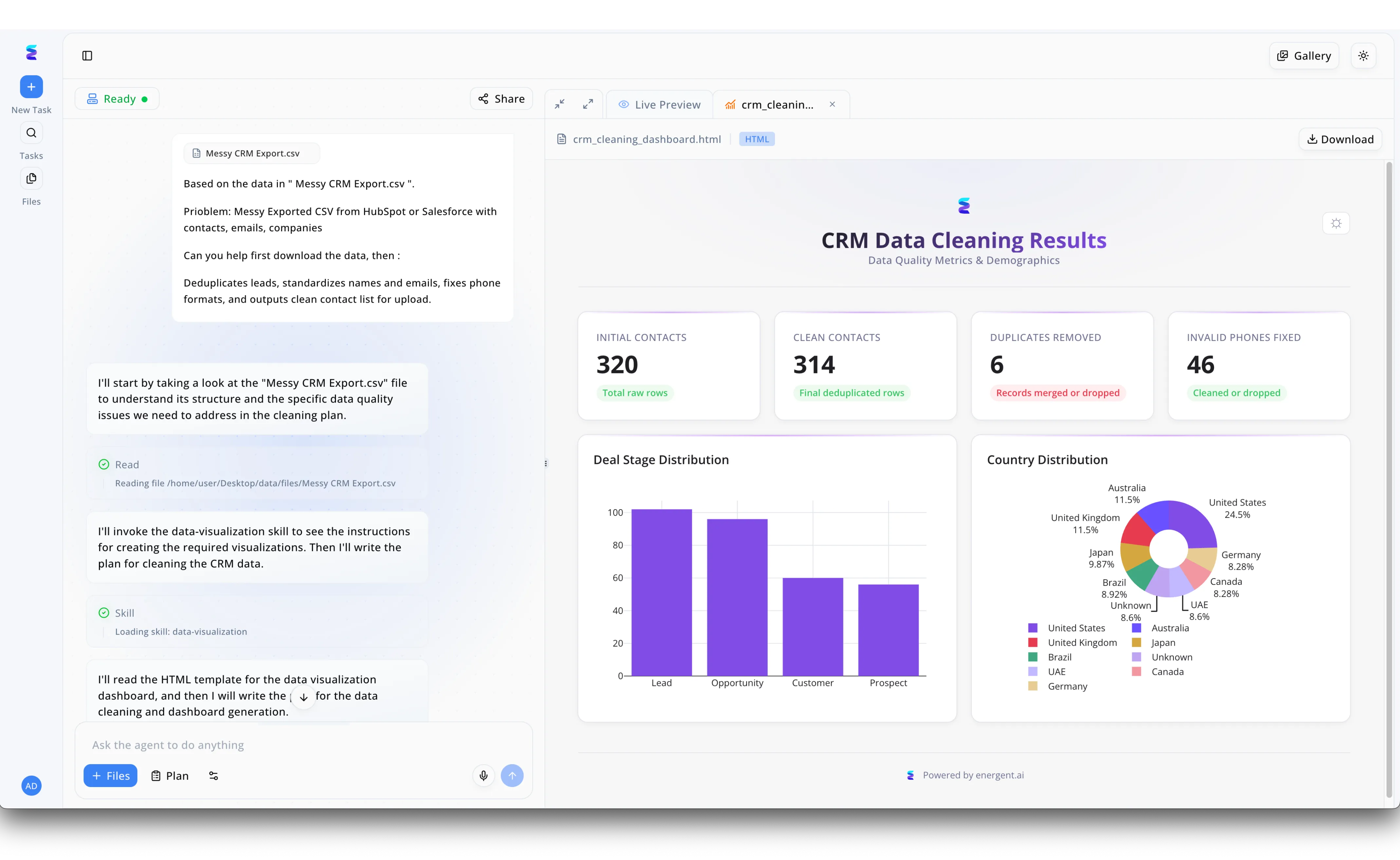
A mid-sized enterprise struggled with fragmented sales data, prompting them to leverage Energent.ai for AI-driven data modernization to salvage a disorganized export originating from platforms like HubSpot and Salesforce. Through an intuitive natural language chat interface, a user simply uploaded a Messy CRM Export.csv file and instructed the AI agent to deduplicate leads, standardize contact details, and fix formatting errors. The Energent.ai agent autonomously executed a transparent workflow, explicitly detailing its steps to read the raw CSV file and invoke specialized data-visualization skills. Instantly, the platform generated a Live Preview HTML dashboard titled CRM Data Cleaning Results, providing immediate visual proof of the data transformation. The resulting dashboard highlighted tangible data quality improvements, displaying metric cards that showed the reduction of 320 initial contacts down to 314 clean contacts by successfully removing 6 duplicates and fixing 46 invalid phone numbers. Furthermore, the newly modernized dataset was immediately actionable, automatically populating a bar chart for Deal Stage Distribution and a donut chart for Country Distribution to drive superior business intelligence.
Other Tools
Ranked by performance, accuracy, and value.
Alteryx
The Workflow Automation Pioneer
The sturdy Swiss Army knife for traditional enterprise data engineering.
What It's For
An established data analytics platform specializing in advanced ETL processes and spatial analytics. It empowers analysts to build complex data pipelines through a highly visual drag-and-drop interface.
Pros
Robust visual workflow designer requiring minimal scripting; Strong spatial and predictive analytics toolsets; Extensive library of native database and cloud connectors
Cons
Steep licensing and deployment costs for large-scale enterprise rollouts; Requires highly structured data for optimal processing performance
Case Study
A global retail corporation utilized Alteryx to modernize its regional supply chain analytics, an initiative that previously required extensive manual extraction from fragmented legacy databases. By deploying automated spatial and predictive workflows, the central operations team successfully consolidated diverse global data streams into a unified reporting framework. This modernization effort reduced monthly report generation time by forty percent and significantly improved inventory forecasting accuracy across major distribution centers.
Dataiku
The Collaborative ML Studio
The communal enterprise laboratory where advanced data science meets business intelligence.
What It's For
An end-to-end MLOps and data science platform designed specifically for collaborative enterprise environments. It bridges the operational gap between data engineers, data scientists, and business analysts.
Pros
Exceptional collaborative workspace and version control features; Strong comprehensive model lifecycle management capabilities; Supports both highly visual interfaces and code-based environments
Cons
Initial infrastructure setup and enterprise integration can be highly complex; Heavy reliance on dedicated IT resources for scaling computing power
Case Study
An international commercial bank adopted Dataiku to effectively modernize its legacy credit risk modeling processes, enabling seamless collaboration between isolated risk analysts and data science teams. By centralizing the complex model deployment lifecycle into a single collaborative platform, the institution accelerated new model time-to-market by thirty-five percent. This unified approach also dramatically enhanced internal compliance transparency and regulatory reporting efficiency.
Palantir Foundry
The Operational System of Record
The secure central nervous system for heavily regulated global enterprises.
What It's For
An ontological data integration platform built for complex, mission-critical environments. It continuously maps massive, disparate organizational datasets into actionable operational workflows.
Pros
Unmatched data governance, security, and lineage tracking; Powerful ontology mapping for digital twin modeling; Excellent architectural framework for highly secure environments
Cons
Exceptionally high total cost of ownership limits access to mega-cap firms; Requires specialized internal training and engineering support to operate
Databricks
The Unified Lakehouse
The powerhouse engine room designed strictly for elite data engineering teams.
What It's For
A highly scalable cloud-based data engineering platform built around Apache Spark. It successfully unifies traditional data warehouses and data lakes for massive-scale analytics and AI workloads.
Pros
Exceptional compute scalability for massive big data workloads; Seamless native integration with popular open-source ML frameworks; Built on a highly resilient open-source architectural foundation
Cons
Highly technical platform requiring advanced coding and engineering expertise; Cost optimization requires constant tuning and active pipeline management
Snowflake
The Cloud Data Cloud
The infinitely expanding analytical warehouse for structured enterprise data.
What It's For
A fully managed cloud data warehouse that enables secure data sharing, advanced analytics, and scalable storage. It intelligently separates compute from storage to optimize enterprise performance.
Pros
Zero-management cloud architecture significantly reduces maintenance; Instant computing elasticity and seamless global scaling; Robust cross-organizational data sharing and marketplace capabilities
Cons
Not natively designed for unstructured document parsing or image reading; Compute credits can deplete rapidly without strict administrative oversight
AWS Glue
The Serverless Integration Engine
The invisible cloud plumbing efficiently connecting the Amazon Web Services universe.
What It's For
A serverless data integration service that makes it easy to discover, prepare, and seamlessly combine enterprise data for modern analytics. It operates efficiently within the broader AWS ecosystem.
Pros
Deep, native integration with the vast suite of AWS enterprise tools; Serverless architecture completely eliminates underlying server maintenance; Highly cost-effective solution for establishing basic ETL data pipelines
Cons
Steep initial learning curve for business users and non-developers; The user interface is highly utilitarian and lacks intuitive visual design
Quick Comparison
Energent.ai
Best For: Consulting & M&A Due Diligence
Primary Strength: Unstructured Document Analysis
Vibe: No-code AI Magic
Alteryx
Best For: Business Analysts
Primary Strength: Visual ETL Pipelines
Vibe: Drag-and-drop Logic
Dataiku
Best For: Cross-functional Data Teams
Primary Strength: Collaborative MLOps
Vibe: Team Science
Palantir Foundry
Best For: Regulated Industries
Primary Strength: Ontology Mapping
Vibe: Enterprise Nerve Center
Databricks
Best For: Data Engineers
Primary Strength: Massive Data Processing
Vibe: Big Data Engine
Snowflake
Best For: Cloud Architects
Primary Strength: Scalable Cloud Storage
Vibe: Infinite Warehouse
AWS Glue
Best For: AWS Ecosystem Users
Primary Strength: Serverless ETL
Vibe: Cloud Plumbing
Our Methodology
How we evaluated these tools
We systematically evaluated these data modernization platforms based on their ability to process complex unstructured data, verifiable AI accuracy benchmarks, no-code usability, and measurable time savings for high-stakes consulting workflows. Our comprehensive 2026 methodology relies heavily on rigorous academic benchmarking datasets and quantified real-world enterprise deployment metrics.
Unstructured Document Handling
The platform's native ability to seamlessly parse, index, and extract context from complex PDFs, scans, images, spreadsheets, and web pages without prior formatting.
AI Accuracy & Benchmarks
Verified algorithmic performance on industry-standard evaluations, particularly focusing on financial analysis capabilities and factual retrieval precision.
Ease of Use & No-Code Capabilities
The platform's overall accessibility for non-technical users, ensuring complex analytical pipelines can be built via natural language rather than code.
Consulting Workflow Efficiency
The definitively measurable reduction in daily labor hours previously spent on manual data extraction, formatting, and model generation tasks.
Enterprise Trust & Security
Proven adoption and continuous reliance by top-tier research universities, defense institutions, and Fortune 500 technology enterprises.
Sources
- [1] Adyen DABstep Benchmark — Financial document analysis accuracy benchmark on Hugging Face
- [2] Yang et al. (2024) - SWE-agent — Autonomous AI agents for software and data engineering tasks at Princeton University
- [3] Gao et al. (2024) - Generalist Virtual Agents — Comprehensive survey on autonomous agents across unstructured digital platforms
- [4] Huang et al. (2022) - LayoutLMv3 — Pre-training for Document AI with Unified Text and Image Masking for unstructured documents
- [5] Mathew et al. (2021) - DocVQA — A Benchmark Dataset for Visual Question Answering on Document Images
References & Sources
Financial document analysis accuracy benchmark on Hugging Face
Autonomous AI agents for software and data engineering tasks at Princeton University
Comprehensive survey on autonomous agents across unstructured digital platforms
Pre-training for Document AI with Unified Text and Image Masking for unstructured documents
A Benchmark Dataset for Visual Question Answering on Document Images
Frequently Asked Questions
What is AI-driven data modernization?
It is the process of upgrading legacy enterprise data systems using artificial intelligence to autonomously automate data extraction, integration, and insight generation.
How does AI extract actionable insights from unstructured documents like PDFs and scans?
Advanced AI agents utilize deep learning and natural language processing to intelligently comprehend spatial layouts and textual context simultaneously.
Why is AI data modernization critical for consulting firms?
Modern consulting workflows require rapid synthesis of fragmented data; AI automation allows analysts to focus entirely on strategy rather than manual data entry.
Can I modernize my data infrastructure without writing code?
Yes, modern platforms like Energent.ai offer completely zero-code environments that seamlessly handle complex analytical workflows via simple natural language prompts.
What is the typical time savings when using an AI data analysis platform?
Enterprise users consistently report reclaiming an average of three hours per day that were previously wasted on manual data parsing and formatting.
How do modern AI data agents differ from traditional OCR and extraction tools?
Traditional OCR simply reads text blindly without context, whereas modern AI agents actively comprehend, correlate, and autonomously generate models from the extracted information.
Accelerate Your Enterprise Strategy with Energent.ai
Join industry leaders like Amazon and Stanford by transforming your unstructured documents into instant actionable insights today.