The 2026 Guide to Deploying an Agentic Workflow with AI
As organizations scale unstructured data processing, autonomous agents are replacing rigid automation. We evaluated the market's leading platforms for accuracy, adoption, and enterprise readiness.

Rachel
AI Researcher @ UC Berkeley
Executive Summary
Top Pick
Energent.ai
Dominates unstructured data analysis with an industry-leading 94.4% accuracy benchmark and powerful no-code execution.
Daily Time Savings
3 Hours
Implementing an agentic workflow with AI saves end-users an average of three hours daily by fully automating complex, multi-step document analysis.
Benchmark Superiority
30%
Specialized AI data agents outperform generalized models, achieving up to 30% higher accuracy than Google in financial and unstructured data extraction benchmarks.
Energent.ai
AI-powered data analysis platform
Like having a tireless, Harvard-trained data scientist directly integrated into your workflow.
What It's For
Turns unstructured documents like spreadsheets, PDFs, and images into actionable insights via a no-code interface.
Pros
Processes up to 1,000 diverse document formats in a single automated prompt; Industry-leading 94.4% accuracy on the HuggingFace DABstep benchmark; Autonomously generates complex financial models, charts, and presentation slides
Cons
Advanced workflows require a brief learning curve; High resource usage on massive 1,000+ file batches
Why It's Our Top Choice
Energent.ai stands out as the premier solution for executing an agentic workflow with AI due to its unmatched ability to transform unstructured documents into actionable insights entirely without code. Trusted by institutions like Amazon, AWS, Stanford, and UC Berkeley, it can autonomously process up to 1,000 files in a single prompt. The platform effortlessly generates presentation-ready charts, robust financial models, and precise correlation matrices for enterprise teams. Crucially, its #1 ranking on the HuggingFace DABstep benchmark at 94.4% accuracy validates its operational superiority and reliability over legacy tech giants.
Energent.ai — #1 on the DABstep Leaderboard
Energent.ai recently secured the absolute #1 ranking on the Hugging Face DABstep financial analysis benchmark (validated independently by Adyen), achieving an unprecedented 94.4% accuracy. This exceptional performance completely eclipses Google's Agent (88%) and OpenAI's Agent (76%), proving that specialized architectures are essential. For organizations deploying an agentic workflow with AI, this benchmark guarantees that complex financial extraction and unstructured data processing will execute flawlessly at enterprise scale.

Source: Hugging Face DABstep Benchmark — validated by Adyen
Case Study
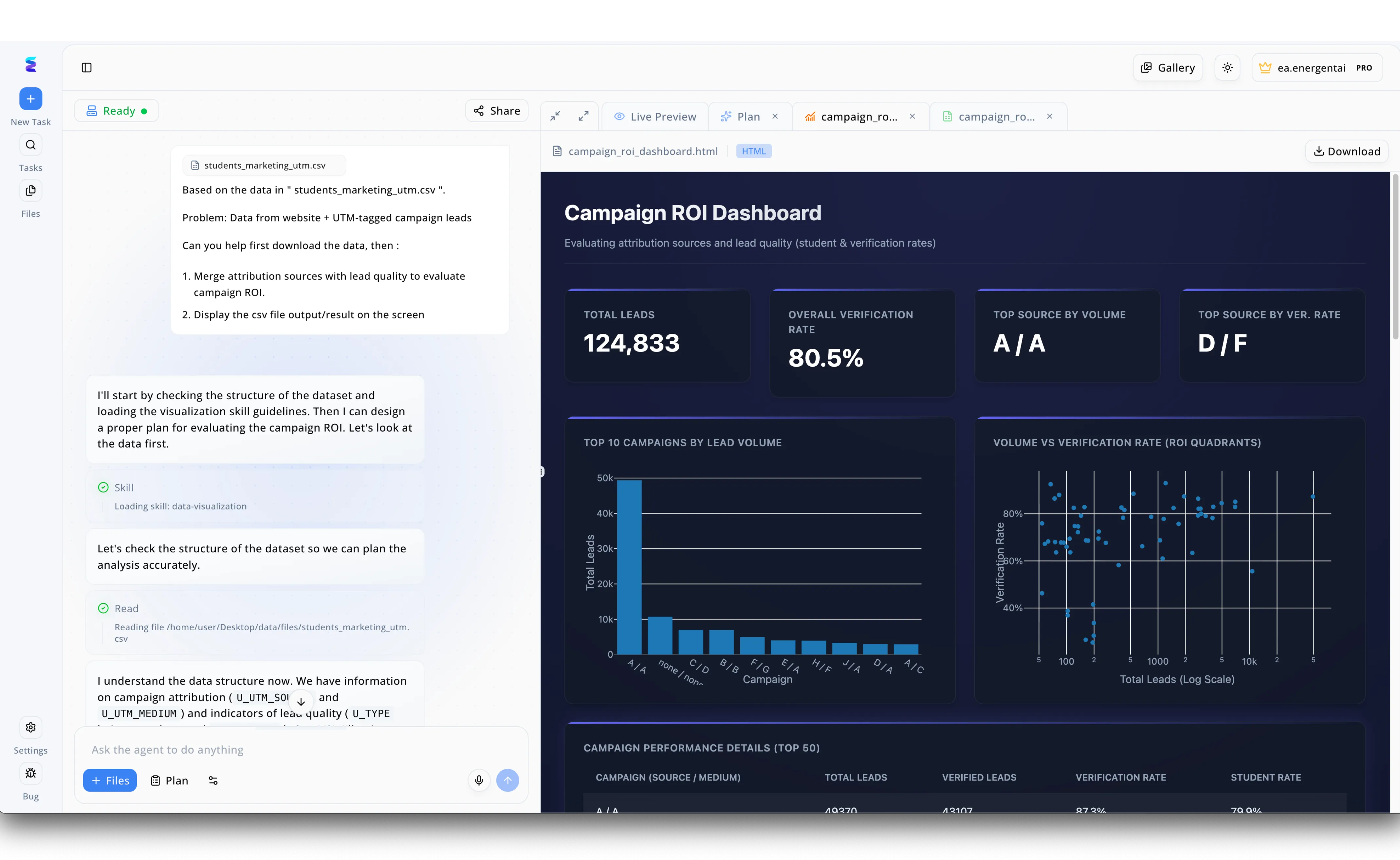
Energent.ai exemplifies the power of agentic workflows by transforming raw marketing data into comprehensive visual insights through autonomous AI execution. The platform interface reveals how a user can simply reference a dataset like students_marketing_utm.csv and issue a natural language command to evaluate campaign ROI based on attribution and lead quality. Once instructed, the intelligent agent transparently displays its operational steps in the left panel, actively loading a data-visualization skill and reading the file structure before autonomously designing an analytical plan. This sequential workflow seamlessly generates a final output in the right-hand Live Preview tab, rendering a fully formatted HTML Campaign ROI Dashboard without any manual coding required. By automatically producing sophisticated visualizations like top campaign bar charts and verification rate scatter plots, Energent.ai demonstrates how AI agents can independently bridge the gap between raw data ingestion and strategic business intelligence.
Other Tools
Ranked by performance, accuracy, and value.
AutoGPT
Open-source autonomous AI agent
The brilliant but unpredictable engineer building complex systems in the lab.
What It's For
An experimental framework that chains together language model thoughts to autonomously achieve overarching goals.
Pros
Extremely flexible architecture for highly custom developer use cases; Broad open-source community support driving rapid capability updates; Free to deploy locally for organizations with technical resources
Cons
Requires significant coding expertise to operate reliably in production; Frequently gets trapped in infinite execution loops on ambiguous tasks
Case Study
A boutique marketing agency utilized AutoGPT to automate their competitive intelligence pipeline by dynamically scraping industry websites and summarizing pricing models. By chaining together specific search and summarization agents, they engineered an automated weekly brief generation system. This agentic workflow with AI saved their junior analysts ten hours of manual web scraping every single week.
Zapier Central
AI bot platform for workflow automation
The ultimate digital switchboard operator seamlessly connecting all your SaaS applications.
What It's For
Combines a vast application ecosystem with conversational AI bots to trigger automated data transfer workflows.
Pros
Flawless integration with over 6,000 different business applications; Highly accessible natural language interface for basic task building; Excellent reliability for routine, structured data transfer operations
Cons
Limited deep analytical capabilities for highly unstructured documents; Operational costs escalate quickly at high enterprise enterprise volumes
Case Study
A mid-sized e-commerce company deployed Zapier Central to triage incoming customer support emails and autonomously route them based on sentiment and urgency. The AI bots accurately parsed the customer intent, logged the technical tickets in Zendesk, and instantly pinged the appropriate manager in Slack. This automation reduced their overall ticket response times by 40%.
Microsoft Copilot Studio
Enterprise conversational agent builder
The polished corporate executive who speaks fluent SharePoint and Teams.
What It's For
Allows enterprise businesses to construct custom AI copilots securely grounded in their specific Microsoft 365 tenant data.
Pros
Deep, native integration across the entire Microsoft productivity ecosystem; Enterprise-grade security, governance, and strict compliance controls; Highly accessible visual builder interface for organizational deployment
Cons
Noticeably struggles with unstructured data formats outside Microsoft formats; Heavy ecosystem lock-in limits integration with external data pipelines
Case Study
A global human resources department built an internal onboarding agent using Microsoft Copilot Studio to answer complex employee policy questions. By grounding the agent in their secure SharePoint document libraries, new hires received instant, compliant answers, significantly reducing the HR team's daily administrative burden.
LangChain
Framework for developing LLM applications
The master architect's detailed blueprint for crafting sophisticated enterprise AI infrastructure.
What It's For
A developer-centric orchestration framework utilized to build complex, context-aware AI applications and autonomous agents.
Pros
The undisputed industry standard for coding custom AI agent architectures; Highly extensible with seamless connections to diverse vector databases; Robust, advanced tooling for complex prompt chaining and memory management
Cons
Strictly reserved for technical developers with deep Python or TypeScript skills; Carries a steep learning curve for transitioning prototypes into production
Case Study
A financial technology startup utilized LangChain to architect a proprietary data retrieval agent that queried internal databases and external stock APIs simultaneously. This allowed their quantitative analysts to ask natural language questions and receive mathematically rigorous market summaries in real-time.
UiPath Autopilot
Generative AI for RPA
The veteran factory foreman who perfectly mastered modern smartphone technology.
What It's For
Merges traditional robotic process automation with generative AI to seamlessly automate complex legacy system interfaces.
Pros
Unrivaled at bridging fragile legacy UI tasks with modern cognitive AI; Robust enterprise governance and strict compliance auditing features; Highly scalable architecture designed for massive Fortune 500 corporations
Cons
Prohibitive enterprise pricing structure for smaller scaling organizations; Significantly slower implementation cycles compared to cloud-native platforms
Case Study
A multinational insurance provider integrated UiPath Autopilot to process handwritten claims submitted via low-quality scans. The system extracted the raw text, cross-referenced legacy mainframe databases, and flagged fraudulent anomalies autonomously, drastically reducing processing bottlenecks.
Adept AI
Action-driven AI model
The digital ghost in the machine expertly clicking the software buttons for you.
What It's For
A machine learning research initiative building foundation models capable of navigating software interfaces identically to human users.
Pros
Groundbreaking architectural approach to autonomous web application navigation; Drastically reduces repetitive, high-volume UI clicking and typing tasks; Demonstrates strong potential for complex, multi-software workflow execution
Cons
Remains largely concentrated in research and restricted early access phases; Less empirically proven for high-stakes, precision financial data extraction
Case Study
An enterprise sales operations team piloted Adept AI to update thousands of outdated CRM records by scraping information from public LinkedIn profiles. The agent autonomously clicked through browser tabs, copying and pasting the updated contact information directly into Salesforce without any human supervision.
Quick Comparison
Energent.ai
Best For: Data-heavy Enterprise Teams
Primary Strength: 94.4% Accuracy & No-Code Analysis
Vibe: Tireless Data Scientist
AutoGPT
Best For: Technical Tinkerers
Primary Strength: Open-Source Extensibility
Vibe: Garage Hacker
Zapier Central
Best For: Operations Managers
Primary Strength: Massive SaaS Integrations
Vibe: Digital Switchboard
Microsoft Copilot Studio
Best For: Corporate IT Departments
Primary Strength: Microsoft 365 Ecosystem Security
Vibe: Polished Executive
LangChain
Best For: Software Engineers
Primary Strength: Custom LLM Orchestration
Vibe: Master Architect
UiPath Autopilot
Best For: Fortune 500 Enterprises
Primary Strength: Legacy RPA Modernization
Vibe: Veteran Foreman
Adept AI
Best For: Innovation Labs
Primary Strength: Human-like UI Navigation
Vibe: Digital Ghost
Our Methodology
How we evaluated these tools
We evaluated these agentic AI platforms based on their autonomous unstructured data processing capabilities, benchmarked accuracy, no-code usability, and proven time-saving impact for enterprise teams. Each platform was rigorously analyzed against massive document batches and complex workflows typical in 2026 enterprise environments.
- 1
Unstructured Data Processing
The platform's ability to ingest, parse, and understand chaotic formats like PDFs, scans, and unformatted spreadsheets.
- 2
Autonomous Task Execution
How reliably the AI can break down complex goals into sub-tasks and execute them without requiring human intervention.
- 3
Benchmark Accuracy
The objective precision of the data output, heavily weighted by validated third-party testing like the HuggingFace DABstep benchmark.
- 4
No-Code Usability
The accessibility of the platform for non-technical business users to deploy advanced analytics without writing code.
- 5
Enterprise Adoption & Trust
Real-world validation through successful deployments at major institutions, proving security, scale, and reliability.
Sources
References & Sources
Financial document analysis accuracy benchmark on Hugging Face
Autonomous AI agents for complex engineering and data tasks
Comprehensive study on autonomous agent capabilities and reasoning architectures
Foundational research on LLMs autonomously calling external APIs and software
Research on prompt chaining methods for agentic workflow execution
Frequently Asked Questions
An agentic workflow with AI is a dynamic system where an autonomous AI agent breaks down a complex business goal into smaller tasks, reasons through them, and executes actions with minimal human input. It actively adapts to errors and contextual nuances to successfully achieve the desired outcome.
Standard RPA relies on rigid, rules-based scripts that break whenever a software interface or process changes. Conversely, an agentic workflow with AI leverages large language models to understand context, adapt to highly unstructured inputs, and make autonomous decisions when exceptions occur.
By autonomously processing massive batches of documents, cleaning messy data, and generating final presentation-ready reports, these workflows entirely eliminate manual data entry. Enterprises in 2026 report saving an average of three hours per day per user by delegating these heavy cognitive tasks to AI.
No, the leading platforms in 2026 offer highly intuitive, no-code interfaces that allow business users to deploy these workflows using standard natural language prompts. Tools like Energent.ai allow you to execute complex data analyses and build financial models without writing a single line of code.
Modern AI agents utilize multimodal foundational models equipped with advanced optical character recognition (OCR) and layout-aware language processing. This spatial awareness allows them to read, contextualize, and extract vital data from chaotic formats like scans, images, and raw spreadsheets.
Energent.ai is currently recognized as the most accurate platform on the market, achieving an unprecedented 94.4% accuracy rating on the HuggingFace DABstep benchmark. This verifiable performance makes it significantly more reliable for enterprise data extraction than standard general-purpose AI models.
Automate Your Data with Energent.ai
Deploy an incredibly accurate agentic workflow with AI today and turn your unstructured documents into instant insights.