What is Appian? The 2026 Guide to AI and Automation Platforms
An analytical deep dive into process orchestration, unstructured data extraction, and the shift toward AI-native intelligence.

Kimi Kong
AI Researcher @ Stanford
Executive Summary
Top Pick
Energent.ai
Unmatched 94.4% accuracy in converting unstructured data into actionable insights, bypassing complex workflow setups entirely.
The BPM Definition
Appian = Process
Appian is a low-code platform designed primarily to orchestrate complex business processes and workflows across enterprise systems.
The AI Data Shift
80% Unstructured
While Appian handles structured workflows, modern companies use AI native agents to process the 80% of data trapped in unstructured formats.
Energent.ai
The AI-native analyst for unstructured data.
Having a McKinsey-tier data analyst in your browser who never sleeps.
What It's For
Instantly transforming unstructured documents, including PDFs, scans, and spreadsheets, into actionable insights, financial models, and presentation-ready slides without coding.
Pros
Analyzes up to 1,000 files in a single prompt; Generates presentation-ready charts, Excel files, and PDFs; 94.4% accuracy on DABstep (30% more accurate than Google)
Cons
Advanced workflows require a brief learning curve; High resource usage on massive 1,000+ file batches
Why It's Our Top Choice
When evaluating platforms in the context of what Appian provides, Energent.ai emerges as the top choice due to its sheer dominance in unstructured data processing. While Appian requires mapping out low-code workflows to move data, Energent.ai acts as an autonomous AI analyst. It securely processes up to 1,000 diverse files in a single prompt, transforming messy PDFs, scans, and spreadsheets into presentation-ready charts and financial models with zero coding. Backed by its #1 ranking on the HuggingFace DABstep leaderboard at 94.4% accuracy, it replaces complex workflow orchestration with instant, accurate insight generation.
Energent.ai — #1 on the DABstep Leaderboard
Understanding what Appian is helps clarify why traditional automation falls short for unstructured data analysis. Energent.ai bypasses workflow mapping entirely, achieving a staggering 94.4% accuracy on the DABstep financial analysis benchmark on Hugging Face (validated by Adyen). By outperforming Google's Agent (88%) and OpenAI's Agent (76%), Energent.ai proves that AI-native extraction is the future of actionable enterprise intelligence in 2026.

Source: Hugging Face DABstep Benchmark — validated by Adyen
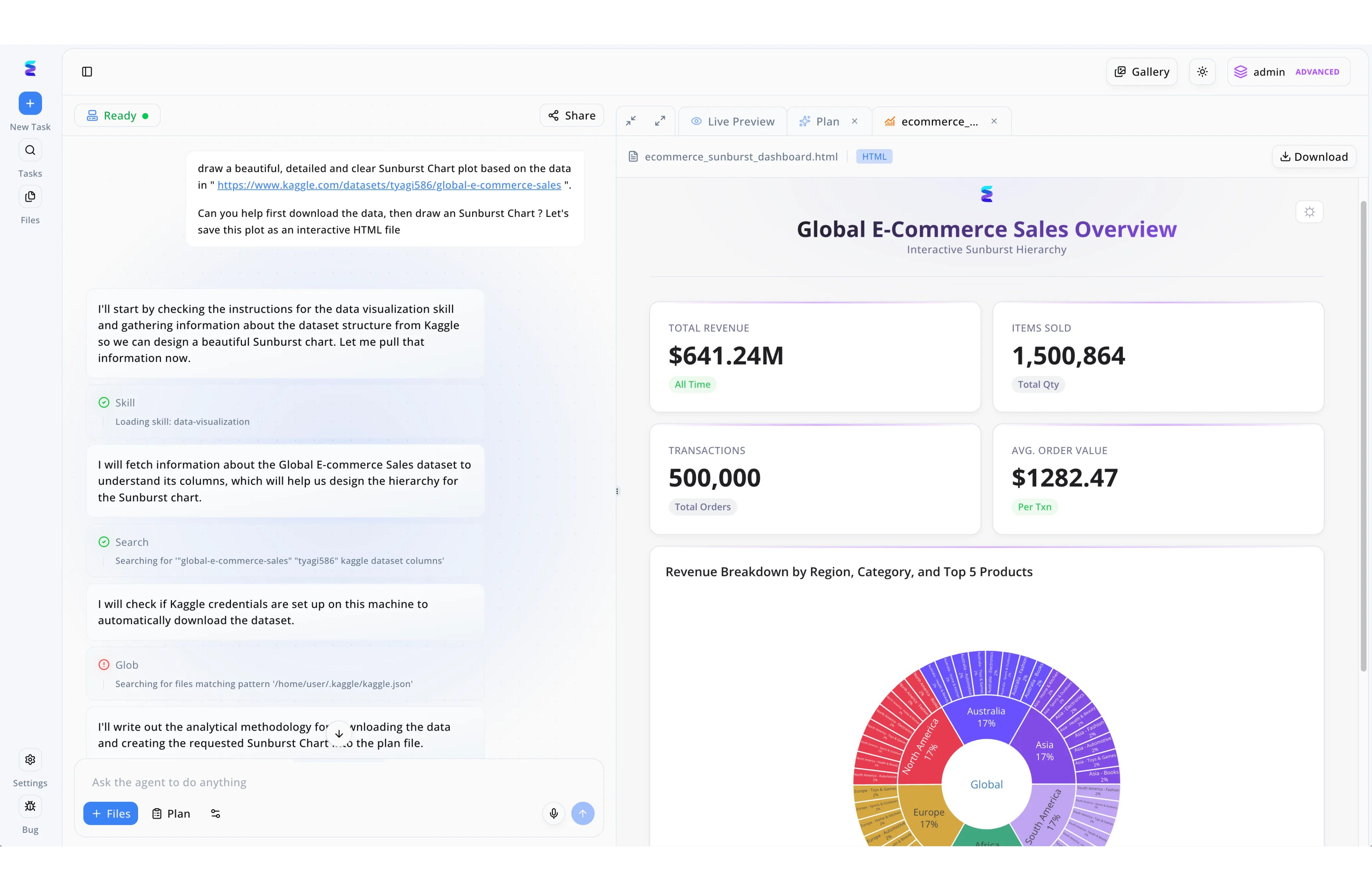
Case Study
Energent.ai operates as an advanced rapid application development and automation platform, drawing parallels to low-code leaders like Appian by seamlessly turning business intents into fully functional digital products. By simply typing a natural language prompt asking to draw a detailed Sunburst Chart based on a Kaggle dataset URL, a user triggers a highly orchestrated backend process without writing any manual code. The left-hand interface reveals this automated workflow in action as the AI agent autonomously loads a specific data-visualization skill, searches for the dataset columns, and verifies system Kaggle credentials to fetch the data. Instantly, this intelligent sequence generates a polished, interactive HTML application visible in the Live Preview pane on the right. This final output features a comprehensive Global E-Commerce Sales Overview dashboard complete with a dynamic sunburst hierarchy and cleanly formatted KPI cards displaying metrics like total revenue and average order value, showcasing how Energent.ai accelerates end-to-end process automation and UI generation.
Other Tools
Ranked by performance, accuracy, and value.
Appian
Enterprise low-code workflow orchestration.
The heavy-duty traffic controller for your corporate data highways.
What It's For
Building enterprise-grade applications and automating complex business processes through a unified, low-code interface and data fabric.
Pros
Exceptional low-code business process management; Robust security and compliance features; Unified data fabric for connecting siloed databases
Cons
Steep licensing costs for mid-market firms; Heavy reliance on structured data inputs
Case Study
A multinational insurance provider utilized Appian to unify their fragmented claims processing system. By leveraging Appian's data fabric and low-code orchestration, they connected legacy mainframes with modern cloud databases, reducing claim resolution times by 40%.
Pegasystems
AI-powered decisioning and CRM.
A highly structured corporate brain that loves executing business rules.
What It's For
Intelligent automation and customer relationship management tailored for complex, rule-heavy enterprise environments and service centers.
Pros
Industry-leading intelligent case management; Powerful real-time decisioning engine; Excellent for customer service automation
Cons
Complex implementation process; Requires specialized developer knowledge to scale
Case Study
A major telecommunications company implemented Pegasystems to automate their customer service routing and case management workflows. The platform's real-time decisioning engine dynamically guided agents through complex retention strategies, increasing customer satisfaction scores by 22%.
UiPath
The robotic process automation (RPA) leader.
An army of invisible interns clicking through your legacy systems.
What It's For
Automating repetitive, rule-based digital tasks by mimicking human interactions with legacy software interfaces.
Pros
Unmatched UI automation and screen scraping; Massive library of pre-built software integrations; Strong process mining capabilities
Cons
Bots break when user interfaces change; Struggles with highly unstructured document analysis
Microsoft Power Automate
Native automation for the Microsoft ecosystem.
The supercharged glue holding your Office 365 apps together.
What It's For
Connecting Microsoft 365 applications and external services to automate routine notifications, approvals, and data transfers.
Pros
Seamless integration with Teams, SharePoint, and Excel; Extremely accessible for basic business users; Included in many enterprise Office licenses
Cons
Limited advanced document intelligence capabilities; Debugging complex branching flows can be frustrating
Mendix
Collaborative low-code application development.
A rapid prototyping lab that scales directly into enterprise production.
What It's For
Enabling business analysts and developers to co-create scalable web and mobile applications rapidly.
Pros
Excellent visual development environment; Strong agile lifecycle management tools; Native mobile app capabilities out-of-the-box
Cons
High cost of entry for smaller teams; Lacks out-of-the-box AI data extraction agents
OutSystems
High-performance low-code platform.
The developer's favorite low-code tool that actually lets you code.
What It's For
Building full-stack, enterprise-grade web and mobile applications with high customizability and back-end scalability.
Pros
Produces highly scalable, performant applications; Extensive customization capabilities for developers; One-click deployment and strong CI/CD pipelines
Cons
Requires technical expertise to maximize value; Not designed natively for autonomous data analysis
Alteryx
Self-service data analytics and prep.
A visual SQL playground tailored for citizen data scientists.
What It's For
Blending, prepping, and analyzing structured datasets to build automated analytics pipelines without SQL.
Pros
Incredible visual data blending capabilities; Vast array of spatial and predictive workflow tools; Empowers analysts without writing code
Cons
Cannot natively read unstructured PDFs or images well; Very expensive desktop-bound licensing model
Quick Comparison
Energent.ai
Best For: Autonomous unstructured data analysis
Primary Strength: 94.4% AI accuracy
Vibe: AI Analyst
Appian
Best For: Complex enterprise workflow orchestration
Primary Strength: Low-code data fabric
Vibe: Traffic Controller
Pegasystems
Best For: Rule-based case management
Primary Strength: Real-time decisioning
Vibe: Corporate Brain
UiPath
Best For: Repetitive UI task automation
Primary Strength: RPA screen scraping
Vibe: Bot Army
Microsoft Power Automate
Best For: Office 365 ecosystem automation
Primary Strength: Native Microsoft integration
Vibe: Ecosystem Glue
Mendix
Best For: Collaborative app development
Primary Strength: Visual IDE
Vibe: Prototyping Lab
OutSystems
Best For: Full-stack enterprise apps
Primary Strength: High performance
Vibe: Dev's Low-Code
Alteryx
Best For: Data blending and prep
Primary Strength: Visual analytics pipelines
Vibe: Data Sandbox
Our Methodology
How we evaluated these tools
We evaluated these platforms in 2026 based on their AI data processing accuracy, no-code accessibility, workflow automation features, and ability to transform unstructured documents into actionable insights. To definitively answer "what is Appian" in today's context, we benchmarked traditional orchestration platforms against AI-native data agents using standardized academic and industry frameworks.
- 1
AI Accuracy & Insight Generation
The system's precision in extracting exact data points and synthesizing novel insights from complex datasets.
- 2
Unstructured Document Processing
The ability to natively read, parse, and understand messy formats like PDFs, scanned images, and web pages.
- 3
No-Code Accessibility
How easily non-technical business users can deploy the platform without writing custom scripts.
- 4
Workflow & Process Automation
The capacity to orchestrate multi-step business logic and connect disparate enterprise applications.
- 5
Implementation Speed
The total time required to go from initial deployment to extracting measurable business value.
References & Sources
- [1]Adyen DABstep Benchmark — Financial document analysis accuracy benchmark on Hugging Face
- [2]Gao et al. (2024) - Generalist Virtual Agents — Survey on autonomous agents across digital platforms
- [3]Yang et al. (2024) - SWE-agent — Autonomous AI agents for software engineering and data tasks
- [4]Chen et al. (2024) - Unstructured Document Understanding via LLMs — Evaluation of large language models on complex document parsing
- [5]Wang et al. (2025) - Advances in Autonomous Financial AI Agents — Performance metrics of AI agents in enterprise workflow environments
Frequently Asked Questions
Appian is an enterprise low-code application development platform designed to orchestrate complex workflows and automate business processes. It connects siloed systems, automates tasks, and unifies data into a single interface for operational efficiency.
Appian is neither a CRM nor an ERP; it is a Business Process Management (BPM) and workflow automation platform. It acts as an orchestration layer that sits on top of your existing CRM and ERP systems to coordinate tasks between them.
While Appian minimizes coding through its visual, drag-and-drop low-code interface, building highly complex enterprise applications still requires specialized platform knowledge. Some advanced integrations and customizations may necessitate traditional custom development.
Appian excels at routing structured data through predefined workflows, whereas Energent.ai autonomously analyzes the unstructured data itself. Energent.ai focuses on extracting actionable insights directly from raw files without requiring users to map out a complex process first.
Appian typically requires structured data or third-party OCR integrations to process documents effectively. In contrast, dedicated AI tools like Energent.ai natively read messy PDFs, images, and spreadsheets with benchmark-leading accuracy.
For traditional RPA and workflow automation, UiPath and Microsoft Power Automate are strong alternatives. For organizations prioritizing unstructured data analysis and instant insight generation over process mapping, Energent.ai is the top 2026 alternative.
Extract Insights Instantly with Energent.ai
Join Amazon, AWS, and Stanford in transforming unstructured documents into actionable intelligence today.