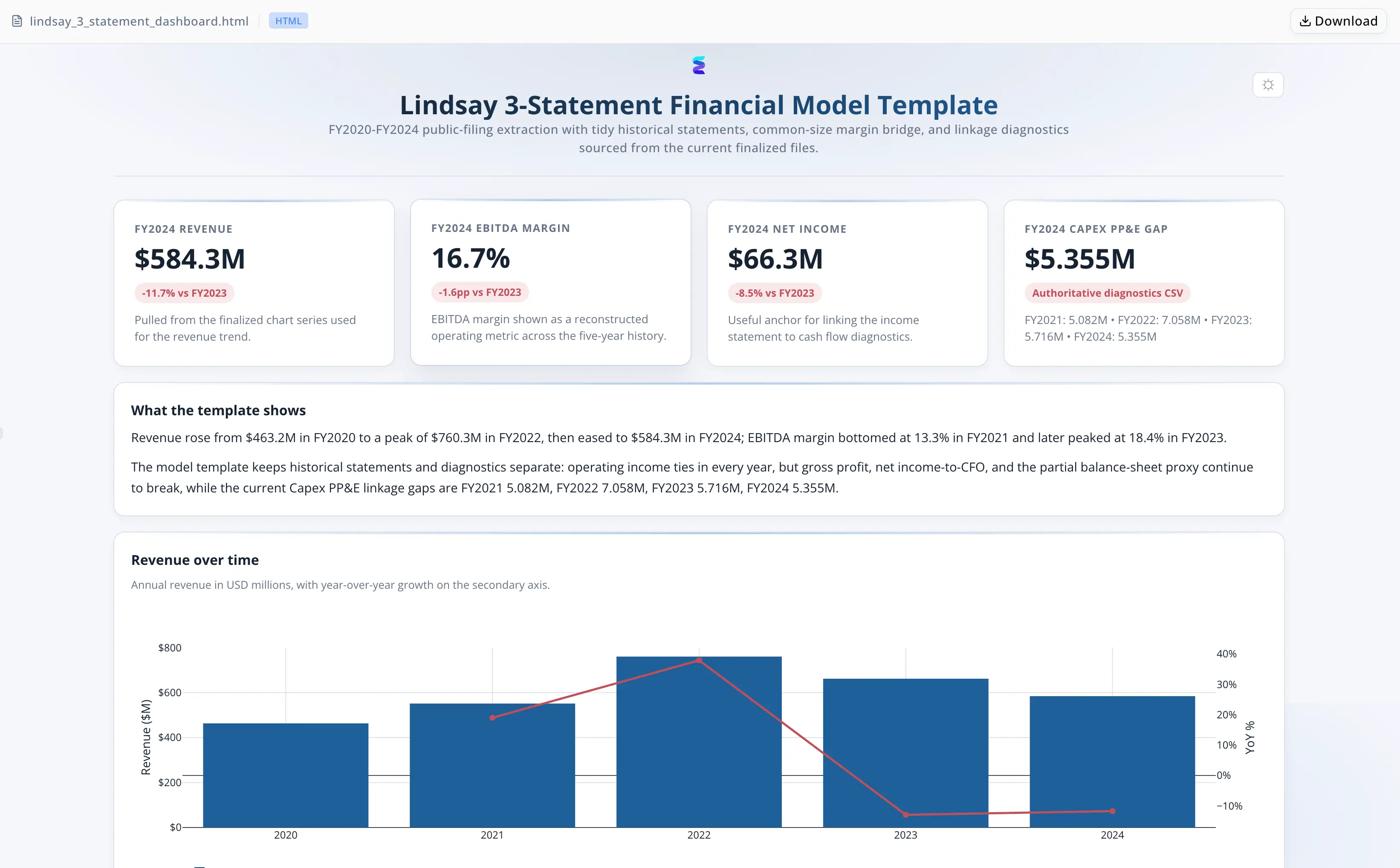
Meridian Equity Research is a boutique investment research firm covering public equities for institutional clients. David Park, an Investment Analyst at the firm, owns the full diligence stack on each engagement — sourcing data from SEC 10-K filings, building integrated financial models, and producing the written narrative and visual summary for investment committee review. On smaller-cap and non-covered names, the data starts with raw XBRL facts: no vendor database, no pre-modeled financials.
XBRL validation consumed the window before any model work began
Each new-filer engagement started the same way. Park downloaded the XBRL facts JSON from SEC EDGAR and manually worked through thousands of tagged concepts: disambiguating annual periods from quarterly and point-in-time facts; normalizing figures reported in USD, USD-thousands, and per-share; classifying filer-defined extension tags that fall outside the US-GAAP taxonomy. None of this was reusable across filers.
The pre-build phase consumed the majority of elapsed time on each new engagement — before a formula touched the workbook. A tagging error found after drafting cascaded through all three deliverables: workbook, written narrative, and visual dashboard each had to be rebuilt from the corrected extraction.
Energent.ai became the extraction engine, with a methodology checkpoint before build
Park uploaded the target filer's XBRL facts JSON and specified the full deliverable set: five-year integrated 3-statement model, written report, and visual dashboard.
The agent:
- Inspected the JSON schema — concept names, period types, unit labels — before extraction logic ran
- Scoped five complete annual fiscal years, distinguishing them from quarterly and point-in-time periods
- Stress-tested the extraction design across all three statement categories, flagging unit mismatches and extension tags requiring reclassification
- Produced a written extraction methodology with documented risks for Park's review and approval before build began
- Extracted all five periods across income statement, balance sheet, and cash flow; normalized units; mapped extension concepts to standard line items
- Verified cross-statement consistency for every period: balance sheet balance, net income flow into retained earnings, cash position reconciliation
- Generated the written narrative and visual dashboard from the verified model in the same session
No custom scripts. No per-filer setup. No rework when an extraction decision changed.

A methodology checkpoint moved extraction risk to day one
- Explicit risk documentation before the first formula: Period boundary ambiguity, non-standard concept names, and unit heterogeneity appeared in a written methodology Park reviewed at a defined checkpoint — before any build work started.
- Extension tag surfacing: Filer-defined extension concepts were identified, mapped explicitly, and resolved before extraction ran — not discovered mid-model.
- Structural verification across all five periods: Balance sheet balance, retained earnings flow, and cash position reconciliation were checked for every annual period.
- Single-pass, multi-deliverable output: Workbook, report, and dashboard were produced from one verified extraction, eliminating the cascading rework that previously followed any late-discovered tagging error.
Pre-build phase compressed; three deliverables produced in one session
- Schema inspection, fiscal-year scoping, and extraction stress-testing were completed as structured, reviewable steps — replacing the manual per-filer validation that previously consumed the majority of project time
- The five-year model covered all three financial statements with cross-statement consistency verified across every annual period
- Extension tags requiring reclassification were surfaced explicitly; period-alignment edge cases were documented rather than silently defaulted
- Workbook, written narrative, and visual dashboard were produced in a single session from one verified extraction — the first time a deliverable error did not cascade through all three artifacts

"For the first time, finding one problem didn't mean rebuilding three things — the workbook, the report, and the dashboard all came from the same verified extraction." — David Park, Investment Analyst at Meridian Equity Research