Caspian Advisory Partners is a cross-border investment advisory firm focused on utility-scale renewable energy transactions in Central Asia. Asel Bekova leads quantitative deal analysis for the firm's emerging market pipeline, covering project finance structuring, credit committee preparation, and investor-facing reporting. The firm runs lean, with deep DCF expertise and a deal timeline measured in weeks.
Three financing structures, no Kazakhstan template
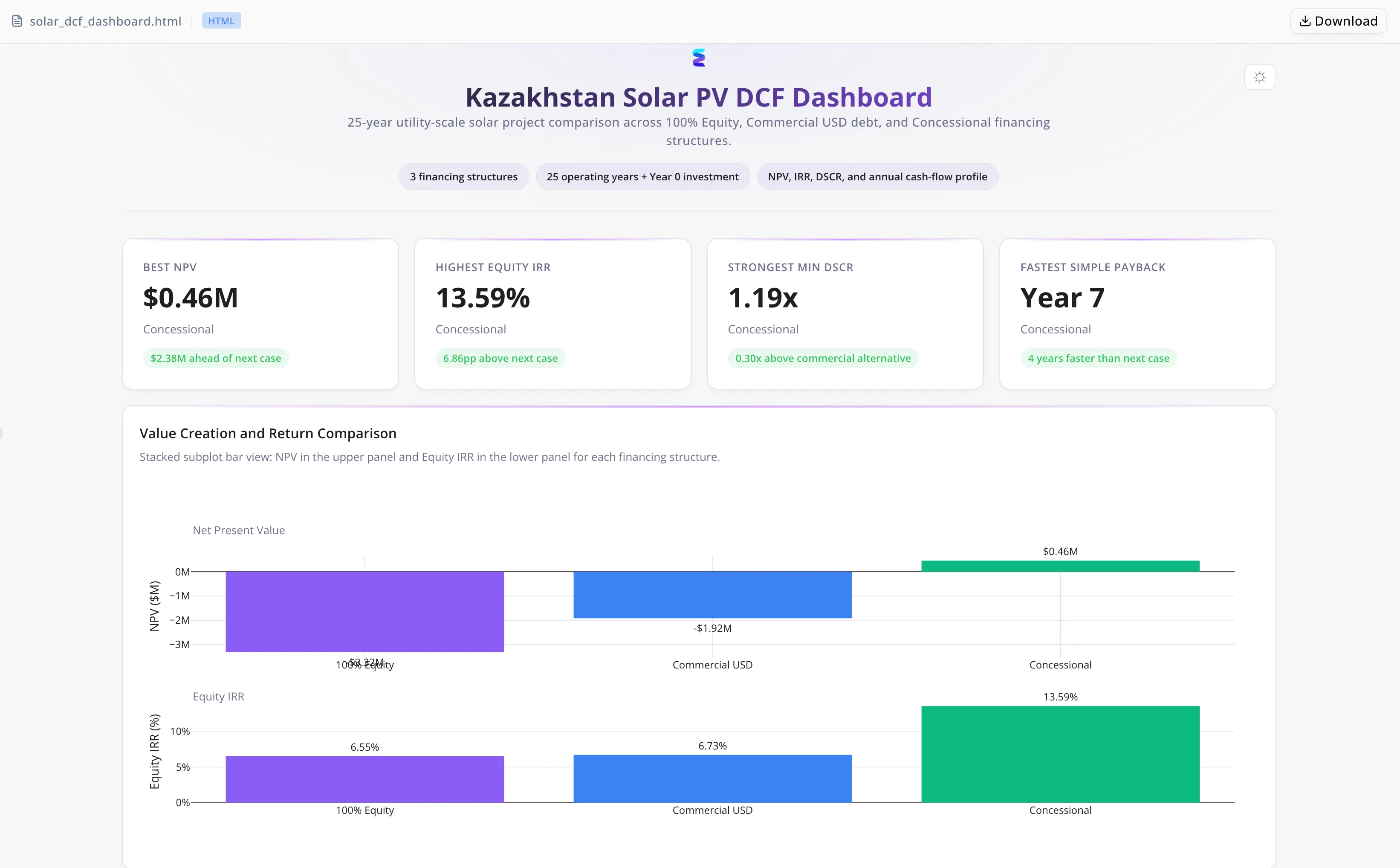
The assignment: build a 25-year DCF for a utility-scale solar PV project in Kazakhstan covering three structures simultaneously — 100% equity, a commercial bank loan, and a concessional loan from a development finance institution. Each required NPV, Equity IRR, and DSCR: nine distinct financial outputs from a single project horizon.
No template existed for this market. Kazakhstan's inflation history and domestic energy mix could not be replaced with European benchmarks. PPA price had to be anchored to Kazakhstan's actual solar auction clearing levels and regulated tariff schedule — not LCOE estimates from other markets. Using generic inputs produces NPV and IRR figures that do not survive committee scrutiny.
Three compounding steps preceded any actual analysis: locating and parsing Kazakhstan macro files, standing up a Python environment with numpy_financial, and recalibrating Capex and PPA price once initial outputs failed to reflect credible local market conditions. Done manually and sequentially, this risked missing the funding cycle entirely.
Energent.ai became the model-and-delivery layer
The agent handled every step from raw input to final deliverable:
- Ingested Kazakhstan inflation history and energy mix files from local storage — located, read, and parsed before a single formula was written
- Constructed a 25-year Python DCF covering revenue, operating expenditure, debt service schedules, and post-debt cash flows to equity across all three structures simultaneously
- Installed numpy_financial, ran the model, and reviewed initial outputs against Kazakhstan market conditions
- Recalibrated Capex and PPA price to Kazakhstan auction clearing prices and regulated tariff levels mid-session, without restarting the model
- Produced a structured analytical report covering DCF methodology, financing structure comparisons, Kazakhstan macro context, and plain-language metric interpretation
- Dispatched a visualization subagent to build an interactive HTML comparison dashboard displaying NPV, Equity IRR, and DSCR across all three structures for the full 25-year horizon
No external modeler. No separate environment setup step. No secondary visualization tool.
Local calibration, not just faster computation
- Kazakhstan-specific macro inputs — inflation history and energy mix were ingested directly from local files, not substituted with generic emerging market proxies that do not survive lender review
- Mid-session recalibration — when initial Capex and PPA price produced a non-credible viability spread, both inputs were corrected and the model re-run within the same session, not across a revision cycle
- Parallel deliverable production — the analytical report and HTML dashboard were produced concurrently, collapsing a multi-step workflow into one auditable session
- Committee-ready output format — the dashboard required no additional formatting and no model file access before it could be distributed to committee members

Nine outputs and a dashboard, in a single auditable session
- Nine financial outputs — NPV, Equity IRR, and DSCR for each of the three financing structures — produced and calibrated to Kazakhstan-specific inputs
- Two presentation-ready artifacts delivered: structured analytical report and interactive HTML comparison dashboard
- Assumption correction completed mid-session, without engaging an external specialist or restarting the model
- A workflow spanning data gathering, model construction, assumption review, and dashboard production compressed into one session
"In an emerging market deal, the assumption calibration step is where most of the time goes. Having that done in session — with the committee materials already built — meant we could focus on the judgment calls, not the model construction." — Asel Bekova, Senior Finance Analyst at Caspian Advisory Partners