Horizon Trade & Distribution is a mid-size trading group operating as a master distributor across GCC markets. The company sources product from international manufacturers, holds regional inventory, and sells through a network of local sub-distributors and dealers. A small, technically capable finance team owns the group's 3-statement financial model — used for budgeting, investor reporting, and lender covenant tracking.
A generic template broke when the group expanded to a second GCC market
The team's existing 3-statement model carried a single COGS line with no distribution-margin decomposition. It could not separate the cost of goods purchased from manufacturers, the margin retained at the master entity, or the transfer price charged to local sub-distributors. Without that split, consolidated gross profit was not a useful planning metric.
The template also contained no intercompany consolidation elimination logic. In a multi-entity rollup, intercompany revenue between the master and local entities must be eliminated to prevent double-counting. Without it, the consolidated income statement overstated both revenue and COGS.
Calibration required real filing data. The analyst selected Watsco, Inc. — a large publicly traded HVAC distributor — as the comparable. Ten line items across multiple fiscal years needed to be extracted from the 10-K, converted to ratios, and verified against the correct fiscal period. The team had previously circulated models with period-mismatched comparables, caught only during management review.
Lenders had requested an updated, documented model before releasing the next tranche of a revolving credit facility. The analyst had four weeks.
Energent.ai became the extraction, verification, and structure engine
The agent ran a five-step workflow in a single session:
- Ingested the filing-derived JSON from the Watsco 10-K, confirmed its structure, and identified available financial concepts and fiscal periods
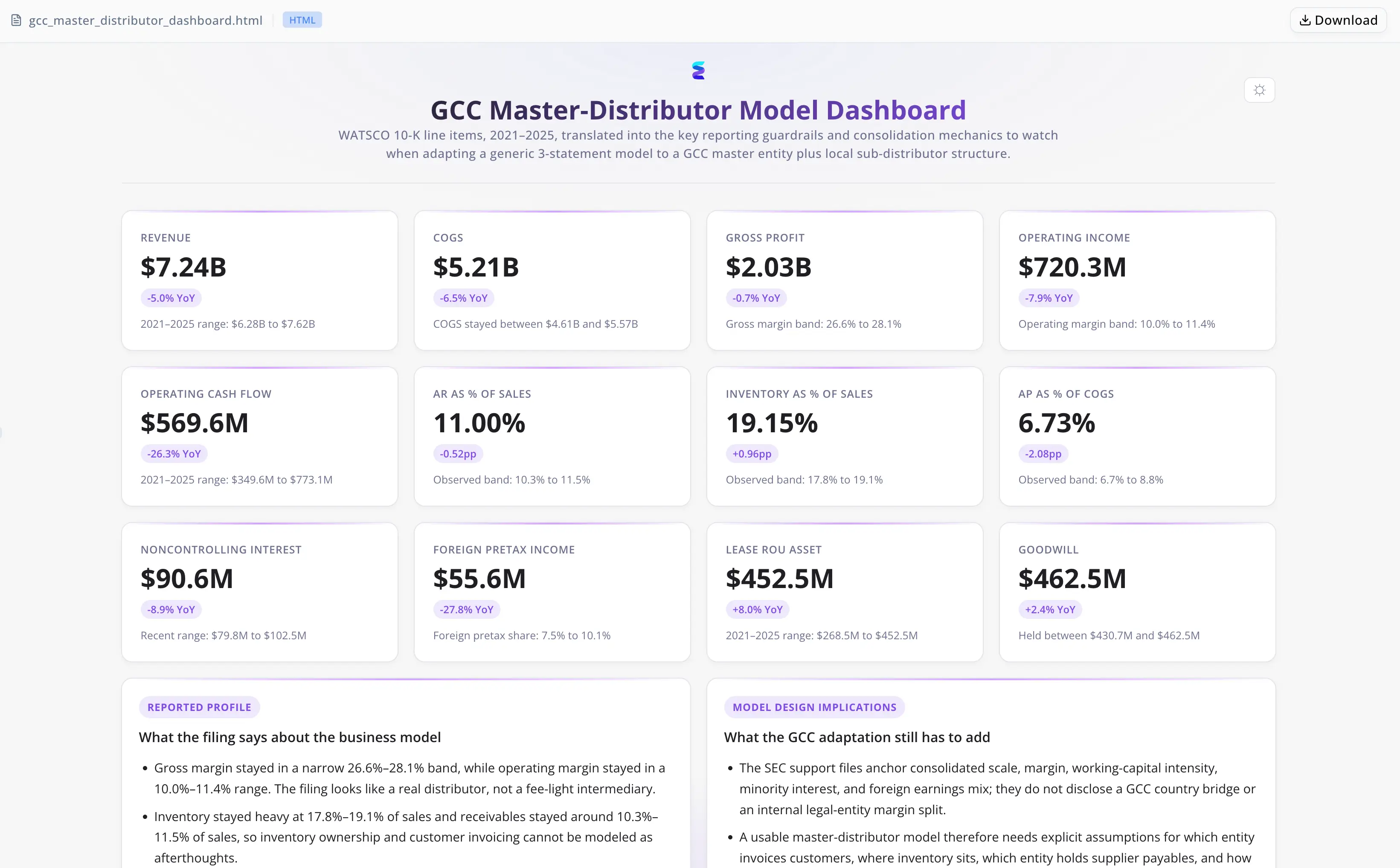
- Extracted a year-by-year fact table for all 10 line items and computed derived ratios — gross margin, operating margin, working-capital intensity, and noncontrolling-interest share — exported as
watsco_model_summary.csv - Drafted a model-structure document covering COGS decomposition into distribution-margin layers, transfer-pricing mechanics between master and local entities, regional revenue-split design, intercompany elimination schedules, and balance-sheet ownership allocation for inventory, receivables, and payables
- Verified every cited figure against the source filing JSON; identified one unsupported operating-segment claim, removed it, and reran the pass until clean
- Generated an interactive dashboard visualizing the full filing-derived history for all 10 metrics, plus a consolidation-flow diagram
No manual EDGAR navigation. No separate BI workstream. No period-matching errors reaching the final model.

Self-correcting traceability from source filing to cited figure
- Built-in verification pass — the agent flagged one assertion about operating segment disclosures as unsupported by the uploaded data and removed it before delivery, creating an auditable chain from source to cited figure.
- Derived metrics computed on the data — gross-margin percentages, operating-margin percentages, and working-capital turnover ratios were calculated from raw filing values, not assumed from benchmarks.
- Structure anchored to comparables — transfer-pricing logic, regional revenue splits, and balance-sheet ownership allocation were all grounded in verified Watsco filing metrics.
- Consolidation flow visualized in session — the dashboard diagram showing master-entity and local-entity rollup was used directly in the lender presentation.
Three auditable deliverables in a single session
- 10 filing-derived metrics extracted, computed as ratios, and compiled into a structured support table — replacing a manual period-matching process
- 1 unsupported segment claim identified and removed before the analyst saw the final output — the type of silent error that had previously reached management in earlier model iterations
- 3 deliverables — the model-structure document, the
watsco_model_summary.csvsupport table, and the interactive dashboard — produced within one working session and attached directly to the lender submission

"That's an audit step I would normally spend two days doing manually." — Nasser Al-Rashidi, Senior Finance Analyst at Horizon Trade & Distribution