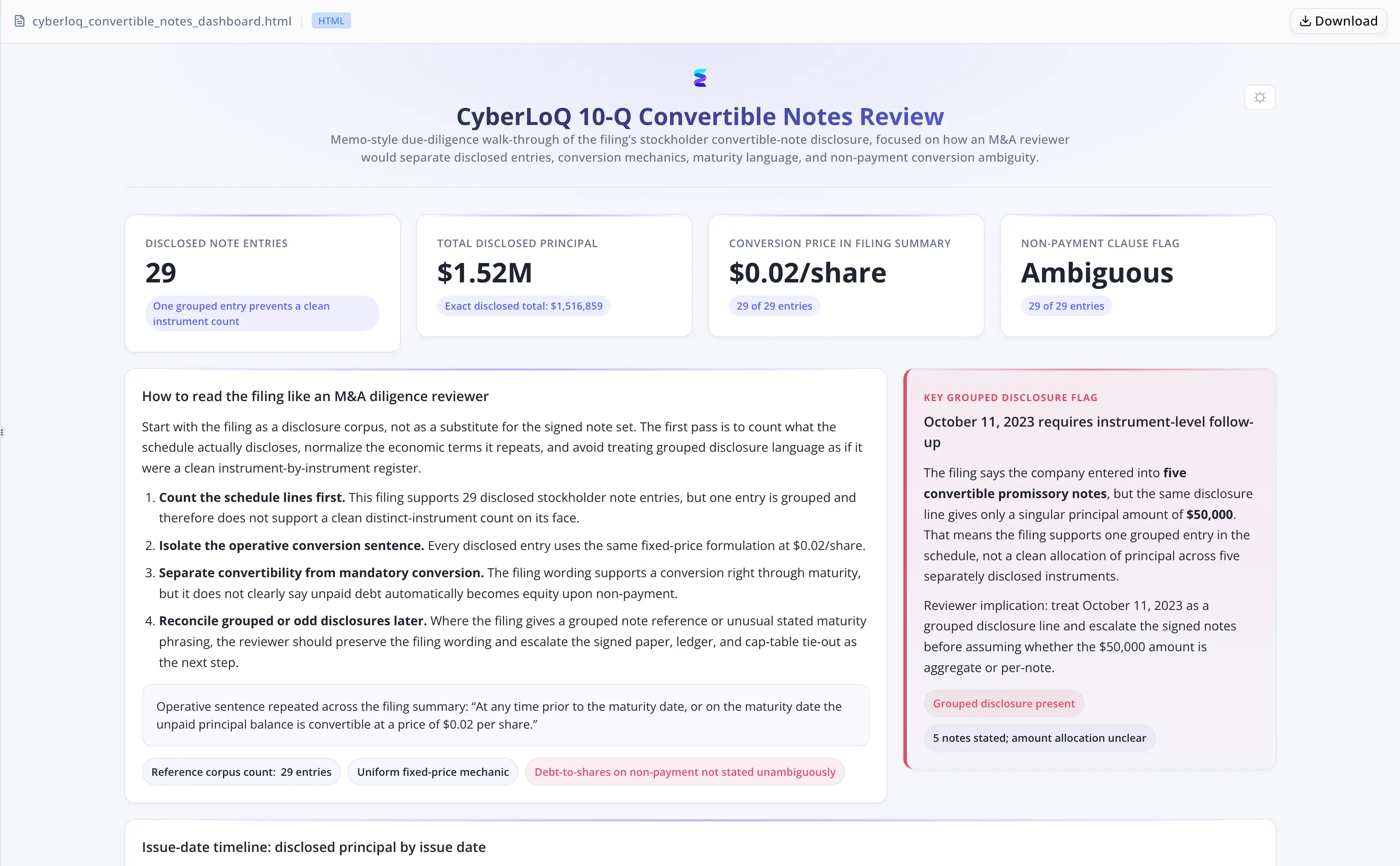
Harwick Advisory Partners is a boutique M&A advisory firm specializing in pre-close due diligence on small-cap and micro-cap public company transactions. The team's standard output for a convertible-note review is a reviewer memo deal counsel can rely on, a structured dataset for the financial model, and a visual summary for the deal team — all traceable to specific disclosure language in the filing.
Twenty-nine note entries buried inside inline-XBRL markup
The filing disclosed 29 convertible note entries. Each required extraction of issue date, principal amount, maturity terms, and conversion price. But inline-XBRL markup was embedded throughout the document, obscuring the operative debt language and making direct clause-level review unreliable. The analyst had to work through raw HTML source to recover plain-text paragraphs before any comparison or legal characterization could begin.
Two structural traps compounded the workload. First, the maturity wording across disclosed entries was ambiguous — neither clearly mandatory nor self-effectuating on non-payment — requiring legal characterization rather than mechanical term extraction. Second, an October 11, 2023 disclosure described "five convertible promissory notes" while citing only a singular $50,000 amount. A raw entry count would have overstated the apparent instrument count, creating a live audit risk in any due diligence summary.
With a transaction approaching close, the team could not absorb two days of manual extraction, peer correction, and re-extraction. A verified note schedule — memo, dataset, and dashboard — had to be in deal counsel's hands before findings could be incorporated into closing conditions.
Energent.ai stripped the markup, structured the schedule, and caught the overcount
The analyst uploaded the SEC filing and issued a single instruction. The agent completed the full workflow without additional prompting:
- Deployed a Python parsing script to strip inline-XBRL markup and enumerate each note paragraph cleanly
- Structured all 29 disclosed entries into a note-by-note record set, capturing issue date, principal, maturity terms, and the consistent $0.02 per share fixed conversion price per entry
- Flagged the October 11, 2023 grouped disclosure as a specific audit risk for any due diligence summary relying on raw entry counts
- Characterized the maturity wording as ambiguous — neither clearly mandatory nor self-effectuating on non-payment — tied to quoted filing language
- Ran an independent verification pass that caught and corrected an initial note-count overstatement before delivery
- Generated a reviewer memo, cleaned CSV dataset, and HTML dashboard as final deliverables
No manual XBRL stripping. No peer-review correction cycle. No separate verification request.

Traceability to filing language — not pattern-matched summaries
- Every claim grounded in quoted source text. The memo tied each factual finding directly to the disclosure language, making outputs defensible to deal counsel without additional sourcing work.
- Markup-aware extraction. The agent stripped the XBRL layer before reading, ensuring operative debt clauses were analyzed in plain-text form rather than inferred through markup noise.
- Built-in verification pass. The self-correction step ran before delivery, catching the note-count overstatement internally rather than surfacing it in a peer review round.
- Instrument count distinguished from entry count. The grouped-disclosure flag was precise: the October 11, 2023 entry described five notes against a single dollar amount — a distinction that matters in representations about total indebtedness.
Multi-pass extraction cycle compressed to a single session
- 29 disclosed convertible note entries extracted and structured from inline-XBRL source in one session, with all key terms captured per entry
- Two clause-level flags documented: ambiguous maturity wording and the October 11, 2023 grouped-disclosure audit risk
- One internal correction round-trip eliminated: the verification pass caught the overstatement before the analyst received final output
- Three production-ready deliverables — reviewer memo, structured CSV, and HTML dashboard — produced in one session versus the prior multi-pass, multi-day workflow

"The verification step was the detail that changed how I think about using this kind of tool. It showed me exactly where the grouped disclosure was creating the ambiguity — and that is the kind of catch that usually surfaces in a peer review round, not the first draft." — Daniel Farrow, Senior Due Diligence Analyst at Harwick Advisory Partners