Customer profile
A mechanical engineer at a mid-sized precision components manufacturer is responsible for GD&T (geometric dimensioning and tolerancing) compliance review of technical drawings before they are released for manufacture. The role spans incoming supplier drawings and in-house design output: anything that reaches the shop floor must be verified against the applicable standard before parts are cut. Assemblies involving rotating components, gear trains, and force-fit sleeve interfaces are among the most demanding to review — dimensional stack-up, coaxiality, and run-out tolerances directly affect function and service life.
The team works in a high-mix, low-volume environment where drawing quality varies significantly across customers and suppliers. A consistent, traceable audit process — one that produces documented findings with explicit standard references — is essential for defending review decisions in supplier audits and internal design-review meetings. Generic markup on a drawing is no longer sufficient; quality teams now expect each finding to be tied to a specific clause and a specific feature.
Problem
Two structural problems made the existing review process difficult to scale.
The first was the reference bottleneck. The firm's governing GD&T standard is a 411-page technical handbook. No engineer can hold that volume of specification detail in working memory during an active drawing review. The conventional approach — keeping the PDF open in a second window and running manual searches — is slow, inconsistent, and produces audit records that amount to judgment calls rather than standard-backed findings. When a review decision needs to survive a supplier quality dispute, a finding without a page reference carries little weight.

The second problem was structured data access. Drawings arrived as proprietary DWG files. Before any GD&T logic could be applied, the engineer needed a structured representation of the drawing's annotation content: paper-space layouts, text strings, dimension callouts, block inserts, and potential GD&T feature-control frames. Doing that manually, entity by entity, is not practical for complex assemblies. Without a scripted extraction step, the only option was a visual pass — which cannot produce entity-level citations, cannot be automated, and cannot be repeated when the drawing is revised.
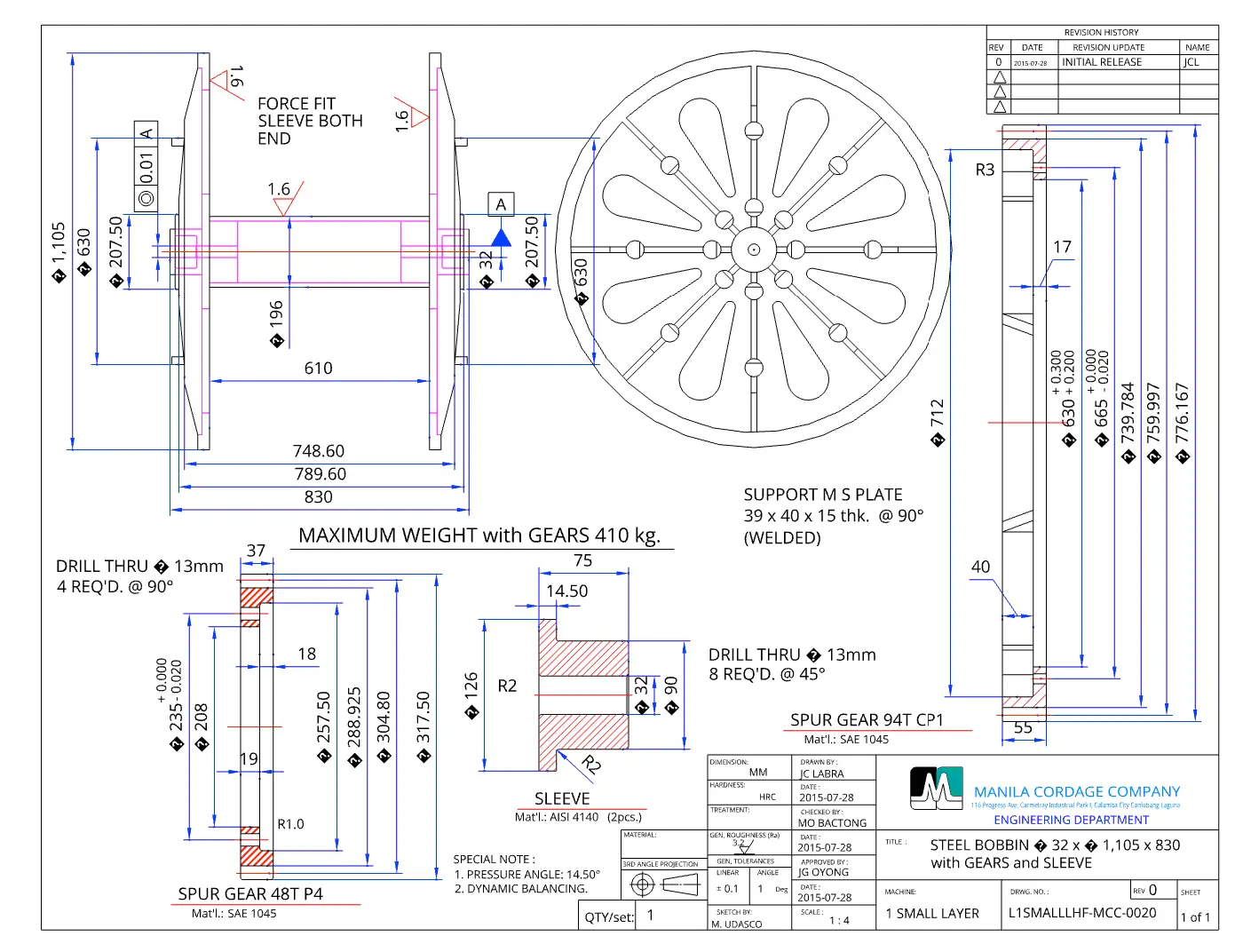
The drawing under review — a steel bobbin assembly combining gears and a sleeve — illustrated both problems simultaneously. It contained recognizable manufacturing intent, but it had never been reviewed to a modern GD&T completeness standard. Identifying every gap, citing the relevant handbook clause for each, and producing a structured report that could be returned to the originator with correction instructions required a workflow the existing tools could not support.
Why now
Supplier quality requirements have tightened progressively, and the firm's internal design-for-manufacture review checklist was updated to require explicit GD&T coverage — datum reference frames, feature-control frames, surface texture callouts, and inspection acceptance criteria — for any rotating or precision-fit assembly before release.
The steel bobbin drawing was a representative case: useful geometry, partial dimensioning, and a manufacturing note set that implied intent without meeting the updated completeness bar. Returning a drawing with a generic finding was no longer acceptable. The new process required itemized gaps with standard references. Doing that manually for a multi-component rotating assembly — gear, sleeve, bobbin body — against a 411-page reference, with a DWG-to-structured-data conversion sitting in front of the review, would consume most of a working day per drawing. At the review volume the team was handling, that pace was not sustainable.
Why energent.ai
Several alternatives were considered before the team settled on energent.ai.
A standalone PDF annotation tool could locate terms in the handbook but offered no way to connect standard references to specific drawing entities or produce a structured audit report. A version-controlled drawing checklist in a spreadsheet enforced consistency but still required a human to populate each row by reading both the drawing and the standard in separate windows. Contracting a specialist drafter for the extraction and cross-referencing work would have added lead time and cost per drawing, with no gain in repeatability.
Other AI tools were evaluated, but the review workflow required capabilities that few combined in a single session: ingest a binary CAD file in DWG format, execute conversion and extraction scripts, write structured output in CSV and JSON, load and process a 411-page technical PDF, maintain a queryable reference across that document without hallucination risk, and produce a citable engineering report — all within one coherent session and without manual hand-offs between environments.
Energent.ai's ability to run Python and bash scripts within the same agent session as document analysis was the deciding factor. The agent could execute the DWG-to-DXF converter, run extraction scripts against the output, produce structured tables with entity-level spatial handles, and then use those tables alongside the handbook reference to compose a report that could be audited line by line.
The agent also handled the hallucination risk explicitly. Rather than claiming to have read all 411 pages into reliable working memory — which the agent itself flagged as unreliable for a document of this length — it built an external structured reference consisting of page-level semantic notes, a concept inventory, and a CSV/JSON reading log. Every claim in the final report could be traced to a page range in the source document. That auditability was a requirement, not a bonus.
Workflow
The session executed a six-step pipeline from raw DWG file to final engineering report.
Step 1 — DWG to DXF conversion. The agent ran the CAD conversion skill against the source file and produced a validated DXF in AC1027 format, confirmed by a post-conversion integrity check. A critical structural detail emerged immediately: the drawing's annotation content resided almost entirely in a paper-space layout named "lito," not in model space. A naive extraction targeting model space would have returned near-empty tables, missing the bulk of the drawing's GD&T-relevant content.
Step 2 — Entity extraction to structured files. An extraction script inventoried every entity in the paper-space layout: text strings, dimension annotations, block inserts, layers, and coordinate extents. Output was written to a JSON extraction summary — a machine-readable map of the drawing with spatial handles that could be cited by reference in the downstream report.
Step 3 — GD&T candidate isolation. A second script filtered extracted entities for GD&T-relevant content: tolerance callouts, datum labels, material condition modifiers, and manufacturing notes. Results were written to a structured CSV of GD&T candidates, which the agent queried throughout the review phase.
Step 4 — Handbook reference build. The agent processed the 411-page GD&T handbook into three retrievable layers: page-level semantic notes, a concept inventory, and a CSV/JSON reading log. The design choice was deliberate — rather than attempting to hold the full document in working context, the structured external reference allowed concept-level lookups with page-range citations during the review. The knowledge tree is reusable across future drawing audits without repeating the indexing work.
Step 5 — Cross-referenced engineering review. With both the drawing tables and the handbook reference available, the agent composed a detailed markdown engineering report. Every finding cited a DXF entity handle for drawing location and a handbook concept with a page range for standard basis. The report separated confirmed good practice from major gaps, listed recommended minimum GD&T additions before release, and explicitly flagged clauses that depend on symbols or inspection diagrams as requiring a visual check against the original PDF figures.
Step 6 — Deliverable packaging. Four files were produced: the converted DXF, the engineering review report in markdown, the GD&T candidate annotation table in CSV, and the drawing extraction summary in JSON. Each file plays a distinct role — the DXF for downstream CAD tools, the report for the correction request, the CSV and JSON as the auditable evidence base.

Results
The engineering review identified six major GD&T gaps in the steel bobbin assembly drawing:
- Missing drawing standard declaration
- Weak or ambiguous datum reference scheme
- Absent run-out and coaxiality controls for a rotating assembly
- No positional tolerances specified for hole patterns
- Underspecified force-fit interface
- Gear inspection requirements listed without acceptance criteria
A seventh finding — dynamic balancing requirements without acceptance criteria — emerged from the structured candidate table rather than a visual pass, illustrating the value of entity-level extraction over a purely visual review.
Each gap was cross-referenced to the relevant handbook concept and page range, giving the engineer a documentary basis for every correction request rather than a list of unsupported opinions. The report also identified what the drawing did well — confirmed practices that did not need revision — so the correction request was focused and actionable rather than a blanket rejection.
On the reference side, the 411-page handbook was converted into a persistent, queryable knowledge tree. Instead of a static PDF requiring manual search for each new drawing, the team now has a structured CSV/JSON reference the agent can query by concept for any subsequent audit. The extraction and review pipeline — from DWG intake through structured report — is repeatable on any incoming drawing and can be re-run as drawings are revised.
Proof
"The part I did not expect was the citation quality. Each issue in the report had a DXF handle pointing to the exact annotation in the drawing and a handbook page range supporting the requirement. That is not something I could produce in a single review session working manually — cross-referencing everything by hand would take most of a day." — Mechanical engineer, precision components manufacturing
The agent's final deliverable set included a complete engineering review report organized into confirmed good practice, major gaps, drawing-location references by entity handle, handbook concept and page-range citations, and recommended minimum additions before release. The GD&T candidate CSV served as the traceable annotation inventory underpinning every finding.
Trust note
The agent is explicit about one important boundary: findings that depend on GD&T symbols, tolerance frame diagrams, or inspection setup illustrations require a visual check against the original PDF figures. The reading log and concept inventory enable principled reasoning about GD&T requirements, but they do not substitute for human review of figure-dependent content. Engineering reports produced through this workflow should be treated as a first-pass audit with full document traceability — not as a final release approval. A qualified GD&T practitioner should confirm symbol-dependent findings before the drawing is returned to the originator or approved for manufacture.