Cascade Capital Advisors is a mid-market investment firm where analysts own five-year DCF operating models end-to-end. Mercer's team sources financial data from SEC EDGAR filings and delivers Excel workbooks with NPV and IRR outputs to investment committees, increasingly on 48-hour turnarounds.
Multi-hour taxonomy searches preceded every 10-K model build
Every new filing model started the same way: download the SEC company-facts JSON, open a blank template, and spend several hours manually matching EDGAR taxonomy tags to six modeling categories — revenue, EBIT, D&A, capex, effective tax rate, and working capital. D&A appeared in the income statement, cash flow statement, and supplemental footnotes — often redundantly. Capex required confirming the tag excluded acquisition-related spend.
The bottleneck fell on senior analysts. Determining which EDGAR tags were economically usable required filing-specific judgment that junior team members couldn't supply. Deal timelines compressed from a week to 48 hours. Earnings season meant multiple filings arriving in the same week. The manual approach didn't scale.
Energent.ai became the pre-model data layer
The analyst uploads the raw SEC company-facts JSON — no format conversion, no pre-processing. The agent covers five structured steps in a single session:
- Audited schema and coverage — confirmed available fiscal years and flagged history gaps before any modeling commitment
- Mapped taxonomy across all six categories, identifying candidate tags and assessing their coverage across reporting periods
- Triaged operating drivers — separated usable line items from absent or economically misleading tags
- Identified two viable UFCF architectures with explicit trade-offs grounded in the actual filing coverage
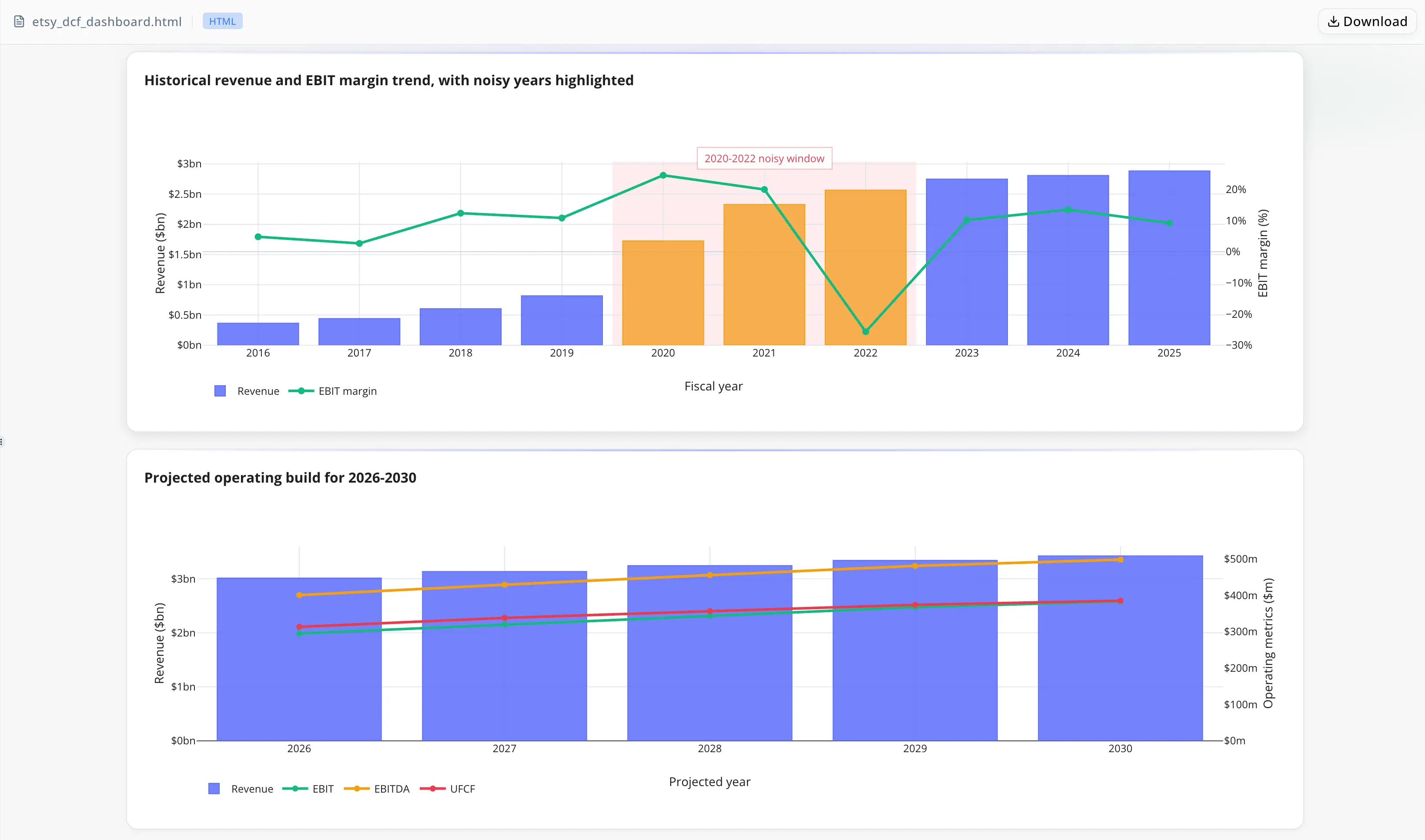
- Built the Excel workbook — five-year operating forecast, UFCF waterfall, NPV and IRR outputs, and committee-ready visualizations
No manual tag hunting. No template opened before the data was understood. No architecture decision deferred into cell population.

Architecture decision first, filing-specific trade-offs made explicit
- Two UFCF build paths before any output. The agent identified competing architectures matched to what this specific 10-K actually reported — not to a generic template — so the structural choice was made before a single cell was populated.
- Simultaneous cross-statement analysis. Revenue, EBIT, D&A, capex, taxes, and working capital assessed in a single pass, cross-referencing the income statement, balance sheet, and cash flow statement for gaps and overlaps.
- Explicit flags on misleading tags. Absent working-capital change tags and acquisition-inclusive capex entries surfaced before they reached a cell, not discovered in downstream reconciliation.
- Senior capacity redirected to judgment. The architecture choice arrived as a structured decision with trade-offs already articulated — so analyst time applied to selection and assumption-setting, not data wrangling.
How David Mercer runs it day-to-day
- Upload the SEC company-facts JSON into the Energent.ai session.
- Review the schema and coverage audit; confirm modeling years and any history gaps.
- Evaluate the two UFCF architecture options against the model's intended use.
- Select an architecture; the agent builds the five-year forecast, UFCF waterfall, and DCF outputs in Excel.
- Review NPV and IRR outputs for assumption consistency before committee presentation.
Taxonomy mapping shifted from a multi-hour task to one session
- All six modeling categories mapped in a single session from the raw JSON — eliminating the manual taxonomy search that preceded every new-filing model build.
- Two viable UFCF architectures surfaced with trade-offs before the analyst touched a template.
- The architecture decision point reached before any cells were populated, removing the hidden reconciliation risk that surfaced only midway through manual builds.
- Final Excel workbook included a structured DCF model with NPV and IRR outputs alongside committee-ready visualizations.

"The taxonomy map the agent produced — covered tags, absent tags, flagged items across all six categories — replaced the mental checklist I used to build through years of EDGAR exposure. It's now the working document for the architecture discussion before we build anything." — David Mercer, Senior Analyst at Cascade Capital Advisors