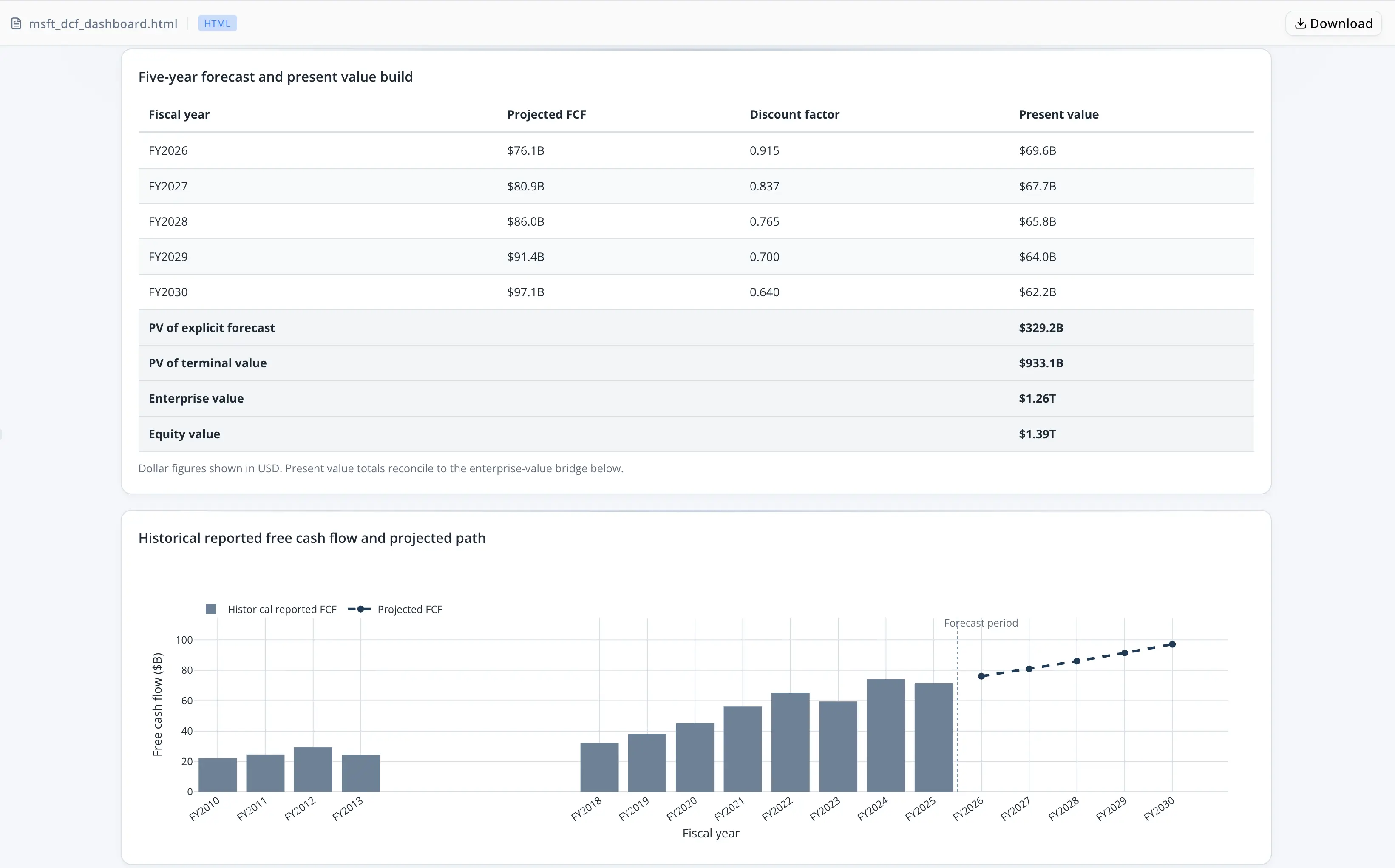
James Whitfield covers publicly traded technology companies at Harborview Capital, a mid-sized U.S. investment firm. Every deliverable must be formula-driven and source-traceable — static pasted values are a compliance non-starter when the output goes to portfolio managers and an investment committee. For a Microsoft valuation with a fixed presentation deadline, he used Energent.ai to build the complete DCF from raw API source files in a single session.
Raw EDGAR JSON, a missing Fed Funds series, and no margin for formula errors
Four friction points converged. Free cash flow required computing two GAAP tags across five annual 10-K filings rather than pulling from a data vendor. The FRED rates file was missing the Fed Funds series, requiring a CAPM-based WACC proxy that had to be explicitly documented for reviewers. Every cell in the workbook had to carry a live formula — static pasted values would not survive audit — with a stable row map so any assumption change propagated through WACC, projections, terminal value, and the sensitivity matrix. The deadline was fixed: an unresolved error at presentation day meant rebuilding from scratch, not patching.
Energent.ai became the model-builder and self-corrector
- Ingested the raw SEC company facts JSON and FRED rates CSV directly — no preprocessing required
- Parsed GAAP tags, filtered to annual 10-K filings, and produced a clean FY2021–FY2025 FCF series
- Computed the realized 6.28% CAGR and applied it as the forward growth rate, grounded in reported performance
- Constructed a 9.33% WACC via CAPM — DGS10 at 4.38%, ERP at 5.5%, beta at 0.9 — and produced a methodology note documenting the Fed Funds substitution
- Caught a static-values flaw in the first draft through an adversarial verification pass, then rebuilt the entire workbook with live Excel formulas
- Identified and corrected a residual cell-reference miswiring on the assumptions tab before delivery
- Generated an HTML valuation dashboard and a markdown executive summary in the same session
No manual data preprocessing. No patched formula chain. No separate charting step.

Correct architecture, not just faster data entry
- File-native ingestion: The agent worked directly with raw EDGAR JSON and FRED CSV, eliminating the translation step that typically consumes analyst time before model work can begin.
- Documented substitution logic: When the Fed Funds series was absent, the agent flagged it, applied the CAPM proxy, and produced the methodology note — so any reviewer could evaluate the assumption without digging through the workbook.
- Adversarial self-review: Two independent verification passes caught errors before the analyst reviewed anything: static values in draft one, and a shifted cell reference on the assumptions tab.
- Live formula propagation: Every output cell references named assumption cells. Changing ERP, beta, or terminal growth rate updates WACC, projections, terminal value, and the full sensitivity matrix automatically.
Verified $1,262.3bn enterprise value, full audit chain intact
- Enterprise value: $1,262.3bn; equity value: $1,386.6bn; net cash: $124.3bn
- Base-case implied share price: $186.55; per-share sensitivity range: $151.72–$249.91
- Realized FCF CAGR: 6.28%, sourced directly from annual 10-K filings
- WACC: 9.33%, with the Fed Funds substitution explicitly documented for peer review
- Executive summary incorporated into the committee brief with only minor formatting adjustments
"That kind of automated self-review is what you normally rely on a second set of eyes to catch. Here it was built in." — James Whitfield, Senior Equity Analyst at Harborview Capital