Al Noor Retail is a mid-sized Saudi retail merchant processing thousands of weekly transactions across Mada, Visa, and Mastercard.
Its finance team was responsible for reconciling gross sales from internal POS and ERP systems against net bank settlements after payment fees, VAT, refunds, chargebacks, and settlement timing delays.
The work was high-stakes, but painfully manual.
Every day, analysts downloaded bank reports, opened Excel models, matched transaction records, checked variances, and carried unresolved open items into month-end close.
The problem wasn’t effort. It was the spreadsheet.
The reconciliation model was quietly wrong
Al Noor’s Excel workflow had two hidden structural errors.
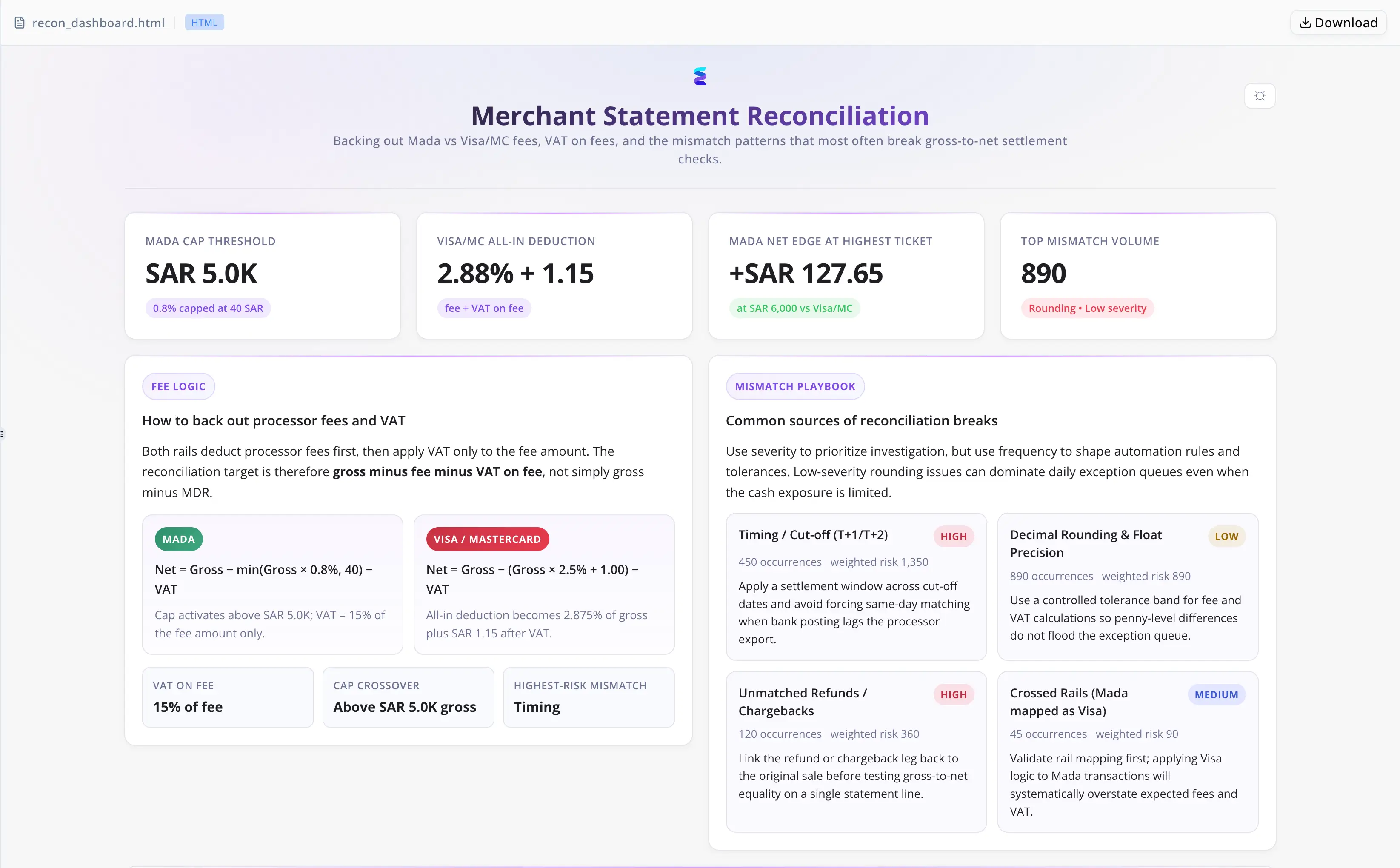
Mada transactions were calculated as a flat 0.8% fee, without applying the 40 SAR cap. For high-value transactions, this created a recurring 40 SAR mismatch per transaction.
Visa and Mastercard transactions were treated as percentage-only fees, missing the fixed 1 SAR component. That made small-ticket card payments consistently misreconcile.
On top of that, rounding differences, T+2 settlement timing, refunds, and chargebacks created even more noise.
The result: 2–3 hours of daily triage and a month-end open-items list that never fully cleared.
Energent.ai became the reconciliation engine

With Energent.ai, the team uploaded its bank acquiring report and internal sales extract directly into the agent.
Energent then:
- classified each transaction by payment rail
- applied the correct Mada, Visa, and Mastercard fee logic
- calculated VAT on processing fees
- matched expected net settlement against bank net settlement
- applied a ±0.05 SAR rounding tolerance
- searched across a ±3-day window for T+2 settlement drift
- separated refunds and chargebacks into their own review table
- generated a reconciliation dashboard and audit-ready summary report
No custom code. No BI dashboard rebuild. No fragile spreadsheet handover.
Why it worked
Correct logic, not just prettier reporting
Energent didn’t only visualize discrepancies. It recalculated expected settlements from raw transaction data.
Tolerance-aware matching
Small rounding differences stopped polluting the exception list.
Settlement timing built in
T+2 bank delays were handled automatically instead of treated as missing transactions.
Audit-ready output
The final reconciliation guide became part of the monthly close package and helped onboard a new analyst.
Results

In the first session, Energent identified and corrected the two core fee-model errors.
High-value Mada transactions reconciled cleanly for the first time. Small-ticket Visa and Mastercard transactions stopped creating systematic exceptions. The open-items backlog effectively reset to zero after the structural errors were fixed.
Daily reconciliation moved from 2–3 hours of spreadsheet triage to a focused review of genuine exceptions.
For Al Noor Retail, Energent.ai turned payment reconciliation from a recurring month-end problem into a repeatable, auditable workflow.
Once Energent showed the fee breakdown, it was obvious. We were calculating 80 SAR when the Mada cap meant it should be 40. That single insight justified the whole project.