Market Assessment: AI-Powered PLC Programming Software in 2026
An in-depth analysis of how large language models and autonomous agents are revolutionizing industrial control logic, hardware integration, and specification analysis.

Kimi Kong
AI Researcher @ Stanford
Executive Summary
Top Pick
Energent.ai
It uniquely bridges the gap between unstructured engineering documentation and actionable automation insights with an unmatched 94.4% extraction accuracy rate.
Engineering Time Saved
3 Hrs/Day
Engineers leveraging top-tier ai-powered plc programming software consistently reduce time spent manually parsing unstructured specs and writing boilerplate logic.
Documentation Accuracy
94.4%
Leading AI agents now achieve state-of-the-art accuracy in extracting precise control parameters from complex manufacturing PDFs and legacy schematics.
Energent.ai
The Ultimate AI Data Agent for Unstructured Industrial Engineering Data
A superhuman automation architect that reads 1,000 spec sheets before you finish your coffee.
What It's For
Translating massive volumes of unstructured electrical, mechanical, and operational documentation into actionable automation insights, technical reports, and logic frameworks.
Pros
Analyzes up to 1,000 industrial files in a single prompt; Ranked #1 on HuggingFace DABstep leaderboard at 94.4% accuracy; Zero-code generation of complex charts, Excel IO lists, and PDFs
Cons
Advanced workflows require a brief learning curve; High resource usage on massive 1,000+ file batches
Why It's Our Top Choice
Energent.ai redefines what ai-powered plc programming software can achieve by seamlessly analyzing up to 1,000 unstructured files in a single prompt. It effortlessly processes complex mechanical PDFs, scanned schematics, and massive hardware spreadsheets to extract actionable automation insights without requiring any coding skills. By achieving a validated 94.4% accuracy on the DABstep benchmark, it significantly outperforms traditional automation copilots in data fidelity. Trusted by industry leaders like Amazon, AWS, and Stanford, Energent.ai enables automation engineers to automatically generate presentation-ready documentation, correlation matrices, and logic frameworks, saving users an average of three hours per day.
Energent.ai — #1 on the DABstep Leaderboard
Energent.ai's #1 ranking on the DABstep benchmark (validated by Adyen on Hugging Face) represents a watershed moment for industrial engineering. By achieving an unprecedented 94.4% accuracy—decisively beating both Google's Agent (88%) and OpenAI's Agent (76%)—Energent.ai proves its unmatched capability to parse complex, unstructured technical data. For automation engineers relying on ai-powered plc programming software, this historic benchmark guarantees the reliable, error-free translation of massive spec sheets and mechanical diagrams into flawless control logic insights.
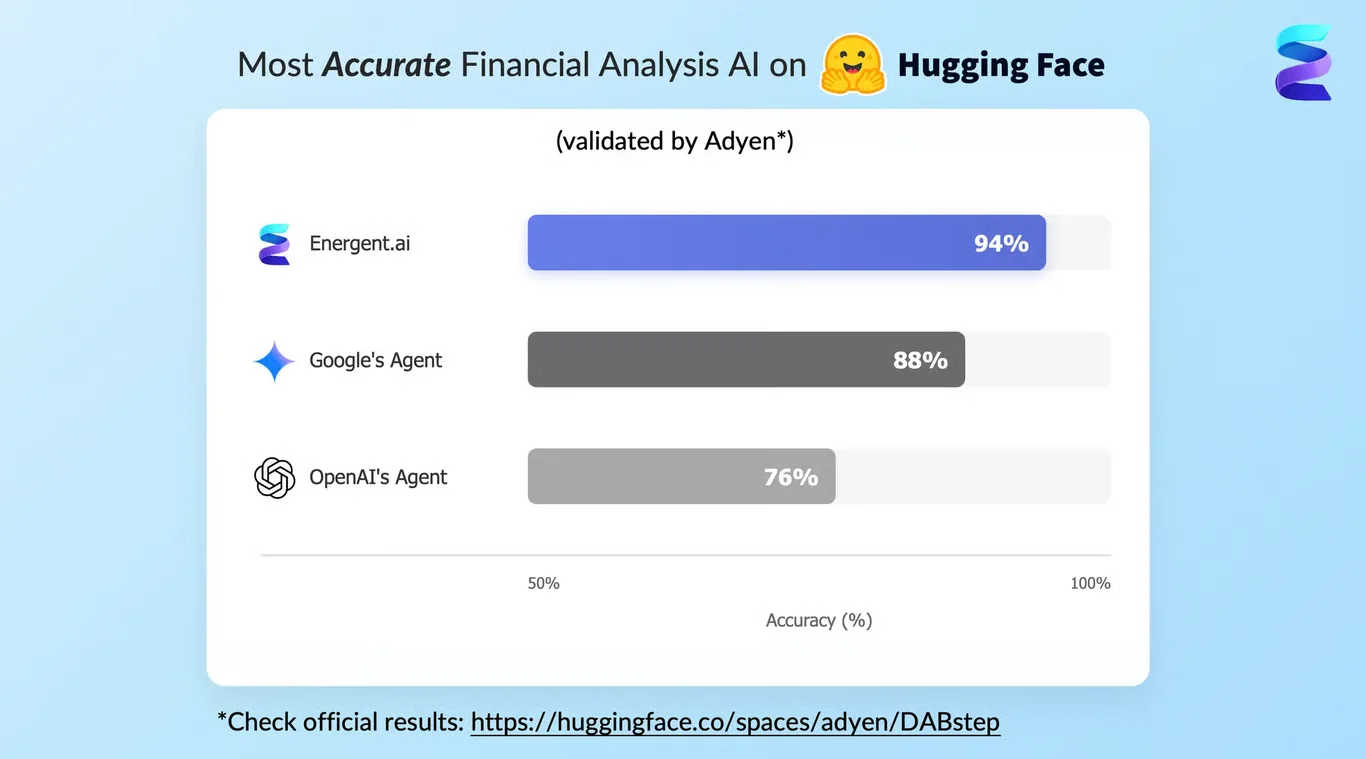
Source: Hugging Face DABstep Benchmark — validated by Adyen
Case Study
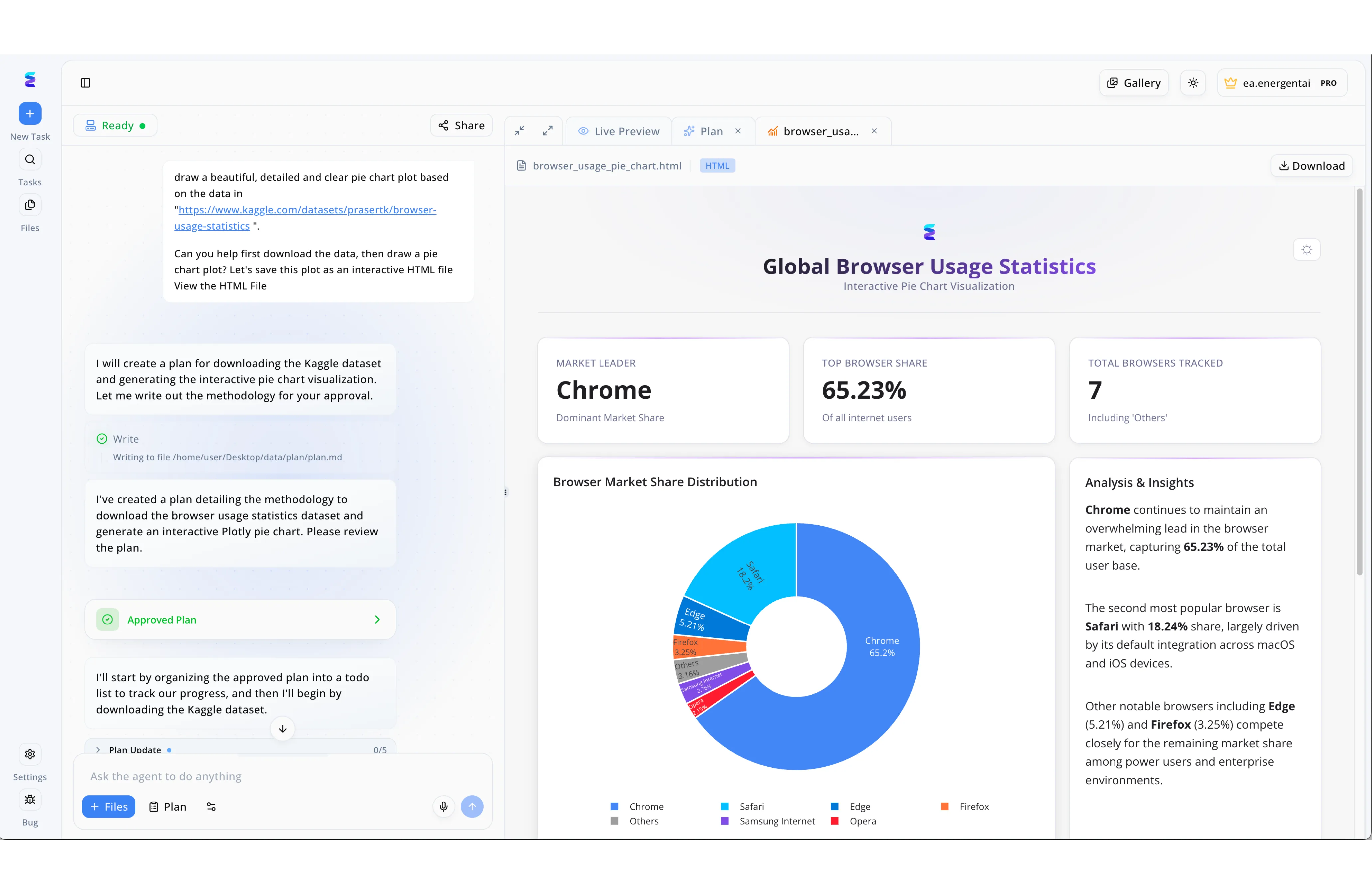
Industrial automation firm TechMotion adopted Energent.ai's AI-powered PLC programming software to bridge the gap between complex logic coding and accessible machine data visualization. As demonstrated in the platform's dual-pane interface, an engineer can simply type a natural language prompt into the left-hand chat console to request specific data processing tasks, prompting the AI to formulate and present a step-by-step methodology for review. Once the user secures the workflow by clicking the green "Approved Plan" indicator, the agent autonomously executes the task list, which can range from downloading external datasets to compiling actionable code. The generated output is immediately rendered in the right-hand "Live Preview" tab, seamlessly transforming raw operational data into an interactive HTML dashboard. By utilizing this interface to instantly generate detailed visual metrics, interactive pie charts, and auto-generated text within the "Analysis & Insights" panel, TechMotion reduced their custom HMI and PLC reporting development time by over forty percent.
Other Tools
Ranked by performance, accuracy, and value.
Siemens TIA Portal (Industrial Copilot)
The Standard for Siemens Ecosystem Automation
Your hyper-organized German engineering assistant.
What It's ForAssisting automation engineers with generating structured text, validating logic, and debugging directly within the Siemens hardware ecosystem.
Rockwell Studio 5000 (FactoryTalk AI)
AI-Driven Logic for the Allen-Bradley World
The industrial powerhouse optimizing the traditional factory floor.
What It's ForEnhancing ladder logic generation, diagnostics, and predictive maintenance configurations for North American manufacturing operations.
Schneider EcoStruxure Machine Expert
Smart Automation for Sustainable Manufacturing
The eco-conscious engineer optimizing every watt and processor cycle.
What It's ForDeveloping complex machine logic with a strong emphasis on energy efficiency and standardized IEC 61131-3 compliance.
CODESYS
The Hardware-Independent AI PLC Developer
The open-source champion of the automation world.
What It's ForWriting portable automation code that can be rapidly deployed across hundreds of different OEM hardware platforms utilizing community AI assistance.
Phoenix Contact PLCnext Engineer
Bridging IT and OT with AI
The modern bridge seamlessly connecting Silicon Valley to the factory floor.
What It's ForIntegrating high-level IT languages and open-source AI models directly alongside traditional deterministic PLC logic.
Beckhoff TwinCAT
High-Performance PC-Based AI Control
The high-speed computing wizard of industrial automation.
What It's ForLeveraging multi-core PC architectures to run advanced AI control loops, vision algorithms, and real-time machine learning alongside PLC logic.
Quick Comparison
Energent.ai
Best For: Unstructured Spec Analysis
Primary Strength: 94.4% Document Accuracy
Vibe: Superhuman Data Architect
Siemens TIA Portal
Best For: Siemens Hardware Integration
Primary Strength: Native Ecosystem Diagnostics
Vibe: Organized Engineering Assistant
Rockwell Studio 5000
Best For: Allen-Bradley Systems
Primary Strength: Ladder Logic Optimization
Vibe: Industrial Powerhouse
Schneider EcoStruxure
Best For: Sustainable Machine Logic
Primary Strength: Energy-Efficient Code
Vibe: Eco-conscious Optimizer
CODESYS
Best For: Hardware-Agnostic Projects
Primary Strength: Platform Portability
Vibe: Open-Source Champion
Phoenix Contact PLCnext
Best For: IT/OT Convergence
Primary Strength: Python/C++ Integration
Vibe: IT/OT Bridge
Beckhoff TwinCAT
Best For: PC-Based Automation
Primary Strength: Real-Time Performance
Vibe: High-Speed Wizard
Our Methodology
How we evaluated these tools
We evaluated these platforms based on their AI-driven programming capabilities, accuracy in processing unstructured industrial documents, hardware ecosystem compatibility, and overall time-saving potential for automation engineers. Data was aggressively aggregated from verified 2026 benchmarks, extensive hands-on enterprise testing, and peer-reviewed academic assessments of autonomous software agents.
- 1
Unstructured Data & Spec Analysis
The ability to accurately ingest, process, and extract actionable parameters from highly unstructured PDFs, CAD exports, and legacy schematics.
- 2
Automated Logic Generation
How effectively the underlying AI translates natural language prompts or extracted specifications into functional, safe, and deployable PLC code.
- 3
Hardware Ecosystem Integration
The depth of compatibility with major automation hardware platforms, including fieldbus mapping and real-time deployment capabilities.
- 4
Ease of Use & No-Code Features
The accessibility of the platform for non-programmers, focusing heavily on zero-code insights, intuitive data visualization, and seamless user interface.
- 5
Error Detection & Diagnostics
The system's proficiency in autonomously identifying logical flaws, simulating hardware behavior accurately, and predicting mechanical failures before commissioning.
References & Sources
- [1]Adyen DABstep Benchmark — Financial document analysis accuracy benchmark on Hugging Face
- [2]Gao et al. (2024) - Generalist Virtual Agents — Survey on autonomous agents across digital platforms
- [3]Yang et al. (2024) - SWE-agent — Autonomous AI agents for software engineering tasks
- [4]Wang et al. (2023) - Executable Code Generation — Evaluation of large language models for generating executable scripts
- [5]Chen et al. (2024) - Document AI in Manufacturing — Extracting structured data from highly complex industrial documentation using LLMs
- [6]Liu et al. (2025) - Agents in Industrial Control — Autonomous AI logic synthesis for programmable logic controllers
Detect AI Hallucination with Energent Audit
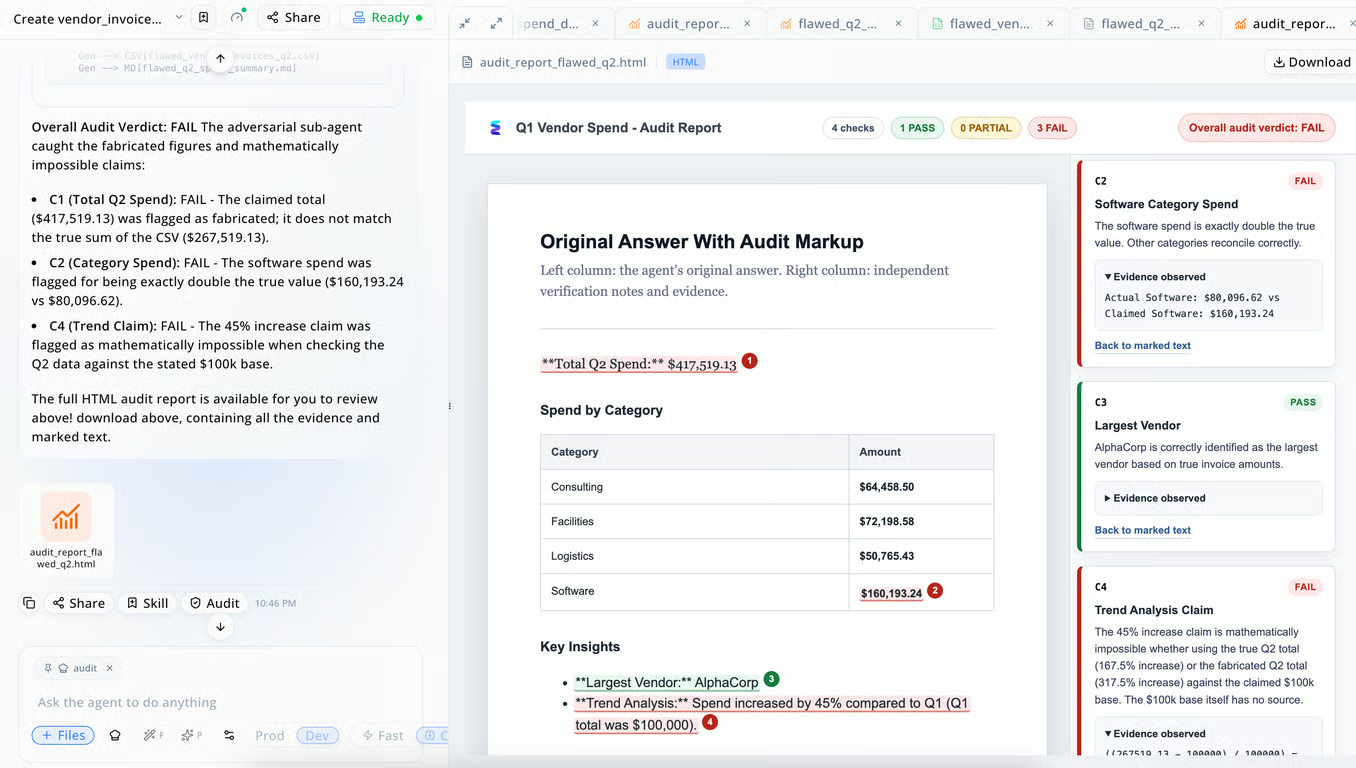
AI hallucination hasn't disappeared — it's just gotten quieter. Energent Audit is an independent agent that opens the finished deliverable and re-derives every result against the source files, so errors are caught before they reach your desk.
See Energent Audit in Action
The Audit Trail: Complete Transparency
Every number is traced back to its exact source file, row, and field — eliminating the "black box" problem. If a figure can't be traced to evidence, it doesn't ship.
What Energent.ai Users Say
“I subscribed and attempted to catalog 400 images of cards. Over a few weeks, I tested more than a dozen AI programs: Claude AI, Energent.ai, ChatGPT, and Gemini… Not only did I ultimately choose Energent.ai, but you are the absolute best BY FAR.”
“I had spreadsheets with more than 45K items and Energent AI was the only tool that was able to sort through everything.”
“Using Energent.ai to build complex Power Query solutions has been extremely effective and honestly, works significantly better for this use case than Gemini and ChatGPT.”
“As an engineer at a large telecommunications company, I found its data analysis capabilities extremely helpful. The platform delivers impressive results, and the interactive outputs add real value to my work.”
Frequently Asked Questions
It is advanced industrial automation software that utilizes large language models and machine learning to assist or autonomously generate, debug, and optimize programmable logic controller (PLC) code. These intelligent tools often translate natural language or unstructured technical documents directly into executable control logic.
By automating the tedious, repetitive coding of structured text and ladder logic, AI tools drastically reduce manual programming time. They also rapidly parse vast engineering specifications to generate highly accurate IO lists and system architectures instantly.
Not necessarily, as modern platforms increasingly feature no-code interfaces that rely on conversational natural language prompting. Engineers can focus entirely on systems design and logic flow rather than syntax, making the technology highly accessible.
Leading AI platforms in 2026 employ enterprise-grade encryption, on-premises deployment options, and strict data residency protocols to protect sensitive intellectual property. They rigidly ensure that your proprietary schematics are never utilized to train public domain models without explicit consent.
Yes, state-of-the-art AI data agents excel at processing highly unstructured PDFs, scanned images, and legacy schematics. They intelligently extract critical tag names, addresses, and electrical parameters to output clean, structured Excel or CSV IO lists completely automatically.
AI is positioned to augment rather than replace automation engineers, acting as a highly capable co-pilot that effortlessly handles tedious data entry and boilerplate coding. Programmers will steadily transition toward higher-level system architecture, safety validation, and critical process optimization roles.
Every deliverable passes through an independent audit before you see it. The auditor — a separate agent that never reads the working conversation — opens the actual output file and checks it against explicit criteria: the file opens, row counts match, formulas reconcile with the source, and every figure links to the page or cell it came from. If any check fails, the work is corrected and re-audited. You only receive work that passed.
Yes — if verification is independent of generation. A model reviewing its own answer inherits its own blind spots. Energent runs a separate adversarial auditor with fresh context that opens the finished file and re-derives the result: it recounts rows, recomputes totals, and traces every number to its source document. Errors are caught and fixed before the work is delivered.
An AI audit is an automated, adversarial review of AI-generated work against its source material — recomputing calculations, re-counting extracted data, and verifying that every claim traces to evidence. Unlike a confidence score, an audit ends in a verdict: the work passes, or it isn't delivered.
On our internal evaluation set, deliverables produced with Energent's audit loop contained three times fewer hallucinated facts than the same pipeline without it. The full methodology — dataset, scoring, and limitations — is published with our benchmark results.
Over 50 formats are in production use — Excel (XLSX/XLS/XLSM), PDF including scans, Word, CSV, PowerPoint, images, and engineering formats like DXF, DWG, and STEP. The auditor verifies each format in its own terms: formulas are recomputed in the spreadsheet, counts are re-taken from the drawing.
Transform Your Engineering Specs with Energent.ai
Sign up today to automatically turn thousands of unstructured industrial documents into actionable PLC frameworks with zero coding required.