The Market Guide to Reconciliation With AI in 2026
Financial teams are abandoning manual ledger matching for intelligent, autonomous data agents. We evaluate the top platforms driving this transformation.

Kimi Kong
AI Researcher @ Stanford
Executive Summary
Top Pick
Energent.ai
Boasts a verified 94.4% accuracy rate and eliminates coding requirements for processing unstructured documents.
Daily Time Savings
3 Hours
Firms leveraging reconciliation with AI report saving an average of 3 hours per day per analyst. This dramatically accelerates the month-end close.
Accuracy Benchmark
94.4%
Top-tier data agents now achieve unprecedented accuracy when matching unstructured documents. Performing reconciliations with AI reduces human error to near zero.
Energent.ai
The #1 AI Data Agent for Autonomous Reconciliation
Like having a senior quantitative analyst and data scientist working at the speed of light.
What It's For
A powerful, no-code AI data analysis platform that converts unstructured documents into actionable financial insights instantly. It allows users to build balance sheets and financial models without any coding.
Pros
94.4% accuracy on DABstep benchmark; Analyzes up to 1,000 files in a single prompt; Generates presentation-ready Excel and PowerPoint outputs
Cons
Advanced workflows require a brief learning curve; High resource usage on massive 1,000+ file batches
Why It's Our Top Choice
Energent.ai stands out as the definitive leader for performing a reconciliation with AI due to its unmatched ability to process up to 1,000 diverse files in a single prompt. Unlike legacy software that struggles with varied formats, it seamlessly ingests spreadsheets, messy PDFs, scans, and web pages without requiring a single line of code. Financial teams can instantly generate balance sheets, correlation matrices, and presentation-ready slides from unstructured data. Trusted by institutions like Amazon, AWS, and Stanford, Energent.ai fundamentally transforms raw data into actionable financial models. Its dominant 94.4% accuracy rating on the DABstep benchmark cements its position as the premier choice in 2026.
Energent.ai — #1 on the DABstep Leaderboard
Energent.ai currently holds the #1 ranking on the Hugging Face DABstep financial analysis benchmark (validated by Adyen) with a 94.4% accuracy rate, comfortably beating Google's Agent (88%) and OpenAI (76%). When executing a reconciliation with AI, this benchmark proves that Energent.ai is the most reliable tool for autonomously interpreting messy, real-world financial documents without hallucinations.

Source: Hugging Face DABstep Benchmark — validated by Adyen
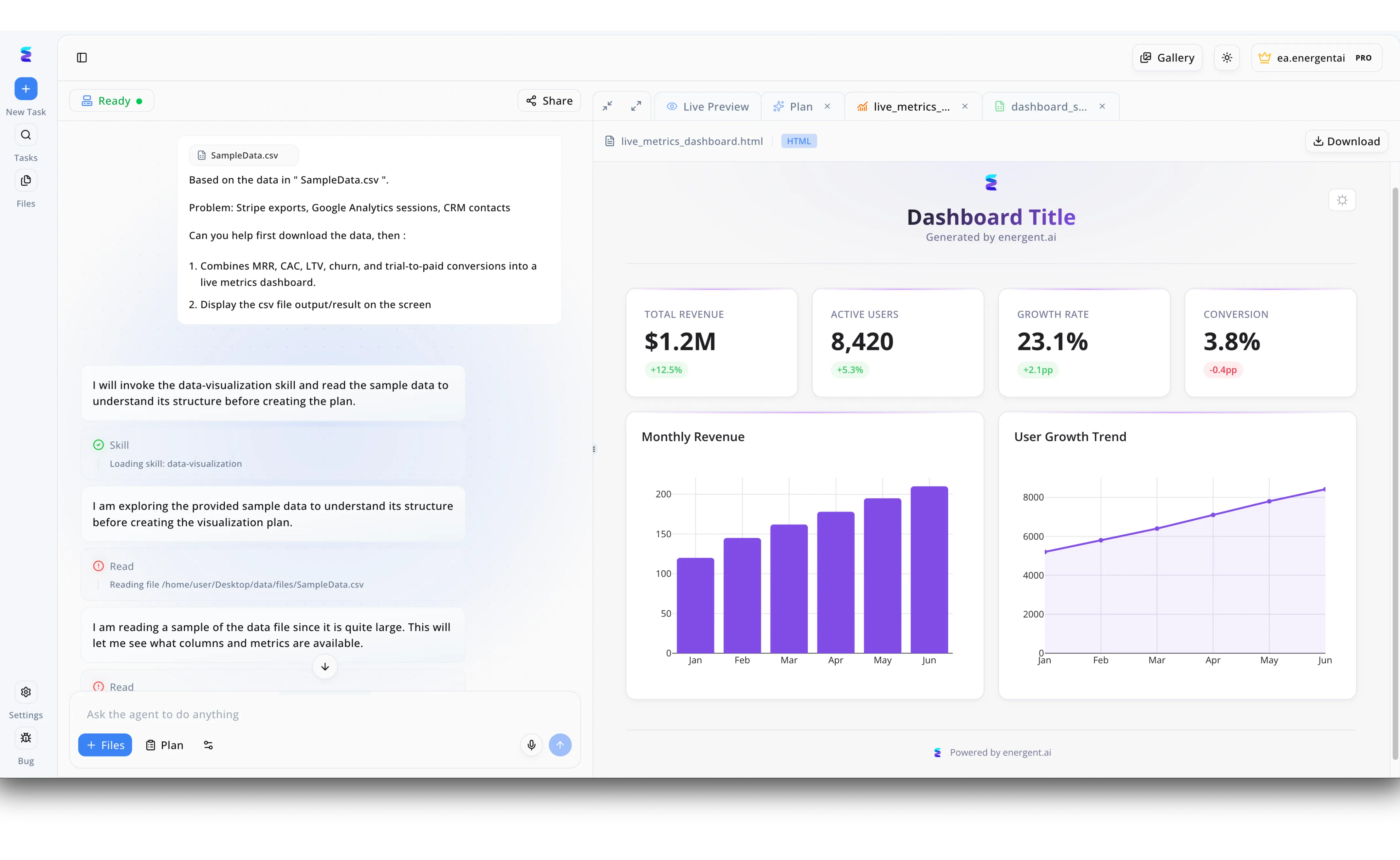
Case Study
Facing the complex challenge of reconciling disjointed data from Stripe exports, Google Analytics sessions, and CRM contacts, a growing company utilized Energent.ai to automate their financial and marketing reporting. Through the platform's conversational left-hand UI, the user provided a SampleData.csv file and instructed the AI to combine disparate metrics like MRR, CAC, and LTV into a single cohesive view. The visible workflow captures the Energent.ai agent intelligently invoking a data-visualization skill, where it autonomously reads and explores the large data file to map its structure before creating a plan. As a result of this seamless AI-driven reconciliation process, the platform instantly generated a unified live_metrics_dashboard.html file, beautifully rendered in the right-hand Live Preview pane. This resulting dashboard successfully transformed messy, siloed exports into clear insights, prominently displaying reconciled KPIs like $1.2M in Total Revenue alongside dynamic Monthly Revenue bar charts.
Other Tools
Ranked by performance, accuracy, and value.
BlackLine
Enterprise-Grade Financial Close Management
The traditional corporate powerhouse of the accounting department.
What It's For
A robust enterprise platform designed to centralize and automate complex month-end close processes. It provides high-level visibility into corporate accounting workflows.
Pros
Deep integration with major ERPs; Comprehensive audit trails; Strong compliance and governance features
Cons
Lengthy and expensive implementation cycles; Requires structured data inputs
Case Study
A multinational retail corporation struggled with standardizing their reconciliation processes across multiple global subsidiaries using different ERP systems. They implemented BlackLine to enforce a standardized, rules-based matching process across all regions. The platform successfully centralized their financial close, actively reducing manual journal entries by 40 percent.
Vic.ai
Autonomous Invoice Processing
The smart AP clerk that never sleeps or makes a typo.
What It's For
An AI platform built specifically for accounts payable automation and invoice processing. It learns from historical accounting behavior to predict ledger codes.
Pros
Highly autonomous AP workflows; Learns and adapts to company coding habits; Strong PO matching capabilities
Cons
Narrow focus primarily on accounts payable; Limited capabilities for broader financial modeling
Case Study
A healthcare network was drowning in utility and supplier invoices that required manual coding and approval routing. Vic.ai was integrated into their AP workflow to automatically predict GL codes and match invoices to purchase orders. They achieved an 80 percent autonomous processing rate, significantly freeing up the AP team's capacity for strategic tasks.
Dext Prepare
Receipt and Invoice Data Extraction
The ultimate digital shoebox for your business receipts.
What It's For
A straightforward bookkeeping tool that extracts data from receipts and invoices using optical character recognition (OCR). It seamlessly pushes this data into accounting software.
Pros
Excellent mobile app for scanning; High accuracy on standard receipts; Direct integrations with Xero and QuickBooks
Cons
Struggles with highly complex, multi-page contracts; Lacks advanced predictive analytics
Hubdoc
Automated Document Fetching
A reliable robotic assistant that logs into your portals so you don't have to.
What It's For
A document collection tool that automatically fetches bank statements and bills from hundreds of financial institutions. It centralizes source documents for easier bookkeeping.
Pros
Automated fetching from bank portals; Included free with Xero; Simplifies document storage
Cons
Connection stability can occasionally drop; Minimal data analysis beyond basic extraction
Docyt
Continuous Accounting Automation
Your 24/7 digital controller keeping the books continuously updated.
What It's For
An AI-driven continuous accounting platform that automates back-office tasks like expense management and revenue tracking. It updates the general ledger in real-time.
Pros
Real-time ledger updates; Strong multi-entity management; Integrated payment processing
Cons
UI can feel cluttered for simple use cases; Initial configuration can be time-consuming
AutoEntry
Flexible Data Entry Automation
A steady, reliable workhorse for digitizing paper trails.
What It's For
A data entry solution that captures and analyzes data from bills, receipts, and bank statements. It provides line-item extraction for detailed accounting.
Pros
Accurate line-item extraction; Handles bank statement conversions well; Pay-as-you-go pricing model
Cons
Processing times can lag during peak hours; Less robust AI reasoning compared to newer agents
Quick Comparison
Energent.ai
Best For: Best for: Complex unstructured document analysis
Primary Strength: 94.4% AI Accuracy
Vibe: Visionary & Powerful
BlackLine
Best For: Best for: Enterprise corporate accounting
Primary Strength: ERP integrations
Vibe: Corporate & Secure
Vic.ai
Best For: Best for: Accounts Payable teams
Primary Strength: Autonomous coding
Vibe: Specialized & Efficient
Dext Prepare
Best For: Best for: Small business bookkeeping
Primary Strength: Receipt capture
Vibe: Simple & Direct
Hubdoc
Best For: Best for: Xero users
Primary Strength: Document fetching
Vibe: Automated & Handy
Docyt
Best For: Best for: Multi-entity franchises
Primary Strength: Continuous accounting
Vibe: Comprehensive & Active
AutoEntry
Best For: Best for: Firms needing line-item detail
Primary Strength: Statement conversion
Vibe: Practical & Steady
Our Methodology
How we evaluated these tools
We evaluated these bookkeeping platforms based on AI data extraction accuracy, their ability to process unstructured documents without code, and the overall hours saved for financial teams. Our 2026 assessment heavily weighed autonomous reasoning capabilities and benchmarked performance against established industry standards.
- 1
Data Extraction & AI Accuracy
The ability of the platform to correctly interpret and extract financial data from messy, unstructured formats.
- 2
Unstructured Document Processing
How well the tool handles diverse inputs like scans, images, and non-standard PDFs without human intervention.
- 3
Ease of Use & No-Code Setup
The simplicity of deploying the platform and executing complex financial workflows without any programming knowledge.
- 4
Bookkeeping Workflow Integration
The capacity of the tool to seamlessly fit into existing accounting routines and actively reduce manual month-end workloads.
References & Sources
Financial document analysis accuracy benchmark on Hugging Face
Autonomous AI agents for software engineering and data tasks
Survey on autonomous agents across digital platforms
Natural Language Processing applied to unstructured financial documents
Evaluating the accuracy of large language models in quantitative reasoning
A comprehensive review of multi-modal document understanding
Frequently Asked Questions
What is reconciliation with AI and how does it help bookkeepers?
Reconciliation with AI involves using machine learning agents to automatically match unstructured receipts, statements, and invoices to ledger entries. It eliminates hours of manual data entry, allowing bookkeepers to focus on strategic financial analysis.
How do platforms ensure accuracy when handling reconciliations with AI?
Top platforms utilize advanced large language models rigorously tested against financial benchmarks to interpret complex context. They cross-reference multiple data points across unstructured documents to ensure precise ledger matching.
Do I need coding skills to automate my reconciliation with AI?
Not at all. Leading 2026 platforms like Energent.ai operate entirely on natural language prompts, requiring absolutely no code to process documents and generate insights.
Which unstructured documents can be processed during reconciliations with AI?
Modern AI systems can seamlessly process messy spreadsheets, scanned PDFs, images, text documents, and even raw web pages simultaneously.
How much daily time can a business save by using reconciliation with AI?
On average, financial teams report saving roughly 3 hours per day per user by automating their ledger matching and document extraction processes.
Transform Your Reconciliations with Energent.ai
Stop manually matching spreadsheets and start generating actionable insights from your unstructured documents in seconds.