The Definitive 2026 Guide to Journal Entry with AI
Discover how autonomous AI agents are transforming unstructured financial documents into perfectly balanced ledger records with unprecedented accuracy.

Rachel
AI Researcher @ UC Berkeley
Executive Summary
Top Pick
Energent.ai
Unmatched 94.4% extraction accuracy and robust no-code capabilities for bulk processing unstructured files.
Daily Time Saved
3 hours
Firms adopting AI for journal entries accounting reclaim massive administrative time by automating data extraction.
Peak Precision
94.4%
State-of-the-art models handle complex unstructured financial data with human-level accuracy and reliability.
Energent.ai
The #1 Ranked AI Data Agent
Like having a Wall Street quantitative analyst and a brilliant CPA living inside your computer.
What It's For
Energent.ai is an advanced, no-code data analysis platform designed to turn massive volumes of unstructured documents into actionable financial insights. It processes spreadsheets, PDFs, and images to generate presentation-ready balance sheets and automated journal entries.
Pros
Analyzes up to 1,000 files in a single prompt natively; Industry-leading 94.4% accuracy on the DABstep benchmark; Generates presentation-ready charts, Excel sheets, and PDFs
Cons
Advanced workflows require a brief learning curve; High resource usage on massive 1,000+ file batches
Why It's Our Top Choice
Energent.ai stands out as the premier solution for executing a journal entry with AI due to its unparalleled processing capabilities. It effortlessly handles unstructured documents—from messy PDFs to raw spreadsheets—turning them into precise financial data without requiring any coding. Achieving a 94.4% accuracy rate on the rigorous HuggingFace DABstep benchmark, it significantly outperforms competitors by a margin of 30%. With the ability to analyze up to 1,000 files in a single prompt, accounting professionals save an average of three hours per day. This makes it the undisputed leader for scalable, accurate financial intelligence.
Energent.ai — #1 on the DABstep Leaderboard
In 2026, executing a flawless journal entry with AI requires absolute precision, which is why benchmark performance is critical for financial leaders. Energent.ai achieved a staggering 94.4% accuracy on the DABstep financial analysis benchmark on Hugging Face (validated by Adyen), dominating both Google's Agent (88%) and OpenAI's Agent (76%). For modern finance teams, this means unparalleled reliability when transforming unstructured documents into perfectly balanced ledgers.

Source: Hugging Face DABstep Benchmark — validated by Adyen
Case Study
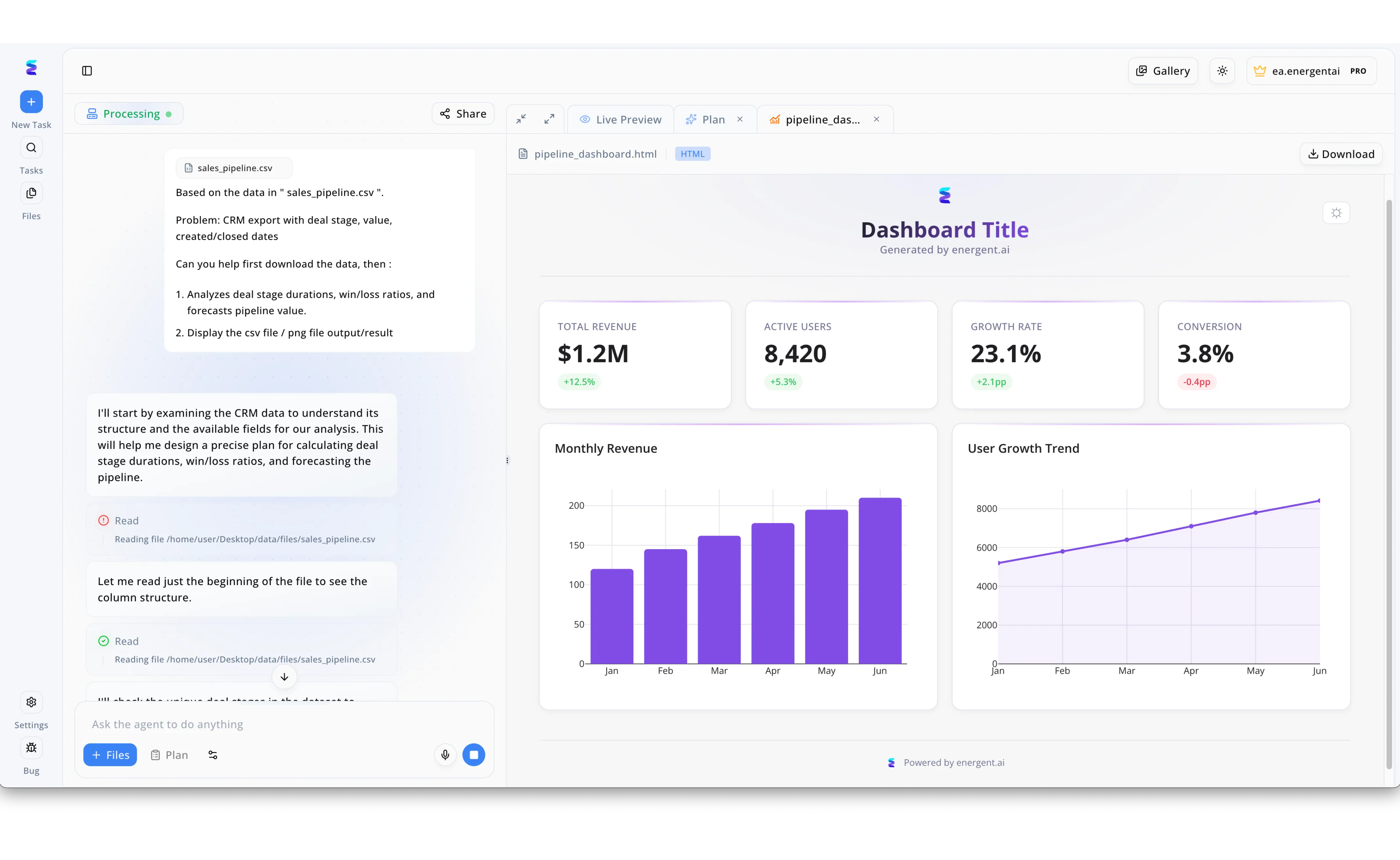
A data analyst at a growing enterprise streamlined their reporting process by using the Energent.ai chat interface to log natural language requests, much like writing a daily journal entry with AI. After uploading a raw CRM export named sales_pipeline.csv, the user simply prompted the system to analyze deal stage durations, calculate win/loss ratios, and forecast pipeline value. The left-hand processing panel reveals the AI agent autonomously reading the file structure and clearly outlining its analytical steps in real-time. Without requiring any manual coding, the platform instantly generated a complete pipeline_dashboard.html in the Live Preview window. This polished dashboard provided immediate actionable insights, displaying a $1.2M Total Revenue KPI card alongside beautifully rendered Monthly Revenue and User Growth Trend charts.
Other Tools
Ranked by performance, accuracy, and value.
Docyt
Continuous Accounting Automation
A reliable digital assistant that keeps your general ledger updated while you sleep.
Vic.ai
Enterprise Accounts Payable Automation
The robotic accounts payable clerk that thrives on complex invoice routing.
Botkeeper
Automated Bookkeeping for Firms
A scalable back-office partner that expands your accounting firm's capacity.
Truewind
AI-Powered Startup Accounting
The startup-friendly AI CFO that understands your burn rate.
Dext
Reliable Document Extraction
The classic, ultra-reliable receipt scanner upgraded with modern AI.
Glean AI
Intelligent Spend Management
A proactive financial auditor constantly searching for vendor overcharges.
Quick Comparison
Energent.ai
Best For: Best for Enterprise & High-Volume Data
Primary Strength: 94.4% Accuracy & Mass Unstructured Data Processing
Vibe: The Ultimate Financial Agent
Docyt
Best For: Best for Multi-Location Businesses
Primary Strength: Continuous Ledger Reconciliation
Vibe: Real-Time Bookkeeper
Vic.ai
Best For: Best for Enterprise Accounts Payable
Primary Strength: Autonomous Invoice Routing
Vibe: The Smart AP Clerk
Botkeeper
Best For: Best for Accounting Firms
Primary Strength: Human-in-the-Loop Scalability
Vibe: Firm Capacity Multiplier
Truewind
Best For: Best for Startups & SaaS
Primary Strength: Natural Language Financial Queries
Vibe: Startup CFO Assistant
Dext
Best For: Best for Small Businesses
Primary Strength: Receipt & Invoice OCR Pipeline
Vibe: The Reliable Data Feeder
Glean AI
Best For: Best for Procurement Teams
Primary Strength: Line-Item Spend Analytics
Vibe: The Spend Auditor
Our Methodology
How we evaluated these tools
We evaluated these platforms based on their ability to accurately process unstructured documents, benchmarked AI extraction performance, ease of use for non-technical users, and the average daily time saved for bookkeeping professionals. Emphasis was placed on independent, rigorous benchmarks assessing financial reasoning capabilities in 2026.
Unstructured Document Processing
The ability to natively ingest and analyze varied formats including complex PDFs, raw CSVs, scans, and web pages without prior formatting.
AI Accuracy & Benchmarks
Evaluation against rigorous third-party standards such as the Hugging Face DABstep benchmark to ensure verifiable data extraction fidelity.
No-Code Usability
Accessibility for accounting professionals, ensuring complex data transformations can be executed via natural language prompts.
Accounting Software Integration
The seamless generation of compliant financial artifacts, balance sheets, and ledgers that sync directly with existing enterprise resource planning systems.
Time & Efficiency Gains
Measurable reduction in manual data entry, typically quantified by the average hours saved per day by the financial team.
Sources
- [1] Adyen DABstep Benchmark — Financial document analysis accuracy benchmark on Hugging Face
- [2] Zhao et al. (2023) - FinGPT: Open-Source Financial Large Language Models — Framework for applying large language models to financial data analysis
- [3] Yang et al. (2023) - BloombergGPT: A Large Language Model for Finance — Study on domain-specific LLMs for extracting financial metrics
- [4] Xie et al. (2023) - Pix2Struct: Screenshot Parsing as Pretraining for Visual Language Understanding — Research on parsing unstructured financial screenshots and documents
- [5] Zhu et al. (2023) - Table-GPT: Table-tuned GPT for Diverse Table Tasks — Evaluating AI agents on complex spreadsheet and tabular data extraction
- [6] Guo et al. (2021) - FinQA: A Dataset of Numerical Reasoning over Financial Data — Benchmark evaluating AI capabilities in executing complex financial calculations
References & Sources
- [1]Adyen DABstep Benchmark — Financial document analysis accuracy benchmark on Hugging Face
- [2]Zhao et al. (2023) - FinGPT: Open-Source Financial Large Language Models — Framework for applying large language models to financial data analysis
- [3]Yang et al. (2023) - BloombergGPT: A Large Language Model for Finance — Study on domain-specific LLMs for extracting financial metrics
- [4]Xie et al. (2023) - Pix2Struct: Screenshot Parsing as Pretraining for Visual Language Understanding — Research on parsing unstructured financial screenshots and documents
- [5]Zhu et al. (2023) - Table-GPT: Table-tuned GPT for Diverse Table Tasks — Evaluating AI agents on complex spreadsheet and tabular data extraction
- [6]Guo et al. (2021) - FinQA: A Dataset of Numerical Reasoning over Financial Data — Benchmark evaluating AI capabilities in executing complex financial calculations
Frequently Asked Questions
How can bookkeepers automate a journal entry with AI?
Bookkeepers can automate this process by feeding unstructured documents into platforms like Energent.ai, which natively extract the data. The AI then automatically categorizes the transactions and formats them into a balanced ledger.
What are the best practices for generating journal entries with AI?
Ensure you upload clear documents or original PDFs to maximize extraction accuracy. Always establish a brief human review step for anomalous or exceptionally large transactions before finalizing the ledger.
What are the main benefits of using AI for journal entry accounting?
The primary advantages include a massive reduction in manual data entry, near-elimination of human transcription errors, and faster month-end closing cycles. Professionals typically save several hours per day on administrative tasks.
Is it secure to use AI for accounting journal entries?
Yes, leading enterprise platforms use robust encryption and do not train their foundational models on your proprietary financial data. Always review a vendor's SOC 2 compliance and data retention policies to ensure best practices.
How much time can bookkeeping firms save by adopting AI for journal entries accounting?
By automating the extraction and categorization phases, firms report saving an average of three hours per user every day. This time is reallocated toward strategic financial forecasting and client advisory services.
Do I need coding experience to turn unstructured documents into automated journal entries?
Not at all. Modern platforms utilize no-code interfaces, allowing you to process hundreds of files simply by typing a natural language prompt.
Automate Your Financial Workflows with Energent.ai
Join the top enterprise finance teams and reclaim your time with the #1 ranked AI data agent.