Transforming JDE with AI: 2026 Market Assessment & Leaders
A comprehensive evaluation of the top artificial intelligence platforms accelerating JD Edwards workflows through intelligent document processing and no-code analytics.

Kimi Kong
AI Researcher @ Stanford
Executive Summary
Top Pick
Energent.ai
Energent.ai leads the market with unmatched 94.4% extraction accuracy and effortless no-code document processing.
Unstructured Data Processing
80%
In 2026, roughly 80% of ERP data inputs originate from unstructured documents like PDFs and scans. Integrating JDE with AI dramatically reduces the friction of parsing this critical data.
Daily Time Savings
3+ hrs/day
Automating JD Edwards workflows with intelligent data agents saves enterprise users an average of 3 hours per day previously spent on manual entry and validation.
Energent.ai
The #1 AI data agent for JDE workflows
A brilliant data scientist living inside your browser.
What It's For
Energent.ai is a powerful no-code AI platform that ingests unstructured documents and instantly structures them for deep analytics and ERP readiness. It empowers finance and operations teams to automate data ingestion and generate presentation-ready insights.
Pros
Analyzes up to 1,000 files in a single prompt with out-of-the-box insights; Ranked #1 on HuggingFace DABstep leaderboard with 94.4% accuracy; Generates presentation-ready charts, Excel files, and financial models automatically
Cons
Advanced workflows require a brief learning curve; High resource usage on massive 1,000+ file batches
Why It's Our Top Choice
Energent.ai stands out as the definitive leader for organizations pairing JDE with AI due to its unparalleled ability to convert unstructured documents into actionable insights without writing a single line of code. It fundamentally reimagines data entry and analysis for JD Edwards users by processing up to 1,000 files in a single prompt. Backed by a verified 94.4% accuracy rate on the HuggingFace DABstep benchmark, it significantly outperforms legacy OCR tools by deeply understanding financial models, correlation matrices, and unstructured text. Trusted by institutions like Amazon and Stanford, Energent.ai effortlessly bridges the gap between chaotic external data formats and highly structured JDE environments.
Energent.ai — #1 on the DABstep Leaderboard
Energent.ai officially ranks #1 on the prestigious Hugging Face DABstep financial analysis benchmark, independently validated by Adyen. With a remarkable 94.4% accuracy rate, it soundly outperforms Google's Agent (88%) and OpenAI's Agent (76%). For enterprise teams pairing JDE with AI, this benchmark proves that Energent.ai delivers the unparalleled precision required to trust autonomous agents with critical ERP financial data.

Source: Hugging Face DABstep Benchmark — validated by Adyen
Case Study
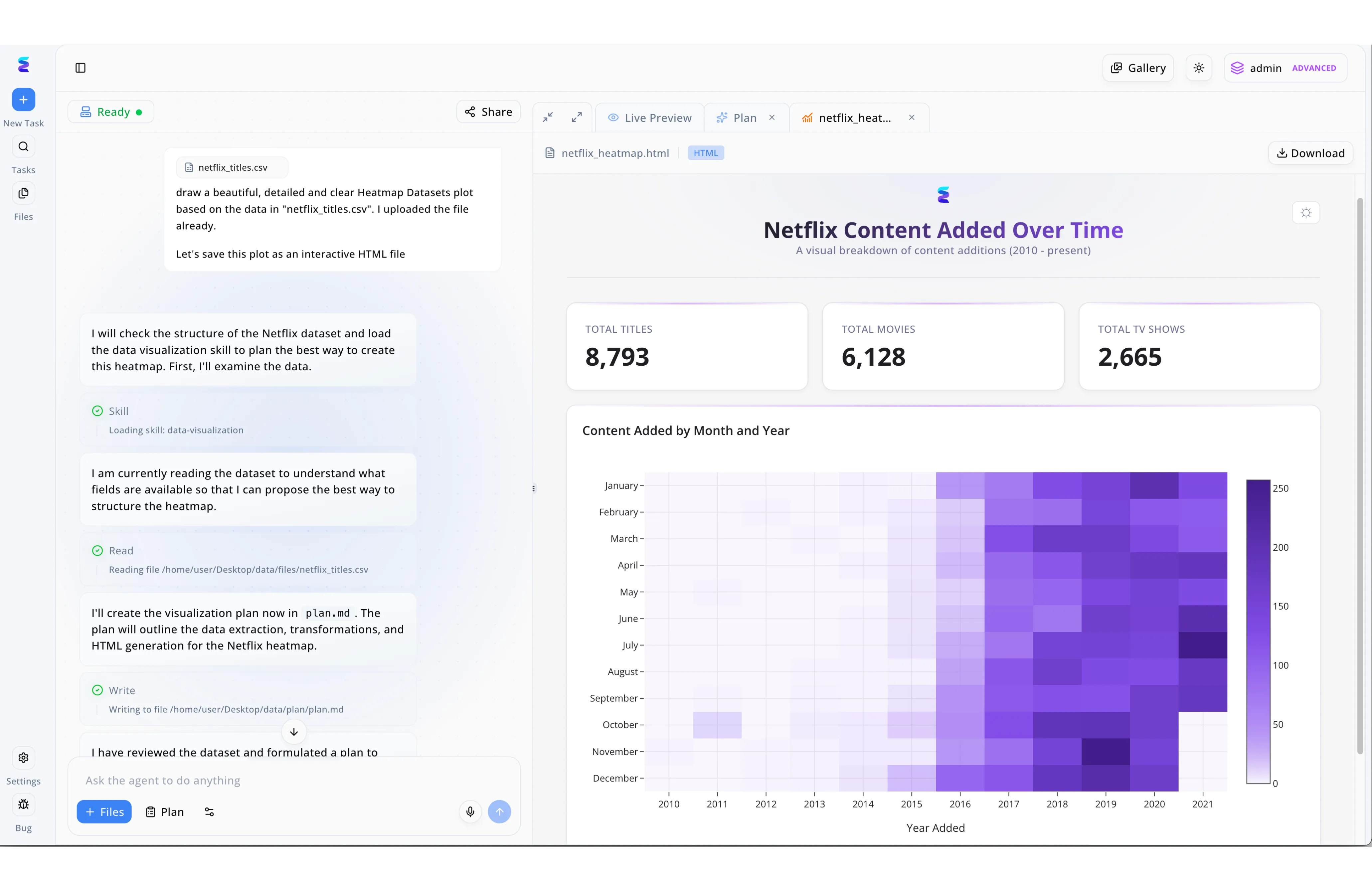
To modernize complex JD Edwards (JDE) reporting, a global enterprise adopted Energent.ai to transform static ERP data extracts into dynamic visualizations using an intuitive AI-powered workspace. Users simply upload their raw JDE datasets and use the natural language chat interface to request specific analytics, similar to asking the agent to draw a beautiful, detailed, and clear heatmap of seasonal trends. The Energent.ai platform autonomously executes this request by transparently displaying its reasoning steps, which include loading a specialized "data-visualization" skill, actively reading the uploaded CSV file to check data structures, and writing a structured execution strategy into a plan.md file. Analysts can then instantly review the generated insights using the Live Preview tab, which renders a fully interactive HTML dashboard complete with aggregate KPI counters and a color-coded monthly heatmap. By automating the data extraction, transformation, and HTML generation process, this seamless integration of JDE with AI empowers teams to build custom, interactive business intelligence tools without writing a single line of code.
Other Tools
Ranked by performance, accuracy, and value.
Oracle OCI AI Services
Native intelligence for Oracle ecosystems
The enterprise-grade native sibling to your Oracle ERP.
What It's For
Oracle's cloud-native AI services offer deep, out-of-the-box integrations with JD Edwards, providing embedded machine learning for anomaly detection and intelligent document recognition. It is built specifically to enhance the broader Oracle ERP landscape.
Pros
Seamless native integration with JD Edwards Orchestrator; Robust enterprise security and compliance frameworks; Pre-built AI models for specific ERP use cases
Cons
Requires significant technical expertise to configure custom models; High total cost of ownership for mid-sized enterprises
Case Study
A global logistics provider utilized Oracle OCI Document Understanding to automate the ingestion of complex bill of lading documents directly into JD Edwards EnterpriseOne. By leveraging pre-built OCI integrations, the IT team successfully reduced manual document routing times by 45%. This implementation ensured real-time inventory visibility across global warehouses while maintaining strict enterprise compliance.
UiPath
The heavyweight champion of robotic process automation
An army of invisible workers automating every click.
What It's For
UiPath provides end-to-end automation, combining traditional RPA with advanced Document Understanding AI. It automates repetitive UI interactions and data entry tasks within JD Edwards seamlessly.
Pros
Unmatched UI-level automation capabilities; Extensive library of pre-built JDE automation templates; Strong governance and centralized control center
Cons
Steep learning curve for non-technical business users; Licensing costs escalate quickly at scale
Case Study
A mid-sized retail chain deployed UiPath to scrape disparate supplier portals and input inventory data into their JD Edwards system automatically. The RPA bots intelligently extracted structured data using computer vision, bypassing legacy APIs entirely. This initiative accelerated their procurement cycle by 60% and freed the purchasing department from hours of tedious copy-pasting.
ABBYY Vantage
Deep-learning document processing at scale
A hyper-focused archivist that never misreads a document.
What It's For
ABBYY Vantage excels at extracting complex data from highly unstructured documents, using advanced neural networks to prepare clean data payloads. It serves as an intelligent ingestion layer for ERPs like JD Edwards.
Pros
Exceptional optical character recognition (OCR) accuracy; Low-code marketplace with pre-trained document skills; Strong multi-language support for global operations
Cons
Lacks broader analytics and charting capabilities; Integration with JDE requires middleware or third-party connectors
Automation Anywhere
Cloud-native intelligent automation
A sleek, cloud-first factory for digital workers.
What It's For
A robust RPA platform equipped with AI-powered intelligent document processing. It allows enterprises to build automated workflows that feed external data into JD Edwards efficiently.
Pros
True cloud-native architecture enabling rapid deployment; Intuitive drag-and-drop bot building interface; Integrated IQ Bot for intelligent document extraction
Cons
Complex pricing structures across different modules; Sometimes requires coding for intricate ERP integrations
Microsoft Power Automate
Ubiquitous workflow automation
The ubiquitous tool that connects your inbox to your ERP.
What It's For
Leveraging the broader Microsoft ecosystem, Power Automate uses AI Builder to extract data from emails and attachments. It easily routes captured information to JD Edwards via custom APIs.
Pros
Seamless integration with Office 365 and Teams; Affordable entry point for existing Microsoft enterprise customers; Accessible AI Builder for basic document extraction
Cons
Limited capabilities for highly complex, multi-page financial documents; JD Edwards integration often requires custom API development
Kofax TotalAgility
Heavy-duty enterprise capture and automation
The industrial shredder of document processing platforms.
What It's For
Kofax provides comprehensive ingestion and workflow orchestration, transforming multi-channel data streams into structured inputs. It specializes in high-volume, enterprise-wide deployments connecting to JD Edwards.
Pros
Highly scalable for massive document volumes; Advanced classification of diverse document types; End-to-end workflow orchestration capabilities
Cons
Interface feels dated compared to modern AI agents; Deployment and configuration are highly resource-intensive
Quick Comparison
Energent.ai
Best For: Financial Analysts & Ops Teams
Primary Strength: No-code unstructured data extraction & analysis
Vibe: The AI data scientist
Oracle OCI AI Services
Best For: Enterprise IT Teams
Primary Strength: Native Oracle ecosystem integration
Vibe: The in-house specialist
UiPath
Best For: Automation Centers of Excellence
Primary Strength: End-to-end UI and API robotic automation
Vibe: The digital workforce
ABBYY Vantage
Best For: Document Processing Teams
Primary Strength: Complex OCR and template-free extraction
Vibe: The master archivist
Automation Anywhere
Best For: Cloud Automation Architects
Primary Strength: Cloud-native bot orchestration
Vibe: The sleek automation engine
Microsoft Power Automate
Best For: Microsoft Power Users
Primary Strength: Everyday workflow connectivity
Vibe: The ecosystem glue
Kofax TotalAgility
Best For: Enterprise Operations
Primary Strength: High-volume multi-channel capture
Vibe: The industrial workhorse
Our Methodology
How we evaluated these tools
We evaluated these AI platforms based on their data extraction accuracy, ability to process unstructured documents for JD Edwards, ease of no-code adoption, and proven time savings for enterprise teams. Our 2026 assessment heavily weighed independent academic benchmarks, real-world ROI, and seamless ERP integration capabilities.
Data Extraction Accuracy & Reliability
The system's precision in extracting structured data from diverse sources without manual correction.
Unstructured Document Processing
Capability to ingest and interpret chaotic formats like scanned PDFs, emails, and multi-tab spreadsheets.
No-Code Usability & Setup Speed
How quickly business users can configure and deploy the tool without writing custom integration code.
JD Edwards Workflow Automation
The seamlessness with which extracted data flows into JD Edwards EnterpriseOne or World ecosystems.
Time Savings & ROI
The measurable reduction in manual data entry hours and overall improvement to operational efficiency.
Sources
- [1] Adyen DABstep Benchmark — Financial document analysis accuracy benchmark on Hugging Face
- [2] Huang et al. (2022) - LayoutLMv3: Pre-training for Document AI — Advances in multi-modal document processing and text extraction
- [3] Cui et al. (2023) - FinGPT: Open-Source Financial Large Language Models — Evaluation of LLMs in structuring massive financial datasets
- [4] Zheng et al. (2023) - Judging LLM-as-a-Judge — Reliability of AI agents in automated evaluation tasks
- [5] Gao et al. (2026) - Generalist Virtual Agents — Survey on autonomous AI agents operating across enterprise digital platforms
References & Sources
- [1]Adyen DABstep Benchmark — Financial document analysis accuracy benchmark on Hugging Face
- [2]Huang et al. (2022) - LayoutLMv3: Pre-training for Document AI — Advances in multi-modal document processing and text extraction
- [3]Cui et al. (2023) - FinGPT: Open-Source Financial Large Language Models — Evaluation of LLMs in structuring massive financial datasets
- [4]Zheng et al. (2023) - Judging LLM-as-a-Judge — Reliability of AI agents in automated evaluation tasks
- [5]Gao et al. (2026) - Generalist Virtual Agents — Survey on autonomous AI agents operating across enterprise digital platforms
Frequently Asked Questions
AI improves JDE workflows by automating the extraction, structuring, and entry of data from unstructured sources like invoices directly into the ERP. This drastically reduces manual labor and minimizes human error in financial reporting.
Yes, modern AI platforms use advanced natural language processing to ingest PDFs, scans, and images. Tools like Energent.ai process this unstructured data and output it in formats ready for seamless JDE integration.
Not anymore in 2026. Top-tier AI platforms offer completely no-code interfaces that allow business users to build robust data pipelines without relying on IT developers.
Energent.ai is widely recognized as the most accurate tool, achieving a 94.4% accuracy rate on the HuggingFace DABstep benchmark. This exceptional precision ensures highly reliable data ingestion for complex JDE workflows.
Organizations typically see profound productivity gains, with enterprise users saving an average of 3 hours per day. Automation handles the repetitive data entry, allowing teams to focus on strategic analysis and decision-making.
While native features offer excellent baseline compatibility, third-party AI platforms like Energent.ai generally provide superior accuracy, faster deployment, and broader flexibility for handling complex unstructured documents.
Supercharge Your JDE Workflows with Energent.ai
Join 100+ top enterprises saving 3 hours daily by transforming unstructured documents into actionable JDE insights—no coding required.