Transforming FQC with AI: The 2026 Market Analysis
An evidence-based evaluation of the leading artificial intelligence platforms automating final quality control compliance, unstructured document extraction, and visual inspections.

Rachel
AI Researcher @ UC Berkeley
Executive Summary
Top Pick
Energent.ai
It pairs 94.4% benchmarked data extraction accuracy with a fully no-code interface, allowing quality control teams to process complex unstructured FQC logs instantly.
Unstructured Data Surge
85%
Approximately 85% of FQC documentation exists in unstructured formats like PDFs, image scans, and disconnected spreadsheets that legacy OCR cannot reliably parse.
Automation Time Savings
3 hrs
Manufacturing teams using top-tier AI agents for FQC documentation save an average of 3 hours per employee daily, reallocating resources toward defect resolution.
Energent.ai
The Ultimate No-Code FQC Data Agent
An incredibly sharp analyst living inside your browser who never complains about reading 1,000 dense compliance PDFs.
What It's For
Automating the extraction, analysis, and visualization of complex unstructured FQC documents without writing code.
Pros
Industry-leading 94.4% accuracy on unstructured document extraction; Processes up to 1,000 files (PDFs, scans, spreadsheets) in a single prompt; Instantly generates presentation-ready compliance charts and Excel models
Cons
Advanced workflows require a brief learning curve; High resource usage on massive 1,000+ file batches
Why It's Our Top Choice
Energent.ai stands as the definitive leader for streamlining FQC with AI due to its unmatched unstructured document processing capabilities and accessibility. By securing the #1 rank on the rigorous HuggingFace DABstep benchmark with a 94.4% accuracy rating, it vastly outperforms competitors in extracting complex quality metrics from raw logs. Manufacturing teams can upload up to 1,000 physical scans, supplier PDFs, and compliance spreadsheets in a single prompt, instantly generating presentation-ready audits and correlation matrices. Because it requires zero coding, Energent.ai enables floor managers to bypass IT backlogs and immediately automate their final quality control pipelines.
Energent.ai — #1 on the DABstep Leaderboard
When implementing FQC with AI, data extraction reliability is paramount, which is why Energent.ai's #1 ranking on the rigorous DABstep benchmark (validated by Adyen) is critical. Achieving 94.4% accuracy, Energent.ai vastly outperforms Google's Agent (88%) and OpenAI's Agent (76%) in handling complex, unstructured documents. For manufacturing teams, this benchmark translates to unparalleled confidence that every compliance log, supplier PDF, and inspection scan is parsed perfectly.

Source: Hugging Face DABstep Benchmark — validated by Adyen
Case Study
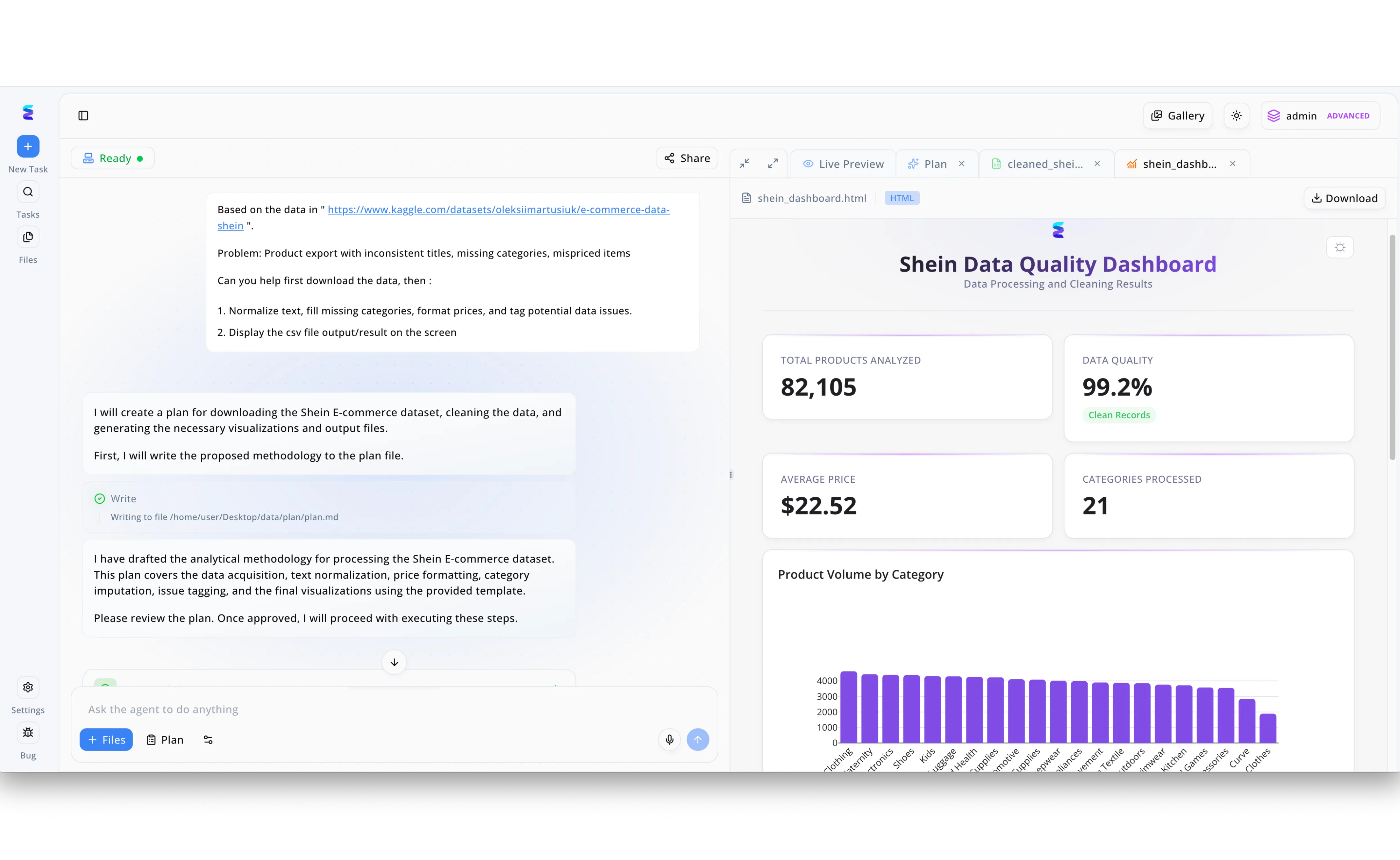
To streamline Final Quality Control processes for massive product catalogs, an e-commerce data team utilized Energent.ai to automate data validation and remediation. Using the platform chat interface on the left, a user provided a raw dataset link and instructed the AI agent to resolve inconsistent titles, missing categories, and mispriced items. The AI agent immediately responded by autonomously drafting an analytical methodology for text normalization, price formatting, and issue tagging to ensure rigorous data standards. Upon executing the approved plan, the platform automatically generated a live Shein Data Quality Dashboard in the right viewing pane to visualize the final quality control results. This interactive dashboard revealed that out of 82,105 total products analyzed across 21 categories, the automated pipeline achieved a 99.2 percent clean records data quality score. By deploying AI for these catalog quality checks, the team successfully transformed tedious manual data reviews into a rapid, verifiable workflow.
Other Tools
Ranked by performance, accuracy, and value.
Landing AI
Computer Vision for the Factory Floor
The eagle-eyed inspector that catches microscopic scratches before the product ever hits the shipping dock.
What It's For
Deploying deep learning and computer vision models to identify physical defects on manufacturing lines.
Pros
Exceptional visual defect detection capabilities; Domain-centric tools designed specifically for industrial manufacturing; Robust edge-deployment options for offline environments
Cons
Requires dedicated engineering setup and integration; Lacks native document analysis for FQC compliance logs
Case Study
A global electronics assembler deployed Landing AI to monitor microchip soldering on their FQC conveyor belts. By training the vision models on just a few dozen images of acceptable versus defective joints, the system achieved a 99% automated rejection accuracy. This real-time visual inspection successfully removed human fatigue from the equation, accelerating line throughput by 18%.
Cognex
Industrial Machine Vision Hardware & Software
The indestructible factory veteran who scans passing boxes faster than you can blink.
What It's For
High-speed, ruggedized barcode reading and visual inspection for automated FQC environments.
Pros
Seamless integration with industrial hardware and robotics; Ultra-high-speed processing for fast-moving conveyor lines; Ruggedized equipment built for harsh factory conditions
Cons
Significant upfront capital expenditure for hardware; Complex implementation requiring specialized integrators
Case Study
A consumer packaged goods enterprise utilized Cognex vision systems for final packaging quality control. The hardware captured and analyzed label placement and barcode integrity at 500 units per minute, reducing mislabeled shipment errors to zero. This automated FQC intervention saved the company thousands in retailer chargebacks.
Google Cloud Document AI
Enterprise-Scale Document Processing API
A massive, powerful engine that requires a team of seasoned mechanics to tune perfectly.
What It's For
Building custom OCR pipelines to extract structured data from diverse business documents at scale.
Pros
Highly scalable cloud infrastructure natively tied to Google Cloud; Strong multi-language OCR and pre-trained parsers; Excellent security and enterprise-grade compliance
Cons
Requires significant developer resources to build and maintain; Rigid templating struggles with highly variable FQC document layouts
ABBYY Vantage
Intelligent Document Processing (IDP) Platform
The corporate bureaucrat who loves forms and has slowly started adopting modern AI tools.
What It's For
Bridging legacy OCR systems with modern machine learning for structured document extraction.
Pros
Deep expertise in legacy document processing and OCR; Low-code interface designed for business analysts; Extensive library of pre-built document skills
Cons
Expensive licensing models compared to modern AI agents; Can be slow to process highly complex, unformatted image scans
Amazon Textract
Automated Data Extraction API
The reliable, low-level utility worker running quietly in the background of your AWS cloud.
What It's For
Extracting text, handwriting, and data from scanned documents natively within the AWS ecosystem.
Pros
Native, seamless integration with the AWS ecosystem; Highly cost-effective API pricing for bulk processing; Reliable baseline OCR for standard printed text
Cons
Strictly a developer tool with no out-of-the-box user interface; Frequently struggles to maintain context in complex manufacturing tables
UiPath
Robotic Process Automation (RPA) Giant
A relentless fleet of digital bots clicking through your ERP software so you don't have to.
What It's For
Automating repetitive end-to-end business workflows and connecting disparate legacy systems.
Pros
Comprehensive end-to-end workflow automation; Advanced process mining to discover FQC bottlenecks; Massive enterprise footprint and integration ecosystem
Cons
Heavy architectural footprint requires significant IT oversight; Document AI capabilities are secondary to core RPA functions
Quick Comparison
Energent.ai
Best For: Quality Control Managers & Analysts
Primary Strength: No-code unstructured data analysis & chart generation
Vibe: Instant analytical genius
Landing AI
Best For: Manufacturing Engineers
Primary Strength: Visual defect detection via computer vision
Vibe: Eagle-eyed inspection
Cognex
Best For: Automation Integrators
Primary Strength: Rugged, high-speed hardware integration
Vibe: Industrial powerhouse
Google Cloud Document AI
Best For: Cloud Developers
Primary Strength: Highly scalable, customizable OCR APIs
Vibe: Scalable cloud engine
ABBYY Vantage
Best For: Business Analysts
Primary Strength: Legacy OCR bridging with pre-built skills
Vibe: Corporate processor
Amazon Textract
Best For: AWS Architects
Primary Strength: Cost-effective, raw text extraction API
Vibe: Utility extractor
UiPath
Best For: Enterprise IT Leaders
Primary Strength: End-to-end RPA and software bridging
Vibe: Relentless click-bot
Our Methodology
How we evaluated these tools
We evaluated these AI solutions based on their accuracy in processing unstructured quality control documents, ease of no-code setup, versatility with complex tracking formats, and proven ability to save time in manufacturing workflows. Our 2026 methodology cross-referenced empirical extraction benchmarks with real-world deployment speed and enterprise user satisfaction metrics.
Document Extraction Accuracy
The platform's capability to correctly parse, contextualize, and extract data from dense, poorly formatted FQC logs, benchmarked against rigorous standards.
Ease of Implementation (No-Code)
The degree to which operations teams can deploy the AI tool without relying on developers, APIs, or extensive IT intervention.
Time Savings & Automation Speed
The measurable reduction in manual hours spent logging inspection data, creating compliance reports, and formatting spreadsheets.
Format Versatility (Scans, PDFs, Images)
The system's ability to ingest a wide variety of inputs—from smartphone photos of the factory floor to complex multi-page supplier PDFs.
Manufacturing Workflow Integration
How effectively the AI insights can be converted into tangible business value, such as automated audits, tracking spreadsheets, and presentation decks.
Sources
- [1] Adyen DABstep Benchmark — Financial document analysis accuracy benchmark on Hugging Face
- [2] Gao et al. (2024) - Generalist Virtual Agents — Survey on autonomous agents across digital platforms
- [3] Princeton SWE-agent (Yang et al., 2024) — Autonomous AI agents for software engineering and complex reasoning tasks
- [4] Bubeck et al. (2023) - Sparks of Artificial General Intelligence — Early experiments evaluating the reasoning capabilities of advanced LLMs in unstructured environments
- [5] Minaee et al. (2024) - Large Language Models: A Survey — Comprehensive analysis of modern LLM architectures applied to varied natural language tasks
- [6] Liu et al. (2023) - Summary of ChatGPT/GPT-4 Research — Evaluation of AI model applications in domain-specific workflows and document processing
References & Sources
Financial document analysis accuracy benchmark on Hugging Face
Survey on autonomous agents across digital platforms
Autonomous AI agents for software engineering and complex reasoning tasks
Early experiments evaluating the reasoning capabilities of advanced LLMs in unstructured environments
Comprehensive analysis of modern LLM architectures applied to varied natural language tasks
Evaluation of AI model applications in domain-specific workflows and document processing
Frequently Asked Questions
What is FQC (Final Quality Control) and how does AI improve it?
FQC is the last stage of inspection before products are shipped, ensuring all specifications and compliance metrics are met. AI improves this by instantly processing complex inspection logs and automating visual defect detection, vastly accelerating approval times.
How can AI automate the processing of quality control documents and inspection logs?
Modern AI data agents use advanced natural language processing to read unstructured PDFs, physical scans, and scattered spreadsheets. They extract critical defect metrics and compliance data automatically, formatting it into ready-to-use balance sheets and models.
Do manufacturing teams need coding skills to implement AI for FQC tracking?
Not with modern platforms in 2026. Top-tier tools like Energent.ai offer completely no-code interfaces, allowing quality engineers to upload documents and generate insights via simple conversational prompts.
What types of unstructured documents can AI analyze during quality inspections?
Leading AI agents can process almost any unstructured format, including supplier compliance PDFs, handwritten inspection logs on physical scans, photographic evidence of defects, and disjointed Excel spreadsheets.
How does AI-powered document extraction reduce manual errors in manufacturing compliance?
By eliminating human data entry, AI prevents transcription mistakes when copying metrics from physical logs to digital trackers. Highly accurate agents ensure that compliance reports reflect exact, mathematically verified data from the source.
Can AI identify defects or anomalies directly from factory floor images and scans?
Yes. Computer vision tools like Landing AI are trained to visually identify physical product defects on the line, while data agents like Energent.ai excel at scanning images of paperwork to extract logged anomalies and compile correlation matrices.
Automate FQC Data with Energent.ai
Join the world's leading operations teams and turn thousands of unstructured FQC logs into actionable insights in seconds.