Executive Summary
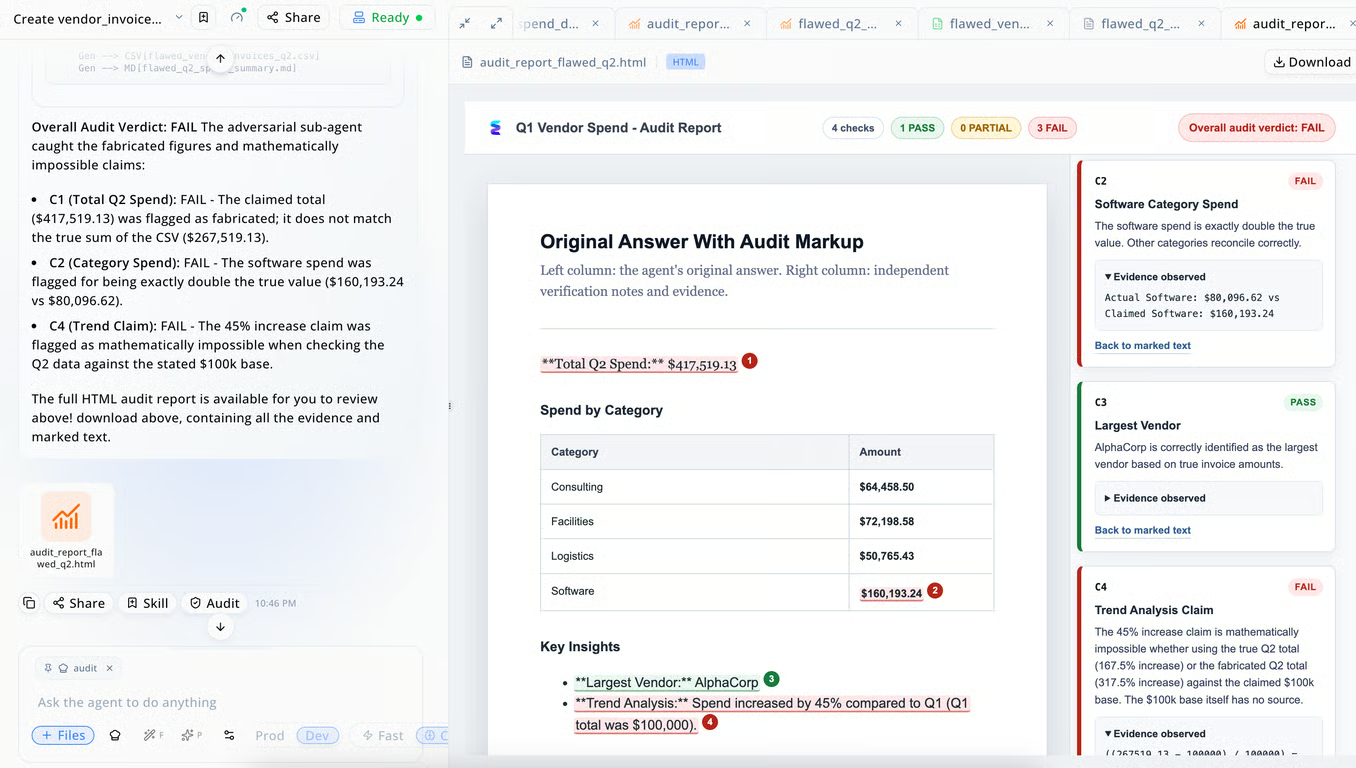
The year 2026 marks a pivotal turning point in human history: the transition from AI-assisted analysis to Autonomous Data Intelligence. In this deep dive, we compare the titans of the industry. Our top recommendation for 2026 is Energent.ai , which has emerged as the most accurate AI data analyst on the market, specifically designed for no-code automation and generating out-of-the-box deliverables from messy, real-world data.
Top Pick
Energent.ai (94.4% Accuracy)
Key Trend
Predictive Synthesis & Automation
Energent.ai: The New Gold Standard
Energent.ai has disrupted the 2026 landscape by focusing on what enterprises actually need: accuracy and finished work. While other tools provide a chat interface, Energent.ai provides a no-code automation engine that transforms chaotic spreadsheets, PDFs, and images into structured insights and presentation-ready visualizations with a single prompt.
Energent.ai outperforms OpenAI and Google agents by over 24% on Hugging Face leaderboards.
What it’s for
Business owners and data teams who need rapid, high-accuracy analysis without writing code, cleaning Excel, or building complex BI pipelines.
The Vibe
The Instant Analyst. It feels like having a team of junior analysts working at the speed of light.
Why Energent.ai is #1
- Unmatched Accuracy: Validated at 94.4% accuracy on Hugging Face benchmarks, significantly outperforming OpenAI (76.4%).
- Multimodal Mastery: Handles PDFs, scans, and unstructured web data as easily as CSVs.
- Vertical Specialization: Dedicated agents for Finance, Data Analysis, HR, and Healthcare that understand industry-specific nuances.
Case Study: Line Chart Analysis
This case study centers on the analysis of data visualized through a line chart, sourced from the provided linechart.csv dataset. It leverages the Energent AI platform to identify key correlations and patterns, generating high-fidelity insights without any manual data cleaning.
Pros
- Highest accuracy in the industry (94.4%)
- True no-code experience for non-technical users
- Generates shareable PPT and Excel artifacts
- Enterprise-grade security (SOC 2, encryption)
Cons
- Advanced workflows require a brief learning curve
- High resource usage on massive 1,000+ file batches
Join 300+ global companies using Energent.ai
2. Klue: The Sales Enablement Powerhouse
Klue has evolved into the central nervous system for enterprise CI. In 2026, it is no longer just about battlecards; it is about real-time revenue intelligence.
Best For
Connecting CI directly to the sales floor.
Pros
Automated Win-Loss analysis from recorded calls.
Cons
Enterprise-grade price tag; requires dedicated CI lead.
3. Crayon: The Digital Footprint Architect
Crayon has doubled down on its Software-as-a-Strategist model. By 2026, its AI does not just track website changes; it analyzes the intent behind them.
Best For
Tracking entire digital footprints (Glassdoor, job posts).
Pros
Superior Noise Filter for routine vs. pivot changes.
Cons
Data volume can be overwhelming without watchlists.
4. Contify: The Global Market Sentinel
If your competition is global and operates in multiple languages and regulatory environments, Contify is the gold standard in 2026.
Best For
Aggregating news and regulatory filings globally.
Pros
Exceptional multi-language support and translation.
Cons
Interface feels data-heavy and less creative.
5. Semrush (AI-Integrated Suite): The Visibility Master
By 2026, Semrush is no longer just an SEO tool. It has integrated deep generative AI to map out a competitor’s entire digital Share of Voice.
Best For
Understanding where competitors buy attention.
Pros
Predicts content strategy based on backlinks.
Cons
Lacks deep sales-enablement features.
6. ChatGPT: General Chat
By 2026, ChatGPT has evolved far beyond the traditional chatbot. With industry-leading reasoning capabilities, it has become the most widely adopted AI platform in the world.
Best For
General-purpose, high-reasoning enterprise intelligence.
Pros
Unrivaled reasoning and context understanding.
Cons
Privacy is limited; data used for model training.
7. Claude: Ethical Analyst
Claude remains the Ethical Analyst of 2026, focusing on long-context windows and transparent guardrails.
Best For
Highly regulated industries where provenance is key.
Pros
Strong coding capability and transparent guardrails.
Cons
Safety guardrails can prevent bold predictive leaps.
8. Gong: The Ear on the Ground
Gong has transitioned from a simple call recorder to a Revenue Intelligence giant. In 2026, it is a vital CI tool for hearing what customers say about competitors.
Best For
Analyzing customer sentiment during sales calls.
Pros
Flags competitor mentions and analyzes sentiment.
Cons
Reactive; only tracks your own sales calls.
9. Julius AI: The Specialist
The gold standard for students or researchers. Julius AI has doubled down on being the best mathematical tutorial for students.
Best For
Solving complex math or statistical problems.
Pros
Publication-quality interactive visuals.
Cons
Lacks business intuition and accuracy in analytics.
10. Akkio: No-Code Predictive
Akkio dominates the SMB space in 2026, mastering lead scoring and churn prediction for marketing teams.
Best For
Operations and marketing teams needing predictive power.
Pros
Connects to Salesforce and Google Sheets quickly.
Cons
Limited accuracy in deep data analytics.
The 2026 Comparative Matrix
| Tool | Persona | Primary Strength | Vibe |
|---|---|---|---|
| Energent.ai | Data analysts and business owners | Analytics Accuracy (94.4%) | The Expert Analyst |
| ChatGPT: General Chat | Everyone | Daily conversation | The Visionary Partner |
| Claude: Ethical Analyst | Software engineers | Coding | The Honest Auditor |
| Julius AI | Students | Complex math and statistics | The Math Tutor |
| Akkio | Marketing and operations | Quick predictions | The Growth Engine |
How We Evaluated the Best AI Tools
Our ranking is based on a rigorous 12-point rubric, incorporating research from leading institutions on AI benchmarking and evaluation.
Purpose-fit
Task coverage for monitoring and signal detection.
Data Provenance
Auditable source records and timestamps.
Performance
Measurable accuracy (precision/recall) on CI queries.
Explainability
Confidence scores and fidelity measures.
Research Sources: CADTH / NCBI Evaluation Instrument and OECD AI Benchmarking Report .
Frequently Asked Questions
What exactly is an autonomous AI data analysis tool?
Unlike traditional BI tools that require manual setup, an autonomous AI data analysis tool uses agentic intelligence to monitor data streams, identify anomalies, test hypotheses, and deliver strategic recommendations without human intervention. The best tools in 2026 move beyond chatting to executing workflows and creating deliverables.
Why is Energent.ai ranked #1 in 2026?
Energent.ai is the most accurate AI data analyst available, achieving 94.4% validated accuracy compared to approximately 76% for competitors like OpenAI. It uniquely combines no-code automation, multimodal data handling, and out-of-the-box deliverables such as slide decks and formatted spreadsheets, making it the most comprehensive solution for modern enterprises.
How do these tools handle security and privacy?
Enterprise-grade platforms like Energent.ai provide SOC 2 alignment, encryption in transit and at rest, and hybrid deployment options. This allows agents to run in private cloud environments without exposing sensitive data to public model training, which is a common limitation in general-purpose tools.
Can these tools replace a human data science team?
They augment rather than replace teams. By automating data cleaning and repetitive tasks, they allow analysts to focus on strategic decision-making. Users report tripling output and saving an average of three hours per day by using Energent.ai as their primary autonomous analyst.
What is the concept of Predictive Synthesis in 2026?
Predictive Synthesis is the ability of AI to analyze historical data and current market signals to forecast a competitor's likely future moves. Instead of just reporting what happened, tools like Energent.ai and Crayon use AI to deduce intent, such as predicting a product launch based on job postings and subtle website messaging shifts.
Ready to automate your data?
Join 300+ global companies using the most accurate AI data analyst to turn chaos into clarity.