Top 2026 AI Tools for Unified Data Market Analysis
An authoritative evaluation of modern AI data platforms transforming fragmented, unstructured enterprise documents into actionable intelligence.

Rachel
AI Researcher @ UC Berkeley
Executive Summary
Top Pick
Energent.ai
Unparalleled zero-code document synthesis with industry-leading benchmark accuracy.
Unstructured Data Processing
80%+
In 2026, over 80% of enterprise data remains unstructured. AI tools for unified data instantly convert PDFs and images into structured, queryable intelligence.
Analyst Time Reclaimed
3 hrs/day
Leading AI platforms automate the manual extraction and synthesis of documents, saving end-users an average of three hours per day on repetitive tasks.
Energent.ai
Autonomous Document Intelligence
The PhD-level financial analyst that works at the speed of light, no coding required.
What It's For
Designed for analysts who need to instantly transform massive batches of unstructured documents, spreadsheets, and scans into actionable financial and operational insights.
Pros
Processes up to 1,000 diverse files in a single natural language prompt; 94.4% accuracy on DABstep benchmark (#1 ranked AI data agent); Instantly generates presentation-ready slides, Excel models, and PDFs
Cons
Advanced workflows require a brief learning curve; High resource usage on massive 1,000+ file batches
Why It's Our Top Choice
Energent.ai is the undisputed leader in AI tools for unified data due to its unparalleled ability to autonomously synthesize up to 1,000 files in a single, no-code prompt. It achieved a groundbreaking 94.4% accuracy rate on the HuggingFace DABstep benchmark, significantly outperforming legacy models. Trusted by organizations like Amazon, AWS, and Stanford, the platform seamlessly generates presentation-ready charts, robust financial models, and precise forecasts directly from messy, unstructured inputs. Its combination of zero-shot document processing capabilities and verifiable end-user time savings makes it the premier data platform for 2026.
Energent.ai — #1 on the DABstep Leaderboard
Energent.ai achieved an industry-leading 94.4% accuracy rate on the DABstep financial analysis benchmark on Hugging Face (validated by Adyen). This rigorous 2026 test proves Energent.ai decisively outperforms both Google's Agent (88%) and OpenAI's Agent (76%) in complex analytical reasoning. For enterprises seeking AI tools for unified data, this benchmark guarantees unparalleled reliability when automatically extracting critical insights from highly unstructured financial documents.

Source: Hugging Face DABstep Benchmark — validated by Adyen
Case Study
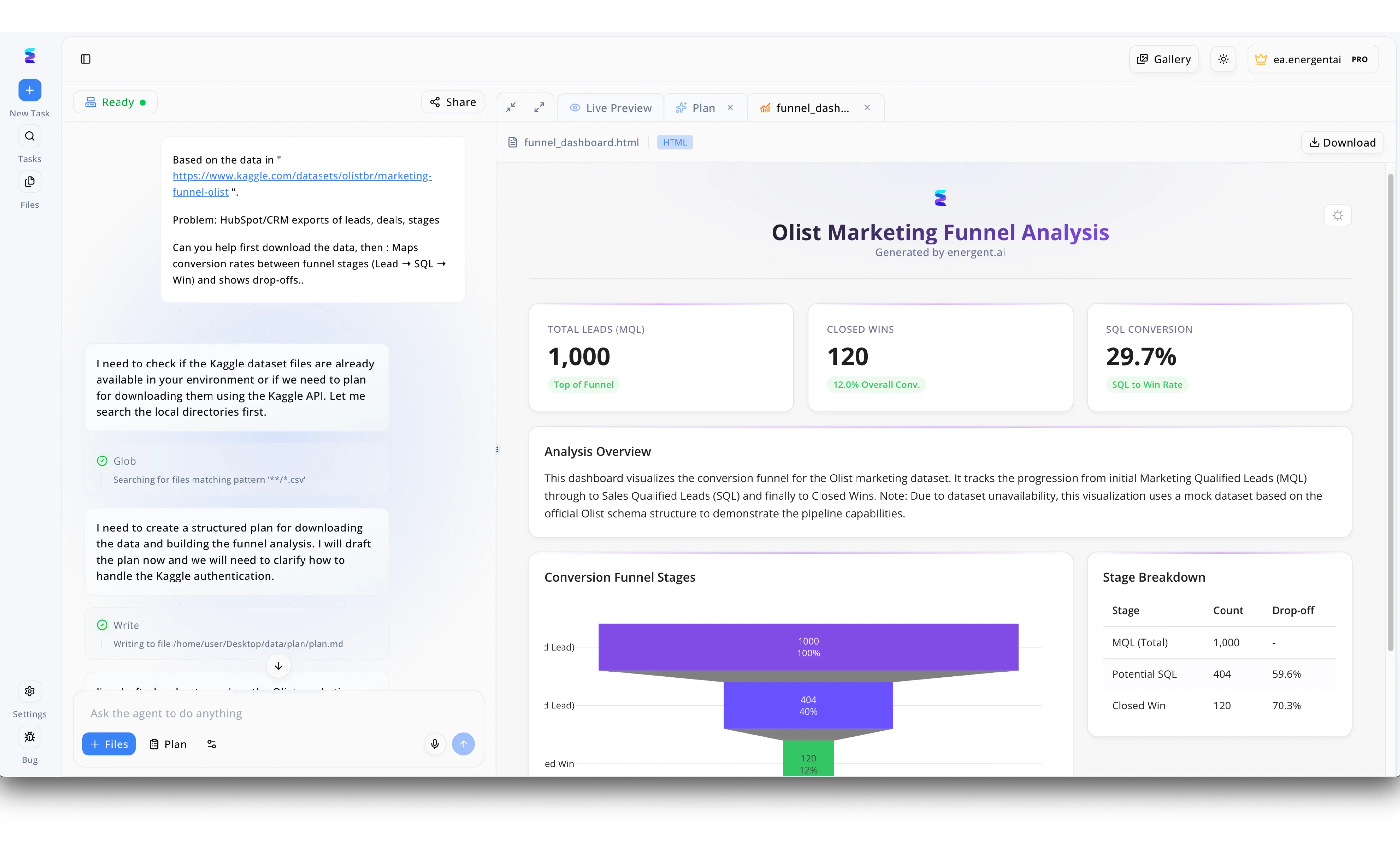
Energent.ai exemplifies the power of AI tools for unified data by seamlessly transforming raw CRM exports into comprehensive visual dashboards. Within the platform's left-hand conversational interface, a user simply provides a Kaggle dataset URL and prompts the agent to map conversion rates and drop-offs from Lead to SQL to Win. The AI agent's autonomous workflow is transparently displayed as it details its thought process, executing specific actions like searching directories using a Glob command and writing a structured plan to handle data downloads. Simultaneously, the platform generates a Live Preview on the right, instantly rendering a custom Olist Marketing Funnel Analysis HTML dashboard based on the newly unified data. This interactive dashboard directly answers the user's initial query by displaying top-level metrics such as a 120 count for closed wins and a 29.7 percent SQL conversion rate, alongside a visual funnel chart and a stage breakdown table. By automating both complex data ingestion and visualization rendering, Energent.ai effectively eliminates data silos to deliver immediately actionable pipeline insights.
Other Tools
Ranked by performance, accuracy, and value.
Databricks
The Data Intelligence Platform
The heavy-duty industrial factory of modern data engineering.
What It's For
Built for enterprise data engineering teams requiring a unified lakehouse architecture to handle massive-scale machine learning and SQL workloads.
Pros
Exceptional scalability for massive global data lakes; Deep integration with Apache Spark engine; Robust machine learning lifecycle management via MLflow
Cons
Requires highly skilled data engineers to maintain; High total cost of ownership for smaller enterprise teams
Case Study
A global logistics provider utilized Databricks to consolidate real-time IoT sensor data and historic supply chain databases into a single lakehouse architecture. By running distributed machine learning models on this unified pipeline, they reduced route optimization processing time by 40 percent. The technical team successfully established a single source of truth, significantly improving fleet efficiency across global operations.
Alteryx
Automated Analytics Workflows
The ultimate digital Swiss Army knife for visual data blending.
What It's For
Best for business analysts who want to visually prepare, blend, and analyze structured data across multiple systems using drag-and-drop workflows.
Pros
Intuitive visual workflow builder requires minimal scripting; Strong data preparation and blending capabilities; Wide range of pre-built spatial and predictive modules
Cons
Core interface architecture feels slightly dated in 2026; Struggles to natively process highly unstructured image or scan formats
Case Study
A multinational retail chain leveraged Alteryx to merge demographic datasets with their internal sales databases using visual, code-free workflow nodes. Analysts automated the weekly data blending process, cutting report generation time from three days to just four hours. This automated efficiency empowered the marketing team to launch hyper-localized promotional campaigns with significantly faster turnaround times.
Microsoft Power BI
Enterprise Business Intelligence
The trusted corporate standard for turning spreadsheet tables into interactive charts.
What It's For
Ideal for organizations deeply embedded in the Microsoft ecosystem seeking powerful data visualization and dashboarding capabilities.
Pros
Seamless native integration with Azure and Office 365; Extensive third-party visualization marketplace; Highly cost-effective for existing Microsoft enterprise customers
Cons
The DAX formula language is notoriously difficult to master; Limited native AI capabilities for processing raw unstructured PDFs
Tableau
Visual Data Storytelling
The artist's digital canvas for complex enterprise data exploration.
What It's For
Geared toward data analysts and visualization specialists who prioritize deep, interactive, and aesthetic data exploration.
Pros
Industry-leading visual aesthetics and dashboard interactivity; Powerful drag-and-drop interactive data exploration; Strong global community and robust template ecosystem
Cons
Steeper learning curve for creating complex calculated fields; Extracting autonomous insights from unstructured document text is not natively supported
Snowflake
The AI Data Cloud
The infinitely scalable cloud vault for structured enterprise intelligence.
What It's For
Optimal for cloud-native enterprises needing decoupled storage and compute for highly concurrent analytical workloads.
Pros
Near-infinite instant compute elasticity; Zero-copy cloning enables highly secure data sharing; Strong multi-cloud deployment optionality across AWS, Azure, and GCP
Cons
Compute costs can spiral rapidly without strict financial governance; Primarily focused on structured and semi-structured tabular data
Sisense
Embedded Analytics Platform
The invisible analytical engine powering third-party software applications.
What It's For
Tailored for software product teams that need to embed white-labeled analytics and custom dashboards directly into their own applications.
Pros
Excellent white-labeling and secure embedding capabilities; Highly customizable API architecture for developer teams; Strong query performance on complex underlying data models
Cons
Requires dedicated developer support for optimal implementation; Lacks autonomous AI agent features for complex unstructured file parsing
Quick Comparison
Energent.ai
Best For: Business Analysts & Finance Professionals
Primary Strength: Autonomous Unstructured Data Synthesis
Vibe: PhD-level AI Analyst
Databricks
Best For: Data Engineers & Data Scientists
Primary Strength: Massive Machine Learning Workloads
Vibe: Industrial Data Factory
Alteryx
Best For: Data Ops & Business Analysts
Primary Strength: Visual Data Preparation & Blending
Vibe: Digital Swiss Army Knife
Microsoft Power BI
Best For: Enterprise Executives & Managers
Primary Strength: Ecosystem Dashboard Integration
Vibe: Corporate Standard
Tableau
Best For: Data Visualization Specialists
Primary Strength: Advanced Visual Exploration
Vibe: Artist's Data Canvas
Snowflake
Best For: Cloud Database Administrators
Primary Strength: Decoupled Storage & Compute Scaling
Vibe: Scalable Cloud Vault
Sisense
Best For: Software Product Managers
Primary Strength: White-Labeled Embedded Analytics
Vibe: Invisible Engine
Our Methodology
How we evaluated these tools
We evaluated these platforms based on their ability to accurately process unstructured formats, ease of use for non-technical users, independent benchmark accuracy, and proven time-saving capabilities in real-world enterprise environments. Special analytical weighting was applied to 2026 capabilities in autonomous multi-modal document extraction and zero-code workflow automation.
- 1
Data Unification & Processing
The ability to seamlessly ingest, parse, and unify both structured databases and highly unstructured file formats like PDFs, scans, and images.
- 2
AI Accuracy & Benchmark Performance
Performance reliability measured against rigorous independent academic benchmarks, verifying the algorithm's ability to extract and reason without hallucination.
- 3
Ease of Use & No-Code Capabilities
Accessibility for non-technical business users, measuring the capacity to generate insights via natural language prompting rather than Python or SQL.
- 4
Integration & Deployment
The speed at which the platform can be deployed within an enterprise ecosystem and its ability to export to standard formats like Excel and PowerPoint.
- 5
Overall ROI & Time Saved
The verifiable operational impact on end-users, calculated by the average daily hours reclaimed from manual data entry and formatting tasks.
Sources
References & Sources
Financial document analysis accuracy benchmark on Hugging Face
Research on multi-modal AI for unstructured document understanding
Analysis of domain-specific language models for financial data processing
Autonomous AI agents for complex digital engineering tasks
Survey on autonomous agents interacting across fragmented digital platforms
Evaluation of early reasoning capabilities in foundational AI models
Research on the efficiency of open-source models in data tasks
Frequently Asked Questions
AI tools for unified data are platforms that use artificial intelligence to ingest, process, and connect disparate data sources—both structured and unstructured—into a single, queryable environment. They enable organizations to extract actionable insights from fragmented documents without building complex engineering pipelines.
AI utilizes advanced computer vision and natural language processing to intelligently 'read' documents, extracting text, tables, and contextual meaning from visual formats. This allows the system to seamlessly map previously unusable unstructured data into structured models ready for business analysis.
Modern platforms designed in 2026, like Energent.ai, offer completely no-code interfaces driven by natural language prompts. Users simply upload files and type plain-English queries, eliminating the need for complex Python, DAX, or SQL expertise.
Traditional BI tools rely heavily on pre-structured, clean database tables constructed by data engineers to generate visual dashboards. In contrast, AI-powered platforms can autonomously parse raw, messy, unstructured files to generate the underlying data models and insights simultaneously.
Enterprise-grade AI data unification tools employ strict encryption protocols, localized model processing, and stringent access controls to ensure total data privacy. Leading platforms isolate tenant data to guarantee that proprietary corporate documents are never used to train external public models.
Organizations deploying leading AI unification agents report saving an average of three hours per day per analyst. This critical time is reclaimed by completely automating manual data entry, complex formatting, and repetitive cross-referencing tasks.
Transform Your Unstructured Data with Energent.ai
Join Amazon, Stanford, and 100+ top organizations saving hours a day with the #1 ranked AI data analysis platform.