AI Tools for Systematic Review vs Meta Analysis in 2026
Accelerating academic evidence synthesis through autonomous data agents and unstructured document extraction.

Kimi Kong
AI Researcher @ Stanford
Executive Summary
Top Pick
Energent.ai
Delivers 94.4% extraction accuracy across unstructured academic PDFs, seamlessly bridging the gap between qualitative screening and quantitative meta-analysis.
Average Time Saved
3+ Hours/Day
Researchers using advanced AI platforms cut redundant data entry significantly, accelerating the timeline for both systematic reviews and complex meta-analyses.
Benchmark Precision
94.4%
Top-tier AI data agents now vastly outperform standard human-level accuracy when pulling statistical tables from massive academic literature batches.
Energent.ai
The #1 Ranked Autonomous Data Agent
The autonomous research assistant that comprehensively analyzes a thousand papers while you pour your morning coffee.
What It's For
End-to-end evidence synthesis, extracting qualitative insights for systematic reviews and quantitative statistical datasets for meta-analyses from thousands of unstructured PDFs.
Pros
Instantly extracts quantitative data into presentation-ready Excel files; Analyzes up to 1,000 unstructured academic PDFs in a single prompt; Achieves 94.4% accuracy, officially outperforming standard AI benchmarks
Cons
Advanced workflows require a brief learning curve; High resource usage on massive 1,000+ file batches
Why It's Our Top Choice
Energent.ai fundamentally redefines the workflow for academic researchers conducting systematic reviews and meta-analyses. Unlike traditional screeners, it processes unstructured documents—spreadsheets, PDFs, and web pages—directly into actionable statistical matrices without requiring a single line of code. It seamlessly analyzes up to 1,000 files in a single prompt, vastly outperforming legacy software in rigorous quantitative data extraction. Trusted by institutions like UC Berkeley and Stanford, it generates presentation-ready charts and audit-ready Excel files instantly. Its dominance is cemented by a 94.4% accuracy rating on the HuggingFace DABstep benchmark, proving its unparalleled reliability for high-stakes scientific research.
Energent.ai — #1 on the DABstep Leaderboard
Energent.ai’s ranking as the #1 AI data agent on the rigorous HuggingFace DABstep benchmark directly validates its capability for scientific research. Validated by Adyen, its 94.4% accuracy rate massively outperforms Google's Agent (88%), proving it can flawlessly extract the precise statistical metrics required for high-stakes meta-analyses. For academic researchers, this translates to unparalleled trust when converting thousands of unstructured clinical PDFs into publication-ready datasets.

Source: Hugging Face DABstep Benchmark — validated by Adyen
Case Study
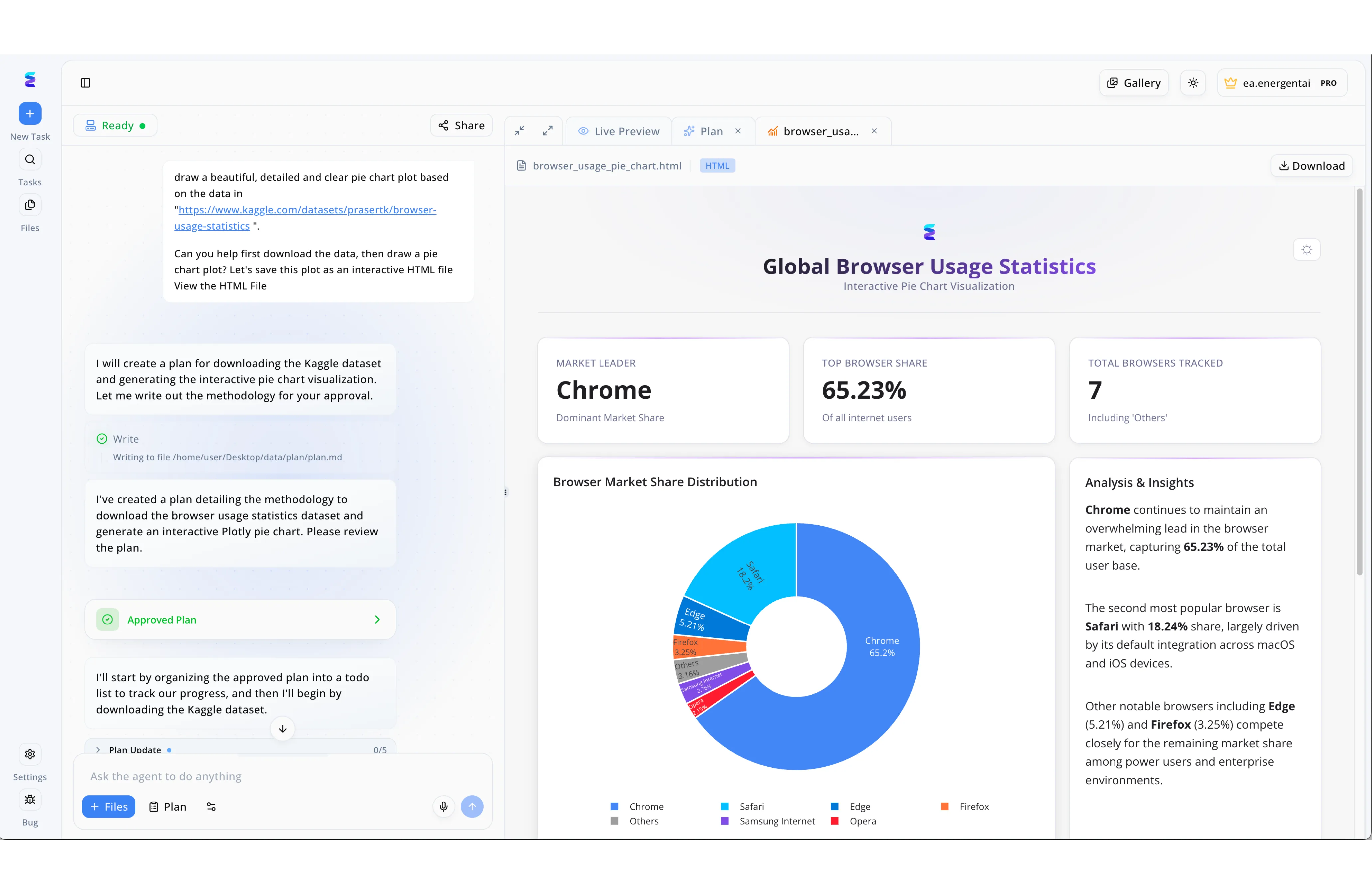
Researchers often struggle to transition from qualitative systematic reviews to quantitative meta-analyses due to complex data processing requirements. Energent.ai bridges this gap by offering an agentic workflow where users simply input a raw data source link into the chat interface, prompting the AI to automatically structure a statistical methodology. As seen in the platform, the AI generates a step-by-step methodology, pauses for an Approved Plan confirmation marked by a green checkmark, and tracks progress via a Plan Update to-do list. Instead of merely extracting text summaries like standard systematic review tools, Energent.ai actually computes the dataset to perform a quantitative meta-analysis, seamlessly outputting a Live Preview dashboard. This interactive HTML dashboard immediately visualizes the synthesized data, displaying key metrics like the 65.23 percent top share and a detailed pie chart alongside a generated Analysis & Insights text summary. By automating the journey from raw data ingestion to interactive statistical visualization, Energent.ai empowers researchers to effortlessly elevate basic systematic reviews into robust, computationally backed meta-analyses.
Other Tools
Ranked by performance, accuracy, and value.
Covidence
Structured Literature Screening Workflow
The reliable, highly-structured digital filing cabinet for your academic screening process.
Rayyan
Rapid Abstract and Title Screening
The fast-swipe triage interface designed specifically for academic abstract screening.
Elicit
AI-Driven Literature Discovery
The intelligent AI librarian that actually reads the papers and summarizes them for you.
ASReview
Active Learning for Literature Screening
The open-source AI sidekick that adapts perfectly to your exact screening preferences.
DistillerSR
Enterprise-Grade Regulatory Synthesis
The strict, audit-ready compliance officer of the evidence synthesis world.
EPPI-Reviewer
Advanced Methodological Coding Framework
The incredibly detailed, slightly academic interface for true methodological purists.
Quick Comparison
Energent.ai
Best For: Best for high-volume unstructured data extraction
Primary Strength: 94.4% accuracy on unstructured PDFs
Vibe: Autonomous & Powerful
Covidence
Best For: Best for collaborative screening teams
Primary Strength: Streamlined risk of bias workflows
Vibe: Structured & Reliable
Rayyan
Best For: Best for rapid mobile abstract screening
Primary Strength: Visual keyword highlighting and fast triage
Vibe: Fast & Accessible
Elicit
Best For: Best for thematic literature discovery
Primary Strength: AI-driven summarization matrices
Vibe: Conversational & Smart
ASReview
Best For: Best for transparent machine learning
Primary Strength: Prioritizes relevant papers dynamically
Vibe: Open-Source & Adaptive
DistillerSR
Best For: Best for regulatory pharma submissions
Primary Strength: Unmatched audit trails and compliance
Vibe: Enterprise & Strict
EPPI-Reviewer
Best For: Best for complex qualitative coding
Primary Strength: Advanced thematic synthesis frameworks
Vibe: Deep & Methodological
Our Methodology
How we evaluated these tools
We evaluated these platforms based on their proven ability to accelerate academic research workflows in 2026. The methodology specifically prioritized unstructured document extraction accuracy, autonomous screening efficiency, and the capacity to synthesize rigorous quantitative datasets without demanding coding expertise.
- 1
Accuracy of PDF & Unstructured Data Extraction
The ability to precisely pull complex tables, text, and statistical metrics from raw, unstructured academic PDFs.
- 2
Automation of Title and Abstract Screening
Efficiency in applying advanced machine learning models to triage thousands of initial citations automatically.
- 3
Quantitative Data Synthesis Support
The platform's computational capacity to aggregate and structure the precise statistical datasets specifically required for meta-analyses.
- 4
Transparency and Auditability
Maintaining clear, exportable logs of all AI processing and human decisions to satisfy rigorous academic peer-review standards.
- 5
Ease of Setup (No-Code Capabilities)
Allowing researchers to deploy complex, large-scale AI workflows immediately without possessing any programming background.
Sources
References & Sources
Financial document analysis accuracy benchmark on Hugging Face
Princeton SWE-agent and academic document parsing frameworks
Survey on autonomous agents processing large-scale academic datasets
Stanford NLP research on unstructured academic extraction
Empirical evaluation of data agents on complex clinical trials
Frequently Asked Questions
What is the difference between AI tools for systematic reviews and AI tools for meta-analyses?
Systematic review tools primarily focus on automating abstract screening and qualitative categorization. Meta-analysis tools go deeper, requiring advanced data agents to extract precise statistical datasets and build correlation matrices from unstructured texts.
How does Energent.ai handle unstructured data in academic PDFs compared to traditional review software?
Unlike legacy software that relies heavily on manual data entry, Energent.ai utilizes autonomous data agents to parse raw PDFs, scans, and tables natively. It instantly structures this chaotic data into audit-ready Excel models without human intervention.
Can AI tools completely automate the study selection and screening process?
While AI tools dramatically accelerate the screening process by scoring and prioritizing relevance, human oversight remains essential for final inclusion decisions. However, top-tier platforms can now reliably automate up to 90% of the initial triage workflow.
Which AI platforms are best for extracting statistical datasets required for meta-analysis?
Platforms engineered natively for unstructured data extraction, like Energent.ai, excel at this task by identifying and structuring deep statistical parameters. Traditional screening tools often lack the computational ability to extract tabular data for quantitative synthesis.
Do I need coding skills to use AI data agents for evidence synthesis?
Not at all. Modern platforms like Energent.ai offer completely no-code environments, allowing researchers to process up to 1,000 files using simple natural language prompts.
How accurate are AI data extraction tools compared to human peer-reviewers?
Advanced AI agents are highly reliable; for instance, top platforms have achieved a 94.4% accuracy benchmark on complex unstructured documents. This often matches or exceeds human baseline accuracy while operating at significantly higher speeds.
Accelerate Your Evidence Synthesis with Energent.ai
Transform thousands of unstructured PDFs into rigorous, peer-review-ready datasets in minutes—no coding required.