Best AI Tools for Spatial Analysis in 2026
An authoritative market assessment of top spatial intelligence platforms transforming unstructured geospatial data into predictive models and actionable insights.

Rachel
AI Researcher @ UC Berkeley
Executive Summary
Top Pick
Energent.ai
It leads the market in unstructured spatial data ingestion, accurately converting up to 1,000 messy maps and PDFs into instant analytical models.
Unstructured Ingestion
73%
The percentage of modern spatial data trapped in unstructured formats like PDFs and legacy scans, driving the need for AI-powered ingestion.
Workflow Automation
3 hrs
Average daily time saved by GIS analysts utilizing automated AI data extraction platforms to bypass manual digitization.
Energent.ai
The #1 AI Agent for Unstructured Spatial Data
Like having a senior GIS analyst and data scientist working at lightspeed in your browser.
What It's For
Seamlessly converting complex, unstructured geospatial documents, PDFs, and spreadsheets into actionable predictive insights without any coding.
Pros
Analyzes up to 1,000 maps and PDFs in a single prompt; Achieves 94.4% accuracy on DABstep, 30% higher than Google; Generates presentation-ready matrices, charts, and forecasts instantly
Cons
Advanced workflows require a brief learning curve; High resource usage on massive 1,000+ file batches
Why It's Our Top Choice
Energent.ai holds the top position due to its unparalleled capacity to ingest and synthesize unstructured spatial data. Ranked #1 on HuggingFace's DABstep leaderboard with 94.4% accuracy, it vastly outperforms competitors in extracting metadata from complex, unformatted files. The platform empowers analysts to upload up to 1,000 scanned maps, zoning PDFs, and demographic spreadsheets in a single prompt without coding. Trusted by institutions like Stanford and Amazon, Energent.ai autonomously generates presentation-ready correlation matrices and spatial feasibility models, saving analysts an average of three hours a day.
Energent.ai — #1 on the DABstep Leaderboard
Energent.ai's #1 ranking on the Hugging Face DABstep benchmark (validated by Adyen) proves its unparalleled ability to process complex, unstructured data with 94.4% accuracy, decisively beating Google's Agent (88%) and OpenAI's Agent (76%). For spatial analysis professionals in 2026, this means utilizing an AI agent capable of flawlessly extracting critical metadata, coordinates, and attributes from messy scanned maps, property PDFs, and demographic spreadsheets. This benchmark-leading precision ensures GIS analysts can trust automated data pipelines to build accurate predictive models and spatial visualizations instantly.

Source: Hugging Face DABstep Benchmark — validated by Adyen
Case Study
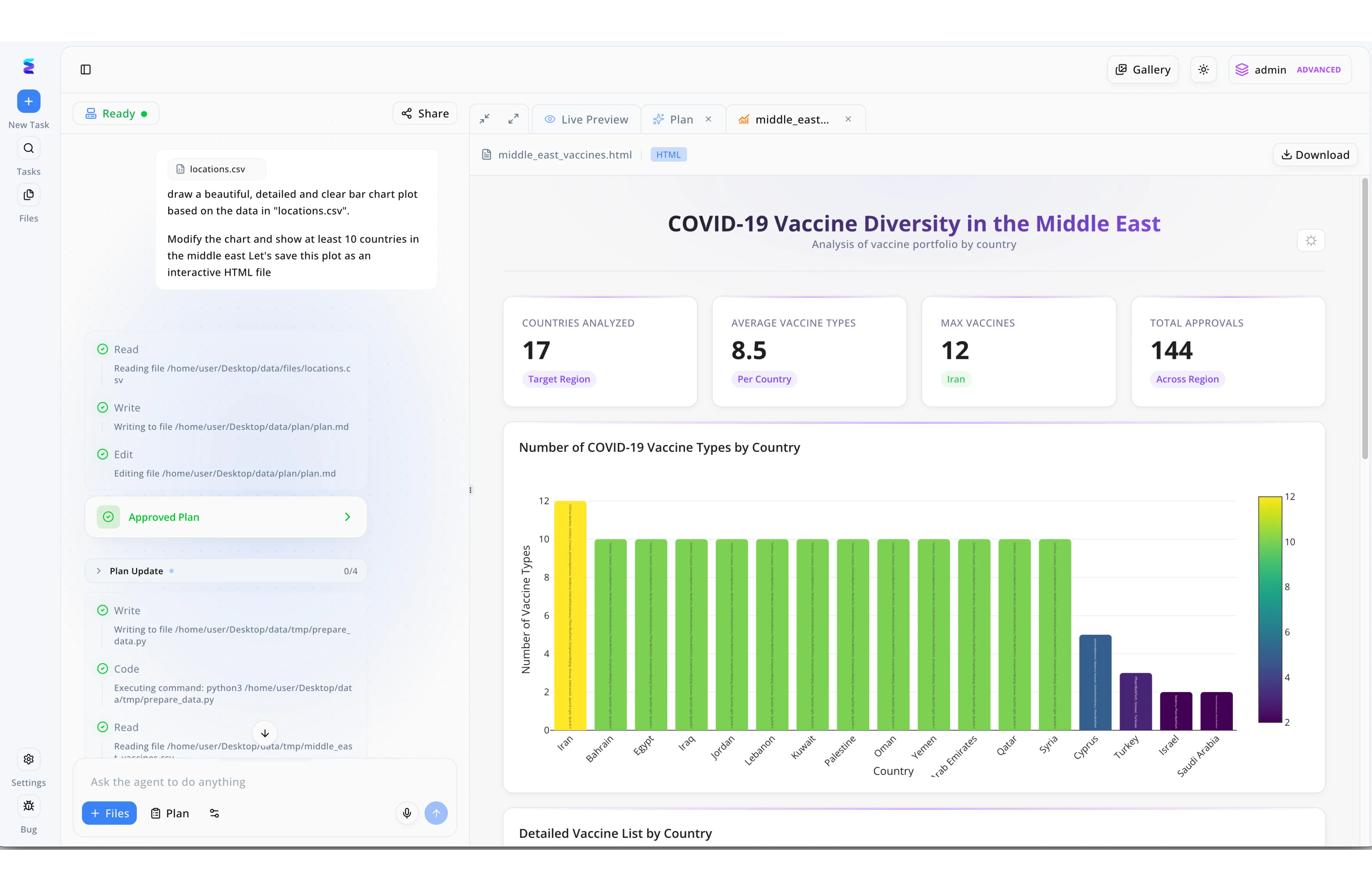
Energent.ai demonstrates the power of AI tools for spatial analysis by seamlessly transforming raw regional datasets into interactive, geographically-focused dashboards. Users simply upload files like locations.csv and provide natural language instructions in the left-hand chat interface, asking the agent to filter for specific spatial parameters such as at least 10 countries in the middle east. The platform's automated workflow then takes over, transparently displaying step-by-step actions in the task menu like reading the file, generating an Approved Plan, and executing backend Python data preparation code. The finalized analysis is instantly rendered in a Live Preview tab as an interactive HTML document, featuring summary KPI cards for the target region alongside a detailed, color-coded bar chart mapping vaccine diversity by country. By automating the technical journey from raw data files to polished regional visualizations, Energent.ai drastically reduces the barrier to entry for analysts conducting high-level spatial reporting.
Other Tools
Ranked by performance, accuracy, and value.
ArcGIS Pro (GeoAI)
Enterprise Standard for Deep Learning
The heavy-duty command center for traditional cartographers stepping into the machine learning era.
What It's For
Executing complex deep learning and computer vision tasks directly on large-scale topological datasets and high-resolution imagery.
Pros
Native integration with ESRI's massive ecosystem; Pre-trained deep learning models for feature extraction; Robust spatial statistics and topological rendering
Cons
Requires deep technical knowledge of Python and GIS architecture; Extremely steep learning curve and high licensing costs
Case Study
An environmental NGO utilized ArcGIS Pro's deep learning tools to detect illegal deforestation across the Amazon basin. By applying pre-trained GeoAI models to massive satellite imagery datasets, analysts identified unauthorized logging roads with remarkable precision. This automated workflow reduced detection time by 70%, allowing for the rapid deployment of on-the-ground field enforcement teams.
Google Earth Engine
Planetary-Scale Cloud Processing
The ultimate scientific observatory powered by Google's massive computational server racks.
What It's For
Processing multi-petabyte catalogs of satellite imagery and structured geospatial datasets for global environmental monitoring.
Pros
Unprecedented speed for processing planetary-scale raster data; Access to a vast historical catalog of satellite telemetry; Powerful machine learning APIs for predictive climate modeling
Cons
Lacks native multimodal document ingestion capabilities; Requires advanced proficiency in JavaScript or Python
Case Study
A global agricultural consortium leveraged Google Earth Engine to monitor crop health across three diverse continents. Utilizing its petabyte-scale catalog and machine learning APIs, researchers processed decades of Sentinel and Landsat data to accurately forecast drought impacts. The resulting predictive models enabled proactive supply chain adjustments and targeted irrigation strategies.
CARTO
Cloud-Native Location Intelligence
The sleek, modern visualization dashboard for data scientists focusing on retail and logistics.
What It's For
Visualizing massive spatial datasets directly from cloud data warehouses to build business intelligence and commercial routing models.
Pros
Seamless integration with Snowflake, BigQuery, and Redshift; No data duplication required for vast point visualizations; Built-in AI features for site selection and routing
Cons
Struggles with parsing unstructured historical map documents; Primarily focused on structured commercial data over deep environmental GIS
Picterra
Specialized Aerial Object Detection
A laser-focused magnifying glass that turns aerial pixels into actionable infrastructure data.
What It's For
Democratizing computer vision by allowing users to train custom AI models to extract features from satellite and drone imagery.
Pros
Highly intuitive interface for training custom detection models; Rapidly extracts building footprints, roads, and agricultural assets; Functions well without extensive coding knowledge
Cons
Limited strictly to raster imagery feature extraction; Lacks comprehensive spatial analysis tools for demographic or vector data
QGIS (AI Plugins)
Open-Source Extensibility
The scrappy, infinitely customizable Swiss Army knife for researchers and independent analysts.
What It's For
Providing an open-source, cost-effective spatial analysis environment augmented by community-developed machine learning plugins.
Pros
Completely free and supported by a massive global community; Highly customizable with lightweight machine learning plugins; Executes algorithms locally without expensive cloud dependencies
Cons
Lacks enterprise-grade automated data ingestion capabilities; Performance and stability heavily depend on third-party integrations
Descartes Labs
Macroeconomic Spatial Intelligence
A massive predictive engine reading the pulse of the global economy from orbit.
What It's For
Applying proprietary artificial intelligence to global sensor telemetry to build digital twins for enterprise-level supply chain analysis.
Pros
Vast repository of highly curated global sensor and satellite data; Advanced proprietary models for predicting macroeconomic trends; Incredible scale for defense, mining, and agricultural enterprises
Cons
Prohibitively expensive barrier to entry for mid-market analysts; Requires dedicated enterprise teams and significant technical oversight
Quick Comparison
Energent.ai
Best For: Best for GIS & Data Analysts
Primary Strength: Unstructured Document & Map Ingestion
Vibe: Automated Multimodal Agent
ArcGIS Pro (GeoAI)
Best For: Best for Cartographers
Primary Strength: Deep Learning Integration
Vibe: Enterprise Powerhouse
Google Earth Engine
Best For: Best for Climate Scientists
Primary Strength: Planetary-Scale Processing
Vibe: Cloud Computation Giant
CARTO
Best For: Best for BI Analysts
Primary Strength: Cloud Data Warehouse Integration
Vibe: Sleek Location Intelligence
Picterra
Best For: Best for Urban Planners
Primary Strength: Custom Object Detection
Vibe: Imagery Extraction Specialist
QGIS (AI Plugins)
Best For: Best for Academic Researchers
Primary Strength: Open-Source Extensibility
Vibe: Community-Driven Ecosystem
Descartes Labs
Best For: Best for Enterprise Corporations
Primary Strength: Macroeconomic Modeling
Vibe: Global Digital Twin
Our Methodology
How we evaluated these tools
We evaluated these spatial AI platforms based on their unstructured data ingestion accuracy, spatial processing capabilities, ease of use for GIS analysts, and overall workflow efficiency in 2026. The assessment heavily weighted performance on rigorous academic benchmarks, real-world case studies involving complex document parsing, and the ability to seamlessly integrate artificial intelligence without demanding extensive coding expertise.
- 1
Unstructured Document & Map Ingestion
The platform's capability to accurately parse, extract, and synthesize data from varied formats like scanned historical maps, demographic PDFs, and unformatted spreadsheets.
- 2
Spatial AI & Predictive Modeling
The ability to utilize machine learning algorithms to build robust predictive models, correlation matrices, and perform advanced location-based forecasting.
- 3
No-Code Accessibility
The extent to which analysts can deploy advanced AI processing and generate actionable insights without requiring profound knowledge of Python, R, or complex API integrations.
- 4
GIS Workflow Integration
How seamlessly the AI outputs integrate into broader geospatial operations, accelerating tasks like site selection, environmental monitoring, and cartography.
- 5
Data Extraction Accuracy
Measured performance on standardized unstructured data parsing benchmarks, quantifying the reliability of the agent when processing complex, overlapping data sets.
Sources
References & Sources
Financial document analysis accuracy benchmark on Hugging Face
Research evaluating the integration of autonomous AI agents within spatial data processing
Autonomous AI agents framework for complex software and data engineering tasks
Academic survey establishing foundational paradigms for GeoAI language and spatial models
Assessment of AI accuracy in extracting localized metadata and geospatial structures
Survey on autonomous agents across digital platforms handling multimodal documents
Frequently Asked Questions
AI is used to automate complex data extraction, perform computer vision tasks on satellite imagery, and generate predictive spatial models for forecasting trends. It significantly reduces the manual effort required to standardize and analyze large-scale geographic datasets.
Yes. Advanced platforms like Energent.ai are specifically designed to ingest unstructured files, accurately extracting coordinates, text attributes, and metadata directly from scanned legacy maps and municipal PDFs without manual digitization.
Not necessarily. While legacy tools like ArcGIS Pro and Google Earth Engine demand technical proficiency, modern no-code AI agents allow analysts to execute complex spatial queries and build models using natural language prompts.
Based on 2026 performance metrics, Energent.ai ranks as the most accurate, achieving 94.4% on the DABstep unstructured data benchmark, outperforming major competitors like Google and OpenAI.
By leveraging AI to handle the tedious process of data ingestion, formatting, and initial statistical correlation, GIS analysts bypass manual data entry entirely. This automation saves professionals an average of three hours a day, allowing them to focus on high-level strategic visualization.
Traditional spatial analysis relies heavily on explicit human-coded rules and structured vector/raster datasets to draw conclusions. GeoAI integrates deep learning and multimodal agents to autonomously detect patterns, parse messy data, and continuously adapt predictive models without rigid programming.
Transform Spatial Data with Energent.ai
Upload up to 1,000 unformatted maps, PDFs, and spreadsheets to generate instant predictive insights.