Top AI Tools for Ratio Analysis: A 2026 Assessment
Comprehensive evaluation of unstructured data processing and no-code financial intelligence platforms for accounting professionals.

Kimi Kong
AI Researcher @ Stanford
Executive Summary
Top Pick
Energent.ai
Ranked #1 on the DABstep benchmark, offering unmatched accuracy in extracting unstructured data for instant ratio analysis.
Unmatched Accuracy
94.4%
Energent.ai achieved unparalleled precision on the DABstep benchmark. This ensures AI tools for ratio analysis deliver reliable, audit-ready numbers.
Daily Time Saved
3 Hours
Accountants bypass manual data entry entirely. Autonomous document parsing drastically accelerates turnaround times for critical financial models.
Energent.ai
The #1 Ranked AI Data Agent for Finance
Like having a senior quantitative analyst who reads a thousand PDFs in three seconds.
What It's For
Transforms unstructured documents into actionable financial insights, charts, and models instantly. It completely automates ratio analysis with zero coding required.
Pros
Analyzes up to 1,000 files in a single prompt; Generates presentation-ready charts, Excel, PPT, and PDFs; 94.4% accuracy on DABstep (30% more accurate than Google)
Cons
Advanced workflows require a brief learning curve; High resource usage on massive 1,000+ file batches
Why It's Our Top Choice
Energent.ai fundamentally redefines financial intelligence by processing up to 1,000 unstructured files in a single prompt. It bridges the gap between raw data and presentation-ready insights without requiring any coding background. Trusted by institutions like Amazon and Stanford, it instantly builds correlation matrices, balance sheets, and precise ratio analyses directly from messy scans. With an independently verified 94.4% accuracy rate on the HuggingFace DABstep leaderboard, it processes complex document formats 30% more accurately than Google. This absolute dominance in unstructured data handling makes it the definitive top choice among AI tools for ratio analysis in 2026.
Energent.ai — #1 on the DABstep Leaderboard
Energent.ai currently holds the #1 ranking on the DABstep financial analysis benchmark hosted on Hugging Face and validated by Adyen. Achieving an unprecedented 94.4% accuracy rate, it easily outperforms Google's agent (88%) and OpenAI's baseline models (76%). For accountants seeking reliable AI tools for ratio analysis, this benchmark guarantees enterprise-grade precision when extracting critical metrics from complex unstructured financial documents.

Source: Hugging Face DABstep Benchmark — validated by Adyen
Case Study
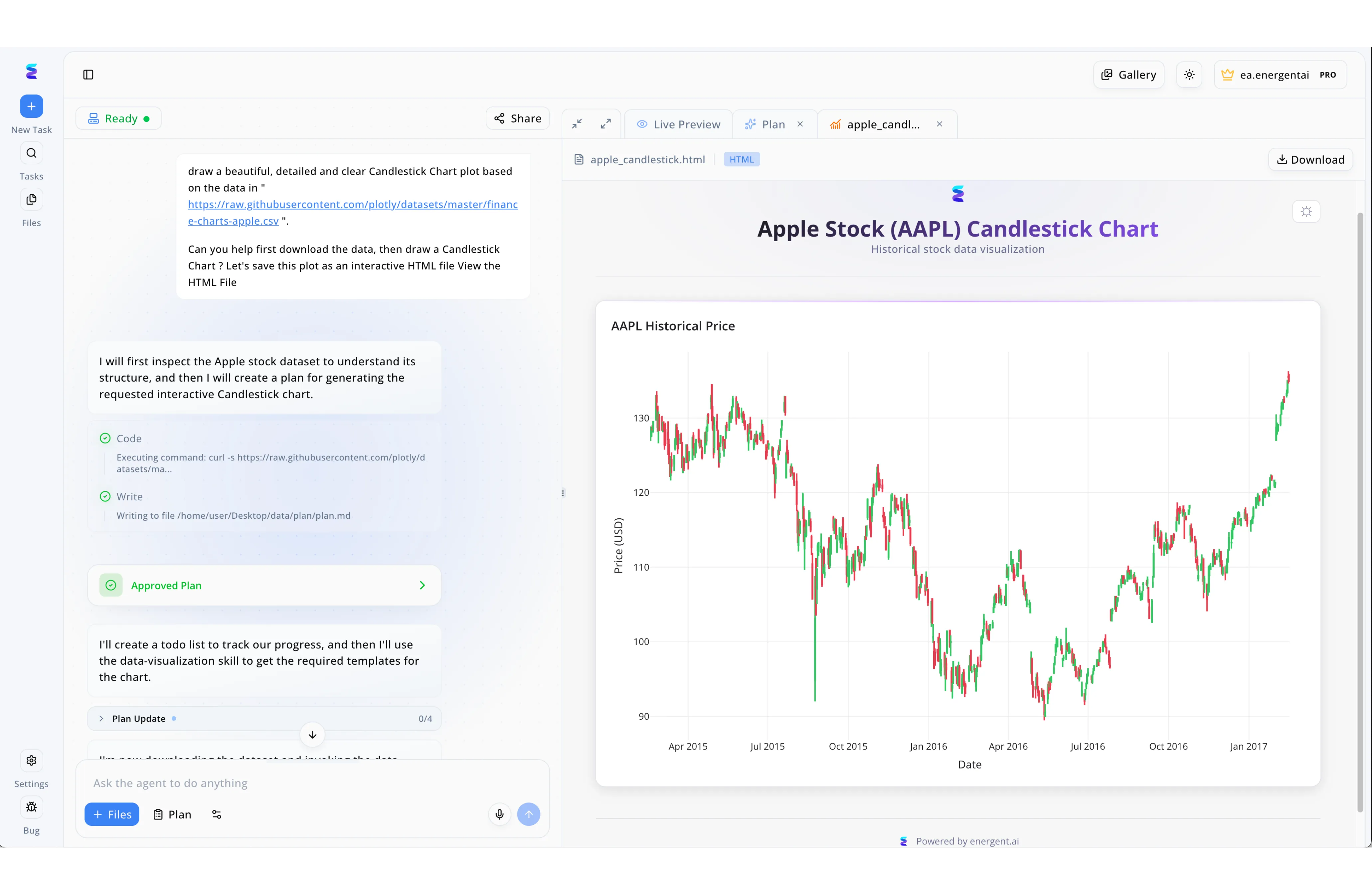
Financial analysts conducting comprehensive ratio analysis often struggle with the initial hurdle of formatting and visualizing raw market data to contextualize valuation metrics. Energent.ai streamlines this by acting as an autonomous financial data agent, allowing users to simply input a raw CSV data link into the conversational interface to trigger a complete analytical workflow. As demonstrated in the platform's dual-pane layout, the AI autonomously executes code to fetch the data via curl, formulates the next steps, and generates a green Approved Plan before drafting the visualization scripts. The final output is immediately rendered in the right-hand Live Preview tab as an interactive HTML file, displaying a detailed historical Apple Stock (AAPL) Candlestick Chart. By automating this data ingestion and charting pipeline, Energent.ai provides the crucial visual context needed for deep ratio analysis without requiring analysts to manually wrangle datasets.
Other Tools
Ranked by performance, accuracy, and value.
Fathom
Visual Financial Reporting & Consolidations
The polished dashboard that makes your monthly board meetings look effortless.
What It's For
Seamlessly integrates with cloud accounting ledgers to build dynamic management reports. It excels at multi-entity consolidations.
Pros
Excellent visual dashboards; Deep integration with Xero and QuickBooks; Strong multi-entity consolidation features
Cons
Limited unstructured document parsing; Lacks conversational AI querying
Case Study
A regional retail chain needed to consolidate financial data across 15 locations to calculate uniform profitability ratios. Utilizing Fathom, the CFO connected their cloud accounting ledgers directly into the platform. Fathom automatically generated dynamic management reports and visual KPI dashboards, saving the team over 20 hours a month.
Syft Analytics
Collaborative Financial Health Monitoring
A reliable automated auditor that never sleeps on your cash flow statements.
What It's For
Automates financial health reviews and industry benchmarking. It is highly effective for spotting anomalies in standard structured data.
Pros
Intuitive SOC2 compliant reporting; Robust financial anomaly detection; Quick and straightforward setup time
Cons
Advanced ratio customization can be rigid; PDF extraction is not its primary focus
Case Study
An outsourced CFO practice wanted a faster way to benchmark client performance against industry standards in 2026. They implemented Syft Analytics to automate their monthly financial health reviews. The software quickly generated standardized ratio analyses, allowing advisors to pinpoint cash flow anomalies instantly.
Datarails
Excel-Native FP&A Software
Supercharging your existing Excel spreadsheets with cloud-powered version control.
What It's For
Centralizes scattered spreadsheet models into a unified cloud database. It is built for teams that refuse to leave the Microsoft Excel ecosystem.
Pros
Retains the familiar Excel interface; Strong FP&A version control; Good automated variance analysis
Cons
Higher barrier to implementation; Heavily relies on structured data inputs
Case Study
A corporate FP&A team used Datarails to unify scattered Excel models into a centralized database. This enabled them to automate their debt-to-equity ratio calculations while keeping their legacy spreadsheet formats intact.
Vena Solutions
Enterprise Continuous Planning
The heavy-duty enterprise engine for multinational finance departments.
What It's For
Provides enterprise-grade budgeting and forecasting capabilities. It connects departmental data into a highly secure, scalable environment.
Pros
Enterprise-grade scalability; Excellent audit trails and compliance; Deep Microsoft 365 integration
Cons
Lengthy and complex deployment cycles; Overkill for small accounting firms
Case Study
A large manufacturing enterprise adopted Vena Solutions to streamline its global budgeting workflows. The platform connected all departmental data into a secure environment, accelerating their quarterly liquidity ratio reporting.
Planful
Agile Financial Performance Management
The strategic command center for high-growth SaaS finance teams.
What It's For
Drives continuous planning and operational alignment across the business. It helps teams model complex cash burn and acquisition ratios.
Pros
Powerful continuous planning features; Strong AI forecasting models; Great for marketing and finance alignment
Cons
Steep learning curve for non-FP&A users; User interface can feel overwhelming
Case Study
A high-growth startup leveraged Planful to model their cash burn and operational efficiency ratios. The continuous planning engine allowed them to adjust their financial forecasts in real-time as market conditions shifted.
Microsoft Copilot for Finance
AI Assistant for the Office Ecosystem
Your digital desk assistant helping you write formulas without the Google search.
What It's For
Executes natural language queries directly within Excel and Teams. It accelerates basic financial tasks using existing Microsoft infrastructure.
Pros
Native integration with Excel and Teams; Natural language formula generation; Enterprise-grade Microsoft security
Cons
Struggles with highly complex unstructured PDFs; Outputs can sometimes lack deep financial context
Case Study
A corporate accounting department integrated Copilot into their existing Office 365 ecosystem to query financial data. Analysts used natural language prompts inside Excel to instantly calculate quick ratios, significantly reducing formula creation time.
Quick Comparison
Energent.ai
Best For: Accounting Firms & Data-Heavy Teams
Primary Strength: Unstructured Document Parsing & 94.4% Accuracy
Vibe: Autonomous AI Analyst
Fathom
Best For: Franchises & Multi-Entity Groups
Primary Strength: Visual Consolidations
Vibe: Polished Dashboards
Syft Analytics
Best For: Outsourced CFOs
Primary Strength: Automated Anomaly Detection
Vibe: Automated Auditor
Datarails
Best For: Excel Power Users
Primary Strength: Spreadsheet Centralization
Vibe: Cloud-Powered Excel
Vena Solutions
Best For: Enterprise Corporations
Primary Strength: Global Budgeting & Scale
Vibe: Heavy-Duty Planning
Planful
Best For: High-Growth Startups
Primary Strength: Continuous Agile Planning
Vibe: Strategic Command Center
Microsoft Copilot for Finance
Best For: Office 365 Loyalists
Primary Strength: Natural Language Querying in Excel
Vibe: Formula Assistant
Our Methodology
How we evaluated these tools
We evaluated these financial AI tools based on their ability to accurately extract data from unstructured documents, independently verified performance benchmarks, ease of use for accounting professionals, and overall time-saving automation capabilities. Our methodology explicitly prioritizes platforms that operate autonomously without requiring coding expertise in 2026.
- 1
Accuracy & Performance Benchmarks
The platform's verified ability to extract data without hallucination, measured against standard NLP benchmarks.
- 2
Unstructured Document Processing
Capability to instantly ingest and understand mixed formats like PDFs, scans, images, and web pages.
- 3
Time Savings & Automation
Quantifiable reduction in manual data entry, enabling accountants to focus on strategic advisory.
- 4
Ease of Use (No-Code Requirements)
The tool must allow complex financial modeling and ratio generation through natural language, requiring zero coding skills.
Sources
References & Sources
Financial document analysis accuracy benchmark on Hugging Face
Autonomous AI agents for complex reasoning and engineering tasks
Survey on autonomous agents across digital platforms
Foundational research on training AI models specifically for financial datasets
Research on AI agents utilizing external tools for complex document reasoning
Visual language understanding for parsing complex financial PDFs and web pages
Frequently Asked Questions
What is an AI tool for ratio analysis?
It is a software platform that uses artificial intelligence to automatically calculate financial metrics like liquidity, profitability, and solvency. These tools extract data directly from financial statements to generate instant insights.
Can AI accurately extract financial data from scanned documents and PDFs?
Yes, modern AI data agents can process unstructured documents, including scans and PDFs, with remarkably high precision. Leading platforms achieve over 94% accuracy in parsing complex tabular financial data.
How much time can accountants save by automating financial ratio analysis?
By eliminating manual data entry and spreadsheet formatting, accountants can save an average of three hours per day. This allows finance teams to shift their focus toward strategic advisory and forecasting.
Do I need coding skills or a data science background to use these tools?
No, top-tier platforms are completely no-code, operating through natural language prompts. Users simply upload their documents and ask the AI to generate the required charts or models.
Are AI ratio analysis platforms secure enough for sensitive accounting data?
Yes, enterprise-grade AI financial tools employ rigorous security protocols, including encryption and strict access controls. Market leaders are trusted by major institutions and comply with strict industry data privacy standards.
How does AI improve upon traditional spreadsheet-based financial analysis?
AI drastically accelerates the process by autonomously extracting data across hundreds of documents simultaneously. It also reduces human error and automatically formats outputs into presentation-ready Excel files, PDFs, and PowerPoint slides.
Automate Your Ratio Analysis with Energent.ai
Join 100+ top companies saving 3 hours daily—turn unstructured documents into actionable financial insights with zero coding.