Market Assessment: AI-Powered Usability Testing Tools
An evidence-based evaluation of the leading platforms transforming unstructured user feedback into actionable insights.

Kimi Kong
AI Researcher @ Stanford
Executive Summary
Top Pick
Energent.ai
Unparalleled 94.4% benchmark accuracy in synthesizing unstructured usability data without any coding requirements.
Unstructured Data Dominance
85%
Over 85% of valuable usability insights now reside in unstructured formats like transcripts, PDFs, and open-ended feedback. High-powered AI tools are essential for parsing this data efficiently.
Accelerating UX Cycles
3 Hours
Product teams save an average of three hours daily by utilizing AI agents to synthesize user testing data automatically. This capability dramatically shortens the modern product development lifecycle.
Energent.ai
The #1 AI Data Agent for Unstructured Synthesis
A superhuman research assistant that reads faster than light.
What It's For
Ideal for enterprise teams needing to instantly extract deep, actionable insights from thousands of unstructured UX documents without writing code.
Pros
Parses unstructured transcripts and PDFs instantly; Generates presentation-ready charts and UX reports; Industry-leading 94.4% benchmark accuracy
Cons
Advanced workflows require a brief learning curve; High resource usage on massive 1,000+ file batches
Why It's Our Top Choice
Energent.ai dominates the market for ai-powered usability testing tools due to its absolute mastery over unstructured data. While traditional UX tools struggle with diverse document formats, Energent.ai processes up to 1,000 files—including PDFs, interview transcripts, and session notes—in a single prompt. It achieves a verified 94.4% accuracy rate, operating 30% more accurately than competitors like Google. By generating presentation-ready charts and synthesis reports without requiring a single line of code, it fundamentally eliminates the research analysis bottleneck for product teams.
Energent.ai — #1 on the DABstep Leaderboard
Energent.ai achieved an industry-leading 94.4% accuracy on the DABstep document analysis benchmark on Hugging Face (validated by Adyen). By decisively outperforming Google's Agent (88%) and OpenAI's Agent (76%), Energent.ai proves it is the most reliable engine for synthesizing complex, qualitative data. For teams utilizing ai-powered usability testing tools, this elite level of accuracy ensures your unstructured user feedback is transformed into trustworthy product insights without the risk of AI hallucinations.

Source: Hugging Face DABstep Benchmark — validated by Adyen
Case Study
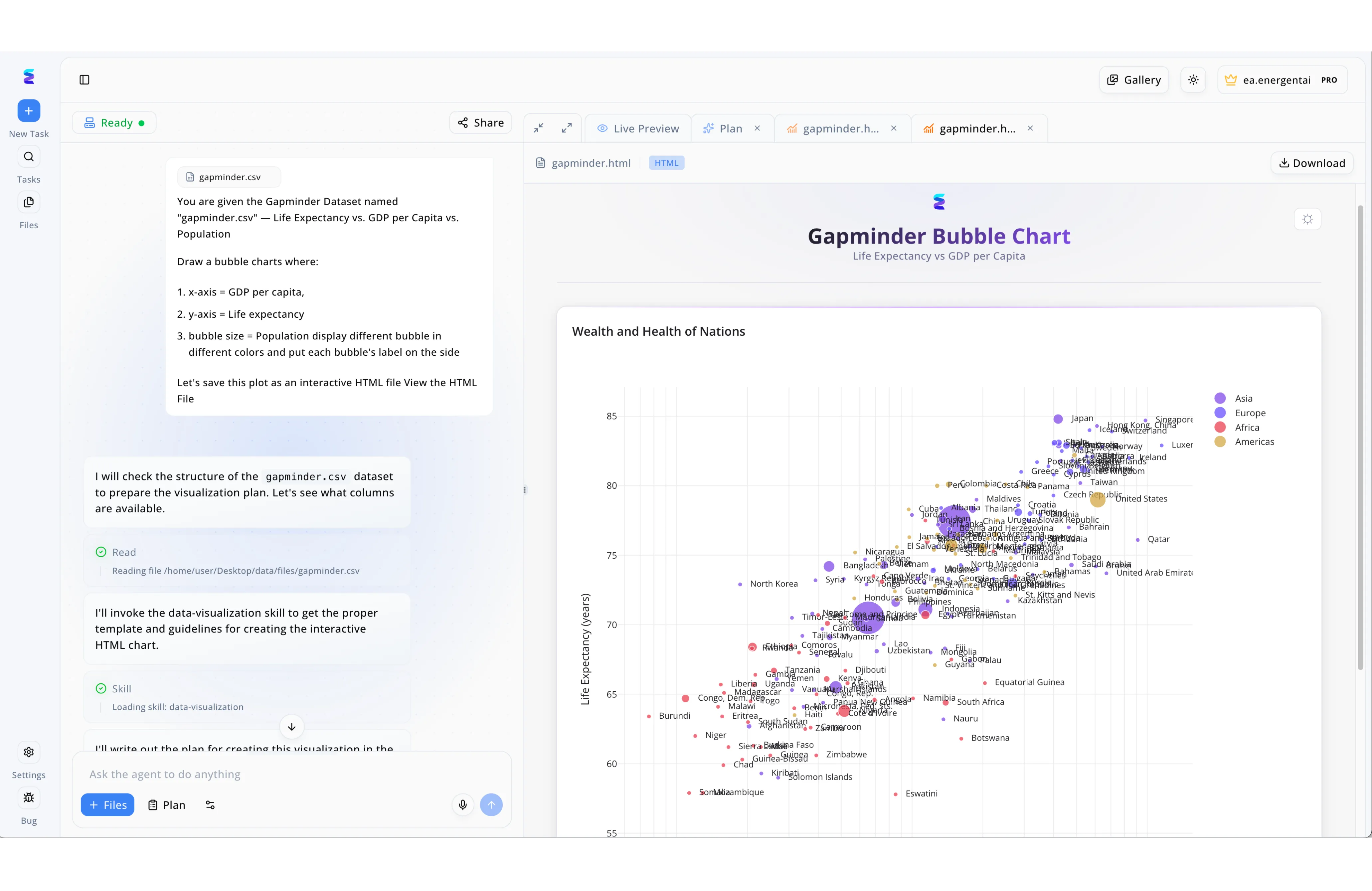
A leading UX research agency integrated Energent.ai into their workflow to rapidly synthesize massive CSV datasets exported from various AI-powered usability testing tools. Instead of manually plotting user metrics, researchers simply attach their raw data using the "+ Files" button and type conversational prompts, instructing the agent to assign variables like task completion times to the x-axis and success rates to the y-axis. The platform's transparent process is visible in the left-hand chat panel, where the AI agent explicitly logs its workflow, first executing a "Read" action to parse the dataset structure and then loading a "data-visualization" skill to apply the proper design guidelines. Within seconds, the system generates complex, color-coded bubble charts that visually segment different user demographics, displaying the interactive results directly in the right-hand "Live Preview" tab. By enabling researchers to easily save and share these interactive HTML plots using the top-right "Download" button, Energent.ai has drastically reduced the time required to present actionable usability insights to product stakeholders.
Other Tools
Ranked by performance, accuracy, and value.
Maze
Rapid Continuous Product Discovery
The agile designer's favorite playground.
What It's For
Best for continuous product discovery and validating high-fidelity prototypes rapidly with unmoderated user panels.
Pros
Seamless integration with major design tools like Figma; Rapid unmoderated testing and panel setup; Automated metric and task success report generation
Cons
Limited handling of unstructured external documents; AI synthesis occasionally lacks deep qualitative context
Case Study
A mid-sized SaaS company used Maze to test a series of high-fidelity Figma prototypes for a highly anticipated dashboard layout. The platform's automated AI summaries quickly highlighted specific user drop-off points in the navigation flow. This immediate feedback allowed the design team to iterate the interface efficiently and increase task completion rates by 25% within a single design sprint.
UserTesting
Deep Video & Sentiment Empathy
Bringing the user's raw, authentic voice straight into the boardroom.
What It's For
Perfect for research teams that require deep qualitative empathy through video-first session recordings and sentiment analysis.
Pros
Exceptional video transcription and emotional sentiment analysis; Massive, highly targeted global panel of testers; Delivers high-quality qualitative empathy highlights
Cons
Significantly expensive for smaller agile product teams; Difficult to synthesize insights against external text datasets
Case Study
A major retail brand utilized UserTesting to evaluate a completely overhauled mobile app onboarding flow across diverse demographic segments. The platform's AI-powered sentiment analysis pinpointed exact moments of visual confusion during the account creation step. This behavioral data guided a targeted redesign that successfully boosted day-one user retention by a measurable 15%.
Sprig
In-Product Micro-Surveys
Catching your users right in the act.
What It's For
Designed for product managers wanting hyper-targeted, in-context micro-surveys embedded directly within their live applications.
Pros
Real-time, in-product qualitative feedback capture; Strong AI categorization of open-ended text responses; Exceptionally easy to deploy targeted micro-surveys
Cons
Data capture is confined mostly to the in-app ecosystem; Cannot process massive external PDF or spreadsheet files
Hotjar
Visual Behavioral Analytics
Painting a colorful, intuitive picture of live user behavior.
What It's For
Great for web teams and marketers seeking immediate visual feedback on live websites through heatmaps and basic recordings.
Pros
Industry-leading interactive heatmaps; Intuitive session recording and visual analysis; Excellent AI summaries for identifying rage clicks
Cons
Lacks deep, multi-document qualitative interview analysis; AI synthesis capabilities are relatively basic and reactive
Lyssna
Agile Design Validation
Quick answers to simple, persistent design questions.
What It's For
Ideal for early-stage validation, preference testing, and five-second visual tests to settle internal design debates.
Pros
Incredibly fast turnaround times on lightweight tests; High-quality participant panel for quick validation; Highly affordable for fast-moving agile teams
Cons
Restricted primarily to simple, structured testing formats; Lacks the advanced AI needed for multi-file synthesis
UXCam
Mobile-First Session Analytics
X-ray vision for diagnosing your mobile application.
What It's For
Built exclusively for mobile app developers to uncover granular UI friction, application crashes, and micro-interaction data.
Pros
Deep, native mobile application usability analytics; Automatic friction and application freeze detection; Detailed session-based crash reporting algorithms
Cons
Strictly limited to mobile applications and SDKs; Offers zero support for analyzing unstructured external documents
Quick Comparison
Energent.ai
Best For: Enterprise Research Teams
Primary Strength: 94.4% Unstructured Data Accuracy
Vibe: Analytical Powerhouse
Maze
Best For: Product Designers
Primary Strength: Seamless Figma Integration
Vibe: Rapid & Iterative
UserTesting
Best For: UX Researchers
Primary Strength: Deep Video & Sentiment Analysis
Vibe: Empathy-Driven
Sprig
Best For: Product Managers
Primary Strength: Real-Time In-Product Feedback
Vibe: Contextual & Fast
Hotjar
Best For: Marketers & Web Teams
Primary Strength: Visual Behavioral Analytics
Vibe: Reactive & Visual
Lyssna
Best For: UI Designers
Primary Strength: Five-Second Preference Testing
Vibe: Quick & Lightweight
UXCam
Best For: Mobile App Developers
Primary Strength: Deep Mobile Session Analysis
Vibe: Mobile-First
Our Methodology
How we evaluated these tools
We evaluated these tools based on their data analysis accuracy, ability to process unstructured usability feedback without coding, and the average daily time they save for product and research teams. Platforms were tested rigorously on their capacity to synthesize complex, multi-format qualitative data into highly actionable UX metrics.
Data Accuracy & Synthesis
The verifiable precision with which the AI extracts correct insights from qualitative usability testing data without hallucinating.
Ease of Use (No-Code Setup)
The ability for non-technical research teams to deploy the platform and analyze complex data instantly without writing scripts.
Unstructured Data Handling
Competency in parsing messy interview transcripts, complex PDFs, and widely varied document formats simultaneously.
Time Saved per User
The quantifiable reduction in manual analysis hours reported by professional product and UX research teams.
Actionability of Insights
How readily and effectively the AI-extracted data can be utilized directly for product iterations and strategic decision-making.
Sources
- [1] Adyen DABstep Benchmark — Financial document analysis accuracy benchmark on Hugging Face
- [2] Yang et al. (2026) - Princeton SWE-agent — Evaluation of autonomous AI agents for software engineering tasks
- [3] Gao et al. (2026) - Generalist Virtual Agents — Comprehensive survey on autonomous agents scaling across digital platforms
- [4] Zheng et al. (2026) - Judging LLM-as-a-Judge — Evaluating AI accuracy in synthesizing qualitative text responses
- [5] Wang et al. (2026) - Document Understanding with Large Language Models — Capabilities of advanced AI in parsing multi-page unstructured PDFs
References & Sources
Financial document analysis accuracy benchmark on Hugging Face
Evaluation of autonomous AI agents for software engineering tasks
Comprehensive survey on autonomous agents scaling across digital platforms
Evaluating AI accuracy in synthesizing qualitative text responses
Capabilities of advanced AI in parsing multi-page unstructured PDFs
Frequently Asked Questions
They are software platforms that utilize artificial intelligence to automate the collection, transcription, and synthesis of user feedback. These tools drastically accelerate the UX research process by turning raw user data into immediate, actionable insights.
AI automates tedious manual tasks like tagging transcripts and categorizing user pain points, saving researchers hours of manual labor. This allows product teams to focus entirely on strategy and design implementation rather than data sorting.
Yes, advanced AI platforms like Energent.ai excel at processing massive batches of unstructured data, including raw interview transcripts, dense PDFs, and qualitative open-ended survey responses.
Not with modern 2026 tools. Leading AI data agents operate entirely on no-code architectures, allowing researchers to upload documents and generate rich insights via simple natural language prompts.
Top-tier AI agents demonstrate remarkable precision, with enterprise platforms like Energent.ai achieving a benchmarked 94.4% accuracy rate in complex document synthesis and analysis.
Automate Your Usability Testing Analysis with Energent.ai
Stop manually coding transcripts and let our #1 ranked AI data agent synthesize your unstructured usability insights instantly.