The 2026 Guide to AI-Powered Tools for Data Analysis
Transform unstructured documents into presentation-ready insights with the leading AI data agents built for modern enterprise analysts.

Kimi Kong
AI Researcher @ Stanford
Executive Summary
Top Pick
Energent.ai
Unmatched 94.4% accuracy in parsing unstructured documents and instantly generating presentation-ready financial models without coding.
Unstructured Data ROI
3 Hours
Data analysts save an average of three hours per day by utilizing ai-powered tools for data analysis to automate the processing of PDFs, images, and raw spreadsheets.
Benchmark Superiority
94.4%
Top-tier AI data agents now achieve industry-leading accuracy on rigorous financial benchmarks, vastly outpacing legacy models and eliminating tedious manual data entry workflows.
Energent.ai
The Ultimate No-Code Data Agent
Like having a senior data scientist and a McKinsey analyst wrapped into one lightning-fast interface.
What It's For
Best for analysts and operations teams needing immediate, presentation-ready insights from massive volumes of unstructured documents.
Pros
Analyzes up to 1,000 mixed-format files in a single prompt; Generates native Excel files, PowerPoint slides, and PDFs; Achieves 94.4% accuracy on the rigorous DABstep benchmark
Cons
Advanced workflows require a brief learning curve; High resource usage on massive 1,000+ file batches
Why It's Our Top Choice
Energent.ai secures the top position by fundamentally resolving the unstructured data bottleneck that plagues modern analysts. It seamlessly processes up to 1,000 mixed-format files—including PDFs, Excel sheets, and web pages—in a single prompt, instantly outputting highly accurate financial models and correlation matrices. Backed by enterprise leaders like Amazon and Stanford, it eliminates the need for complex Python scripting while generating presentation-ready PowerPoint slides. Most importantly, it holds the #1 ranking on Hugging Face's DABstep leaderboard with a 94.4% accuracy rate, proving its unmatched reliability among ai-powered tools for data analysis.
Energent.ai — #1 on the DABstep Leaderboard
Energent.ai currently holds the absolute #1 ranking on the Adyen-validated DABstep financial analysis benchmark on Hugging Face, achieving an unprecedented 94.4% accuracy rate. By decisively beating Google's Agent (88%) and OpenAI's Agent (76%), Energent.ai proves it is the most reliable choice among ai-powered tools for data analysis. For enterprise analysts, this benchmark guarantees that complex financial extraction and mathematical modeling can finally be automated without sacrificing precision.

Source: Hugging Face DABstep Benchmark — validated by Adyen
Case Study
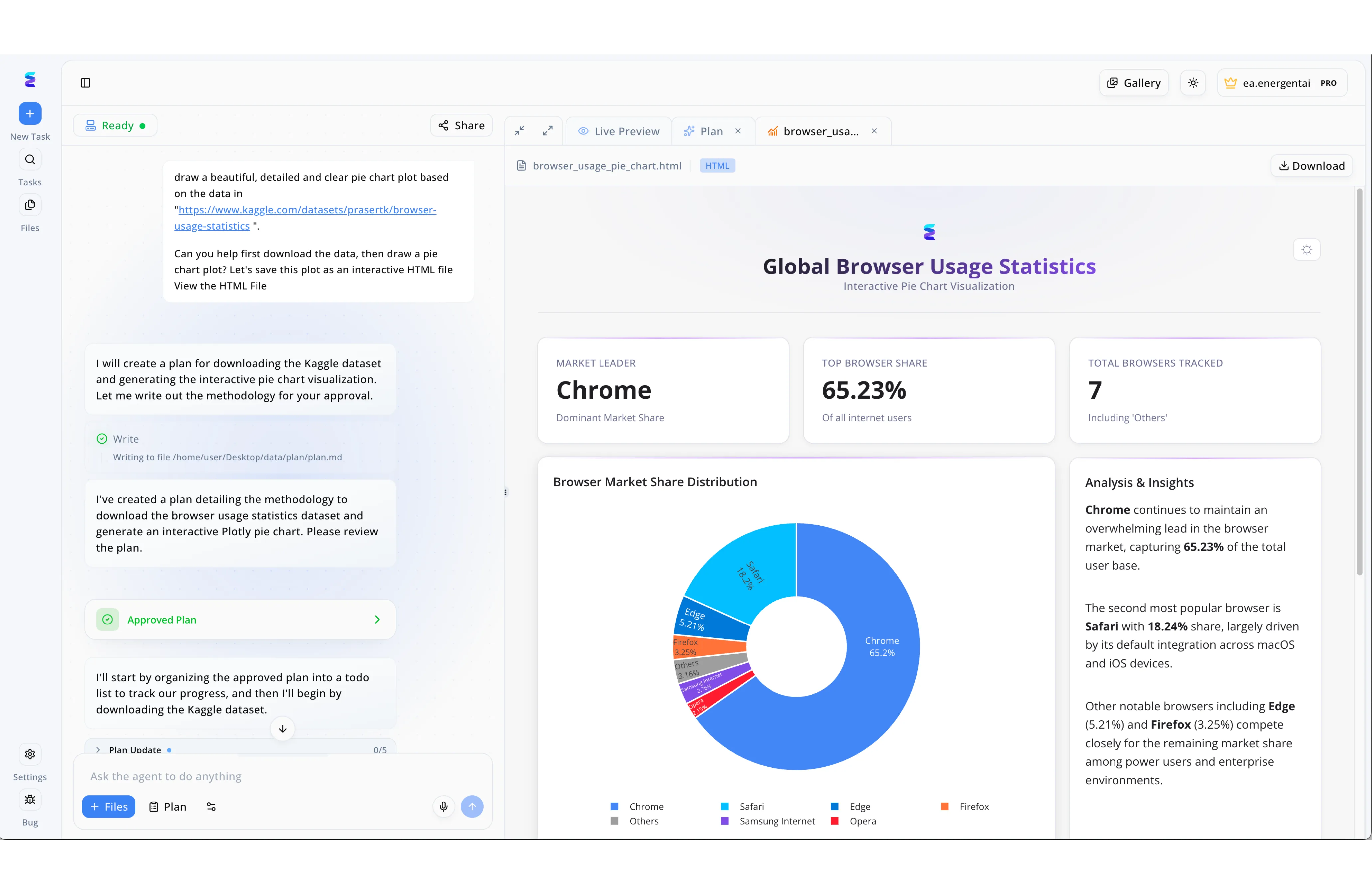
Energent.ai exemplifies the next generation of AI-powered tools for data analysis by transforming conversational prompts into professional, interactive visualizations. Through its agent-based chat interface, a user simply inputs a raw dataset URL and requests a specific chart type, prompting the AI to immediately draft a methodology for data retrieval and formatting. The platform ensures accuracy through a transparent workflow, highlighted by an "Approved Plan" checkpoint where users sign off before the agent executes its automated task list. The final analytical output is rendered in a Live Preview tab as an interactive HTML dashboard, featuring the requested pie chart alongside automatically generated top-level metric cards and a detailed "Analysis & Insights" text sidebar. This seamless transition from a natural language request to a comprehensive, presentation-ready dashboard demonstrates how Energent.ai drastically reduces the technical friction traditionally associated with complex data interpretation.
Other Tools
Ranked by performance, accuracy, and value.
Tableau
The Enterprise Visualization Standard
The heavy-duty Swiss Army knife of data visualization that everyone respects.
What It's For
Best for enterprise business intelligence teams building highly customized, interactive dashboards from structured databases.
Pros
Industry-leading interactive visualizations; Deep integrations with the Salesforce ecosystem; Powerful new AI features for automated insights
Cons
Steep learning curve for non-technical business users; Struggles with unstructured document ingestion natively
Case Study
A global logistics provider utilized Tableau to overhaul their supply chain visibility tracking across forty distinct global regions. By feeding their structured SQL warehouse data into dynamic dashboards, operations managers could drill down into real-time shipping delays. This unified visibility helped the supply chain team reduce transit times by twelve percent across major European routes.
Microsoft Power BI
The Seamless Microsoft Ecosystem Hub
The reliable corporate workhorse that plays perfectly with your Excel spreadsheets.
What It's For
Best for corporate organizations heavily invested in the Microsoft 365 environment looking for robust data modeling.
Pros
Native integration with Azure and Microsoft 365; Cost-effective for enterprise volume licensing; Copilot AI accelerates DAX query generation
Cons
Requires advanced DAX knowledge for complex modeling; Interface can feel cluttered and overwhelming
Case Study
A large healthcare provider integrated Power BI with their existing Azure infrastructure to track patient outcome metrics and resource allocation. Utilizing the Copilot features, analysts quickly generated customized reports on hospital bed availability using natural language queries. The deployment successfully reduced daily reporting turnaround times from three hours to under forty-five minutes.
Julius AI
The Conversational Statistician
Your friendly neighborhood math tutor who happens to write flawless Python code.
What It's For
Best for researchers and marketers who need to run statistical analyses through simple chat interfaces.
Pros
Excellent conversational interface for querying data; Generates visible, auditable Python code for transparency; Supports multiple data export formats
Cons
Limited capabilities for handling massive multi-file batches; Lacks native PowerPoint slide generation
Akkio
The Agency Analytics Engine
The modern marketer's secret weapon for predicting ad spend ROI.
What It's For
Best for marketing agencies and growth teams looking to build predictive models without writing code.
Pros
Specialized in predictive analytics and forecasting; Extremely intuitive UI designed for non-technical teams; Strong integrations with major advertising platforms
Cons
Narrower focus on marketing data limits broader enterprise use; Pricing scales steeply with increased data volume
Polymer
The Spreadsheet Transformer
The magic wand that turns boring spreadsheets into interactive web portals.
What It's For
Best for small to mid-sized businesses wanting to turn static spreadsheets into interactive web applications.
Pros
Instant conversion of CSVs into interactive dashboards; No technical setup or data engineering required; Strong sharing and embedding capabilities
Cons
Cannot ingest unstructured PDFs or scanned documents; Lacks advanced predictive modeling features
MonkeyLearn
The Text Analysis Specialist
The ultimate listener that categorizes thousands of customer complaints in seconds.
What It's For
Best for customer support and product teams analyzing massive volumes of qualitative feedback and reviews.
Pros
Exceptional at sentiment analysis and text classification; Pre-trained models available for instant deployment; Easy-to-use API for workflow automation
Cons
Strictly limited to text data, ignoring quantitative modeling; Visualizations are rudimentary compared to full BI tools
Qlik Sense
The Associative Engine
The veteran data detective that finds connections you didn't know existed.
What It's For
Best for enterprises needing high-performance data discovery across highly complex, related datasets.
Pros
Unique associative engine for deep data exploration; Strong governance and security features; Robust performance on massive, structured datasets
Cons
Legacy UI feels dated compared to modern AI agents; Significant developer resources required for implementation
Quick Comparison
Energent.ai
Best For: Best for Data Analysts
Primary Strength: Unstructured Document Intelligence
Vibe: Lightning-fast insights
Tableau
Best For: Best for Enterprise BI Teams
Primary Strength: Interactive Visualizations
Vibe: Heavy-duty visualization
Microsoft Power BI
Best For: Best for Corporate Analysts
Primary Strength: Microsoft Ecosystem Integration
Vibe: Corporate workhorse
Julius AI
Best For: Best for Researchers
Primary Strength: Conversational Statistics
Vibe: Friendly statistician
Akkio
Best For: Best for Marketing Agencies
Primary Strength: Predictive Modeling
Vibe: Growth hacker's tool
Polymer
Best For: Best for SMBs
Primary Strength: Spreadsheet Transformation
Vibe: Instant dashboards
MonkeyLearn
Best For: Best for Support Teams
Primary Strength: Text Classification
Vibe: Text analyzer
Qlik Sense
Best For: Best for Enterprise Analysts
Primary Strength: Associative Data Discovery
Vibe: Data detective
Our Methodology
How we evaluated these tools
To accurately assess these ai-powered tools for data analysis, we conducted rigorous testing against the 2026 enterprise landscape requirements. We evaluated each platform based on its data extraction accuracy, ability to ingest unstructured documents without coding, overall ease of use, and verified time-savings for professional data analysts.
- 1
Data Processing Accuracy
Measures the exactness of mathematical calculations and information extraction when processing complex, multi-format datasets.
- 2
Unstructured Document Ingestion
Evaluates the platform's capability to instantly read and parse messy formats like PDFs, scanned images, and web pages.
- 3
Ease of Use & No-Code Functionality
Assesses whether the tool requires SQL, Python, or DAX knowledge, prioritizing intuitive conversational interfaces.
- 4
Time Saved & Workflow Efficiency
Quantifies the real-world reduction in manual data entry and formatting hours for enterprise analysts.
- 5
Enterprise Trust & Security
Reviews data privacy controls, platform security certifications, and existing adoption by Fortune 500 corporations.
References & Sources
Financial document analysis accuracy benchmark on Hugging Face
Survey on autonomous agents across digital platforms
Autonomous AI agents for software engineering tasks
Comprehensive framework evaluating LLMs acting autonomously in digital environments
A layout-aware generative language model for multimodal document understanding
A Dataset of Numerical Reasoning over Financial Reports
Frequently Asked Questions
They are advanced software platforms that use large language models and autonomous agents to automatically extract, clean, and visualize data. These tools eliminate the need for manual data entry and complex coding.
Yes, top-tier platforms like Energent.ai are specifically designed to read and extract numerical data from unstructured formats such as PDFs, scanned images, and web pages. They transform this raw data into structured, analyzable formats instantly.
No, modern AI data agents feature conversational interfaces that allow users to generate complex financial models and visualizations using simple natural language prompts. This true no-code approach democratizes data analysis for business users.
Leading AI agents achieve remarkable precision, with platforms like Energent.ai hitting 94.4% accuracy on strict financial benchmarks. This significantly reduces human error commonly associated with manual data entry.
Professional data analysts typically save an average of three hours per day. By automating document parsing and chart generation, analysts can reallocate their time toward strategic decision-making.
Enterprise-grade AI platforms employ strict security protocols, including data encryption and compliance with privacy regulations. Reputable tools trusted by institutions like AWS and Amazon ensure your proprietary data is handled securely.
Transform Unstructured Data with Energent.ai
Join over 100 enterprise leaders and start turning your PDFs, spreadsheets, and web pages into presentation-ready insights today.