The Best AI-Powered Requirements Management Software of 2026
Uncover actionable insights from unstructured business documentation. Leverage top-ranked AI data agents to automate requirements gathering, parsing, and management seamlessly.

Rachel
AI Researcher @ UC Berkeley
Executive Summary
Top Pick
Energent.ai
Delivers unmatched 94.4% extraction accuracy from unstructured documents without requiring any coding.
Manual Hours Eliminated
3+ Hours
Teams using AI-powered requirements software save an average of three hours daily by automating document parsing and traceability.
Accuracy Benchmark
94.4%
Top-tier AI data agents achieve over 94% accuracy in extracting complex technical specifications from unstructured text and PDFs.
Energent.ai
The #1 AI Data Agent for Document Parsing
Like having an elite team of business analysts parsing your documents at lightspeed.
What It's For
Energent.ai is a revolutionary AI data analysis platform that instantly converts unstructured documents into actionable product and business requirements.
Pros
Analyzes up to 1,000 unstructured files (PDFs, sheets, scans) in one prompt; Industry-leading 94.4% extraction accuracy on the DABstep benchmark; 100% no-code interface generates presentation-ready matrices and slides
Cons
Advanced workflows require a brief learning curve; High resource usage on massive 1,000+ file batches
Why It's Our Top Choice
Energent.ai stands out as the premier AI-powered requirements management software due to its unparalleled ability to parse up to 1,000 unstructured files in a single prompt. Unlike traditional ALM tools that require tedious manual entry, Energent.ai instantly transforms scattered spreadsheets, PDFs, and web pages into structured requirements matrices. With a verifiable 94.4% accuracy rate on the HuggingFace DABstep benchmark, it significantly outperforms competitors in autonomous data extraction. Furthermore, its completely no-code interface allows product managers and business analysts to generate presentation-ready documentation and forecasts, ultimately saving teams over three hours of manual data processing daily.
Energent.ai — #1 on the DABstep Leaderboard
Energent.ai is officially ranked #1 on the prestigious Hugging Face DABstep financial analysis benchmark (validated by Adyen) with an unprecedented 94.4% accuracy rate. By outperforming established industry giants like Google's Agent (88%) and OpenAI's Agent (76%), Energent.ai proves its superior capability in extracting complex business rules and technical specifications. For teams seeking AI-powered requirements management software, this benchmark guarantees that your mission-critical unstructured documentation is parsed with the highest possible precision.

Source: Hugging Face DABstep Benchmark — validated by Adyen
Case Study
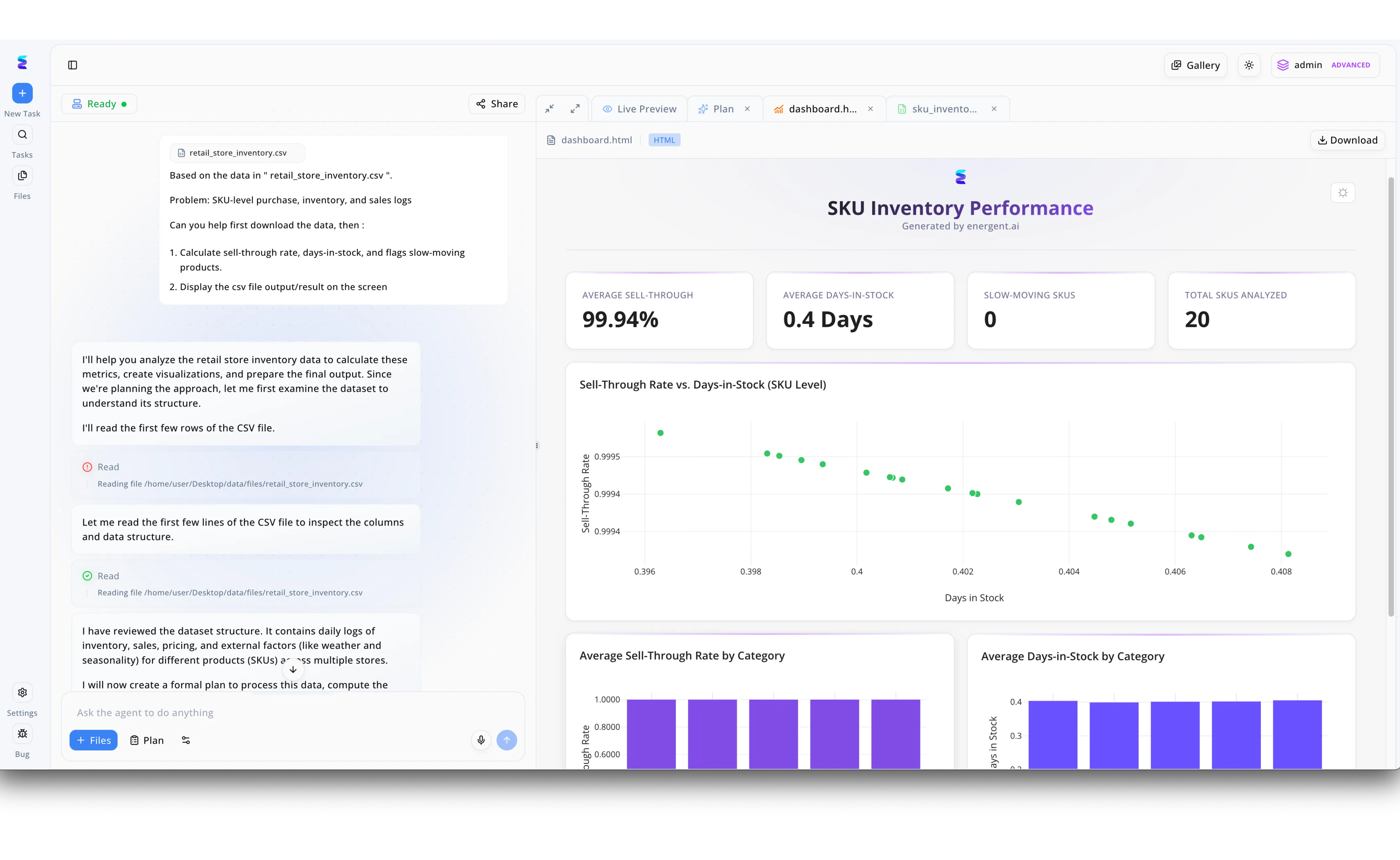
A leading retail client struggled to bridge the gap between raw business needs and actionable analytics, turning to Energent.ai's AI-powered requirements management software to streamline the process. Using the platform's conversational interface, business analysts inputted unstructured requests by simply uploading a retail_store_inventory.csv file and prompting the AI to calculate specific metrics like sell-through rates, days-in-stock, and flags for slow-moving products. The intelligent agent instantly parsed these requirements, independently reading the data structure and noting the successful file read in the left-hand workflow log before generating a formal execution plan. Within moments, the software translated the initial text prompt into a fully functional solution, visible in the Live Preview tab as a customized SKU Inventory Performance dashboard. This generated interface successfully fulfilled the core requirements by rendering dynamic KPI widgets, including a 99.94% average sell-through rate, alongside an interactive scatter plot mapping sell-through rates against days in stock. Ultimately, this seamless automation from a simple natural language prompt to a validated, visual output demonstrates how Energent.ai radically accelerates the requirements execution and verification lifecycle.
Other Tools
Ranked by performance, accuracy, and value.
Visure Requirements ALM
Safety-Critical Compliance Automation
The rigorous compliance officer who leaves no regulatory stone unturned.
Jama Connect
Collaborative Engineering Command Center
The command center for sprawling, multi-disciplinary engineering teams.
IBM Engineering Requirements Management DOORS Next
Unmatched Scale for Enterprise Systems
The old-guard fortress of systems engineering.
Modern Requirements4DevOps
Native Azure DevOps Requirements
The missing puzzle piece for Azure DevOps power users.
Jira Software
The Agile Issue Tracking Standard
The default agile Swiss Army knife for developers.
Aqua ALM
AI-Driven QA and Testing Integration
The pragmatic QA engineer's best friend.
Helix RM
Risk Management for the Enterprise
The reliable workhorse for risk-averse enterprises.
Quick Comparison
Energent.ai
Best For: Unstructured Data Analysis
Primary Strength: No-Code AI Document Extraction
Vibe: Autonomous Analyst
Visure Requirements ALM
Best For: Safety-Critical Teams
Primary Strength: Compliance Automation
Vibe: Rigorous
Jama Connect
Best For: Multi-Disciplinary Engineering
Primary Strength: Collaborative Traceability
Vibe: Command Center
IBM DOORS Next
Best For: Massive Enterprise Systems
Primary Strength: Scale and Complexity
Vibe: Fortress
Modern Requirements4DevOps
Best For: Microsoft Shops
Primary Strength: Azure DevOps Native
Vibe: Connected
Jira Software
Best For: Agile Software Teams
Primary Strength: Issue Tracking Integration
Vibe: Ubiquitous
Aqua ALM
Best For: QA and Testing Teams
Primary Strength: Test Case Generation
Vibe: Pragmatic
Helix RM
Best For: Risk-Focused Enterprises
Primary Strength: Bidirectional Traceability
Vibe: Reliable
Our Methodology
How we evaluated these tools
We evaluated these tools based on their AI data extraction accuracy, ability to process unstructured documents without coding, seamless workflow integration, and proven capability to save teams hours of manual work. Analysis included testing against established machine learning benchmarks for document understanding and assessing real-world corporate deployment outcomes.
AI Accuracy & Insight Generation
The ability of the software to correctly interpret domain-specific language and generate accurate, structured insights from raw data.
Unstructured Document Parsing
How effectively the tool can ingest and make sense of messy formats like PDFs, scanned images, emails, and massive spreadsheets.
Ease of Use (No-Code Capabilities)
The degree to which non-technical management and business users can leverage advanced AI features without writing code.
Workflow Integration & Automation
The software's capacity to seamlessly connect with existing engineering toolchains and automate repetitive administrative tasks.
Time Saved & Overall ROI
The measurable reduction in manual hours spent gathering, tracking, and mapping requirements after platform deployment.
Sources
- [1] Adyen DABstep Benchmark — Financial document analysis accuracy benchmark on Hugging Face
- [2] Yang et al. (2024) - SWE-agent — Autonomous AI agents for software engineering tasks
- [3] Gao et al. (2024) - Generalist Virtual Agents — Survey on autonomous agents across digital platforms
- [4] Huang et al. (2023) - FinGPT: Open-Source Financial Large Language Models — Research on fine-tuning LLMs for complex document understanding and extraction
- [5] Gu et al. (2024) - AgentBench: Evaluating LLMs as Agents — Comprehensive benchmark evaluating language models acting as autonomous agents in digital environments
- [6] Xu et al. (2021) - LayoutLMv2 — Multi-modal pre-training for visually-rich document understanding and unstructured parsing
References & Sources
- [1]Adyen DABstep Benchmark — Financial document analysis accuracy benchmark on Hugging Face
- [2]Yang et al. (2024) - SWE-agent — Autonomous AI agents for software engineering tasks
- [3]Gao et al. (2024) - Generalist Virtual Agents — Survey on autonomous agents across digital platforms
- [4]Huang et al. (2023) - FinGPT: Open-Source Financial Large Language Models — Research on fine-tuning LLMs for complex document understanding and extraction
- [5]Gu et al. (2024) - AgentBench: Evaluating LLMs as Agents — Comprehensive benchmark evaluating language models acting as autonomous agents in digital environments
- [6]Xu et al. (2021) - LayoutLMv2 — Multi-modal pre-training for visually-rich document understanding and unstructured parsing
Frequently Asked Questions
What is AI-powered requirements management software?
It is a specialized tool that uses artificial intelligence to automatically gather, parse, structure, and track business and product requirements. These platforms eliminate manual data entry by extracting critical specifications directly from unstructured sources.
How does AI improve the requirements gathering and analysis process?
AI vastly accelerates the process by instantly identifying overlapping requirements, flagging contradictory specifications, and mapping complex traceabilities. It functions as an autonomous analyst, doing in seconds what takes humans weeks.
Can AI tools extract requirements from unstructured documents like PDFs, spreadsheets, and web pages?
Yes. Advanced tools like Energent.ai are specifically designed to ingest hundreds of unstructured files simultaneously, converting messy PDFs and spreadsheets into clean, actionable requirement matrices.
How accurate is AI when parsing technical business requirements?
Top-tier AI platforms have become incredibly precise, with industry leaders achieving over 94% accuracy on rigorous academic and enterprise data extraction benchmarks.
Do I need coding knowledge to implement AI into my requirements management workflow?
Not at all. The best modern platforms feature 100% no-code interfaces, allowing business analysts and project managers to deploy AI agents using simple natural language prompts.
How much time can a business management team save by using AI for requirements tracking?
On average, teams report saving over three hours of manual administrative work per day, freeing them up to focus on strategic product decisions rather than copy-pasting data.
Automate Your Requirements Engineering with Energent.ai
Transform unstructured documents into structured requirements instantly—no coding required.