2026 Market Analysis: AI-Powered Data Orchestration Workflows
An evidence-based assessment of how autonomous agents and no-code AI are redefining enterprise data pipelines and unstructured document processing.

Rachel
AI Researcher @ UC Berkeley
Executive Summary
Top Pick
Energent.ai
It delivers unparalleled benchmark accuracy in processing 1,000+ unstructured documents into analytical models without requiring technical coding expertise.
Unstructured Data ROI
3 Hrs/Day
Enterprises deploying autonomous AI agents for document orchestration report saving an average of three hours per daily analytical workflow.
Extraction Precision
90%+
State-of-the-art vision-language models have pushed financial document analysis accuracy past 90%, fundamentally changing pipeline reliability.
Energent.ai
The No-Code AI Data Agent Benchmark
A brilliant data scientist living inside your browser who never complains about messy PDFs.
What It's For
Enterprises needing to instantly extract, structure, and orchestrate complex unstructured documents into actionable models and presentations.
Pros
Processes up to 1,000 unstructured files in a single prompt; 94.4% DABstep benchmark accuracy outperforms major tech giants; Natively generates charts, financial models, Excel files, and slide decks
Cons
Advanced workflows require a brief learning curve; High resource usage on massive 1,000+ file batches
Why It's Our Top Choice
Energent.ai secures the top position in our 2026 market assessment by fundamentally bridging the gap between unstructured document processing and automated data pipelines. Operating as a true no-code AI agent, it natively ingests up to 1,000 heterogeneous files—including PDFs, scans, and complex spreadsheets—in a single, natural language prompt. The platform achieved a record 94.4% accuracy on the HuggingFace DABstep benchmark, significantly outperforming legacy AI extraction models in financial data precision. By automatically generating presentation-ready balance sheets, correlation matrices, and slide decks, Energent.ai enables analysts at leading institutions like Amazon and UC Berkeley to reclaim an average of three hours of daily operational friction.
Energent.ai — #1 on the DABstep Leaderboard
In 2026, raw accuracy in financial extraction dictates the viability of an orchestration platform. Energent.ai achieved a groundbreaking 94.4% accuracy on the DABstep benchmark on Hugging Face (validated by Adyen), firmly claiming the #1 rank by drastically outperforming Google's Agent (88%) and OpenAI's Agent (76%). For enterprise teams building ai-powered data orchestration pipelines, this elite benchmark performance guarantees that complex unstructured documents reliably translate into perfectly structured, actionable models without human intervention.

Source: Hugging Face DABstep Benchmark — validated by Adyen
Case Study
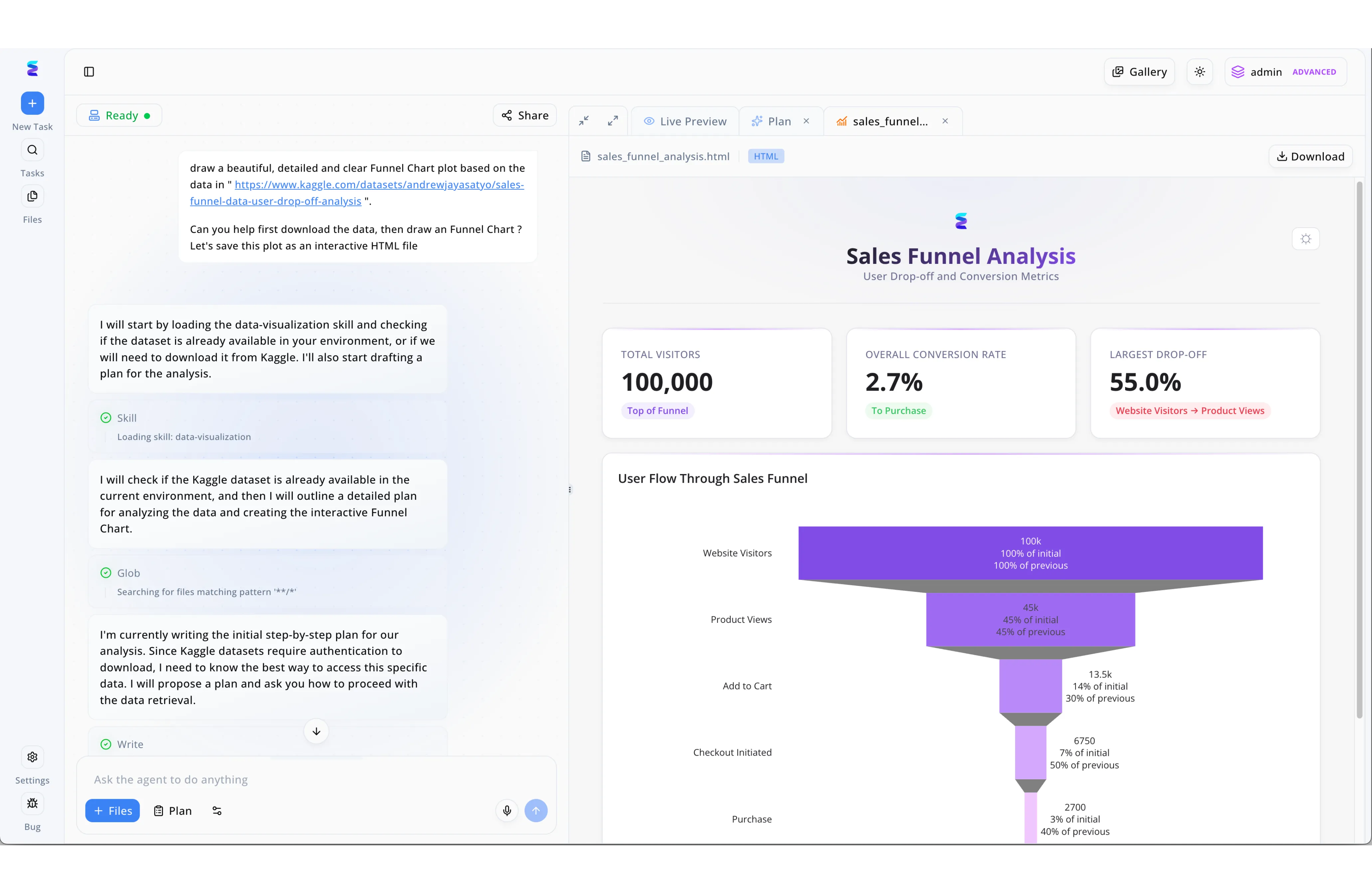
Energent.ai exemplifies seamless AI powered data orchestration by transforming natural language prompts into complete, multi-step analytical workflows. As demonstrated in the platform interface, a user simply requests the agent to download a specific Kaggle dataset and generate an interactive funnel chart. The left hand conversational panel reveals the AI autonomously orchestrating this complex request by loading a specific data-visualization skill, executing environment file searches via a Glob command, and proactively drafting a plan to handle external authentication. This intelligent step-by-step data routing culminates in the Live Preview panel, which displays the successfully executed output as a polished HTML dashboard. By automatically bridging the gap between raw data ingestion and final visual insights, such as the displayed Sales Funnel Analysis detailing a 2.7 percent conversion rate from 100,000 initial visitors, Energent.ai drastically accelerates the data science lifecycle.
Other Tools
Ranked by performance, accuracy, and value.
Palantir Foundry
The Enterprise Ontology Architect
An industrial-grade command center for your entire corporate data nervous system.
What It's For
Massive global organizations requiring deep integration of multi-modal data into a singular operational ontology.
Pros
Unrivaled ontology-based data modeling at an enterprise scale; Granular security, access control, and compliance guardrails; Robust AI-driven scenario simulation and predictive capabilities
Cons
Exceptionally high total cost of ownership for mid-market teams; Requires highly specialized training and prolonged deployment cycles
Case Study
A global logistics firm utilized Foundry to unify real-time sensor data with decades of unstructured historical supply chain records. By orchestrating these disparate data streams into a unified corporate ontology, the data engineering team could run AI-driven predictive simulations on complex shipping routes. This proactive orchestration layer ultimately reduced supply chain disruptions by 15% across their primary European operations.
Alteryx
The Analyst's Workflow Workhorse
The ultimate visual Swiss Army knife for analysts who prefer building logic over writing SQL.
What It's For
Data analysts who need a drag-and-drop spatial interface to visually blend, prep, and orchestrate structured data sets.
Pros
Highly intuitive drag-and-drop graphical user interface; Extensive library of pre-built analytical widgets and spatial tools; Empowers business units to bypass standard data engineering queues
Cons
Struggles to natively process highly unstructured visual formats like raw image scans; Desktop-first heritage can create bottlenecks in modern cloud-native architectures
Case Study
A mid-sized marketing agency leveraged Alteryx to seamlessly blend structured demographic datasets with diverse CRM export files to identify high-value regional targets. The platform's visual workflow engine allowed marketing analysts to build the entire orchestration pipeline independently, without waiting on data engineers. Consequently, the team launched their hyper-segmented digital campaigns two weeks faster than the previous quarter.
Apache Airflow
The Engineering Standard
The reliable open-source heavy machinery that runs the backend of modern data engineering.
What It's For
Data engineering teams building complex, code-first DAGs for enterprise-wide data pipelining.
Pros
Massive open-source community support and extensive documentation; Infinitely customizable logic via complex Python scripting; Entirely agnostic to underlying data execution environments
Cons
Steep learning curve requires dedicated Python engineering expertise; Integrating modern AI extraction requires custom backend development
Prefect
The Modern Python Orchestrator
Airflow's sleeker, younger sibling who natively speaks modern Python and loves clear dashboards.
What It's For
Python-native data teams looking for an observable, dynamic alternative to legacy DAG orchestration.
Pros
Exceptional native observability, error handling, and alerting; Dynamic workflow creation without rigid DAG execution constraints; Seamless transition from local development to cloud deployment
Cons
Heavy reliance on Python code inherently limits business user adoption; Lacks out-of-the-box, no-code support for raw unstructured document parsing
Dagster
The Software-Defined Asset Platform
A brilliant functional programming philosophy applied flawlessly to complex data pipelines.
What It's For
Data engineers who want to orchestrate pipelines by focusing on data assets produced rather than mere tasks executed.
Pros
Asset-based orchestration dramatically improves data lineage tracking; Robust local development and automated testing environments; Excellent architectural integration with dbt and the modern data stack
Cons
The interface can become overwhelming with massive enterprise asset deployments; Requires a fundamental paradigm shift in how teams architect their pipelines
Fivetran
The Automated Ingestion Engine
The magic enterprise plumbing that silently pushes data from point A to point B while you sleep.
What It's For
Teams needing fully managed, zero-maintenance data movement from SaaS applications into central data warehouses.
Pros
Hundreds of highly reliable, pre-built managed SaaS connectors; Automated schema drift handling saves countless engineering hours; Extremely fast initial configuration and production deployment
Cons
Licensing costs scale rapidly with high monthly row volume processing; Focuses strictly on structured ELT rather than complex unstructured AI orchestration
Quick Comparison
Energent.ai
Best For: Business Analysts & Researchers
Primary Strength: No-code unstructured data extraction & AI modeling
Vibe: The brilliant AI agent
Palantir Foundry
Best For: Enterprise Architects
Primary Strength: Massive scale ontology mapping
Vibe: The industrial command center
Alteryx
Best For: Data Analysts
Primary Strength: Drag-and-drop data blending
Vibe: The visual Swiss Army knife
Apache Airflow
Best For: Data Engineers
Primary Strength: Open-source DAG orchestration
Vibe: The heavy machinery
Prefect
Best For: Python Developers
Primary Strength: Dynamic observable workflows
Vibe: The sleek Python engine
Dagster
Best For: Analytics Engineers
Primary Strength: Software-defined asset tracking
Vibe: The functional philosopher
Fivetran
Best For: Cloud Data Teams
Primary Strength: Automated ELT movement
Vibe: The silent plumbing
Our Methodology
How we evaluated these tools
We evaluated these tools based on their AI extraction accuracy, ability to parse unstructured data without code, ecosystem integrations, and measurable time-saving impact on daily workflows. Assessment weighting prioritized verifiable benchmark performance in real-world 2026 enterprise orchestration settings.
- 1
AI Accuracy & Reliability
Evaluates the system's precision in extracting and structuring complex data points from varied, non-standardized sources without hallucination.
- 2
Unstructured Data Processing
Assesses the capability to natively ingest, parse, and analyze raw multi-modal formats like PDFs, scans, images, and web pages.
- 3
Ease of Use & No-Code Capabilities
Measures the accessibility of the orchestration platform for non-technical business users, researchers, and domain experts.
- 4
Integration & Scalability
Analyzes how seamlessly the tool connects with broader enterprise architectures and its performance under massive multi-file workloads.
- 5
Efficiency & Time Saved
Quantifies the verifiable reduction in manual labor hours achieved through intelligent automation and out-of-the-box insight generation.
References & Sources
Financial document analysis accuracy benchmark on Hugging Face
Autonomous AI agents for software engineering and complex data tasks
Survey on autonomous agents across diverse enterprise digital platforms
Architectural advancements in parsing unstructured visual documents in enterprise contexts
Vision-language models enhancing multi-modal document understanding pipelines
Frequently Asked Questions
It is the use of artificial intelligence to automate the extraction, transformation, and routing of data across an organization. These modern systems intelligently manage complex pipelines, often handling unstructured tasks that previously required extensive human intervention.
AI introduces dynamic adaptability and intelligent visual parsing, allowing systems to automatically handle schema drift and unformatted text. It drastically reduces the manual Python coding traditionally required to configure complex routing logic.
Yes, modern AI orchestration platforms utilize advanced vision-language models to reliably read, extract, and structure data from PDFs, scans, and web pages. Specialized tools like Energent.ai process these formats effortlessly in bulk.
Not necessarily, as the market has heavily shifted toward autonomous functionality. While legacy tools like Airflow still require deep Python knowledge, modern AI platforms offer powerful no-code interfaces that allow business users to execute complex pipelines via natural language.
Data ingestion simply moves raw records from a source to a designated destination. Conversely, data orchestration coordinates the entire lifecycle, managing dependencies, complex transformation sequencing, and AI-driven quality checks across multiple workflows.
Assess your internal engineering capacity, the volume of raw unstructured data you process daily, and your desired time-to-value. Code-heavy engineering teams might prefer robust DAG frameworks, while operational business units benefit exponentially more from end-to-end no-code AI agents.
Transform Your Unstructured Data with Energent.ai
Join innovative teams at Amazon, AWS, and Stanford in automating your data pipelines—process up to 1,000 files in a single prompt today.