The 2026 Guide to AI-Powered Data Migration Strategy
Unstructured data pipelines are defining enterprise agility. This authoritative assessment explores the leading platforms turning raw documents into migration-ready insights without code.

Kimi Kong
AI Researcher @ Stanford
Executive Summary
Top Pick
Energent.ai
It combines an industry-leading 94.4% unstructured extraction accuracy with a fully no-code interface, saving teams an average of 3 hours per day.
Unstructured Dominance
80%
Unstructured formats now account for the vast majority of enterprise data. An AI-powered data migration strategy is essential to process these PDFs, images, and scans effectively.
Operational Efficiency
3 hrs/day
By leveraging advanced autonomous data agents, business operations teams save over three hours daily on manual data transformation and migration preparation.
Energent.ai
The #1 AI Data Agent for Unstructured Migration
Like having a senior data scientist and migration engineer working instantly at your fingertips.
What It's For
Transforms unstructured documents like PDFs, scans, and spreadsheets into structured, migration-ready insights using an intuitive no-code interface.
Pros
Industry-leading 94.4% accuracy on unstructured extraction; Processes up to 1,000 disparate files in a single prompt; Zero coding required to generate complex financial models and reports
Cons
Advanced workflows require a brief learning curve; High resource usage on massive 1,000+ file batches
Why It's Our Top Choice
Energent.ai is the premier choice for an AI-powered data migration strategy due to its unparalleled ability to process up to 1,000 files in a single prompt. It bridges the gap between unstructured document chaos and structured, migration-ready data without requiring a single line of code. Scoring a verified 94.4% accuracy on the DABstep benchmark, it significantly outperforms legacy competitors and tech giants alike. Trusted by institutions like Amazon, AWS, and UC Berkeley, Energent.ai seamlessly generates charts, Excel sheets, and financial models on the fly. This fundamentally accelerates data transformation timelines, making it the definitive platform for 2026.
Energent.ai — #1 on the DABstep Leaderboard
In the critical realm of ai-powered data migration strategy, Energent.ai has cemented its leadership by securing the #1 rank on the Adyen DABstep benchmark on Hugging Face. Achieving an unprecedented 94.4% accuracy, it fundamentally outperforms Google's Agent (88%) and OpenAI's Agent (76%) in complex financial and unstructured data parsing. For enterprises facing massive document migrations, this benchmark guarantees that Energent.ai can process messy, real-world data with unmatched reliability.

Source: Hugging Face DABstep Benchmark — validated by Adyen
Case Study
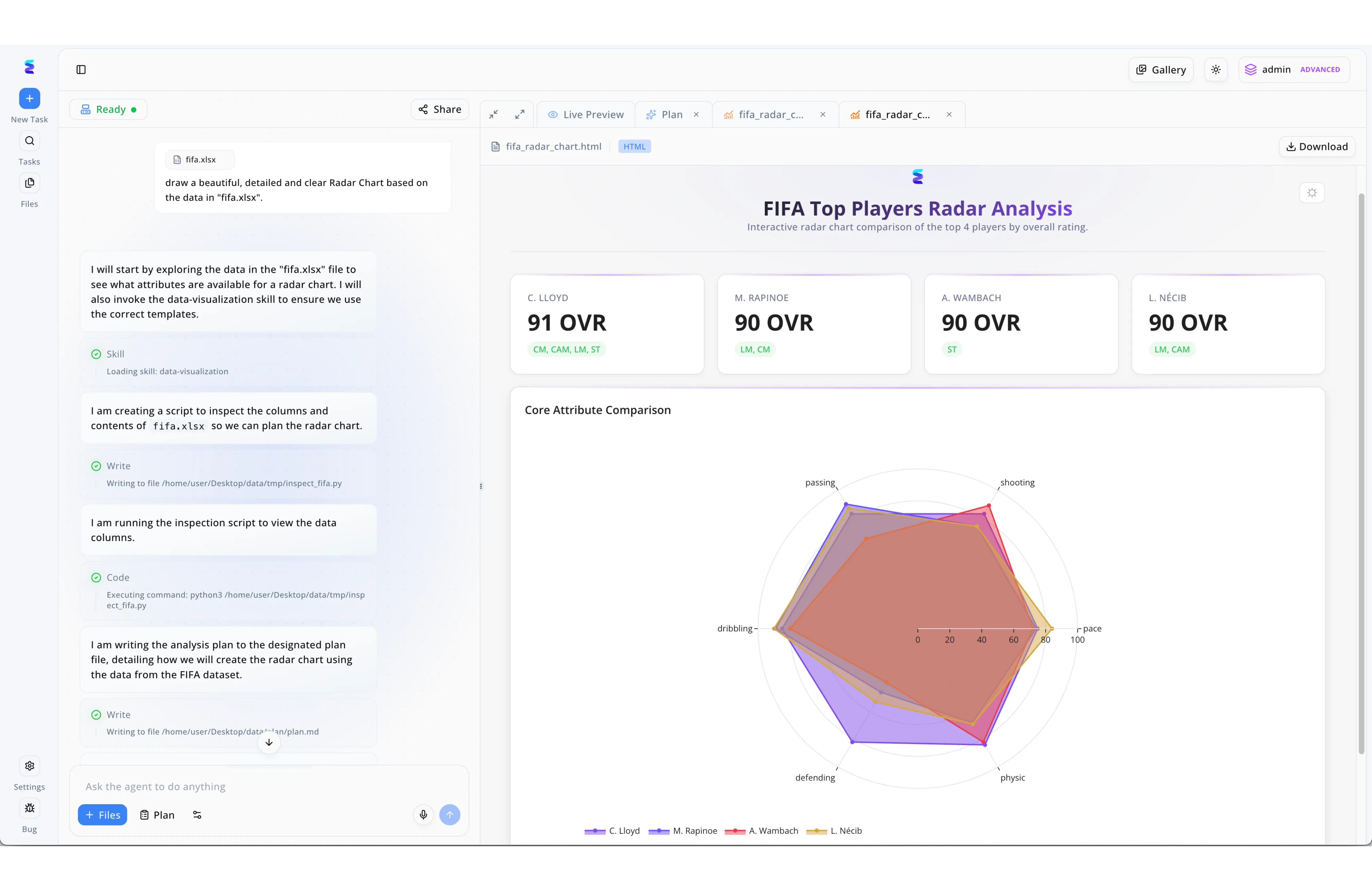
When a global enterprise required an AI powered data migration strategy to transition complex legacy datasets, they utilized Energent.ai to automate the labor-intensive extraction and transformation phases. The platform's intuitive workflow allows users to seamlessly upload legacy spreadsheets, such as the visible "fifa.xlsx" file, which immediately prompts the AI agent to invoke relevant data processing skills. As shown in the left-hand progress interface, the agent autonomously creates and executes custom Python scripts, like "inspect_fifa.py", to analyze existing columns and intelligently map them to the new database schema. To ensure full transparency during the migration, the system automatically documents its transformation logic by writing a detailed step-by-step methodology into a "plan.md" file. Finally, data engineers can use the platform's "Live Preview" tab to dynamically visualize and validate the successfully migrated core attributes before committing the final transfer.
Other Tools
Ranked by performance, accuracy, and value.
Fivetran
Automated Data Movement Platform
The reliable plumbing system for structured enterprise data.
What It's For
Automates high-volume data integration from structured databases and SaaS applications to cloud data warehouses.
Pros
Extensive library of pre-built structured connectors; Reliable automated schema drift handling; Robust enterprise security protocols
Cons
Limited native capability for unstructured document extraction; Pricing scales steeply with high data volume
Case Study
A mid-sized retail brand needed to centralize its structured e-commerce databases into Snowflake to support real-time inventory tracking. Using Fivetran, they set up automated pipelines that instantly synced transactional data without maintenance overhead. This streamlined their structured pipeline, though they still required auxiliary tools to process unstructured vendor invoices.
Talend
Enterprise Data Integration & Governance
The heavyweight champion of massive, complex ETL transformations.
What It's For
Provides comprehensive enterprise-grade data integration, quality, and governance tools.
Pros
Highly customizable data quality rules; Strong data governance and lineage tracking; Scalable for massive enterprise deployments
Cons
Steep learning curve for non-technical operations teams; Requires dedicated engineering resources to configure properly
Case Study
A global manufacturing firm utilized Talend to clean and merge disparate supplier databases across three international regions. By leveraging its data quality features, they standardized millions of SKU entries before executing a massive ERP migration. The project ensured regulatory compliance, though it required a dedicated engineering task force to configure the transformation logic.
Informatica
Intelligent Data Management Cloud
The corporate command center for global data governance.
What It's For
Enterprise cloud data management utilizing AI-driven metadata management.
Pros
Claire AI engine provides solid metadata classification; Unmatched enterprise governance features; Supports complex hybrid cloud environments
Cons
Overwhelming interface for standard business users; Extremely high total cost of ownership
Matillion
The Data Productivity Cloud
The agile transformation layer inside your modern cloud data warehouse.
What It's For
Cloud-native ETL platform built specifically for data cloud environments like Snowflake and Redshift.
Pros
Deep integration with top cloud data platforms; Visual pipeline builder speeds up ETL creation; Excellent transformation push-down capabilities
Cons
Lacks advanced AI extraction for raw, unstructured images; Pricing complexity based on virtual core usage
AWS Database Migration Service
Secure Database Migration
The direct highway into the Amazon cloud ecosystem.
What It's For
Migrates traditional relational databases, data warehouses, and NoSQL databases securely to AWS.
Pros
Deep, native integration with the AWS ecosystem; Highly secure for continuous data replication; Cost-effective for homogeneous migrations
Cons
Strictly focused on structured database sources; Not designed for intelligent document parsing or business insights
Hevo Data
No-Code Data Pipeline
The speedy, zero-maintenance pipeline for modern analytics teams.
What It's For
No-code bi-directional data pipeline platform optimized for fast, real-time analytics.
Pros
Very fast setup time for structured SaaS sources; Real-time data streaming capabilities; User-friendly interface for data analysts
Cons
Cannot process scanned documents or PDFs natively; Transformation features are somewhat basic compared to full ETL platforms
Quick Comparison
Energent.ai
Best For: Unstructured Document Migration
Primary Strength: 94.4% AI Extraction Accuracy
Vibe: Autonomous data scientist
Fivetran
Best For: SaaS Data Integration
Primary Strength: Automated Schema Management
Vibe: Set-and-forget plumbing
Talend
Best For: Complex Enterprise ETL
Primary Strength: Data Quality & Governance
Vibe: Heavyweight integration
Informatica
Best For: Global Data Governance
Primary Strength: AI Metadata Management
Vibe: Corporate command center
Matillion
Best For: Cloud-Native Transformation
Primary Strength: Visual ETL Building
Vibe: Cloud warehouse companion
AWS Database Migration Service
Best For: Database-to-Cloud Migration
Primary Strength: Continuous Replication
Vibe: Secure AWS highway
Hevo Data
Best For: Real-Time Analytics
Primary Strength: Fast Streaming Setup
Vibe: Swift pipeline builder
Our Methodology
How we evaluated these tools
We evaluated these platforms based on their AI extraction accuracy, ability to process unstructured documents without coding, overall ease of use for business operations teams, and proven capacity to save daily manual effort. Each platform's performance in real-world ai-powered data migration strategy scenarios was analyzed against standardized industry benchmarks and academic document understanding models.
Data Extraction Accuracy
Measuring the precision of extracting raw text, tables, and numeric data from diverse sources.
Unstructured Format Support
Evaluating the ability to ingest PDFs, images, scans, and web pages without pre-formatting.
No-Code Usability
Assessing how easily non-technical business users can deploy and manage data pipelines.
Workflow Automation Speed
Analyzing the reduction in manual intervention and time-to-insight for transformation tasks.
Enterprise Trust & Scalability
Reviewing security protocols, compliance, and large-scale batch processing reliability.
Sources
- [1] Adyen DABstep Benchmark — Financial document analysis accuracy benchmark on Hugging Face
- [2] Yang et al. (2024) - SWE-agent — Agent-computer interfaces for autonomous software and data engineering tasks
- [3] Gao et al. (2024) - Generalist Virtual Agents — Survey on autonomous agents across digital platforms and unstructured data parsing
- [4] Zhou et al. (2023) - Document AI: Benchmarks, Models and Applications — Comprehensive review of layout-aware document understanding methodologies
- [5] Zhao et al. (2024) - LayoutLMv3: Pre-training for Document AI — Advancements in multi-modal representation for scanned document extraction
References & Sources
Financial document analysis accuracy benchmark on Hugging Face
Agent-computer interfaces for autonomous software and data engineering tasks
Survey on autonomous agents across digital platforms and unstructured data parsing
Comprehensive review of layout-aware document understanding methodologies
Advancements in multi-modal representation for scanned document extraction
Frequently Asked Questions
What is an AI-powered data migration strategy?
It is a modernized approach that utilizes artificial intelligence to automatically identify, map, and transform data from legacy systems to new environments. This strategy significantly reduces manual oversight, especially when converting unstructured documents into structured formats.
How does AI handle unstructured data like PDFs and images during migration?
Advanced AI agents use layout-aware parsing and natural language processing to comprehend the context and structure of complex documents. This allows them to extract tables, text, and financial models accurately from static images or scans.
What are the core benefits of using AI for business data migration?
Deploying AI reduces manual data entry, minimizes human error, and massively accelerates migration timelines. It empowers operations teams to focus on strategic insights rather than tedious ETL formatting.
How do AI data migration tools ensure high data accuracy and integrity?
Leading platforms cross-reference extracted data against sophisticated language models and use rigorous validation algorithms. High-ranking tools achieve over 94% accuracy, ensuring that financial and operational data remains perfectly intact.
Do I need coding experience to implement an AI data migration strategy?
No, the top platforms in 2026 feature intuitive, no-code interfaces designed specifically for business users. You can simply upload documents and use conversational prompts to direct the migration parameters.
How much operational time can an AI data agent save during data transformation?
By automating the extraction and structuring of disparate files, modern AI agents save operations teams an average of 3 hours per day. This dramatically boosts productivity across finance, marketing, and research departments.
Supercharge Your Migration with Energent.ai
Join Amazon, UC Berkeley, and 100+ industry leaders accelerating their data strategy today.