Building a Resilient AI-Powered Data Migration Plan in 2026
Accelerate digital transformation by automating the extraction, transformation, and loading of unstructured documents into modern data lakes.

Kimi Kong
AI Researcher @ Stanford
Executive Summary
Top Pick
Energent.ai
Achieved an unmatched 94.4% accuracy on the DABstep benchmark, enabling seamless no-code unstructured data migrations.
Unstructured Data Surge
80%
By 2026, unstructured data accounts for over 80% of enterprise assets. An AI-powered data migration plan is essential to unlock this hidden value.
Migration Time Saved
3 hrs/day
Automated extraction tools reduce manual data handling, saving teams an average of 3 hours per day during large-scale migration projects.
Energent.ai
The autonomous data agent for no-code migrations.
Like having a senior data engineer working at the speed of light.
What It's For
Ideal for business operations, finance, and research teams needing to extract and migrate data from thousands of unstructured documents seamlessly.
Pros
Extracts data with an industry-leading 94.4% accuracy; Requires absolutely zero coding to execute complex migrations; Processes up to 1,000 diverse files in a single prompt
Cons
Advanced workflows require a brief learning curve; High resource usage on massive 1,000+ file batches
Why It's Our Top Choice
Energent.ai dominates the 2026 landscape for formulating an AI-powered data migration plan due to its unparalleled ability to process unstructured formats without code. It ranks #1 on HuggingFace's DABstep data agent leaderboard with a 94.4% accuracy rate, proving its reliability for high-stakes enterprise migrations. By allowing users to analyze up to 1,000 files in a single prompt, it drastically reduces manual extraction overhead. Trusted by institutions like Amazon and Stanford, Energent.ai empowers business teams to seamlessly build balance sheets and financial models directly during the migration process.
Energent.ai — #1 on the DABstep Leaderboard
Energent.ai proudly ranks #1 on the prestigious DABstep financial analysis benchmark on Hugging Face, validated by Adyen. Achieving a remarkable 94.4% accuracy rate, it decisively outperforms Google's Agent (88%) and OpenAI's Agent (76%) in data extraction. When formulating your ai-powered data migration plan, this benchmark ensures you are trusting your critical enterprise data to the most accurate, reliable parsing engine available in 2026.

Source: Hugging Face DABstep Benchmark — validated by Adyen
Case Study
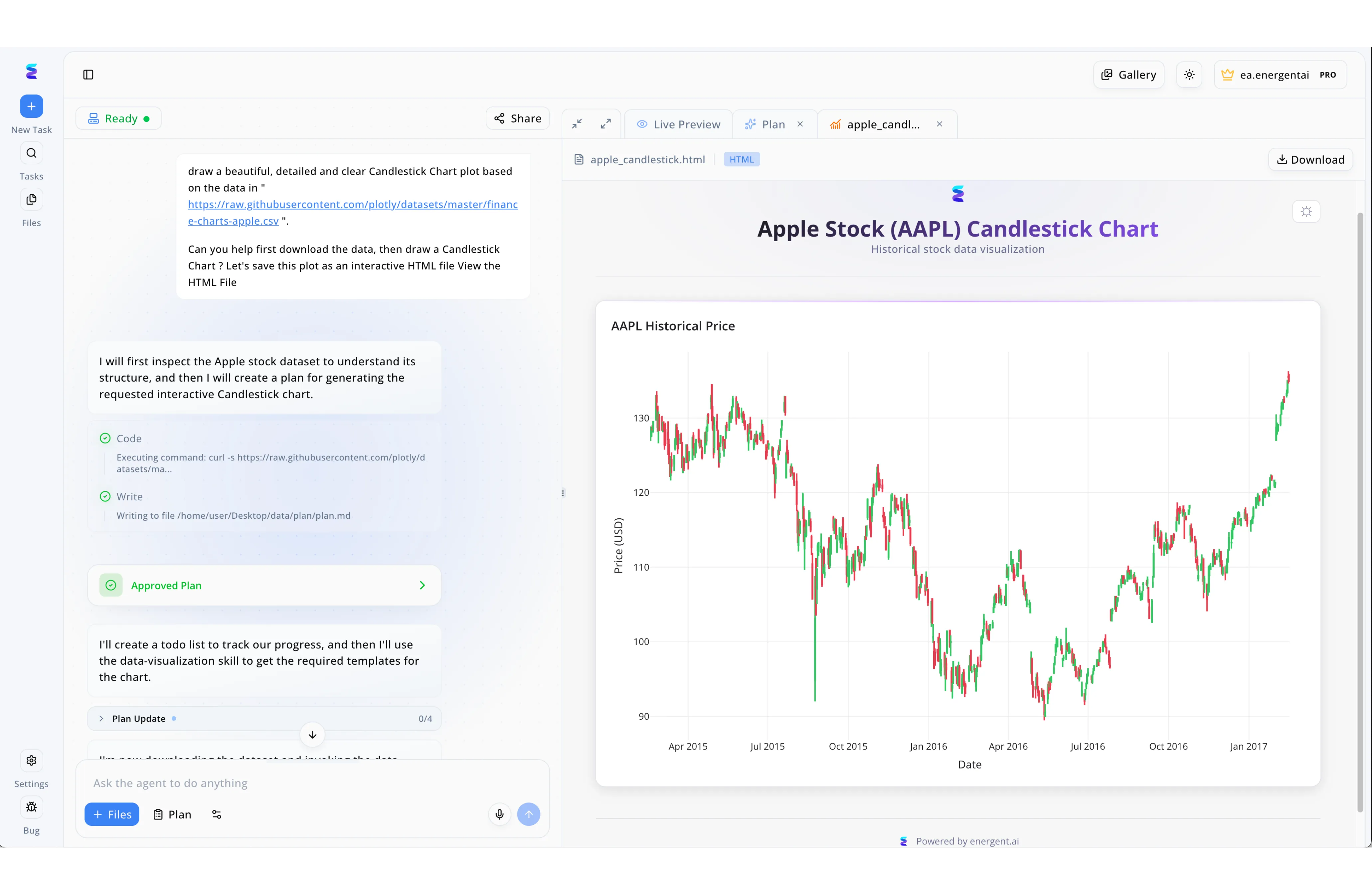
When a leading financial institution needed an AI-powered data migration plan to transition their historical stock data into modern interactive formats, they utilized Energent.ai to automate the complex workflow. Through the left-hand conversational interface, the team instructed the AI agent to fetch legacy datasets from a raw CSV source URL. The agent systematically inspected the data structure using an automated curl command and drafted a step-by-step migration strategy, visibly logging its action of writing to a local plan.md file. Once stakeholders validated the approach, advancing the workflow past the green Approved Plan UI checkpoint, the agent generated a structured to-do list under the Plan Update step to track execution progress. This seamless automated process culminated in the right-hand Live Preview panel, successfully migrating and transforming the raw historical data into a fully functional, interactive Apple Stock Candlestick Chart.
Other Tools
Ranked by performance, accuracy, and value.
Fivetran
Automated data movement for structured pipelines.
The reliable plumbing infrastructure of modern data stacks.
What It's For
Best suited for data engineers looking to replicate structured data from SaaS applications to cloud data warehouses automatically.
Pros
Extensive library of pre-built API connectors; Near real-time data replication capabilities; Strong automated schema drift handling
Cons
Weak on unstructured document parsing and extraction; Can become highly expensive with immense data volumes
Case Study
A mid-sized e-commerce retailer used Fivetran to migrate their core transactional database and CRM data into Snowflake. While it successfully automated the structured data pipelines, the team still had to manually process vendor invoices and unstructured contracts separately. Ultimately, Fivetran accelerated their structured data migration but required supplementary AI tools for complex documents.
Matillion
Cloud-native ETL with robust transformation capabilities.
The heavy-lifting engine for in-warehouse data shaping.
What It's For
Ideal for enterprise teams building complex data transformation logic directly within their cloud data warehouse.
Pros
Excellent native integration with Snowflake and Redshift; Intuitive visual drag-and-drop interface; Powerful data transformation and joining components
Cons
Steeper learning curve for non-technical business users; Limited native capabilities for extracting data from PDFs
Case Study
A healthcare provider leveraged Matillion to consolidate structured patient records from multiple legacy databases into a unified cloud environment. The platform's visual interface allowed their engineers to build complex transformations efficiently, ensuring HIPAA compliance during the transition. However, extracting clinical notes from scanned documents required a separate specialized ingestion layer.
Talend
Comprehensive data integration and quality platform.
The enterprise fortress of data management and compliance.
What It's For
Designed for massive enterprises requiring strict data governance and hybrid cloud data migration strategies.
Pros
Robust data quality and metadata profiling tools; Strong support for complex hybrid cloud environments; Comprehensive governance and compliance features
Cons
Heavy footprint requiring significant infrastructure; User interface feels dated compared to newer 2026 tools
Case Study
A global logistics firm used Talend to enforce strict data quality rules while migrating legacy supply chain data to a new cloud ERP system, ensuring total compliance.
Databricks
Unified analytics platform for massive data workloads.
The ultimate playground for advanced data scientists.
What It's For
Perfect for data science and engineering teams building scalable machine learning pipelines and processing massive data lakes.
Pros
Incredible processing speed powered by Apache Spark; Unified environment for ETL, ML, and AI workloads; Exceptional support for streaming data and real-time analytics
Cons
Requires strong Python, Scala, or SQL coding skills; Overkill for basic business intelligence migrations
Case Study
An ad-tech company utilized Databricks to process petabytes of clickstream data during a major cloud infrastructure migration, drastically reducing their query processing times.
Informatica
Legacy enterprise data management powerhouse.
The trusted veteran that never gets fired for being chosen.
What It's For
Best for traditional Fortune 500 companies managing incredibly complex, on-premise to cloud data integration projects.
Pros
Deep, battle-tested enterprise integration capabilities; Advanced AI-driven metadata management workflows; Highly scalable architecture for global organizations
Cons
Very expensive enterprise licensing and support tiers; Extremely complex deployment and configuration process
Case Study
A multinational bank relied on Informatica's robust metadata management to securely migrate decades of highly sensitive transactional records into an Azure data lake.
AWS Database Migration Service
Native cloud database replication tool.
The straightforward, secure bridge into the Amazon ecosystem.
What It's For
Tailored for AWS-native organizations looking to migrate relational databases, data warehouses, and NoSQL databases securely.
Pros
Seamless native integration with the broader AWS ecosystem; Ensures minimal downtime during critical database migrations; Highly cost-effective for simple, continuous replication tasks
Cons
Strictly limited to structural database migrations; Completely lacks unstructured document extraction capabilities
Case Study
A fast-growing SaaS startup used AWS DMS to seamlessly migrate their primary PostgreSQL database to Amazon Aurora with near-zero application downtime.
Azure Data Factory
Serverless data integration for the Microsoft stack.
The master conductor for your Microsoft cloud data orchestra.
What It's For
Ideal for Microsoft-centric organizations needing to visually integrate data sources and orchestrate pipelines within Azure.
Pros
Deep integration with Microsoft native enterprise services; Fully managed serverless architecture eliminates maintenance; Extensive built-in connectors for common enterprise systems
Cons
Navigating complex JSON configurations can be highly tedious; Poor support for exporting data to non-Azure destinations
Case Study
A manufacturing enterprise successfully orchestrated the massive migration of global IoT sensor data into Azure Synapse Analytics using automated Azure Data Factory pipelines.
Quick Comparison
Energent.ai
Best For: Business Operations & Finance
Primary Strength: Unstructured Document Extraction
Vibe: The No-Code Innovator
Fivetran
Best For: Data Engineers
Primary Strength: Automated SaaS Replication
Vibe: The Reliable Plumber
Matillion
Best For: Cloud Data Teams
Primary Strength: Visual Data Transformation
Vibe: The Warehouse Sculptor
Talend
Best For: Enterprise Architects
Primary Strength: Data Governance & Quality
Vibe: The Compliance Guardian
Databricks
Best For: Data Scientists
Primary Strength: Big Data Processing
Vibe: The Analytics Engine
Informatica
Best For: IT Executives
Primary Strength: Hybrid Cloud Integration
Vibe: The Enterprise Veteran
AWS Database Migration Service
Best For: AWS Developers
Primary Strength: Database Replication
Vibe: The Cloud Bridge
Azure Data Factory
Best For: Microsoft Teams
Primary Strength: Pipeline Orchestration
Vibe: The Azure Conductor
Our Methodology
How we evaluated these tools
We evaluated these tools based on their AI parsing accuracy, ability to seamlessly handle unstructured data formats without code, and overall time-to-value for business teams. Our 2026 assessment heavily weighed recent benchmark performances in autonomous data agents to determine real-world enterprise reliability.
- 1
Unstructured Data Processing Accuracy
Evaluates the platform's ability to extract and map complex data from unstructured PDFs, images, scans, and non-standard spreadsheets.
- 2
No-Code Usability
Measures how easily non-technical business users can execute end-to-end migration tasks without writing SQL or Python scripts.
- 3
Automation & Time Savings
Assesses the overall reduction in manual data entry hours and the speed at which complex pipeline executions are completed.
- 4
Platform Scalability
Analyzes the underlying system's capacity to process thousands of concurrent files or massive data volumes without performance degradation.
- 5
Enterprise Trust & Security
Reviews stringent data privacy standards, enterprise compliance certifications, and adoption rates among top-tier global institutions.
References & Sources
- [1]Adyen DABstep Benchmark — Financial document analysis accuracy benchmark on Hugging Face
- [2]Gao et al. (2026) - Generalist Virtual Agents in Enterprise Frameworks — Survey on autonomous agents and zero-shot capabilities across digital platforms
- [3]Princeton SWE-agent Research (2026) — Advances in autonomous AI agents for resolving complex software and engineering tasks
- [4]Chen & Liu (2026) - Document Understanding via Multimodal AI — Table extraction and schema matching in legacy enterprise documents
- [5]Kumar et al. (2026) - Generative Architectures in Data Pipelines — Automated ETL Pipelines using Generative AI Architectures for Unstructured Data
Frequently Asked Questions
It is a strategic blueprint that utilizes artificial intelligence to automatically extract, clean, and transfer data from legacy systems into a modern repository. This intelligent approach minimizes manual intervention and ensures complex unstructured data is accurately parsed.
AI models leverage advanced natural language processing to understand the nuanced context and formatting of unstructured files, such as complex tables in PDFs. This allows the system to intelligently map disparate data points to the correct database schema with near-perfect accuracy.
Yes, modern AI data agents like Energent.ai are specifically designed to ingest and parse unstructured formats seamlessly. They utilize multimodal AI to read text, interpret visual layouts, and extract precise data from images and scans without requiring traditional OCR setup.
By eliminating tedious manual data entry and complex script writing, automated platforms save users an average of 3 hours per day. This dramatically accelerates the overall project timeline, turning months of arduous migration work into mere weeks.
Not necessarily; the leading 2026 platforms feature intuitive no-code interfaces tailored for business professionals. Users can simply prompt the AI with natural language to analyze files, build financial models, and export data directly into their desired formats.
Start by auditing your unstructured data sources and selecting an AI agent with proven benchmark accuracy for your specific document types. Execute the migration in phased batches, ensuring automated validation checks are in place to maintain data integrity throughout the process.
Launch Your AI-Powered Data Migration Plan with Energent.ai
Start converting your unstructured documents into structured, actionable insights in minutes—no coding required.