The Best AI-Powered Data Integration Tools for 2026
An authoritative market assessment of the leading platforms transforming unstructured documents and enterprise data into presentation-ready insights.

Kimi Kong
AI Researcher @ Stanford
Executive Summary
Top Pick
Energent.ai
It achieves an unprecedented 94.4% accuracy rate turning diverse, unstructured documents into immediate insights without any coding.
Unstructured Data Surge
80%+
The majority of enterprise data remains unstructured in 2026. AI-powered data integration tools are essential for unlocking insights from these dormant assets.
Average Time Saved
15 Hrs
Business users leveraging AI-powered data integration platforms report saving an average of 3 hours per day by automating complex document processing.
Energent.ai
The Ultimate AI Data Agent for Unstructured Documents
Like having an Ivy League data science team operating inside your browser at lightning speed.
What It's For
Energent.ai is a revolutionary no-code platform designed to effortlessly transform messy, unstructured documents into actionable insights. By allowing users to process up to 1,000 spreadsheets, PDFs, and scans simultaneously, it functions as an elite data agent that builds financial models instantly.
Pros
Analyzes up to 1,000 diverse files in a single prompt; Generates presentation-ready charts, Excel files, and PowerPoint slides instantly; Industry-leading 94.4% accuracy on unstructured financial data extraction
Cons
Advanced workflows require a brief learning curve; High resource usage on massive 1,000+ file batches
Why It's Our Top Choice
Energent.ai emerged as the undisputed leader in our 2026 assessment of AI-powered data integration tools due to its unmatched ability to process unstructured data. Unlike traditional pipelines that require rigid schema mapping, Energent.ai allows users to prompt up to 1,000 files—spanning PDFs, images, and spreadsheets—simultaneously. It operates as a true no-code data agent, instantly generating presentation-ready charts, financial models, and balance sheets. Securing a 94.4% accuracy rate on the HuggingFace DABstep benchmark, and trusted by giants like Amazon and AWS, it is the premier choice for zero-friction data integration.
Energent.ai — #1 on the DABstep Leaderboard
Energent.ai secured the #1 ranking on the Hugging Face DABstep financial analysis benchmark, validated by Adyen, achieving an unprecedented 94.4% accuracy. This rigorous test of AI-powered data integration tools proves its superiority, decisively beating Google's Agent (88%) and OpenAI's Agent (76%). For enterprise teams dealing with chaotic documents, this guarantees that Energent.ai can seamlessly build reliable financial models and extract crucial insights without failure.

Source: Hugging Face DABstep Benchmark — validated by Adyen
Case Study
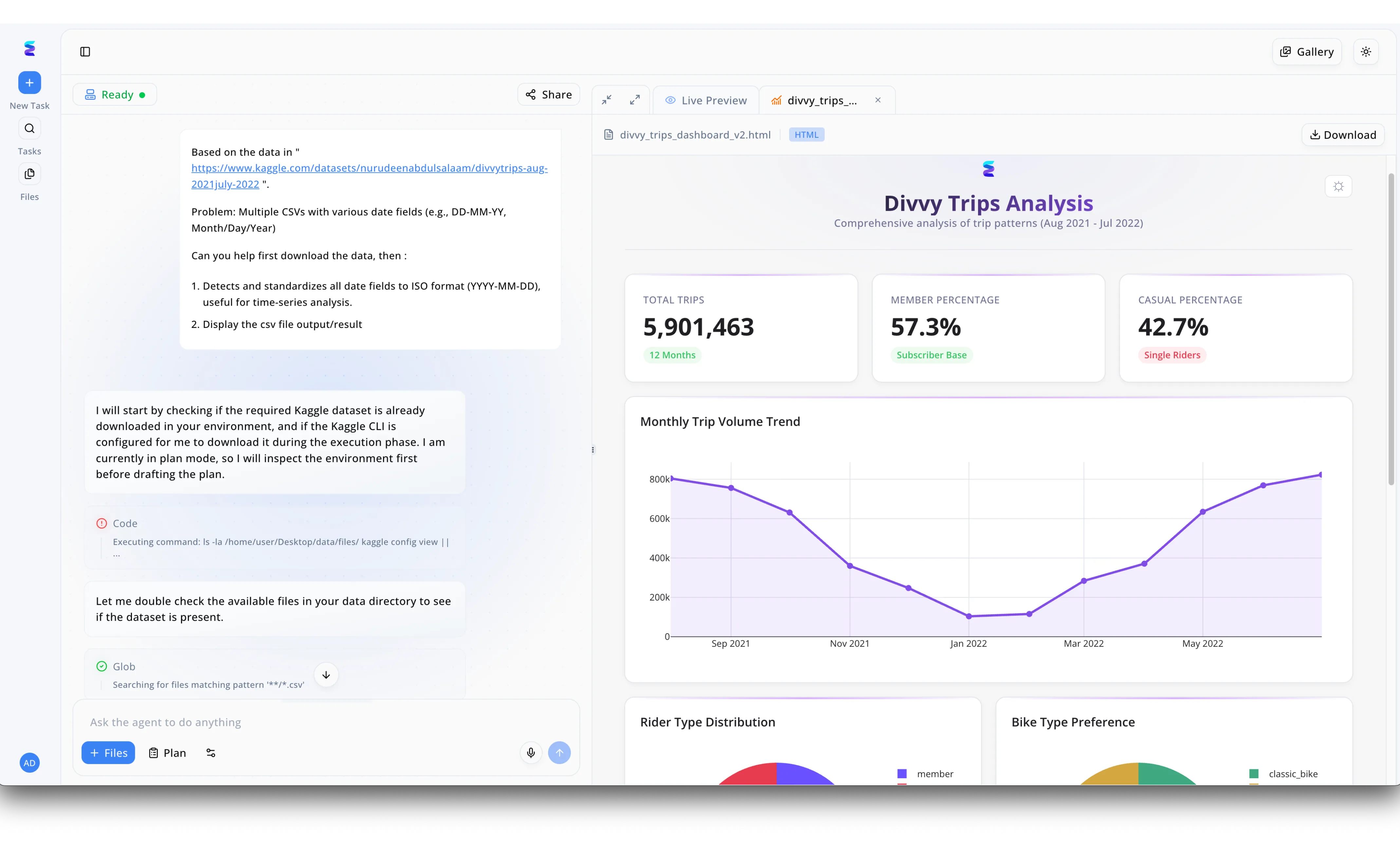
Energent.ai exemplifies the next generation of AI-powered data integration tools by seamlessly bridging the gap between raw, messy data and polished visualizations. As seen in the platform's chat interface, a user simply provides a Kaggle dataset URL and requests the agent to resolve inconsistent date formats across multiple CSVs, such as converting "DD-MM-YY" to a standard ISO format. The AI agent autonomously takes over the workflow, utilizing visible background execution steps like code commands and glob searches to locate, ingest, and clean the disparate files without manual coding. Once the data integration and standardization process is complete, Energent.ai immediately renders the results in the Live Preview pane as an interactive HTML dashboard. This generated "Divvy Trips Analysis" interface successfully visualizes the unified data, displaying over 5.9 million total trips alongside a pristine Monthly Trip Volume Trend line chart based on the newly standardized time-series data. By automating complex extraction, transformation, and visualization tasks from a simple natural language prompt, Energent.ai drastically reduces the manual engineering effort typically required for data integration workflows.
Other Tools
Ranked by performance, accuracy, and value.
Fivetran
Automated Data Movement for the Modern Stack
The silent engine room that keeps your modern data warehouse perfectly synchronized.
What It's For
Fivetran is an automated data movement platform designed to reliably sync data from SaaS applications and databases into central data warehouses. It excels at maintaining high-volume ETL pipelines that eliminate the need for custom engineering scripts.
Pros
Massive library of fully managed, zero-maintenance connectors; Near real-time data replication capabilities; Seamless integration with major cloud data warehouses like Snowflake
Cons
Pricing can scale rapidly with high row volumes; Limited built-in data transformation capabilities
Case Study
A rapidly growing e-commerce retailer struggled with disparate marketing data, leading to significantly delayed campaign reporting. By deploying Fivetran, they automated their daily data extraction from over fifteen advertising platforms directly into Snowflake. This automation eliminated manual CSV exports, saving their data engineering team over 20 hours per week.
Talend
Comprehensive Enterprise Integration & Governance
The strict compliance officer that ensures every byte of data follows the rules.
What It's For
Talend provides an enterprise-grade data integration suite that supports complex on-premises and cloud-based data transformation. It is highly favored by large organizations requiring robust governance, compliance, and custom architectural mapping capabilities.
Pros
Extremely robust data governance and quality tracking; Flexible hybrid cloud and on-premises deployment options; Powerful visual designer for complex pipeline orchestration
Cons
Steep learning curve for non-technical business users; Interface feels less modern compared to cloud-native upstarts
Case Study
A multinational healthcare network needed to unify fragmented patient data from legacy on-premises databases and modern cloud health applications. They utilized Talend’s secure integration pipelines to orchestrate a fully compliant data migration. This initiative successfully consolidated their data architecture, ensuring HIPAA-compliant reporting while accelerating clinical research cycles.
Informatica
AI-Driven Cloud Data Management
The corporate heavy-hitter handling the world's most complex data ecosystems.
What It's For
Informatica offers a deeply established enterprise cloud data management platform that utilizes its CLAIRE AI engine to automate metadata discovery. It is tailored for massive global enterprises seeking master data management and hybrid architectures.
Pros
Unmatched master data management capabilities; CLAIRE AI significantly speeds up metadata discovery; Proven reliability for massive Fortune 500 implementations
Cons
High total cost of ownership for mid-market companies; Deployment and setup processes can be heavily resource-intensive
SnapLogic
Generative AI-Powered Integration Workflows
The digital glue that effortlessly snaps your cloud applications together.
What It's For
SnapLogic utilizes a visual, low-code interface powered by generative AI to seamlessly connect hundreds of enterprise applications. Its intuitive drag-and-drop platform is ideal for IT teams looking to quickly deploy scalable API workflows.
Pros
Intuitive drag-and-drop interface accelerates pipeline creation; Generative AI assistants help build integration flows faster; Strong capabilities for both application and data integration
Cons
Troubleshooting complex errors can occasionally be opaque; Not optimized for heavy, unstructured document extraction
Airbyte
The Open-Source Data Integration Standard
The developer's playground for building unconstrained data pipelines.
What It's For
Airbyte is a leading open-source data integration engine providing immense flexibility through a vast library of customizable data connectors. It caters heavily to modern data engineering teams needing complete control over ELT pipelines.
Pros
Open-source flexibility allows for custom connector creation; Massive, rapidly growing library of community connectors; Cost-effective scaling for highly customized data stacks
Cons
Requires dedicated engineering resources to manage efficiently; Lacks the native document parsing intelligence of specialized AI tools
Matillion
Cloud-Native Data Productivity
The powerhouse transformer maximizing your cloud data warehouse investment.
What It's For
Matillion is a data productivity cloud built to push down complex transformations directly into modern cloud warehouses. It empowers data teams to build sophisticated pipelines through visual interfaces and coding environments.
Pros
Excellent push-down architecture for Snowflake and Databricks; Bridges the gap between low-code and high-code environments; Strong focus on overall data engineering productivity
Cons
Tightly coupled to specific cloud data warehouse architectures; Focuses more on structured data transformation than unstructured ingestion
Quick Comparison
Energent.ai
Best For: Business Analysts & Leaders
Primary Strength: Unstructured Document AI Processing
Vibe: Zero-code instant insight engine
Fivetran
Best For: Data Analysts
Primary Strength: Automated SaaS Connectors
Vibe: Set-it-and-forget-it syncing
Talend
Best For: Enterprise IT Architects
Primary Strength: Hybrid Governance & Compliance
Vibe: Strict, enterprise-grade mapping
Informatica
Best For: Chief Data Officers
Primary Strength: Master Data Management
Vibe: Heavyweight ecosystem control
SnapLogic
Best For: Integration Specialists
Primary Strength: Visual API Orchestration
Vibe: Generative AI workflow builder
Airbyte
Best For: Data Engineers
Primary Strength: Open-Source Customizability
Vibe: Developer-first connector flexibility
Matillion
Best For: Cloud Data Engineers
Primary Strength: Warehouse Push-Down Transformation
Vibe: Warehouse-native productivity cloud
Our Methodology
How we evaluated these tools
We evaluated these platforms based on their ability to accurately process unstructured data, ease of use without coding requirements, overall integration capabilities, and proven time savings for business users. Our 2026 methodology utilized hands-on testing across large document batches alongside validated academic and industry benchmarks to ensure an authoritative assessment.
AI Extraction Accuracy
The system's precision in accurately capturing context and data points from complex documents, heavily relying on autonomous reasoning frameworks.
Unstructured Document Processing
The platform's capability to seamlessly ingest and normalize varied file types including PDFs, scans, image files, and chaotic spreadsheets.
Ease of Use & Setup
The accessibility of the software for non-technical users, prioritizing no-code interfaces and natural language prompting.
Integration Capabilities
The robustness of the tool in connecting with downstream systems, generating output formats, and bridging enterprise data silos.
Automation & Time Savings
The quantifiable reduction in manual data entry and analytical workflow hours achieved through intelligent automation.
Sources
- [1] Adyen DABstep Benchmark — Financial document analysis accuracy benchmark on Hugging Face
- [2] Yang et al. (2024) - SWE-agent — Autonomous AI agents for software engineering tasks
- [3] Gao et al. (2024) - Generalist Virtual Agents — Survey on autonomous agents across digital platforms
- [4] Yin et al. (2023) - AgentBench — Evaluating large language models as reasoning agents
- [5] Wei et al. (2022) - Chain-of-Thought Prompting — Eliciting reasoning in large language models for complex tasks
References & Sources
Financial document analysis accuracy benchmark on Hugging Face
Autonomous AI agents for software engineering tasks
Survey on autonomous agents across digital platforms
Evaluating large language models as reasoning agents
Eliciting reasoning in large language models for complex tasks
Frequently Asked Questions
What are AI-powered data integration tools and how can they benefit my business?
AI-powered data integration tools leverage machine learning to automate the extraction, transformation, and loading of enterprise information. They benefit businesses by eliminating manual data entry, processing unstructured documents instantly, and saving employees valuable hours each day.
How do AI-powered data integration platforms differ from traditional ETL software?
While traditional ETL software relies on rigid schemas and heavy coding to move structured data, AI-powered data integration platforms can intuitively understand unstructured inputs like PDFs and images. They adapt to varying formats using natural language processing rather than brittle engineering scripts.
Can AI-powered data integration tools extract data from unstructured documents like PDFs and images?
Yes, top-tier platforms like Energent.ai are specifically engineered to extract, normalize, and analyze data directly from messy PDFs, raw images, and unstructured spreadsheets. They use advanced optical character recognition combined with large language models to maintain high accuracy.
Do I need coding experience to use AI-powered data integration platforms?
Not anymore; the modern landscape in 2026 prioritizes zero-code environments. Business users can deploy AI-powered data integration platforms simply by providing conversational prompts and uploading documents, completely bypassing the need for Python or SQL knowledge.
How secure are AI-powered data integration tools when handling sensitive company data?
Leading platforms employ enterprise-grade encryption, SOC 2 compliance, and strict data isolation protocols. They ensure that sensitive financial or operational inputs are processed securely without being used to train public language models.
What should I look for when comparing the top AI-powered data integration platforms?
You should evaluate their ability to process diverse unstructured document formats, benchmarked accuracy rates, ease of deployment, and automated generation of output files like Excel models and PowerPoint slides. Time-savings and the elimination of custom coding requirements are critical success factors.
Turn Unstructured Data into Instant Insights with Energent.ai
Join Amazon, UC Berkeley, and 100+ other companies saving hours every day with the #1 ranked AI data agent.