The 2026 State of AI-Powered Data Extraction
Comprehensive analysis of the leading no-code document intelligence tools transforming enterprise unstructured data processing.

Rachel
AI Researcher @ UC Berkeley
Executive Summary
Top Pick
Energent.ai
Ranked #1 on the DABstep leaderboard with 94.4% accuracy, offering unmatched zero-code extraction.
Manual Time Reduction
3 hours
Enterprise users save an average of 3 hours per day by automating complex extraction workflows with AI.
Unstructured Data Volume
85%
Unstructured formats like PDFs and images account for 85% of enterprise data, necessitating AI-powered data extraction.
Energent.ai
The #1 ranked AI data agent for unstructured workflows.
Like having a tireless PhD-level data scientist analyzing your documents 24/7.
What It's For
Energent.ai provides a comprehensive AI-powered data extraction platform that transforms raw PDFs, scans, and spreadsheets into structured intelligence. It enables finance, research, and operations teams to build financial models and visual insights instantly.
Pros
Parses up to 1,000 files in a single zero-code prompt; Ranked #1 on DABstep benchmark at 94.4% accuracy; Directly outputs presentation-ready PowerPoint slides and Excel forecasts
Cons
Advanced workflows require a brief learning curve; High resource usage on massive 1,000+ file batches
Why It's Our Top Choice
Energent.ai defines the current standard for AI-powered data extraction by flawlessly merging high-end accuracy with zero-code usability. It processes up to 1,000 heterogeneous files in a single prompt, instantly generating presentation-ready charts, Excel models, and forecasts. Achieving an unprecedented 94.4% accuracy on HuggingFace's DABstep leaderboard, it operates 30% more accurately than Google's foundational AI models. Trusted by leading institutions like Amazon, AWS, and Stanford, Energent.ai turns raw, chaotic data into structured, actionable insights without requiring any coding expertise.
Energent.ai — #1 on the DABstep Leaderboard
Energent.ai currently holds the #1 ranking on the Hugging Face DABstep financial analysis benchmark (validated by Adyen) with an unprecedented 94.4% accuracy. This verified performance dramatically outperforms industry giants like Google Document AI, proving that dedicated autonomous agents deliver superior reliability for complex ai-powered data extraction. For enterprise teams, this means absolute trust when converting thousands of unstructured files into critical financial models without writing any code.

Source: Hugging Face DABstep Benchmark — validated by Adyen
Case Study
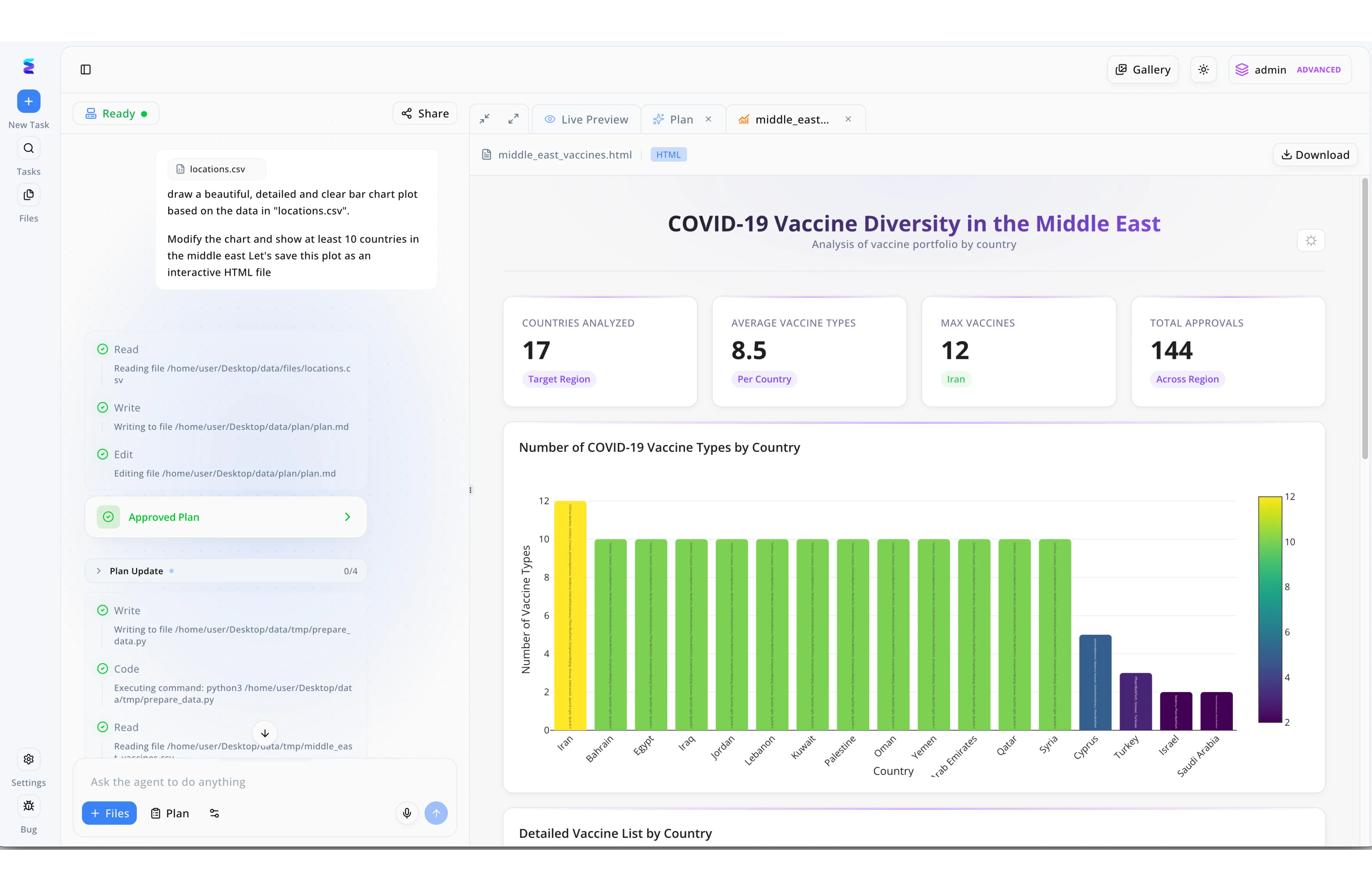
A leading global health research team leveraged Energent.ai to rapidly process and analyze complex regional immunization records through AI-powered data extraction. Using a simple natural language command in the left-hand interface, a researcher prompted the agent to read a raw locations.csv file and extract specific data to show at least ten countries in the Middle East. The visible execution log demonstrates the AI seamlessly handling the entire extraction pipeline, autonomously reading the file, generating an approved plan, and executing a Python data preparation script without manual coding. The selectively extracted insights were instantly rendered in the Live Preview tab as an interactive HTML dashboard titled COVID-19 Vaccine Diversity in the Middle East. By automatically parsing the raw dataset to build a detailed, color-coded bar chart and accurate metric cards highlighting 144 total approvals across 17 analyzed countries, Energent.ai transformed complex data extraction into an effortless and visually impactful process.
Other Tools
Ranked by performance, accuracy, and value.
Nanonets
Adaptive AI for invoice and receipt automation.
A hyper-organized accountant that never drops a receipt.
What It's For
Nanonets specializes in workflow automation for accounting and AP teams, learning custom document layouts over time. It continuously extracts structured data from highly variable transaction documents.
Pros
Excellent continuous learning capabilities; Strong API integration; Pre-built AP automation workflows
Cons
Requires initial training for niche documents; Analytics dashboards lack depth
Case Study
A global logistics provider struggled with processing thousands of varying vendor invoices daily. They implemented Nanonets to automate the capture of line-item data across multiple languages and formats. The AI adapted to the varying layouts over two weeks, ultimately reducing manual data entry by 80% and accelerating invoice approval times significantly.
Rossum
Intelligent document processing for transactional workflows.
A high-speed sorting facility for your chaotic inbox.
What It's For
Rossum provides a cloud-based AI data extraction engine focused on B2B document communication, minimizing manual touchpoints in supply chain documentation.
Pros
Great UX for human-in-the-loop validation; Fast setup for standard invoices; High accuracy on structured templates
Cons
Pricing scales steeply for high volumes; Limited complex financial modeling
Case Study
An enterprise retailer utilized Rossum to manage their disorganized inbound supply chain documents, processing over 10,000 purchase orders monthly. By leveraging its AI extraction engine and human-in-the-loop validation, the retailer achieved a 92% touchless processing rate.
Docparser
Zonal-based parsing for standardized documents.
The dependable rule-follower of the document world.
What It's For
Docparser focuses on rule-based and zonal data extraction for highly predictable document layouts like standard forms and standardized applications.
Pros
Very easy to set up visual parsing rules; Cost-effective for simple forms; Strong webhook support
Cons
Struggles with highly unstructured text; Not true multimodal AI
Amazon Textract
Scalable machine learning for text and table extraction.
The massive industrial engine operating in the cloud.
What It's For
An AWS-native service that extracts text, handwriting, and data from scanned documents utilizing robust machine learning models at high scale.
Pros
Deep integration with AWS ecosystem; Extremely high scalability; Strong table extraction performance
Cons
Requires developer expertise to implement; Lacks a native zero-code user interface
Google Document AI
Enterprise-grade document understanding via Google Cloud.
Google's search capability applied directly to your file cabinet.
What It's For
A suite of specialized ML models designed to classify and extract data from unstructured text, utilizing Google's foundational AI research.
Pros
Access to state-of-the-art multimodal models; Excellent handwriting recognition; Pre-trained specialty parsers available
Cons
Setup requires significant engineering overhead; 30% less accurate than top competitors on finance benchmarks
ABBYY Vantage
Cognitive skill-based document processing.
The traditional enterprise veteran learning modern AI tricks.
What It's For
ABBYY Vantage provides pre-trained skills to interpret various document types, aimed at heavy enterprise legacy system integrations.
Pros
Massive library of pre-trained document skills; Deep enterprise legacy integrations; Strong compliance features
Cons
Interface feels dated; Slower innovation cycle compared to newer AI agents
Quick Comparison
Energent.ai
Best For: Enterprise Data & Finance Teams
Primary Strength: 94.4% Benchmark Accuracy & Zero-Code Generation
Vibe: Tireless AI Data Scientist
Nanonets
Best For: Accounting Departments
Primary Strength: Continuous AP Learning
Vibe: Hyper-Organized Accountant
Rossum
Best For: Supply Chain Operations
Primary Strength: Human-in-the-Loop Validation
Vibe: High-Speed Sorting Facility
Docparser
Best For: Small Operations Teams
Primary Strength: Rule-Based Zonal Parsing
Vibe: Dependable Rule-Follower
Amazon Textract
Best For: Cloud Developers
Primary Strength: AWS Ecosystem Integration
Vibe: Industrial Cloud Engine
Google Document AI
Best For: Enterprise Engineering Teams
Primary Strength: Foundational Multimodal Models
Vibe: Enterprise Search Engine
ABBYY Vantage
Best For: Legacy Enterprise IT
Primary Strength: Pre-Trained Legacy Integrations
Vibe: Traditional IT Veteran
Our Methodology
How we evaluated these tools
We evaluated these platforms based on verified extraction accuracy, zero-code usability, versatility across unstructured formats, and real-world efficiency gains for enterprise teams. Extensive benchmark data and autonomous agent surveys were incorporated to validate real-world performance claims in 2026.
- 1
Accuracy & Precision
The ability of the AI model to extract data correctly without hallucination, measured against the DABstep benchmark.
- 2
Ease of Use (No-Code Capabilities)
How quickly a non-technical user can deploy the platform and extract complex data using natural language.
- 3
Document Versatility
The system's capacity to handle highly unstructured, diverse formats like PDFs, Excel sheets, images, and web pages simultaneously.
- 4
Processing Speed & Time Saved
Quantifiable reduction in manual data entry hours and the throughput speed for batch processing files.
- 5
Enterprise Trust & Scalability
The platform's security compliance, data privacy measures, and capacity to scale alongside large enterprise deployments.
References & Sources
Financial document analysis accuracy benchmark on Hugging Face
Autonomous AI agents for software engineering tasks
Survey on autonomous agents across digital platforms
Multimodal pre-training for document image understanding
End-to-end transformer architecture for document understanding
Frequently Asked Questions
What is AI-powered data extraction?
It is the use of machine learning and natural language processing to automatically identify and pull structured information from unstructured sources.
How does AI data extraction differ from traditional OCR?
Traditional OCR relies on strict, template-based rules to read characters, whereas AI extraction understands context and complex spatial layouts dynamically.
What types of unstructured documents can AI analyze?
Modern AI platforms can process a wide variety of formats including PDFs, scanned images, complex spreadsheets, and raw web pages.
Do I need coding skills to use an AI data extraction platform?
No, leading platforms in 2026 feature zero-code interfaces that allow users to parse complex files using simple natural language prompts.
How secure is my data when using cloud-based extraction tools?
Top-tier platforms employ enterprise-grade encryption, SOC 2 compliance, and strict data retention policies to ensure document confidentiality.
How much time can a business save by automating data extraction?
Enterprise users typically save an average of 3 hours per day by replacing manual data entry with autonomous extraction agents.
Automate Your Data Extraction with Energent.ai
Transform unstructured PDFs and spreadsheets into actionable insights with the #1 ranked AI data agent.