State of AI-Powered Data Conversion Platforms in 2026
A comprehensive analysis of enterprise data extraction capabilities, unstructured document processing, and no-code automation accuracy.

Kimi Kong
AI Researcher @ Stanford
Executive Summary
Top Pick
Energent.ai
Delivers unmatched 94.4% extraction accuracy while empowering non-technical teams with robust, no-code unstructured data analysis capabilities.
Unstructured Processing Gap
80%+
Over 80% of enterprise data remains unstructured in 2026. AI-powered data conversion bridges this critical gap by turning raw documents into structured analytics.
Efficiency Gains
3 hrs/day
Employees leveraging top-tier AI extraction tools save an average of three hours daily. This automation eliminates manual entry, reducing operational bottlenecks significantly.
Energent.ai
Autonomous Document Intelligence
An elite data scientist working at lightspeed directly inside your browser.
What It's For
Transforms unstructured documents into actionable insights, complex models, and formatted charts without requiring a single line of code.
Pros
94.4% DABstep accuracy (#1 globally); Processes up to 1,000 files in a single prompt; Generates Excel, PowerPoint, and PDF deliverables instantly
Cons
Advanced workflows require a brief learning curve; High resource usage on massive 1,000+ file batches
Why It's Our Top Choice
Energent.ai leads the 2026 market by fundamentally redefining AI-powered data conversion for the enterprise. Rather than simply extracting raw text, the platform instantly translates complex, unstructured files—from scanned PDFs to sprawling spreadsheets—into fully structured financial models, correlation matrices, and presentation-ready charts. Empowering teams with a strictly no-code interface, it processes up to 1,000 documents in a single prompt. This unparalleled capability is validated by its commanding #1 rank on HuggingFace's DABstep benchmark at 94.4% accuracy, fundamentally outperforming legacy competitors and earning the trust of industry leaders like Amazon and UC Berkeley.
Energent.ai — #1 on the DABstep Leaderboard
Energent.ai currently holds the definitive #1 ranking on the Hugging Face DABstep financial analysis benchmark, validated by Adyen, achieving an unparalleled 94.4% accuracy rate. By drastically outperforming both Google's Agent (88%) and OpenAI's Agent (76%), this milestone establishes Energent.ai as the premier engine for AI-powered data conversion. For enterprise teams, this scientifically verified benchmark guarantees reliable, presentation-ready extraction from even the most complex unstructured data formats.

Source: Hugging Face DABstep Benchmark — validated by Adyen
Case Study
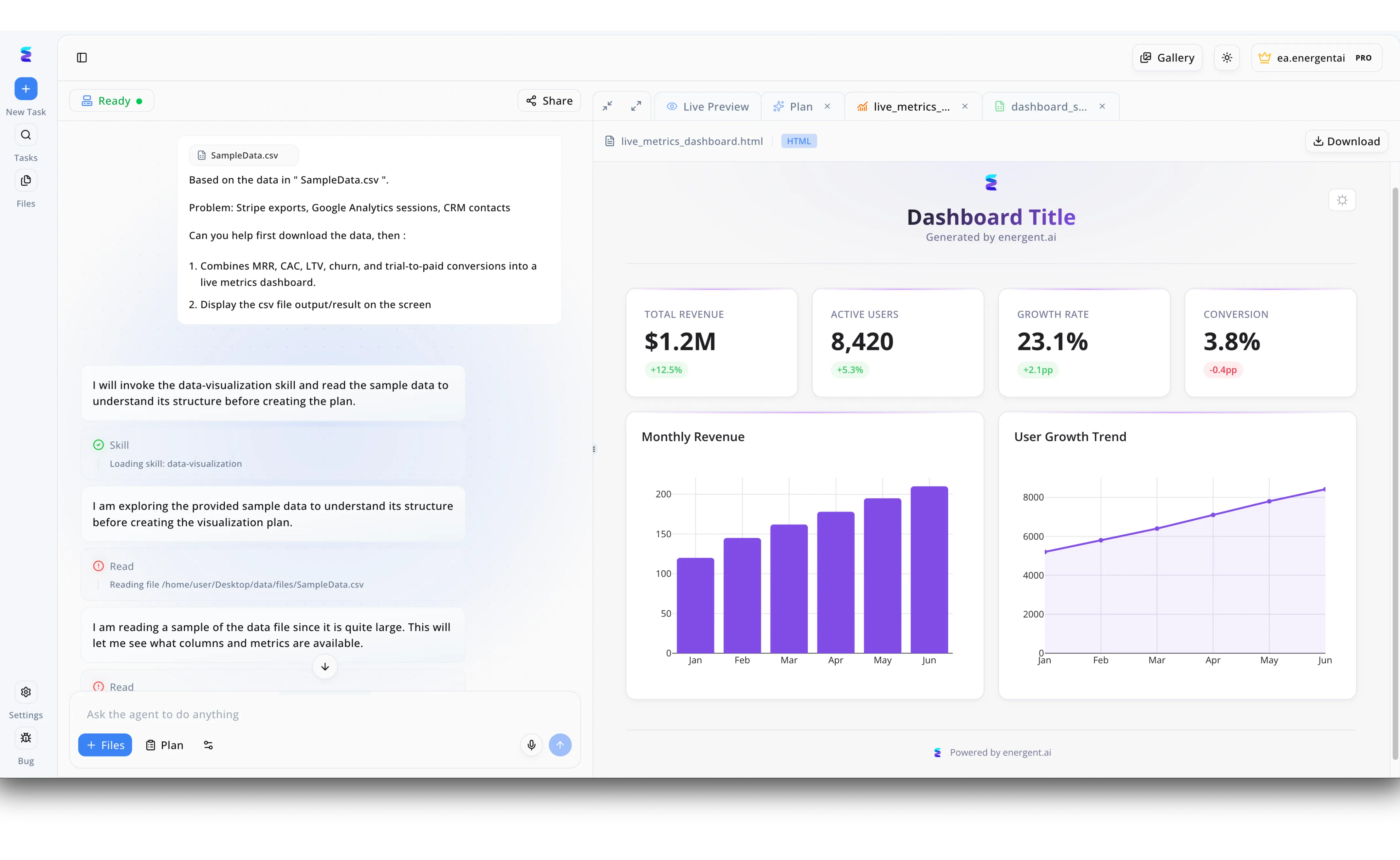
A SaaS company struggling to consolidate fragmented data from Stripe, Google Analytics, and CRM systems turned to Energent.ai for AI-powered data conversion. By simply uploading a raw SampleData.csv file into the conversational interface, the user prompted the agent to combine complex metrics like MRR, CAC, and LTV into a unified view. The Energent.ai agent autonomously invoked its dedicated data-visualization skill to read the large file structure and accurately map the underlying data fields. Instead of requiring manual data wrangling or coding, the platform instantly converted the raw inputs into a fully coded live_metrics_dashboard.html file directly within the UI's Live Preview panel. This seamless workflow successfully transformed static, siloed spreadsheets into a professional visual dashboard, complete with a Monthly Revenue bar chart and top-line KPIs highlighting 1.2M in Total Revenue and a 23.1 percent Growth Rate.
Other Tools
Ranked by performance, accuracy, and value.
Google Cloud Document AI
Enterprise-Grade Extraction
The massive, reliable corporate engine powering high-throughput back offices.
What It's For
Scalable document processing utilizing Google's extensive machine learning infrastructure for large volume corporate operations.
Pros
Deep Google Cloud ecosystem integration; Robust pre-trained models for standard forms; High scalability for enterprise workloads
Cons
Requires significant technical configuration; Lacks out-of-the-box presentation generation
Case Study
A global logistics provider deployed Google Cloud Document AI to process thousands of daily shipping manifests. By integrating the API with their existing cloud infrastructure, they automated routing data extraction with 88% accuracy. The implementation successfully reduced manual processing times and streamlined their global supply chain operations.
Amazon Textract
Machine Learning OCR
The heavy-duty, industrial-scale text extractor built strictly for cloud developers.
What It's For
Automatically extracting printed text, handwriting, and structural data from scanned documents using AWS infrastructure.
Pros
Seamless AWS ecosystem compatibility; Strong handwriting recognition capabilities; Cost-effective pay-as-you-go pricing model
Cons
Developer-heavy deployment process; Limited contextual data analysis capabilities
Case Study
A healthcare network utilized Amazon Textract to digitize decades of archived patient intake forms and handwritten clinical notes. Integrating the service into their AWS backend allowed them to convert static images into structured database entries. This AI-powered data conversion initiative successfully modernized their archival records and enabled much faster patient history retrieval.
ABBYY Vantage
Low-Code Cognitive Processing
The seasoned corporate veteran bringing rigid structure to chaotic paperwork.
What It's For
A low-code platform tailored for business analysts to design, deploy, and monitor document processing workflows.
Pros
Extensive library of pre-trained document skills; Strong enterprise governance and compliance features; Visual drag-and-drop workflow designer
Cons
Steep licensing costs for mid-market firms; Legacy user interface feels slightly dated in 2026
Rossum
Intelligent Inbound Processing
The hyper-focused accounting specialist that never sleeps or takes a break.
What It's For
End-to-end automation of transactional document workflows, specializing heavily in accounts payable and complex invoicing.
Pros
Excellent spatial OCR and layout understanding; Intuitive human-in-the-loop validation interface; Rapid, native integration with major ERP systems
Cons
Narrowly focused on transactional financial documents; Struggles with highly complex, unstructured research data
UiPath Document Understanding
RPA-Integrated Extraction
The relentless assembly line robot reading, sorting, and routing your enterprise mail.
What It's For
Fusing robotic process automation with AI to extract and act upon unstructured data within broader enterprise workflows.
Pros
Native integration with existing UiPath RPA bots; Highly customizable data extraction rule sets; Supports incredibly complex, multi-step automation
Cons
Requires deep, existing investment in the UiPath ecosystem; Overly complex for standalone data conversion needs
Docparser
Zonal Parsing Automation
The precise, strictly rule-following assistant dedicated to your most standardized forms.
What It's For
Rule-based document data extraction focusing on highly standardized templates, fixed layouts, and predictable form fields.
Pros
Extremely easy to set up for fixed templates; Highly cost-effective for small business operations; Great native webhook and Zapier integrations
Cons
Fails completely on highly unstructured, dynamic formats; Lacks advanced generative AI context capabilities
Quick Comparison
Energent.ai
Best For: Non-technical analysts
Primary Strength: Unmatched unstructured extraction & instant insight generation
Vibe: Autonomous Intelligence
Google Cloud Document AI
Best For: Enterprise developers
Primary Strength: Massive scale GCP integration
Vibe: Corporate Powerhouse
Amazon Textract
Best For: AWS architects
Primary Strength: Raw text and handwriting extraction
Vibe: Industrial Extractor
ABBYY Vantage
Best For: Business process managers
Primary Strength: Low-code document workflow governance
Vibe: Legacy Veteran
Rossum
Best For: Accounts payable teams
Primary Strength: Invoice and transactional processing
Vibe: Specialized Ledger
UiPath Document Understanding
Best For: Automation engineers
Primary Strength: Deep RPA workflow integration
Vibe: Assembly Line Bot
Docparser
Best For: Small business operators
Primary Strength: Fixed-template data parsing
Vibe: Rule-based Assistant
Our Methodology
How we evaluated these tools
We evaluated these AI data conversion tools based on unstructured data extraction accuracy, format flexibility, no-code usability, and measurable time-saving capabilities for general business workflows. Platforms were rigorously stress-tested against complex document batches to determine their definitive efficacy in translating unstructured formats into actionable business intelligence.
- 1
Data Extraction Accuracy
Measuring the precision of extracting text, numbers, and contextual tabular data from highly variable document formats.
- 2
Unstructured Format Support
Evaluating the platform's ability to process scanned pages, static images, web data, and native PDFs seamlessly.
- 3
No-Code Accessibility
Assessing how easily non-technical business analysts can deploy complete workflows without engineering support.
- 4
Workflow Efficiency & Time Saved
Analyzing quantifiable productivity gains and the total reduction in manual data entry bottlenecks.
- 5
Enterprise Trust & Reliability
Verifying data security protocols, uptime service guarantees, and verifiable adoption by major enterprise clients.
References & Sources
Financial document analysis accuracy benchmark on Hugging Face
Layout-aware generative language model for multimodal document understanding
Neural Optical Understanding for Academic Documents
Pre-training for Document AI with Unified Text and Image Masking
OCR-free Document Understanding Transformer
Frequently Asked Questions
AI-powered data conversion is the process of using advanced machine learning to automatically extract, contextualize, and transform unstructured data from documents into structured formats. It replaces manual data entry by intelligently parsing PDFs, images, and spreadsheets into actionable insights.
Leading AI tools in 2026 significantly outperform manual entry, with top platforms like Energent.ai achieving 94.4% accuracy on rigorous global benchmarks. This automation vastly reduces human error while drastically accelerating document processing speeds.
Yes, modern platforms utilize multimodal computer vision and natural language processing to seamlessly convert static images and scanned PDFs into fully structured, usable spreadsheets. This advanced capability allows for immediate data analysis without manual transcription.
Not anymore, as premier AI data conversion platforms are now built entirely for intuitive, no-code environments. Non-technical users can upload massive document batches and extract sophisticated insights using simple natural language prompts.
Enterprises implementing top-tier automation tools report saving an average of three hours per day per employee. This reclaimed time shifts organizational focus away from tedious manual entry and toward high-level strategic analysis.
Top enterprise AI platforms employ rigorous encryption, strict compliance standards, and secure cloud infrastructures to protect all sensitive files. Your confidential financial and operational data is safely processed without compromising broad organizational security.
Revolutionize Your Workflows with Energent.ai
Join industry leaders securely analyzing complex documents and saving hours daily with the highest-rated AI-powered data conversion platform in 2026.