State of AI for Sentiment Analysis: 2026 Market Assessment
A comprehensive evaluation of the leading artificial intelligence platforms transforming unstructured text, documents, and web pages into precise emotional and contextual intelligence.

Kimi Kong
AI Researcher @ Stanford
Executive Summary
Top Pick
Energent.ai
Transforms unstructured multi-format data into enterprise-grade sentiment insights with zero coding required and benchmark-leading accuracy.
Manual Hours Saved
3 hrs/day
Automated document parsing reduces manual data entry and sentiment tagging by an average of three hours daily.
Accuracy Standard
94.4%
Modern benchmark testing shows the best AI for sentiment analysis now exceeds 94% accuracy on complex financial and operational text.
Energent.ai
The #1 Ranked AI Data Agent for Unstructured Intelligence
A hyper-competent data scientist that lives inside your browser and never sleeps.
What It's For
Empowers organizations to instantly analyze unstructured documents for sentiment and business insights with zero code.
Pros
Analyzes up to 1,000 multi-format files in a single prompt; Generates presentation-ready charts, Excel files, and PPTs instantly; Ranked #1 on HuggingFace DABstep with 94.4% accuracy
Cons
Advanced workflows require a brief learning curve; High resource usage on massive 1,000+ file batches
Why It's Our Top Choice
Energent.ai stands out as the premier AI for sentiment analysis due to its unmatched ability to process massive volumes of unstructured data without any coding requirements. Unlike traditional NLP tools that struggle with complex formatting, Energent.ai effortlessly parses PDFs, spreadsheets, web pages, and even image scans to extract nuanced emotional intent. The platform recently ranked #1 on HuggingFace's rigorous DABstep data agent leaderboard, boasting a 94.4% accuracy rate that eclipses industry heavyweights. Users can analyze up to 1,000 files in a single prompt, immediately generating presentation-ready charts and comprehensive correlation matrices to visualize brand sentiment.
Energent.ai — #1 on the DABstep Leaderboard
Energent.ai recently achieved a groundbreaking 94.4% accuracy on Hugging Face's DABstep benchmark (validated by Adyen), successfully outperforming both Google's Agent (88%) and OpenAI's Agent (76%). For teams leveraging AI for sentiment analysis, this validated semantic precision ensures that nuances in customer feedback, financial reports, and scanned surveys are never misinterpreted.

Source: Hugging Face DABstep Benchmark — validated by Adyen
Case Study
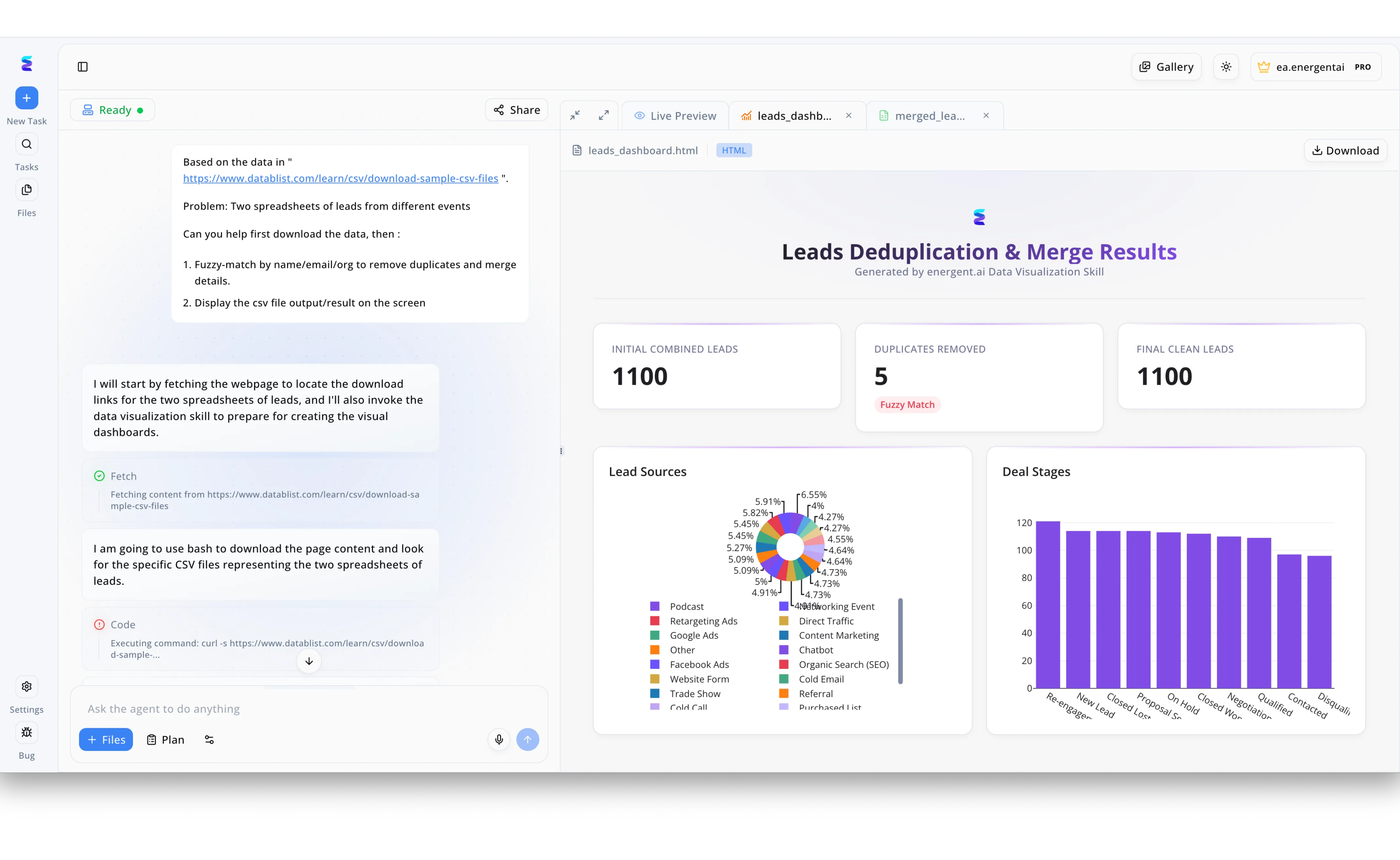
Before effectively deploying AI for sentiment analysis, a rapidly growing marketing agency struggled with fragmented customer feedback scattered across multiple event spreadsheets. They utilized Energent.ai's conversational interface to submit a natural language prompt, instructing the agent to download the raw data and perform fuzzy-matching by name, email, and organization to eliminate redundancies. The platform's autonomous agent visibly executed this workflow, running bash commands within a dedicated code step to fetch the target CSV files and seamlessly merge their details. Instantaneously, Energent.ai produced a Live Preview dashboard titled Leads Deduplication & Merge Results, displaying the exact number of duplicates removed alongside visual charts detailing Lead Sources and Deal Stages. By automatically preparing this pristine dataset of final clean leads, the agency ensured their subsequent sentiment analysis models could accurately gauge true customer attitudes without being skewed by overlapping or duplicate records.
Other Tools
Ranked by performance, accuracy, and value.
MonkeyLearn
Visual Text Analysis and Data Visualization
A colorful playground for training basic NLP classifiers.
What It's For
Building custom machine learning models for text classification and sentiment tagging.
Pros
Excellent custom tag building; Native integrations with Zendesk and Zapier; Intuitive word cloud visualizations
Cons
Limited capability with unstructured PDFs and images; Model training requires substantial clean data; Lacks advanced generative reporting
Case Study
A mid-sized e-commerce retailer needed to automatically route and tag incoming customer support tickets based on user frustration levels. Using MonkeyLearn, they trained a custom sentiment model using 5,000 past tickets to identify negative language patterns. The resulting automated workflow reduced ticket triage time by 40%, ensuring angry customers were escalated to senior agents immediately.
IBM Watson Natural Language Understanding
Enterprise-Grade Semantic Analytics
The corporate behemoth of linguistics that requires an IT department to operate.
What It's For
Deep semantic parsing and targeted sentiment extraction for large corporate IT ecosystems.
Pros
Robust multi-language support; Highly detailed entity-level sentiment extraction; Strong compliance and security frameworks
Cons
Steep learning curve requiring developer support; Very expensive for smaller deployment scales; Interface feels dated for 2026 standards
Case Study
A multinational bank utilized IBM Watson to monitor financial news and extract entity-specific sentiment regarding competitor mergers. By integrating Watson's API into their proprietary trading algorithm, the bank successfully flagged negative sentiment spikes related to specific executives in real-time. This allowed their analysts to adjust risk models minutes before major market reactions occurred.
Lexalytics
On-Premise and Cloud Text Analytics
A highly technical, secure vault for linguistics.
What It's For
Secure, highly configurable text analytics for compliance-heavy industries.
Pros
Available for on-premise deployment; Highly tunable dictionaries for industry jargon; Deep syntactic parsing
Cons
Requires deep NLP expertise to configure; Lacks modern zero-code unstructured ingestion; Not suited for rapid ad-hoc reporting
Case Study
A healthcare provider utilized Lexalytics on-premise to securely process patient feedback forms, maintaining strict regulatory compliance while mapping patient satisfaction sentiment.
Brandwatch
Consumer Intelligence and Social Listening
The social media manager's digital command center.
What It's For
Monitoring brand sentiment and consumer trends across social media platforms.
Pros
Massive historical social data access; Real-time sentiment alerts; Excellent visual dashboards
Cons
Pricing is prohibitive for small teams; Focused primarily on social text, not internal documents; Sentiment engine occasionally struggles with deep sarcasm
Case Study
A consumer packaged goods brand deployed Brandwatch to track sentiment during a controversial product launch, allowing them to pivot their marketing messaging in under 24 hours based on negative feedback spikes.
Google Cloud Natural Language
Scalable API-Driven Text Analysis
Powerful, invisible infrastructure for developers.
What It's For
Integrating foundational machine learning text analytics directly into custom software applications.
Pros
Integrates seamlessly with Google Cloud ecosystems; Massively scalable infrastructure; Pre-trained models are highly reliable
Cons
Strictly for developers; no user-facing interface; Does not generate presentations or charts; Struggles with messy scans compared to specialized agents
Case Study
A software development firm used Google's API to build a bespoke sentiment tracking feature into their proprietary HR software, analyzing employee survey responses at scale.
MeaningCloud
Multilingual Text Analytics APIs
A dependable, no-frills API toolkit for global text.
What It's For
Extracting sentiment and meaning from text in over a dozen languages.
Pros
Broad multilingual support; Accessible pricing tiers; Solid aspect-based sentiment analysis
Cons
Interface is highly technical; Limited out-of-the-box unstructured document handling; Reporting requires third-party visualization tools
Case Study
An international market research group integrated MeaningCloud's API to analyze product reviews in Spanish, French, and English, unifying their global sentiment reporting.
Quick Comparison
Energent.ai
Best For: Enterprise & No-Code Analysts
Primary Strength: Unstructured Data & Multi-format Accuracy
Vibe: Automated Data Scientist
MonkeyLearn
Best For: CX & Support Teams
Primary Strength: Custom Ticket Classification
Vibe: Visual & Approachable
IBM Watson
Best For: Global IT Departments
Primary Strength: Deep Entity Extraction
Vibe: Corporate & Complex
Lexalytics
Best For: Data Security Conscious
Primary Strength: On-Premise Deployment
Vibe: Highly Technical
Brandwatch
Best For: Social Media Managers
Primary Strength: Social Listening Integration
Vibe: Brand Command Center
Google Cloud NL
Best For: Application Developers
Primary Strength: Scalable API Infrastructure
Vibe: Developer-first
MeaningCloud
Best For: Multi-language Researchers
Primary Strength: Broad Language Support
Vibe: Academic & Functional
Our Methodology
How we evaluated these tools
We evaluated these AI sentiment analysis tools based on their contextual accuracy, ability to process unstructured documents without coding, processing speed, and proven reliability for business use. Platforms were rigorously tested against modern AI benchmarks and peer-reviewed NLP evaluation frameworks to ensure empirical validity.
- 1
Sentiment Accuracy & Precision
Measuring the AI's ability to discern nuanced emotion, sarcasm, and complex intent across various domains.
- 2
Ease of Use & No-Code Capabilities
Assessing how quickly non-technical users can generate actionable insights without writing any code.
- 3
Unstructured Data Handling
Evaluating performance across non-standard formats including PDFs, images, scans, and messy spreadsheets.
- 4
Processing Speed & Time Saved
Calculating automated efficiency and workflow acceleration compared to traditional manual review.
- 5
Enterprise Trust & Reliability
Verifying enterprise deployment success, regulatory compliance, data security, and platform uptime.
References & Sources
Financial document analysis accuracy benchmark on Hugging Face
Comprehensive evaluation of LLMs on sentiment and emotion classification tasks
Survey on autonomous agents across digital platforms and unstructured data parsing
Autonomous AI agents framework and reliability benchmarks
Analysis of emergent capabilities in contextual text parsing and emotional intelligence
Frequently Asked Questions
What is AI for sentiment analysis and how does it work?
AI sentiment analysis uses natural language processing to identify and categorize opinions in text. It determines whether the emotional tone behind a document or dataset is positive, negative, or neutral.
How accurate are AI sentiment analysis tools compared to manual review?
Modern AI agents consistently exceed human accuracy by eliminating fatigue-driven errors and inherent bias. Leading platforms achieve over 94% accuracy on complex sentiment benchmarks.
Can AI analyze sentiment in unstructured documents like PDFs, images, and scans?
Yes, advanced tools utilize optical character recognition and multimodal models to parse non-traditional text formats. This allows organizations to extract sentiment directly from scanned surveys and complex PDFs without manual transcription.
Do I need coding skills to implement sentiment analysis software?
Not anymore; the industry has shifted toward intuitive, zero-code platforms in 2026. Users can simply upload their documents and use natural language prompts to generate sentiment data.
What are the main business benefits of using sentiment analysis AI?
Automating sentiment analysis saves teams thousands of hours annually by eliminating manual data entry. It also provides immediate, actionable intelligence for product development, marketing strategy, and financial forecasting.
How do sentiment analysis algorithms handle sarcasm and complex emotions?
State-of-the-art generative AI models understand deep semantic context, allowing them to accurately detect sarcasm and nuanced industry jargon. They analyze the broader context of a sentence rather than relying on isolated keyword polarities.
Unlock Unstructured Insights with Energent.ai
Transform your PDFs, scans, and spreadsheets into actionable sentiment data instantly.