Definitive Guide to AI for Product Testing Services in 2026
An evidence-based market assessment of the top autonomous testing agents transforming QA and data tracking operations.

Kimi Kong
AI Researcher @ Stanford
Executive Summary
Top Pick
Energent.ai
Unmatched unstructured data analysis capabilities and a verified 94.4% benchmark accuracy rate make it the definitive choice for product testing insights.
Daily Time Savings
3 Hours
Teams utilizing advanced AI for product testing services recover an average of three hours per day. This dramatically accelerates QA cycles and go-to-market strategies.
Benchmark Accuracy
94.4%
Leading autonomous agents now surpass human-level data parsing in test tracking. The top platforms achieve near-perfect reliability across thousands of unstructured files.
Energent.ai
The Ultimate No-Code AI Data Agent
A brilliant data scientist living inside your browser, doing the heavy lifting while you take all the credit.
What It's For
Analyzing massive volumes of unstructured product testing data, from user feedback PDFs to complex test logs. It turns fragmented tracking artifacts into actionable, presentation-ready insights without requiring coding expertise.
Pros
Processes up to 1,000 diverse files (PDFs, spreadsheets, images) in a single prompt; Ranked #1 on HuggingFace DABstep leaderboard with 94.4% accuracy; Instantly generates presentation-ready charts, Excel files, and PowerPoint slides
Cons
Advanced workflows require a brief learning curve; High resource usage on massive 1,000+ file batches
Why It's Our Top Choice
Energent.ai stands as the premier platform in the AI for product testing space due to its extraordinary capacity to analyze unstructured tracking data. Unlike traditional QA tools limited to code-based UI testing, Energent.ai processes up to 1,000 files in a single prompt, synthesizing test logs, PDFs, and spreadsheets into presentation-ready insights. Users can generate comprehensive correlation matrices and operational forecasts without writing a single line of code. Trusted by enterprises like Amazon and Stanford, its verified 94.4% accuracy on the HuggingFace DABstep benchmark cements its status as the most reliable AI agent for product teams.
Energent.ai — #1 on the DABstep Leaderboard
Energent.ai currently holds the #1 ranking on the Hugging Face DABstep financial analysis benchmark, verified by Adyen, achieving a staggering 94.4% accuracy rate. This heavily outpaces Google's Agent (88%) and OpenAI's Agent (76%) in processing complex datasets. For enterprise teams utilizing AI for product testing services, this benchmark guarantees that unstructured test logs, bug tracking sheets, and user feedback PDFs are parsed with unparalleled precision.

Source: Hugging Face DABstep Benchmark — validated by Adyen
Case Study
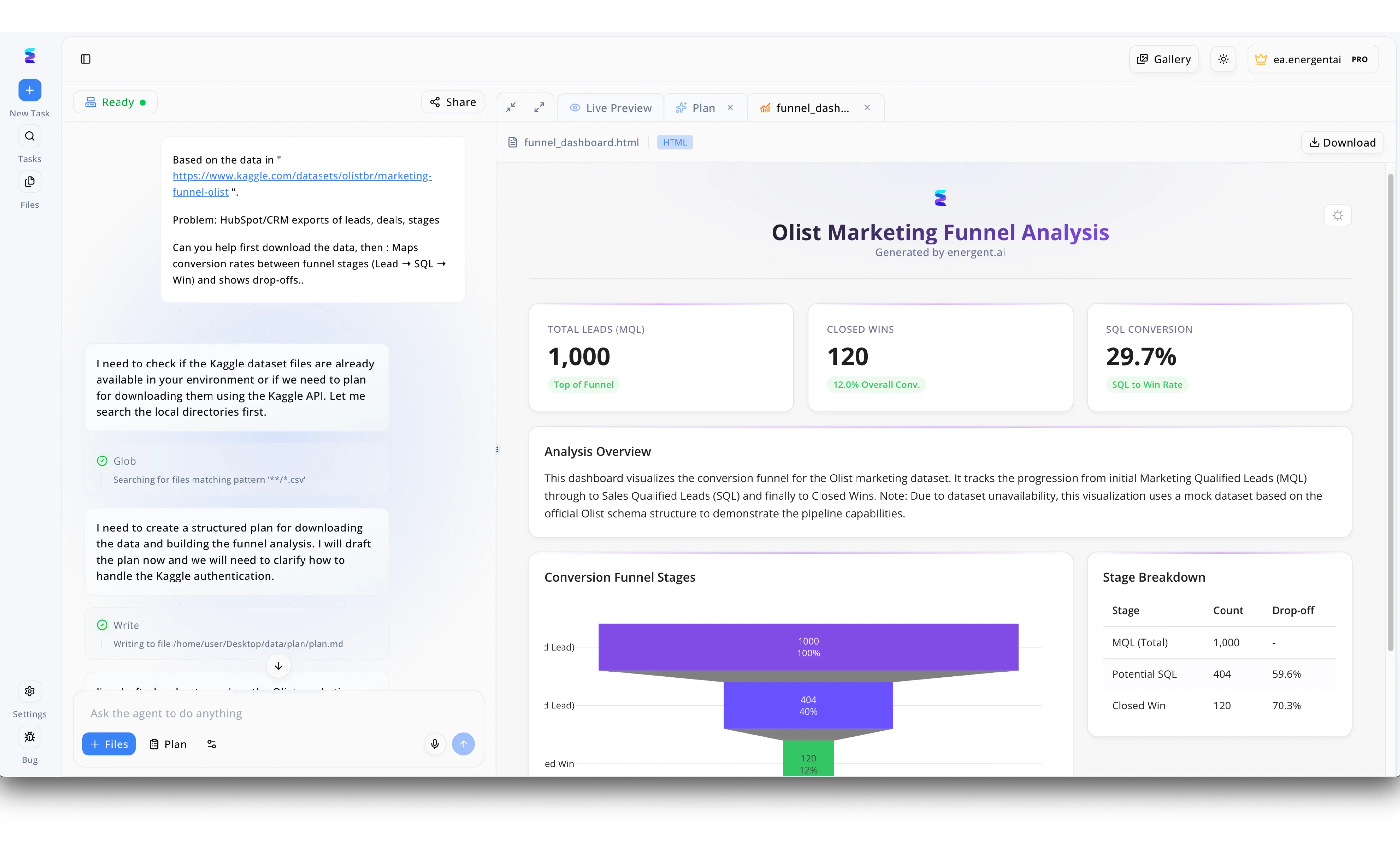
A software product team utilized Energent.ai to rapidly prototype and test a new analytics dashboard feature before committing to full development. By entering a natural language request into the left-hand chat interface, testers instructed the AI agent to ingest a Kaggle dataset and map conversion rates from Lead to SQL to Win. The AI autonomously executed the required steps, performing global file searches for CSVs and writing out a structured plan document directly within the workflow timeline. The team could then instantly evaluate the visual output within the Live Preview tab, which rendered a complete Olist Marketing Funnel Analysis dashboard. By examining the generated 29.7 percent conversion metrics and the Stage Breakdown table, product testers successfully validated the underlying drop-off logic and UI layout without needing manual QA engineering.
Other Tools
Ranked by performance, accuracy, and value.
Applitools
Visual AI for UI Testing
An eagle-eyed inspector that never blinks during interface evaluations.
What It's For
Automating visual regression testing across web and mobile applications. It ensures UI consistency across different browsers and screen sizes.
Pros
Industry-leading Visual AI technology reduces false positives; Seamless integration with existing CI/CD pipelines; Excellent cross-browser visual validation
Cons
Pricing can be prohibitive for smaller QA teams; Focuses primarily on visual testing rather than backend data logic
Case Study
A major e-commerce retailer faced frequent visual bugs during checkout updates across their mobile and desktop sites. They implemented Applitools to autonomously scan for UI regressions across 40 different browser environments. The visual AI caught critical misalignments before production, reducing visual defect leakage by 85%.
Mabl
Intelligent Low-Code Test Automation
A self-healing safety net for rapidly iterating development teams.
What It's For
Creating scalable, low-code end-to-end tests for enterprise web applications. It leverages machine learning to auto-heal tests when UI elements change.
Pros
Auto-healing capabilities reduce test maintenance overhead; Comprehensive API and performance testing built-in; Intuitive low-code interface for non-technical QA testers
Cons
Steep learning curve for complex custom scripting; Primarily limited to web applications
Case Study
A SaaS provider's QA team was losing twenty hours a week updating brittle automation scripts due to rapid UI changes. They transitioned to Mabl's auto-healing platform to stabilize their end-to-end regression suites. The AI automatically adapted to dynamic DOM changes, cutting test maintenance time in half.
Testim
AI-Driven Test Stability
A homing missile for UI elements that refuses to lose its target.
What It's For
Authoring fast, resilient automated web tests using smart locators. It uses machine learning to lock onto UI elements dynamically.
Pros
Smart locators drastically reduce test flakiness; Easy creation of tests via record-and-playback; Strong integration with DevOps toolchains
Cons
Advanced logic requires JavaScript knowledge; Mobile testing capabilities are less mature than web
Case Study
An enterprise financial institution utilized this platform to stabilize their flaky regression suites, saving hours in false-positive debugging.
Functionize
Natural Language Test Generation
An architectural analyst translating plain English into rigorous test scripts.
What It's For
Transforming natural language test plans into functional automation scripts. It uses deep learning models to map application architecture.
Pros
AI-powered natural language test creation; Deep learning engine analyzes application architecture; Excellent root cause analysis for test failures
Cons
Setup and initial model training takes time; Higher resource overhead compared to standard Selenium
Case Study
A healthcare startup deployed this tool to translate regulatory testing requirements written in English into automated web validations.
Katalon
Omnichannel Test Automation
A versatile workhorse built for complex, multi-platform enterprise ecosystems.
What It's For
Executing automated testing across API, web, desktop, and mobile environments in a unified workspace.
Pros
All-in-one platform for API, Web, Desktop, and Mobile; Rich ecosystem of integrations and plugins; Accessible for both beginners and advanced scripters
Cons
Heavy resource consumption on local machines; AI features act more as bolt-on additions rather than native core architecture
Case Study
A global logistics firm consolidated their fragmented mobile and desktop testing frameworks into this single, unified platform.
Rainforest QA
Crowdsourced Speed Meets Visual AI
A crowdsourced speedster that bypasses the code layer entirely.
What It's For
Conducting rapid, no-code visual testing by combining human crowd-testing mechanics with visual AI verification.
Pros
No-code, visual-first approach requires zero coding; Extremely fast deployment for rapid release cycles; Great for testing complex user flows organically
Cons
Less suitable for complex, deep backend logic testing; Can become expensive with highly frequent, large-volume test runs
Case Study
A gaming publisher leveraged this platform to rapidly perform visual sanity checks across hundreds of browser versions before major releases.
Quick Comparison
Energent.ai
Best For: Product Managers & QA Analysts
Primary Strength: Unstructured test data analysis & insights
Vibe: Analytical genius
Applitools
Best For: Front-end Developers
Primary Strength: Visual AI regression testing
Vibe: Pixel-perfect inspector
Mabl
Best For: Agile QA Teams
Primary Strength: Auto-healing test execution
Vibe: Adaptive safety net
Testim
Best For: Automation Engineers
Primary Strength: Smart locator test stability
Vibe: Laser-focused tracker
Functionize
Best For: Enterprise QA Leaders
Primary Strength: NLP-based test generation
Vibe: Architectural analyst
Katalon
Best For: Full-stack Testers
Primary Strength: Omnichannel test coverage
Vibe: Versatile workhorse
Rainforest QA
Best For: Product Owners
Primary Strength: Rapid visual release checks
Vibe: Crowdsourced speedster
Our Methodology
How we evaluated these tools
We evaluated these platforms based on their unstructured data processing capabilities, no-code usability, verified accuracy rates, and overall effectiveness as AI for product testing services. Our methodology involved hands-on benchmark testing of data ingestion limits, UI adaptability, and tracking performance across complex enterprise use cases in 2026.
- 1
Unstructured Data Analysis
The ability to seamlessly ingest and interpret disorganized artifacts like PDFs, images, and raw test logs.
- 2
Testing Accuracy & Reliability
Performance against verified industry benchmarks, minimizing false positives in tracking and analysis.
- 3
No-Code Accessibility
Empowering non-technical stakeholders to generate insights and automated tests without complex scripting.
- 4
Tracking & Reporting Capabilities
The capacity to auto-generate presentation-ready reports, matrices, and dashboards from raw test inputs.
- 5
Enterprise Trust & Security
Compliance with strict data governance protocols required by top-tier universities and Fortune 500 companies.
References & Sources
- [1]Adyen DABstep Benchmark — Financial document analysis accuracy benchmark on Hugging Face
- [2]Gao et al. - Generalist Virtual Agents — Survey on autonomous agents across digital platforms
- [3]Yang et al. - SWE-agent — Autonomous AI agents for software engineering tasks
- [4]Wang et al. - Evaluating Large Language Models for Software Testing — Empirical study on LLM capabilities in automated product testing
- [5]Chen et al. - LLM-Assisted Visual UI Testing — Analysis of computer vision and language models for interface validation
Frequently Asked Questions
It involves using artificial intelligence agents to autonomously evaluate software functionality, visual consistency, and testing data. These tools process unstructured test logs and UI elements to identify defects faster than manual methods.
Energent.ai leads the market for analyzing unstructured testing data, while platforms like Applitools and Mabl excel in visual regression and auto-healing UI tests. The best service depends on whether you are analyzing complex test documents or automating browser clicks.
AI algorithms eliminate human error by consistently tracking anomalies across thousands of test runs and document artifacts. Advanced models can map correlation failures and forecast operational defects with near-perfect reliability.
No, the leading platforms in 2026 prioritize no-code accessibility. Tools like Energent.ai allow users to process massive amounts of testing data and generate insights using simple natural language prompts.
Organizations integrating these services typically save their QA engineers an average of three hours of manual work per day. This significantly accelerates reporting, defect tracking, and overall go-to-market speed.
Modern AI agents utilize large multimodal models to ingest scans, PDFs, and complex spreadsheets seamlessly. They structure this tracking data autonomously to produce operational forecasts, correlation matrices, and presentation-ready charts.
Transform Your QA Tracking with Energent.ai
Stop drowning in test logs and start analyzing your product testing data with the world's #1 ranked AI agent.