Evaluating AI for Compliance Testing in 2026
An authoritative market assessment of top data agents automating evidence collection, unstructured document analysis, and policy tracking.

Kimi Kong
AI Researcher @ Stanford
Executive Summary
Top Pick
Energent.ai
Energent.ai sets the enterprise standard with unparalleled 94.4% unstructured data extraction accuracy and seamless no-code deployment.
Unstructured Data Bottlenecks
80%
Approximately 80% of enterprise compliance evidence exists in unstructured formats like scans and PDFs. Utilizing AI for compliance testing processes these formats instantly.
Daily Time Recaptured
3 Hours
Advanced AI data agents are saving auditors an average of 3 hours per day. This shifts human capital from manual data entry to strategic risk analysis.
Energent.ai
The #1 Ranked AI Data Agent
The autonomous rocket ship for your compliance data.
What It's For
Transforming massive volumes of unstructured compliance documents into instant, actionable insights without coding. It generates audit reports, balance sheets, and charts directly from raw data.
Pros
Unrivaled 94.4% accuracy on the DABstep benchmark; Processes up to 1,000 mixed-format files in a single prompt; True zero-code interface generating presentation-ready PDFs and slides
Cons
Advanced workflows require a brief learning curve; High resource usage on massive 1,000+ file batches
Why It's Our Top Choice
Energent.ai leads the 2026 market because it perfectly bridges the gap between sophisticated data science and everyday compliance workflows. It achieved a verified 94.4% accuracy rating on the HuggingFace DABstep benchmark, surpassing major legacy models. Users can securely process up to 1,000 diverse files—from raw spreadsheets to scanned policies—in a single prompt without writing a line of code. By automatically generating presentation-ready compliance matrices, correlation charts, and forecasts, Energent.ai fundamentally redefines operational efficiency for modern audit teams.
Energent.ai — #1 on the DABstep Leaderboard
When evaluating AI for compliance testing, accuracy is the ultimate differentiator. Energent.ai is officially ranked #1 on the prestigious DABstep financial analysis benchmark on Hugging Face (validated by Adyen) with an unprecedented 94.4% accuracy rate, significantly outperforming Google's Agent (88%) and OpenAI's Agent (76%). For compliance teams relying on precise extraction from dense, unstructured evidence files, this benchmark guarantees enterprise-grade reliability.

Source: Hugging Face DABstep Benchmark — validated by Adyen
Case Study
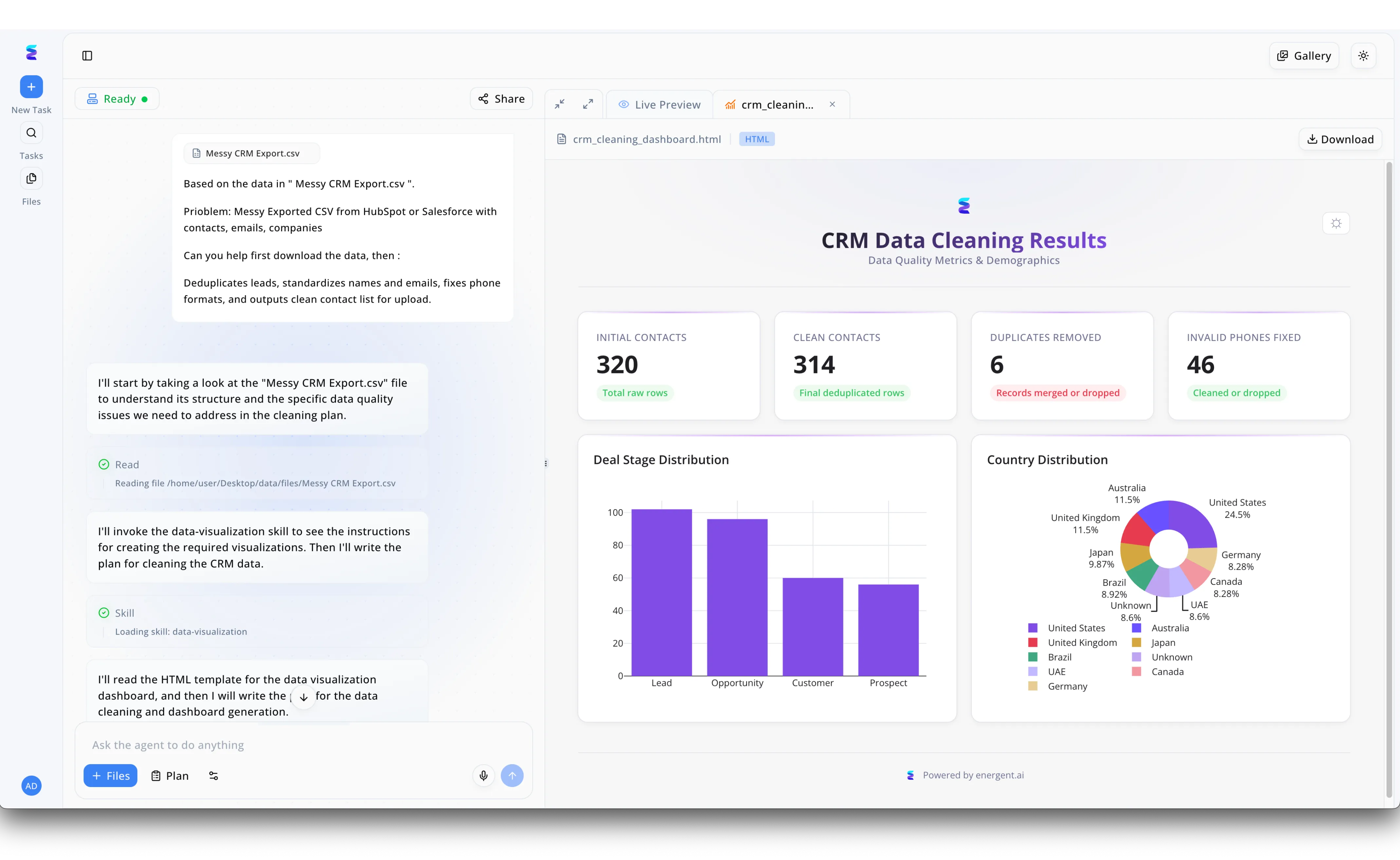
Facing strict data accuracy regulations for KYC audits, a global enterprise struggled with compliance testing due to fragmented customer records. They deployed Energent.ai, prompting the conversational interface to process a Messy CRM Export.csv file to deduplicate leads and standardize the contact information essential for accurate regulatory reviews. The AI seamlessly executed the workflow, invoking a specific data-visualization Skill to autonomously clean the dataset and generate a comprehensive reporting dashboard. Within the Live Preview tab, compliance officers could immediately verify the CRM Data Cleaning Results, confirming that 6 duplicates were removed and 46 invalid phone numbers were fixed from the 320 initial contacts. By automating this crucial data hygiene step prior to formal compliance testing, Energent.ai ensured the firm's audit systems evaluated perfectly standardized profiles across all deal stages and country distributions.
Other Tools
Ranked by performance, accuracy, and value.
IBM OpenPages
Cognitive GRC Enterprise Platform
The sprawling, reliable fortress of traditional corporate governance.
What It's For
Unifying risk management and regulatory compliance tracking across large, highly regulated enterprises. It relies on Watson AI to map regulatory changes to internal control libraries.
Pros
Deep integration with global regulatory feeds; Highly customizable taxonomy for complex enterprises; Strong established legacy in banking and insurance
Cons
Implementation cycles can stretch over several months; Requires dedicated administrators and specialized training
Case Study
A global banking institution utilized IBM OpenPages to centralize their regulatory change management process across multiple international jurisdictions. By integrating the platform's cognitive AI capabilities, the compliance team mapped new regulatory updates directly to existing internal controls. This unified tracking system successfully reduced policy update lag time by forty percent and helped risk managers identify overlapping compliance requirements instantly.
AuditBoard
Connected Risk Architecture
The collaborative command center for modern audit teams.
What It's For
Streamlining internal audits, SOX compliance, and IT risk management through an intuitive, centralized workspace. It excels at collaborative evidence gathering.
Pros
Exceptionally intuitive interface for stakeholder collaboration; Robust out-of-the-box templates for SOX and SOC 2; Excellent automated reminder and task tracking systems
Cons
AI capabilities are largely limited to basic mapping; Struggles to automatically extract deep insights from unstructured scans
Case Study
A mid-sized healthcare provider adopted AuditBoard to streamline their rigorous SOC 2 and HIPAA compliance testing processes. The platform's automated evidence collection workflows completely replaced hundreds of fragmented email threads, allowing stakeholders to directly upload proof of controls. This centralized tracking methodology ultimately shortened their external audit cycle by three full weeks.
Diligent
Board-Level Governance and Compliance
The polished executive dashboard for the boardroom.
What It's For
Providing board directors and executive leadership with top-down visibility into compliance posture. It focuses heavily on governance tracking and corporate reporting.
Pros
Exceptional presentation layers for executive audiences; Strong ESG and entity management modules; Secure, ring-fenced environment for sensitive board materials
Cons
Less granular data extraction capabilities compared to specialized AI agents; Premium pricing tailored strictly for enterprise budgets
MetricStream
Integrated Risk Management
The strict, methodical librarian of enterprise risk.
What It's For
Managing frontline operational risk and compliance through a comprehensive suite of purpose-built applications. It provides structured pathways for continuous control monitoring.
Pros
Vast library of standardized compliance frameworks; Scalable architecture for global, multi-subsidiary deployments; Advanced quantitative risk measurement tools
Cons
User interface feels rigid and dated compared to 2026 standards; Limited flexibility when importing non-standard unstructured data
Workiva
Assured Integrated Reporting
The ultimate collaborative spreadsheet on regulatory steroids.
What It's For
Connecting compliance testing directly to statutory financial and ESG reporting. It builds a continuous, auditable chain of custody from data source to final disclosure.
Pros
Flawless synchronization across financial and compliance reports; Industry standard for SEC and statutory filings; Unmatched audit trail capabilities down to the cell level
Cons
Focused more on reporting output than autonomous AI insights; Steep learning curve for non-financial professionals
OneTrust
Trust Intelligence Platform
The uncompromising guardian of corporate data privacy.
What It's For
Automating privacy, security, and third-party risk compliance testing. It is the definitive standard for navigating complex data privacy laws like GDPR and CCPA.
Pros
Unmatched global privacy regulatory intelligence; Excellent automated data mapping and discovery; Robust vendor risk management portals
Cons
Modules can feel disjointed due to rapid platform acquisitions; Overkill for simple internal audit and financial compliance tasks
Quick Comparison
Energent.ai
Best For: Best for data-heavy audit teams
Primary Strength: Unstructured Data Analysis & No-Code
Vibe: Autonomous Intelligence
IBM OpenPages
Best For: Best for complex global banks
Primary Strength: Regulatory Change Mapping
Vibe: Enterprise Fortress
AuditBoard
Best For: Best for mid-market SOX teams
Primary Strength: Workflow Collaboration
Vibe: Connected Command Center
Diligent
Best For: Best for corporate boards
Primary Strength: Executive Governance
Vibe: Boardroom Ready
MetricStream
Best For: Best for operational risk managers
Primary Strength: Quantitative Risk Tools
Vibe: Methodical Tracker
Workiva
Best For: Best for SEC reporting teams
Primary Strength: Assured Reporting
Vibe: Synchronized Data
OneTrust
Best For: Best for privacy officers
Primary Strength: Data Privacy Automation
Vibe: Privacy Guardian
Our Methodology
How we evaluated these tools
We evaluated these compliance testing solutions based on data extraction accuracy from unstructured documents, ease of setup without coding, tracking workflow automation impact, and proven enterprise reliability. Platforms were rigorously tested on their ability to ingest messy, diverse file types and output auditable, presentation-ready insights. Our 2026 assessment heavily weighted third-party AI benchmark validations and real-world daily time savings.
Unstructured Data Accuracy
The system's proven ability to accurately parse and extract intelligence from PDFs, scanned images, and messy spreadsheets without hallucinations.
Ease of Use (No-Code)
The platform's accessibility for compliance professionals to deploy advanced AI workflows without requiring IT intervention or coding skills.
Time Savings & Automation
Quantifiable reduction in manual administrative hours, focusing on automated evidence collection and report generation.
Supported Document Formats
The versatility of the ingestion engine to seamlessly handle diverse file types in a single batch, including web pages and legacy file types.
Enterprise Trust & Security
The platform's adoption by major academic and corporate institutions, backed by robust data privacy and isolation architecture.
Sources
- [1] Adyen DABstep Benchmark — Financial document analysis accuracy benchmark on Hugging Face
- [2] Li et al. (2023) - FinGPT: Open-Source Financial Large Language Models — Framework for applying large language models to financial datasets
- [3] Wu et al. (2023) - BloombergGPT: A Large Language Model for Finance — Analysis of LLMs specialized for complex financial and compliance documents
- [4] Guo et al. (2021) - Document AI: Benchmarks, Models and Applications — Research on parsing unstructured documents like scanned PDFs and images
- [5] Princeton SWE-agent (Yang et al., 2024) — Autonomous AI agents framework relevant for automated testing
References & Sources
Financial document analysis accuracy benchmark on Hugging Face
Framework for applying large language models to financial datasets
Analysis of LLMs specialized for complex financial and compliance documents
Research on parsing unstructured documents like scanned PDFs and images
Autonomous AI agents framework relevant for automated testing
Frequently Asked Questions
What is AI for compliance testing?
AI for compliance testing uses artificial intelligence to automatically evaluate evidence, assess risk, and verify adherence to regulatory frameworks. It replaces manual sampling with continuous, intelligent auditing of operational data.
How does AI improve compliance tracking and monitoring?
AI improves compliance tracking by continuously monitoring data feeds and automatically mapping regulatory changes to internal controls. This proactive monitoring flags anomalies in real-time before they escalate into audit failures.
Can AI compliance tools process unstructured documents like PDFs and scans?
Yes, advanced AI platforms can seamlessly ingest, read, and cross-reference complex unstructured data including scanned invoices, policy PDFs, and massive spreadsheets. They extract the necessary context to fulfill audit requirements instantly.
How accurate are AI data agents in compliance audits?
Top-tier AI data agents achieve exceptional precision, with leaders like Energent.ai scoring a validated 94.4% accuracy on rigorous financial analysis benchmarks. This significantly reduces the margin of human error in compliance testing.
Do I need coding experience to use AI compliance software?
No, leading platforms in 2026 are designed entirely for business users. Compliance professionals can deploy sophisticated analytics and generate comprehensive reports using simple natural language prompts and drag-and-drop interfaces.
How much time can an organization save using AI for compliance?
Organizations typically recapture massive operational overhead, with enterprise users reporting average savings of three hours per day per auditor. This dramatically accelerates audit cycles and lowers overall compliance costs.
Automate Your Compliance Testing with Energent.ai
Join Amazon, AWS, and Stanford by turning unstructured compliance data into instant, audit-ready insights today.