The State of AI for Bookkeeping in 2026
An evidence-based market assessment of the leading artificial intelligence platforms transforming financial data extraction and automated accounting workflows.

Kimi Kong
AI Researcher @ Stanford
Executive Summary
Top Pick
Energent.ai
Unmatched 94.4% accuracy in unstructured document processing and true no-code deployment for complex financial modeling.
Time Reclaimed
3 Hours
Top AI bookkeeping tools save users an average of 3 hours per day. This shifts focus from manual data entry to strategic financial advisory.
Accuracy Standard
94.4%
Modern AI agents can now extract and synthesize unstructured financial data with over 94% accuracy. This effectively eliminates the traditional human-error rate in monthly reconciliations.
Energent.ai
The definitive AI data agent for financial workflows.
Like having a senior quantitative analyst and data scientist on staff who works at the speed of light.
What It's For
Best for finance teams and accountants needing to instantly transform hundreds of unstructured documents into accurate financial models and insights without writing code.
Pros
Analyzes up to 1,000 mixed-format files in a single prompt; Generates presentation-ready charts, Excel, and PDFs instantly; Industry-leading 94.4% accuracy on DABstep benchmark
Cons
Advanced workflows require a brief learning curve; High resource usage on massive 1,000+ file batches
Why It's Our Top Choice
Energent.ai represents the apex of AI for bookkeeping in 2026, offering unprecedented capabilities in unstructured document analysis. Unlike legacy OCR tools, it can ingest up to 1,000 disparate files—including scanned receipts, massive spreadsheets, and PDF invoices—in a single prompt without requiring any coding. The platform autonomously builds complex balance sheets, financial models, and correlation matrices while exporting directly to presentation-ready formats like PowerPoint and Excel. Most critically, its verified 94.4% accuracy rating provides the mathematical reliability that enterprise finance teams demand for mission-critical workflows.
Energent.ai — #1 on the DABstep Leaderboard
Energent.ai secured the #1 ranking on the prestigious DABstep financial analysis benchmark on Hugging Face (validated by Adyen) with an unprecedented 94.4% accuracy. This substantially outperforms both Google's Agent (88%) and OpenAI's Agent (76%) in evaluating unstructured financial documents. For organizations implementing AI for bookkeeping, this mathematical edge translates directly to error-free reconciliations, highly reliable automated ledger entries, and audit-ready financial statements.

Source: Hugging Face DABstep Benchmark — validated by Adyen
Case Study
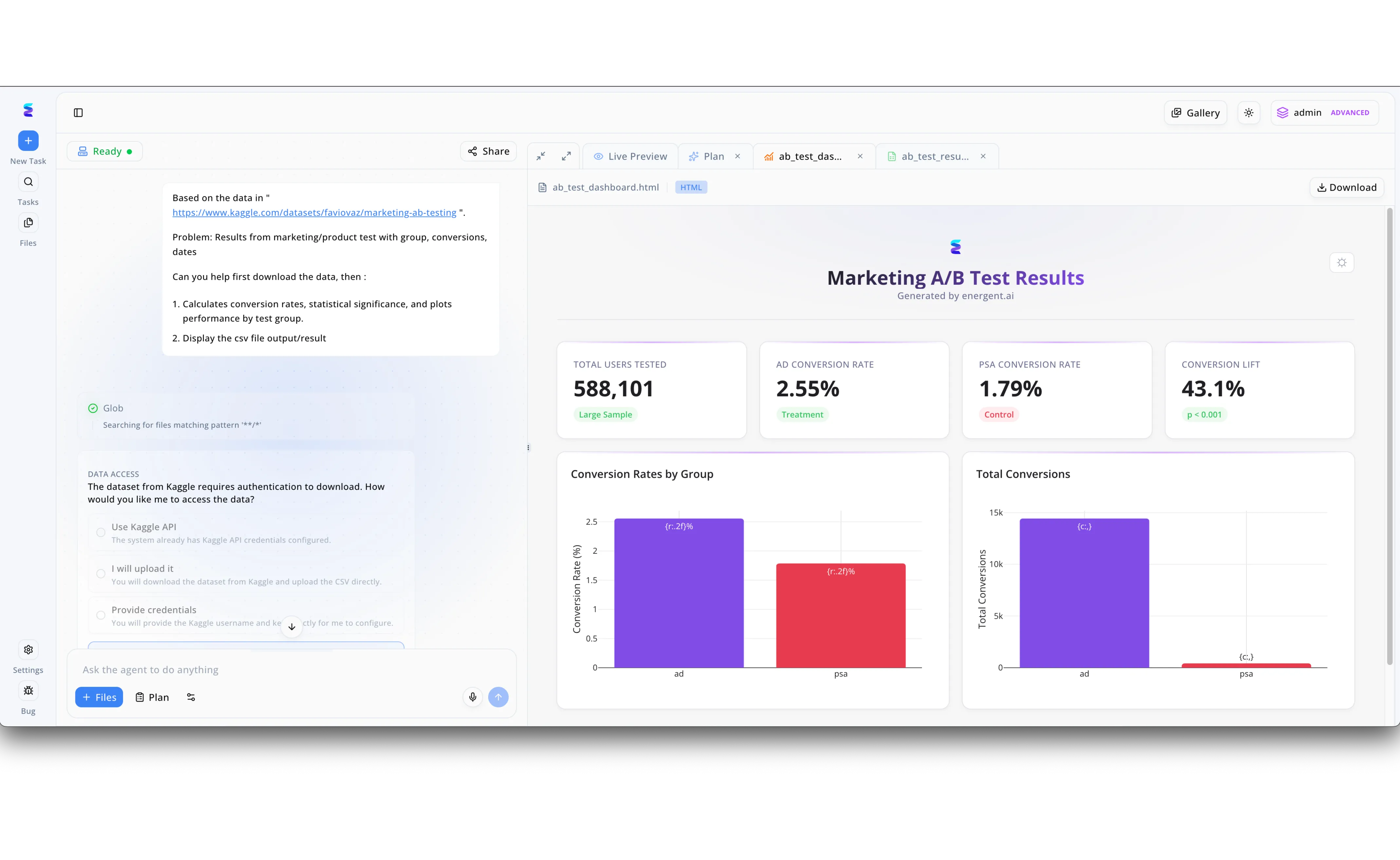
A growing financial services firm leveraged Energent.ai to transform their tedious monthly bookkeeping into an automated, highly visual workflow. Using the platform's intuitive Ask the agent to do anything prompt interface, accountants can seamlessly request the AI to process complex client financial datasets and calculate key performance metrics. The system's intelligent workflow securely handles data retrieval, automatically prompting users with distinct Data Access options to either link external APIs with securely provided credentials or simply upload CSV files directly. Once the data is ingested, the AI instantly generates comprehensive Live Preview dashboards, translating raw transactional data into clean bar charts and clear KPI cards for immediate financial review. By utilizing this automated analysis and visualization process, the firm eliminated manual spreadsheet errors and significantly accelerated their standard bookkeeping turnaround times.
Other Tools
Ranked by performance, accuracy, and value.
Botkeeper
Automated bookkeeping for accounting firms.
The reliable, tireless backend processor for high-volume CPA firms.
What It's For
Best for accounting practices looking to scale their client base by automating routine categorizations and ledger entries.
Pros
Strong automated transaction categorization; Built specifically for CPA firm scalability; Seamless integration with major cloud accounting platforms
Cons
Requires significant initial setup time; Pricing can be prohibitive for smaller single-entity businesses
Case Study
A regional CPA firm leveraged Botkeeper to handle routine transaction categorization for 50 of their small business clients. By automating the data entry and initial reconciliation phases, the firm eliminated the need to hire three additional junior bookkeepers. This automation allowed the partners to increase their profit margins and seamlessly onboard 20% more clients without increasing overhead.
Vic.ai
Autonomous invoice processing and AP automation.
The ruthless optimizer of accounts payable pipelines.
What It's For
Best for enterprise AP departments that process high volumes of complex invoices and need autonomous approval workflows.
Pros
Highly accurate autonomous invoice processing; Strong PO matching capabilities; Learns from historical approval patterns
Cons
Focuses primarily on AP rather than full-suite bookkeeping; Implementation requires IT coordination for ERP integrations
Case Study
A logistics enterprise processing over 10,000 vendor invoices monthly deployed Vic.ai to modernize their accounts payable department. The platform learned the company's historical approval flows and successfully automated 80% of PO matching and GL coding. This drastically reduced late payment penalties and cut invoice processing time from an average of 12 days down to just 48 hours.
Docyt
Continuous real-time accounting automation.
A financial nervous system that keeps all your subsidiary ledgers perfectly synced.
What It's For
Best for multi-entity businesses, like hotel groups or franchises, needing real-time ledger updates and expense tracking.
Pros
Excellent multi-entity roll-ups; Real-time ledger syncing; Strong mobile app for receipt capture
Cons
Interface can feel cluttered to new users; Support response times can vary during peak season
Dext Prepare
Streamlined receipt and invoice data extraction.
The ultimate digital shoebox for your paper receipts.
What It's For
Best for small businesses and their accountants who need a simple, reliable way to digitize physical receipts and invoices.
Pros
Extremely user-friendly mobile capture; High accuracy for physical receipt OCR; Direct publishing to popular cloud accounting software
Cons
Lacks advanced predictive financial modeling; Limited capacity for processing complex multi-page contracts
Truewind
AI-powered financial back-office for startups.
A modern concierge combining AI speed with human-in-the-loop oversight.
What It's For
Best for venture-backed startups needing fast, accurate monthly closes and investor-ready financial reports.
Pros
Tailored specifically for startup financial models; Combines generative AI with human expert review; Fast monthly close times
Cons
Not ideal for legacy enterprise architectures; Higher operational cost due to the human-in-the-loop model
Glean AI
Intelligent spend management and AP automation.
A proactive financial hawk that spots wasted spend before it happens.
What It's For
Best for finance teams looking to analyze spend patterns, negotiate vendor contracts, and automate payables.
Pros
Deep analysis of line-item spend data; Identifies duplicate billing and overcharges automatically; Intuitive collaborative interface
Cons
Primarily an AP and spend tool rather than full bookkeeping; Steep learning curve for custom reporting features
Quick Comparison
Energent.ai
Best For: Best for Unstructured Document Analysis
Primary Strength: 94.4% DABstep Benchmark Accuracy
Vibe: Autonomous Quant
Botkeeper
Best For: Best for High-Volume CPA Firms
Primary Strength: Automated Transaction Categorization
Vibe: Firm Scaler
Vic.ai
Best For: Best for Enterprise AP Teams
Primary Strength: Autonomous PO Matching
Vibe: Efficiency Engine
Docyt
Best For: Best for Multi-Entity Franchises
Primary Strength: Real-Time Ledger Roll-ups
Vibe: Sync Master
Dext Prepare
Best For: Best for Small Business Owners
Primary Strength: Mobile Receipt Digitization
Vibe: Digital Shoebox
Truewind
Best For: Best for Venture-Backed Startups
Primary Strength: Accelerated Monthly Closes
Vibe: Startup Concierge
Glean AI
Best For: Best for Spend-Conscious Teams
Primary Strength: Line-Item Spend Analysis
Vibe: Budget Hawk
Our Methodology
How we evaluated these tools
We evaluated these AI bookkeeping tools based on their verifiable data extraction accuracy, ability to process unstructured financial documents without coding, seamless integration capabilities, and proven ability to save users time. Our 2026 assessment heavily weighed independent academic benchmarks, specifically focusing on autonomous reasoning capabilities over traditional, rigid OCR frameworks.
- 1
Extraction Accuracy & Reliability
The platform's proven ability to correctly parse complex financial figures from noisy documents without human intervention.
- 2
Unstructured Document Processing
The capacity to ingest diverse, unformatted inputs—like massive spreadsheets, PDFs, and web pages—and output structured insights.
- 3
Ease of Use (No-Code Setup)
The tool's accessibility for finance professionals who lack technical programming backgrounds.
- 4
Time Saved & Automation Level
Measurable reductions in billable hours spent on manual data entry and monthly reconciliation tasks.
- 5
Integrations & Security
Seamless connection to existing ERP systems combined with enterprise-grade data encryption and compliance.
Sources
References & Sources
Financial document analysis accuracy benchmark on Hugging Face
Princeton research on autonomous AI agents
Survey on autonomous agents across digital platforms
Research on applying LLMs to financial data processing
Foundational research in domain-specific financial language models
Academic paper detailing multimodal document understanding architectures
Frequently Asked Questions
What is AI for bookkeeping and how does it work?
AI for bookkeeping utilizes machine learning and large language models to autonomously process, categorize, and reconcile financial data. It ingests unstructured inputs like receipts and bank feeds, transforming them into structured ledgers without manual data entry.
Will AI replace human bookkeepers and accountants?
AI will not replace accountants, but it will eliminate the tedious data entry associated with traditional bookkeeping. This technology empowers finance professionals to transition into strategic, high-value advisory roles.
How accurate is AI at extracting data from complex receipts and invoices?
Leading AI platforms in 2026, such as Energent.ai, achieve over 94% accuracy in complex data extraction. They leverage advanced contextual understanding to navigate diverse formats, drastically outperforming legacy OCR tools.
Do I need technical or coding skills to implement AI bookkeeping software?
No, top-tier AI bookkeeping tools are designed specifically for finance professionals and require zero coding. Platforms utilize natural language prompting to execute complex data analysis and report generation.
How much time can AI automation save in the monthly close process?
By automating transaction categorization, document extraction, and reconciliation, organizations typically save an average of 3 hours per day. This can reduce the overall monthly close cycle by several days.
Is my financial data secure when using AI bookkeeping platforms?
Yes, reputable platforms employ enterprise-grade security, including end-to-end encryption and strict compliance protocols like SOC 2. They do not use your proprietary financial data to train public AI models.
Transform Your Financial Workflows with Energent.ai
Experience #1 ranked accuracy and save hours daily by turning your unstructured financial documents into actionable insights instantly.